



Non-toxic and low-toxic oil painting solvents are a brilliant solution for anyone with environmental or health concerns considering working with oil paints, yet the choice between products on the market can be overwhelming. In this guide, I’ll explore seven products to determine their differing qualities, from drying time to flow, brushmark retention, smell, finish, value for money, and packaging. For products that may seem very similar on the outset, I found a compelling degree of difference between each one.
What is the Best Non-Toxic Oil Painting Solvent?
Is Oil Painting Always Toxic?
In reality, every substance has a toxicity to some degree, even water. The definition of toxicity is the extent to which a substance can cause harm to the body. It’s the level of exposure, the potency of a substance, or the dosage that really sets apart the more highly hazardous substances that we may generally understand as ‘toxic’. For example, water has a very low level of potency, so it would take a large dosage to cause harm to the body, whereas a substance such as arsenic is very potent and only a small amount has an effect on the body.
Sometimes there is a misconception that oil paints on their own have toxic properties as a medium. In reality, most oil paints are safe to use as long as the pigments they contain aren’t ingested or inhaled. Oil paints are composed of pigment, an oil binder like linseed or safflower oil, and sometimes stabilising additives. They do not, when used alone, release aromatic fumes. The ‘toxic’ aspect of oil painting comes primarily from the choice of medium you make, which may contain volatile painting solvents.
Why Use a Non-Toxic or Low-Toxic Painting Medium?
As artists, our health should always be a priority, especially when long-term conditions caused by our materials can be completely avoided. Prolonged exposure to turpentine fumes in unventilated spaces may create permanent health conditions, specifically affecting our eyes and lungs. Of course, there are safe ways to paint with ‘toxic’ traditional oil mediums, like working in a well-ventilated room. However, a growing number of people would prefer to avoid the risks almost completely, by using non-toxic and low-toxic mediums instead.
The damage to the environment solvents can cause when disposed of incorrectly is extremely harmful, poisoning waterways and wildlife. Non-toxic and low-toxic mediums step in to somewhat alleviate this concern since they tend to be less potent. Many of these products have branding that contains words like ‘natural’ in an effort to appease environmental concerns, yet some of these are still toxic, and still do contain warning labels about their disposal. For example, turpentine is a natural substance sourced from the processing of pine resin, but it is still hazardous. It’s important to be aware of these products, so we can handle them properly.
Is Non-Toxic Oil Painting New?
Traditionally painters have used mediums like walnut oil or pure linseed oil to make oil paintings if they wished to forego solvent. We are lucky now to have an expansive choice of mediums designed to simulate qualities of solvents that pure oils don’t have, like the heightened drying time, or thinned quality of paint handling. It really depends on the finish of painting that you want to achieve, which I will detail in my tests.
Are Low-Odour Solvents Non-Toxic?
Almost all solvents are made of different blends of hydrocarbon chain polymers, and the most aromatic hydrocarbons happen to be more hazardous than the non-aromatic hydrocarbons. Low-odour solvents are less toxic because most of the harmful aromatic hydrocarbons have been removed through a process of refining. It is important to underline that many of the ‘low-odour’ solvents on the market are still toxic, and should still be handled like any other solvent. They’ve just been treated to give off less fumes, rather than none. Many products of this sort have added citrus oil to mask the chemical edge of the core ingredients. I will highlight which of the following products are low-toxic, and the smell they have.
Are Any Oil Mediums Completely Non-Toxic?
Amazingly, one of the mediums I tested is labelled as non-toxic and represents strides in development in the future of safety in oil painting. The only slight drawback is that since it is an innovative product, the ingredient list is intentionally vague. We have some notes of allergens it may contain, but if you need a full ingredient list to be confident in your medium, this medium may not be for you.
Seven Non-Toxic and Low-Toxic Mediums – Packaging, Odour, and Toxicity
For this comparative article, I tested seven different non-toxic and low-toxic mediums available today. I find it important to note their affordability, alongside details like odour, and safety warnings. Sometimes bottle design can make it difficult for certain artists to open products, so I will detail the kind of lids they have too.

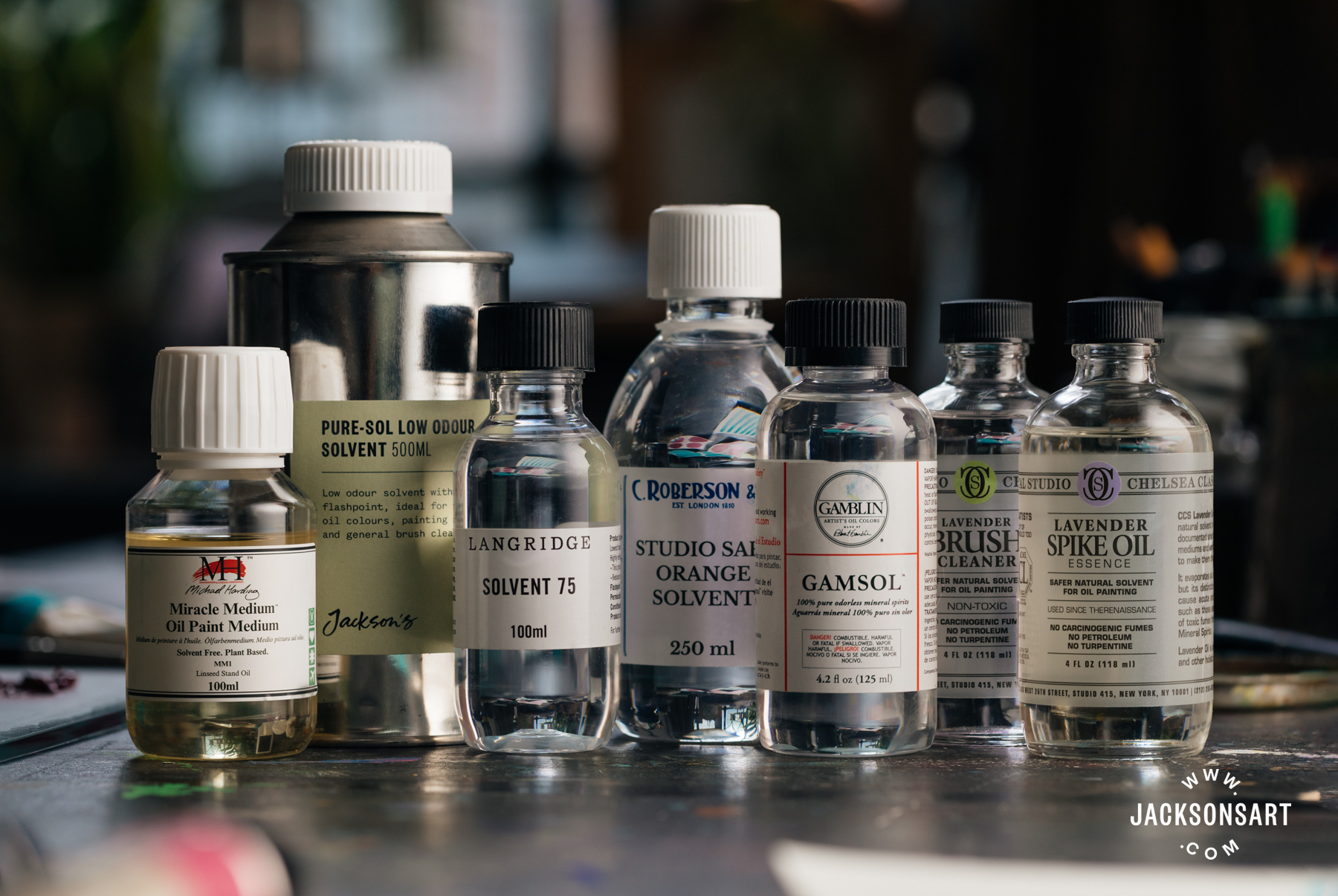
Michael Harding Miracle Medium
Sizes available: 100 ml, 250 ml, and 1000 ml
Odour: Light – like linseed oil
Toxicity: Low-Toxic
The Michael Harding Miracle Medium is low-toxic, safe to travel with, and made from plant ingredients. It doesn’t affect the drying time of oil paints at all and evaporates completely. It has a light, non-intrusive smell like faint linseed oil. The bottle has a safety lock cap, which takes some pressure to click open. It comes in three sizes and is comparatively on the more expensive end of these products. In terms of allergens, it is unsafe for those with a soy allergy. The ingredients list is secret, but we have confirmation that it is 100% derived from plants and contains no palm oil. It is worth noting, that as a brand new product, the long-term effects of using this medium may not yet be known.

Gamblin Gamsol Odourless Mineral Spirit
Sizes available: 125 ml, 500 ml, 1000 ml, and 3780 ml
Odour: None
Toxicity: Low-Toxic
Gamblin Gamsol Odourless Mineral Spirit is a low-toxic solvent, designed specifically to be a safer oil painting medium in class settings. It’s low-toxic because nearly all the harmful aromatic hydrocarbons have been removed so that less than 0.005% remains. It’s designed to rapidly speed up the drying time of oil paint, and amazingly, is completely odourless. The bottle has a safety lid that takes some pressure to click open. It comes in four sizes, and price-wise is comparatively in the middle range of these products. It is made from petroleum distillates.
Gamsol has a flashpoint (the temperature at which a solvent can ignite) of 62°C, making it safer than white spirit or turpentine. Gamblin say that they have tried to make a solvent with a higher flashpoint, but it would take too long to evaporate from the paint layer. They describe Gamsol as a ‘sweet spot’ between safety and performance.

Jackson’s Pure-Sol Low Odour Solvent
Sizes available: 500 ml, 1000 ml, and 2500 ml
Odour: Light – like turpentine
Toxicity: Low-Toxic
Jackson’s Pure-Sol Low Odour Solvent is exactly what it’s titled – a low-odour solvent. It is a safer alternative to turpentine and white spirit because many of the harmful aromatic hydrocarbons in the solvent have been removed. It has a quick drying time and is designed for painting and cleaning. To open the product you have to twist the top off of a plastic pouring tube that pulls out from the can. On first impression, it’s on the difficult side to open and close, but with use, it becomes easier. It comes in three sizes and is the cheapest per ml of all the products I’m reviewing.

C. Roberson & Co Studio Safe Orange Solvent
Sizes available: 250 ml, 500 ml, 1000 ml, and 2000 ml
Odour: Medium – orange scent
Toxicity: Low-Toxic
C. Roberson & Co Studio Safe Orange Solvent is a low-toxic solvent, with citrus oil added to give it a noticeable orange scent. It has a quick drying time and is designed for painting and cleaning. It has a warning label for environmental hazards (so is toxic to marine environments) and a ‘Harmful if swallowed’ warning. The bottle has a safety cap which takes some pressure to click open. It comes in four sizes and is at the lower end of the price range per ml.

Size available: 500 ml
Odour: Very Light
Toxicity: Low-Toxic
Langridge Solvent 75 is a low-toxic solvent, made from petroleum distillates, with virtually no scent. There is a slight hint of solvent smell very close up, which doesn’t travel into the air. The bottle has a safety cap that clicks down and only comes in one size. It’s on the lower end of the price range per ml.

Chelsea Classical Studio Lavender Brush Cleaner
Sizes available: 118 ml and 236 ml
Odour: Strong – lavender
Toxicity: Label says Non-Toxic
The Chelsea Classical Studio Lavender Brush Cleaner is designed to be a brush cleaner but works well as a painting medium too. It is made from natural ingredients, namely lavender, which gives it a strong floral smell. Since it is an innovative product, the ingredient list is intentionally vague, and this medium may not be for you if you need to know the full ingredient list before you start using it as a painting medium. Since it doesn’t contain petroleum distillates, the bottle comes with a screw-off cap, instead of a safety lock. Both Chelsea Classical Studio products are the easiest to open in this selection. It is on the upper end of the price range per ml.

Chelsea Classical Studio Lavender Spike Oil Essence
Sizes available: 118 ml and 236 ml
Odour: Strong – lavender
Toxicity: Low-Toxic
The Chelsea Classical Studio Lavender Spike Oil Essence is a low-toxic medium that has been used since the Renaissance. It performs similarly to turpentine but is slightly oily to use. This product also has a strong lavender scent, which is up to preference. I find it very pleasant and not headache-inducing. This product also has a normal screw top lid and is the most expensive of the products I’m testing.
Staining/Yellowing Test
For my first test of the non-toxic and low-toxic mediums, I applied each one to my Jackson’s Oil Paper alone, to test for any staining or discolouration left behind by the product itself, before I tried it with any paints. Nearly every medium dried completely transparent, with no ghost impression of where the product had been applied. The only one that left a slight impression was Jackson’s Pure-Sol Low Odour Solvent, but this is so slight it would have practically no effect on an actual painting. In terms of drying time, Gamblin Gamsol was definitely the quickest to touch dry, with the slowest being the Michael Harding Miracle Medium. The rest were all touch dry within a day.

It’s worth noting that the slowest drying mediums tend to have a higher flashpoint (meaning they have lower flammability), and this means they have more time to spread out and cause ghosting. However, it does make the solvent safer in the sense that it’s less flammable and less evaporates into the air at any given time. This information can be found in the SDS (safety data sheet) for each solvent.
Non-Toxic and Low-Toxic Solvents with Opaque Oil Colour
I tested mixing and applying every medium with an opaque oil paint, to differentiate between their finish and handling. For this test, I used Jackson’s Professional Oil Colour in Indigo. Seeing them next to each other, there are a few differences between the brands. The following observations are from two days post-application.

Michael Harding Miracle Medium is the most slick, shiny, and wet of all the samples. It feels almost as fresh as when I applied it two days ago. The brilliance of the Indigo colour is great though, and the payoff is strongest in this sample. This result is probably because it evaporates slower than the other mediums in this test, so, over time, it may have a finish slightly closer to the others. The Jackson’s Pure-Sol Low Odour Solvent is touch dry, and matt in finish. The C. Roberson & Co Studio Safe Orange Solvent is tacky to the touch, with some sheen. Langridge Solvent 75 has dried down completely and is matt in finish. The Gamblin Gamsol is very matt and touch dry as well, and has been since yesterday. It is easily the quickest drying of them all and leaves the pigment with no sheen very quickly after application. The Chelsea Classical Studio Lavender Brush Cleaner is touch dry but has retained some sheen. Finally, the Chelsea Classical Studio Lavender Spike Oil is touch dry and has a lovely shiny finish, enhancing the colour.
Between tests, there isn’t a huge variation in the opaque colour tests in brushstroke retention, as they mostly dried evenly. We can see some brushstrokes in the tests that retained sheen, whereas the matt ones are extremely flattened.

Once they were all fully dried down after a week, most of the products made the paint matt in finish. The only exceptions are the Michael Harding Miracle Medium and the Chelsea Classical Studio Lavender Spike Oil. This is impressive, without combining these non-toxic mediums with any additional oils.

Non-Toxic and Low-Toxic Solvents with Semi-Transparent Oil Colour
Next, I carried out the same test but with a semi-transparent oil paint – Magenta. I was curious to see if the results after two days would be any different from the opaque colour, and overall, I found them all to have dried down quicker, with generally less sheen. This time the Michael Harding Miracle Medium was tacky to the touch and shiny. The Jackson’s, C. Roberson, Langridge, and Gamblin mediums were all touch dry and matt. The Chelsea Classical Studio Brush Cleaner was touch dry too but with some sheen, whereas the Chelsea Classical Studio Lavender Spike Oil was touch dry and very shiny.

In terms of brushstroke effect, we can see much more in the semi-opaque tests. I think that they all have retained some impressions from the brush, with the Gamblin Gamsol retaining the least. I think the Jackson’s, Michael Harding, and Roberson mediums all held a comparable medium level of brushstroke retention. The most defined of the dried-down brushstrokes were in both Chelsea Classical Studio products, and Langridge Solvent 75.

After a week and fully dried down, again only the Michael Harding Miracle Medium and Chelsea Classical Studio Lavender Spike Oil remained shiny in finish.

Non-Toxic and Low-Toxic Solvents with Transparent Oil Colour
To complete the trifecta, I also tested each medium with a transparent oil paint – Green Lake. In short, every sample was already touch dry and matt in finish after two days of drying time. From testing the mediums with these three opacity levels, it’s very clear that it has a huge effect on the drying time and finish in interaction with each of these mediums.


In the transparent Green Lake, we can see the greatest example of brushstroke retention in each medium. Each product has at least a medium level of brushmarks left in the dried samples. I would say, however, that there are examples here of the pigment not drying down evenly distributed. To my observation, I think that the Chelsea Classical Studio products, Michael Harding Miracle Medium, and Gamblin Gamsol have the most even distribution of colour.

Distribution and Flow Test
For my next test, I wanted to see how each medium handled and appeared when spreading a very small, single dab of paint, across a bigger surface area. I realise that for some of these products, it is recommended not to use the medium in this kind of ratio with oil paint, but I wanted to push the mediums to really reveal their differing properties in a stark way. For each sample, I used one dip of the brush in medium, with a tiny amount of paint, which I have painted an example of on the sheets. I used Cobalt Teal for these tests, which is opaque.


In terms of evenness of distribution, the Michael Harding Miracle Medium and Jackson’s Pure-Sol Low Odour Solvent dried down the most evenly, with few brushmarks, closely followed by the Chelsea Classical Studio Lavender Spike Oil. The Chelsea Classical Studio Lavender Brush Cleaner has a small increase in brushmarks. I think the Gamblin Gamsol, Langridge Solvent 75, and C Roberson & Co Orange Solvent have high levels of brushmark retention, with the Gamblin Gamsol having the most uneven finish.

In terms of flow, the Michael Harding and both Chelsea Classical Studio mediums were the most slick to paint with and could have continued covering a larger surface area.

Activating Pre-Applied Paint
For my final test sheet, I wanted to see how each medium performed when used to spread a blob of paint that had already been applied two hours prior. I wanted to simulate what it may be like to be actively working on a wet painting, and using each medium to move an area of pure paint that had already been applied. I dabbed the same-sized small blob down the left-hand side of the sheet, and spread each one to the right in a single stroke, with a single dip of medium.
From my observation, I find that the Chelsea Classical Studio Lavender Spike Oil is the best performing, both in the intensity of colour in the brushstroke, and evenness. The Chelsea Classical Studio Lavender Brush Cleaner and Gamblin Gamsol both did a good job in terms of the intensity of colour, but I found the finish to be slightly irregular. The Jackson’s Pure-Sol Low Odour Solvent, C. Roberson & Co, and Langridge Solvent 75 are comparable in evenness and slightly lighter in finish.
As in all my tests, the results are as ‘good’ as the finish you are looking to achieve with your painting. I won’t say that a fast or slow drying time, or matt or shiny finish is preferable because it really depends on what you need your oil mediums to do. It is startling how much variety can be found in the same oil colours when they are handled with different non-toxic and low-toxic mediums. Personally, I am very excited by the results of the Chelsea Classical Studio Lavender Spike Oil, with its quick drying time, pleasant floral smell, and generally shiny finish. Hopefully, this guide gives you all the information you could need when selecting your own solvent.
Further Reading
Chelsea Classical Studio: Renaissance Recipes for Modern Painters
Langridge Solvent 75 and Safe-Clean-Up
Solvent Safety Guide: Taking Care With Oil Paint Solvents
Shop Oil Painting Solvents on jacksonsart.com



8 thoughts on “What is the Best Non-Toxic Oil Painting Solvent?”
Thanks for this. I am a learner with oil
paint and this examination was really
helpful. I can see me coming back to
the article many times after deciding
what sort of finish I’m aiming for.
That’s great to hear, thank you Penny
Very interesting article. I want to try gamsol with soak staining on
unprimed canvas. Is gamsol as damaging to raw canvas as turps?
Thank you for your question and I’m glad you enjoyed the article! Yes, I wouldn’t recommend using Gamsol on raw canvas as any painting solvent can cause it to become fragile and brittle over time. From a conservation perspective, acrylics are more sound for soak staining on raw canvas.
Interesting & helpful article but I was
surprised not to see Zest-It amongst the
list of products. Can you please say why
it was omitted? Thanks
Hi Dee, the article covers the solvents and mediums we have tested and stock in our online shop and Jackson’s stores.
Thanks for this great, and very thorough,
article. I am new to oil painting and have a
further question. The article essentially
suggests safer alternatives to turps, which
is just what I was looking for. Traditionally,
turps itself can be mixed with an oil
medium, such as linseed oil in order to
achieve various effects and for different
practical reasons. Can the various
solvents/mediums that you mention also
be mixed with an oil medium, in the same
way as one does with turps? Or a) does
that simply not work / cause unintended
consequences and b) is it simply not
necessary? Are they to be used in isolation
or can/should they be combined with
something such as linseed? Thanks very
much in advance.
Hi Simon, thanks for your question. Yes, any of these solvents (apart from the Chelsea Classical Studio Lavender Brush Cleaner) can be combined with linseed oil to make a low-viscosity oil medium for painting. The proportions would be the same as using a traditional solvent, and there are various recipes that I’m sure you’ve come across. However, if you’re making a medium or varnish using dammar resin, then only traditional turpentine is suitable. Petroleum distillates can’t dissolve dammar.
Comments are closed.