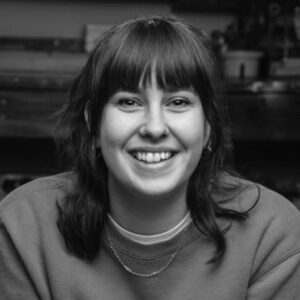


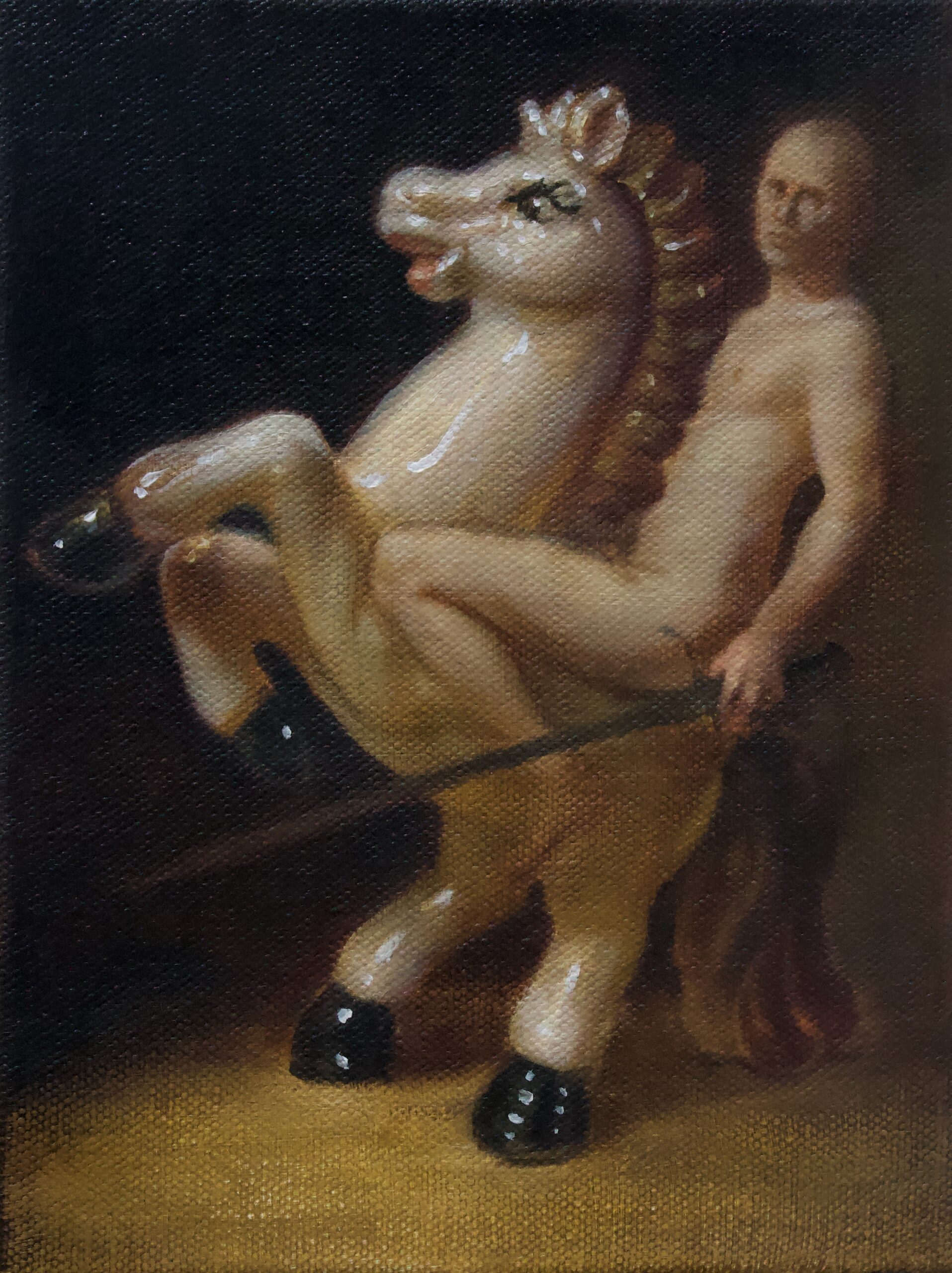
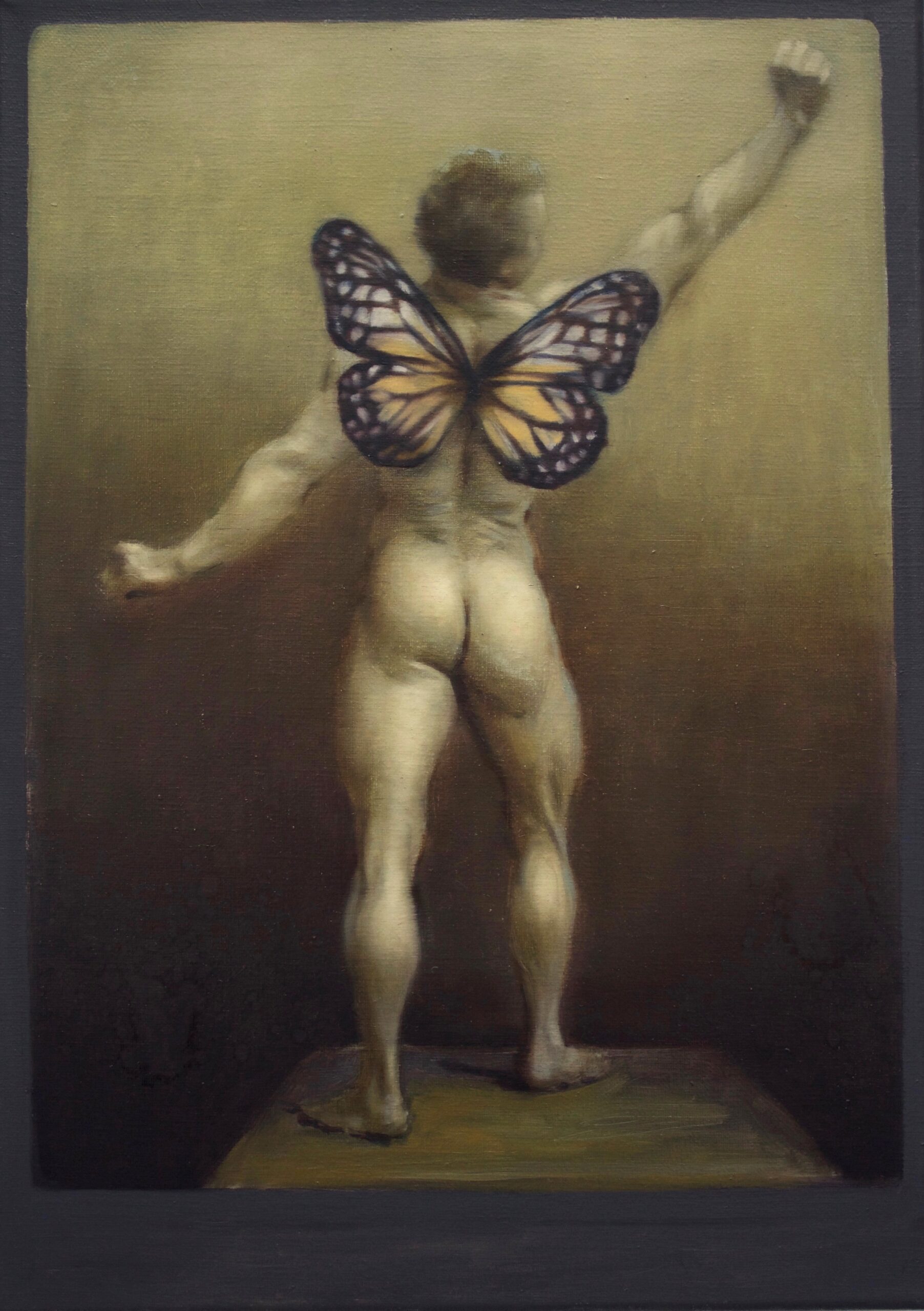
Angela Lizon won Jackson’s Art Prize 2026 with her oil painting, Essex Emerald, which you can see in person at our upcoming exhibition of finalists at Bankside Gallery.
The judges said, ‘Small but powerful in its take on the hyper-macho posturing prevalent in today’s politics, Essex Emerald juxtaposes aggressive masculinity with early 20th-century fairy painting. Angela Lizon’s exquisite painting also borrows from the language of 17th-century Dutch art, grounding her work in a particular sense of implied gravitas. The work is an impressive, perfectly composed anatomical portrayal, with complex paint handling and a sensitive touch, while its small scale further subverts its timely theme. Humorous, punchy, and original, Essex Emerald left a strong impression on the judging panel.’
We visited Angela in her studio to find out more about her move from minimalist abstraction to eight-foot white kittens, her supportive studio setup at Spike Island, and the disappointing world leaders that inspired her winning work.

Angela Lizon
Oil on canvas, 8 x 10 cm | 3.1 x 3.9 in
Contents
0:00 “It’s taken me a long time to find myself in my art”
0:05 “It was part of that thing about taking really cheap ornaments and making them something valuable.”
0:47 “I don’t deliberately try to subvert things. I’m just using elements that I have and that I’m interested in, like the part of me”
0:58 Introduction
1:21 “We used to spend the summers going to the museums, which were all free”
1:38 “My father was a carpenter and worked for a building company…if you asked him what he was making, he always said the door to the forest”
2:36 “Artists don’t have friends”
3:29 “I always knew I wanted to be a painter, but it was suggested to me that I could maybe do sculpture, but I didn’t feel it. I have only ever wanted to be a painter”
3:41 “I specialised in figurative painting, and I combined that with studying the use of colour. We had a tutor who gave us lessons on mixing colour, which was very useful.”
4:18 “Horses and carts were being used in the streets; it was absolutely gorgeous to see, but very, very hard for the people to live there.”
5:10 “In Bristol, at the time, there were lots of deserted warehouses, because there was a lot of bombing that happened during the war, and it hadn’t been redeveloped.”
5:56 “I found it too expensive to hire a model. So I started working from still lives.”
6:36 “My youngest daughter had an image of a white kitten on a pink background with badly pasted ballet shoes in front of it. I thought, that’s a really great image, but it needs to be eight feet.”
7:32 “I liked the idea of interspersing items from my background into what some people would consider better taste.”
7:49 “I don’t mind if they’re animals or people, but it’s something about the face and the expression.”
8:40 “I’ll just choose an area that I want to start on – maybe they’re the brightest flowers”
9:07 “I like that seductive quality the flowers have.”
10:03 “I used his paintings, and I adjusted the colour, and I put fairies in them”
10:30 “And it was the idea of what happens in the garden at nighttime when you’re not looking”
11:46 “I make a digital collage on the computer”
12:06 “So I’ve taken the machismo and made it harmless, neutralising it.”
12:43 “It’s not a critique of bodybuilding as an art form; it’s just the fact that it has to do with showing off your muscles and strength.”
13:33 “Although I am making the paintings of the fairies in a slightly disparaging way, I also feel quite fond of them.”
14:32 “I think that colour is more precious when you use it in small quantities, like a jewel.”
16:26 “My preferred surface to work on is an oil-primed surface, because it has a bit of resistance.”
0:00 “That’s the process that I use – painting, smoothing it, painting, smoothing it, sometimes over and over again during the day.”
17:04 “That’s the process that I use – painting, smoothing it, painting, smoothing it, sometimes over and over again during the day.”
17:51 “At some point, you do have to give up on a painting, and I have occasionally, but I quite like to rescue them if they’re going wrong.”
18:39 “Velázquez is the artist I admire most for his technique – they look so realistic from a distance, but when you look close up, they just break up into loads of blobs of paint, and it’s just a kind of magic.”
19:24 “I don’t know when to leave things, so I do tend to fill in everything and bring everything up to a total finish.”
20:24 “There’s a great benefit to working in what can be quite an isolating practice, but having a studio within a really vibrant environment like we are.”
21:56 “I’d rather follow my own path.”
22:51 “So I couldn’t believe it when I had the phone call, and I was told that I’d won.”
24:27 “just paint and don’t overthink things.”
25:10 Credits
Film Extract
“My mother is descended from a long line of cockneys, and my father came to England as a displaced person from Poland after the Second World War. We didn’t have much art in our house growing up because there wasn’t much money, so that was a luxury. We didn’t buy ornaments or paintings, but we did have a print of The Hay Wain that came free with the vacuum cleaner.”
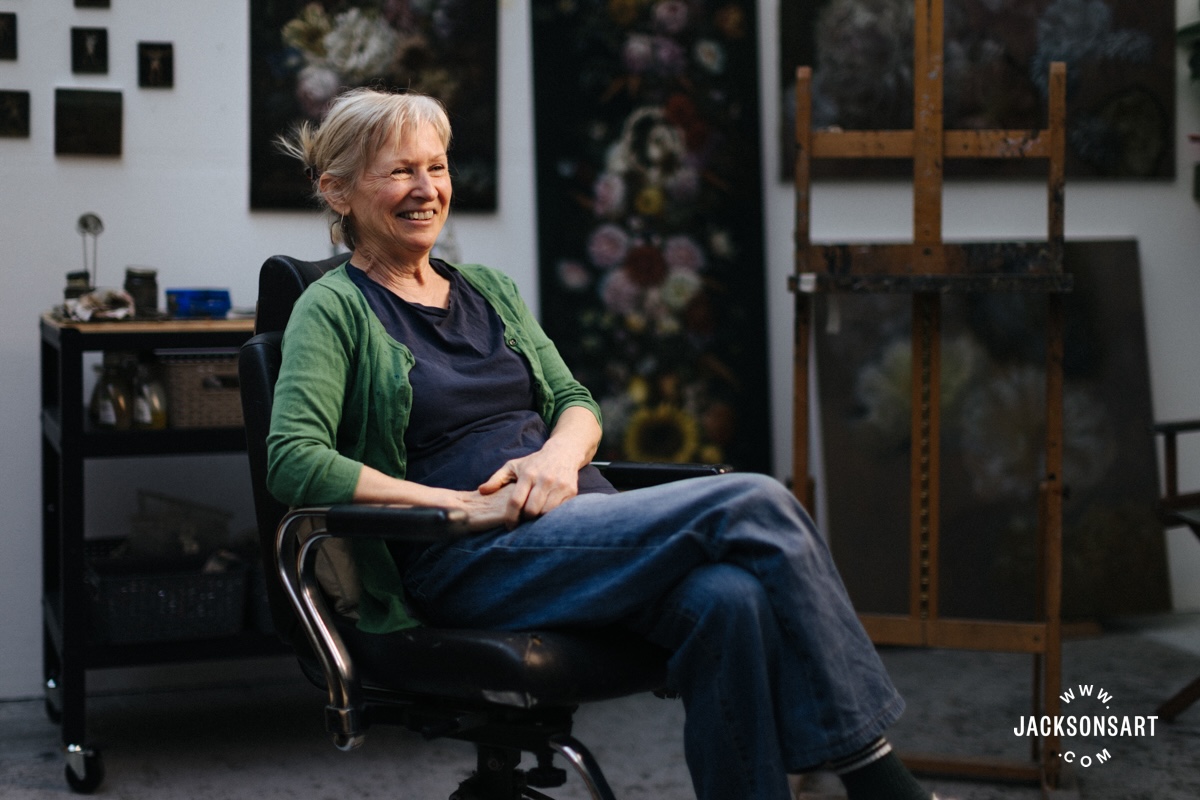
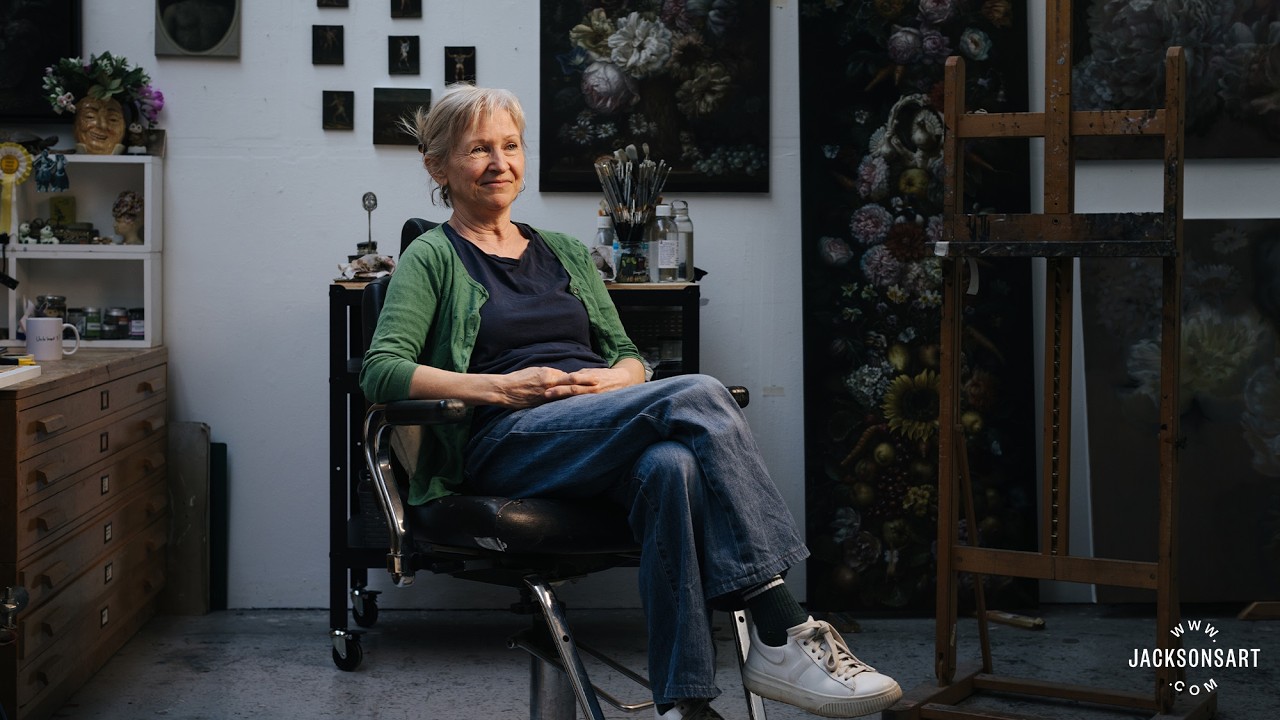
My name is Angela Lizon. I’m a painter and I’m the 2026 winner of Jackson’s Art Prize. I’m here in my studio in Bristol at Spike Island, and I’ll be talking about my painting practice.
The idea for the painting came from a very famous photograph of Putin riding a horse topless. And I thought, ‘Why does he need to do that when he’s a world leader?’ Why does he need to show himself off in that light? You know, that kind of macho stance like Bolsonaro, Boris Johnson. I said, there’s a whole load of really nasty male leaders.
The idea of the aggressive fairies is taking aggressive postures, and I’ve shrunk them down to that size and given them the butterfly wings. So I’ve taken the machismo and made it harmless, neutralising it. Although I am making the paintings of the fairies in a slightly disparaging way, I also feel quite fond of them. I’m just using them as a symbol of something. In all my paintings, I try to paint sensitively. It’s not always easy to achieve, but I do try to get some kind of feeling into the brushwork. There is a moth called the Essex Emerald. All the titles are from actual butterflies and moths. You take it how you want it.
Angela Lizon
Oil on canvas, 20 x 15 cm | 35 x 47 in
It was marvellous to hear I’d won the First Prize. I couldn’t believe it, especially with such a small painting. I’ve been watching the prizes being handed out. I think there was a really generous ratio of prizes for the Jackson’s Art Prize, and once I got through to the shortlist, I thought, there’s an actual chance of maybe getting a prize.
And as they were being given out and they went up in size, I thought, well, that’s it then. I haven’t won a prize this time. So I couldn’t believe it when I had the phone call and I was told that I’d won.
My first purchase with the prize money was a beautiful new painting trolley. I’m not sure what I’m going to do with the rest – I could do with a new computer, which I might invest in. I’m thinking about it carefully, I’m not going to splash the cash just yet.
Background
I grew up in Wembley. It was a little bit of a cultural desert, but there were lots of really good tube routes into central London. We used to spend the summers going to the museums, which were all free. We used to go to Kew Gardens; it cost a penny to get in there. I’ve got two brothers – I’d have liked a sister, but I had two brothers.
My mother is descended from a long line of cockneys, and my father came to England as a displaced person from Poland after the Second World War. We didn’t have much art in our house growing up because there wasn’t much money, so that was a luxury. We didn’t buy ornaments or paintings, but we did have a print of The Hay Wain that came free with the vacuum cleaner.
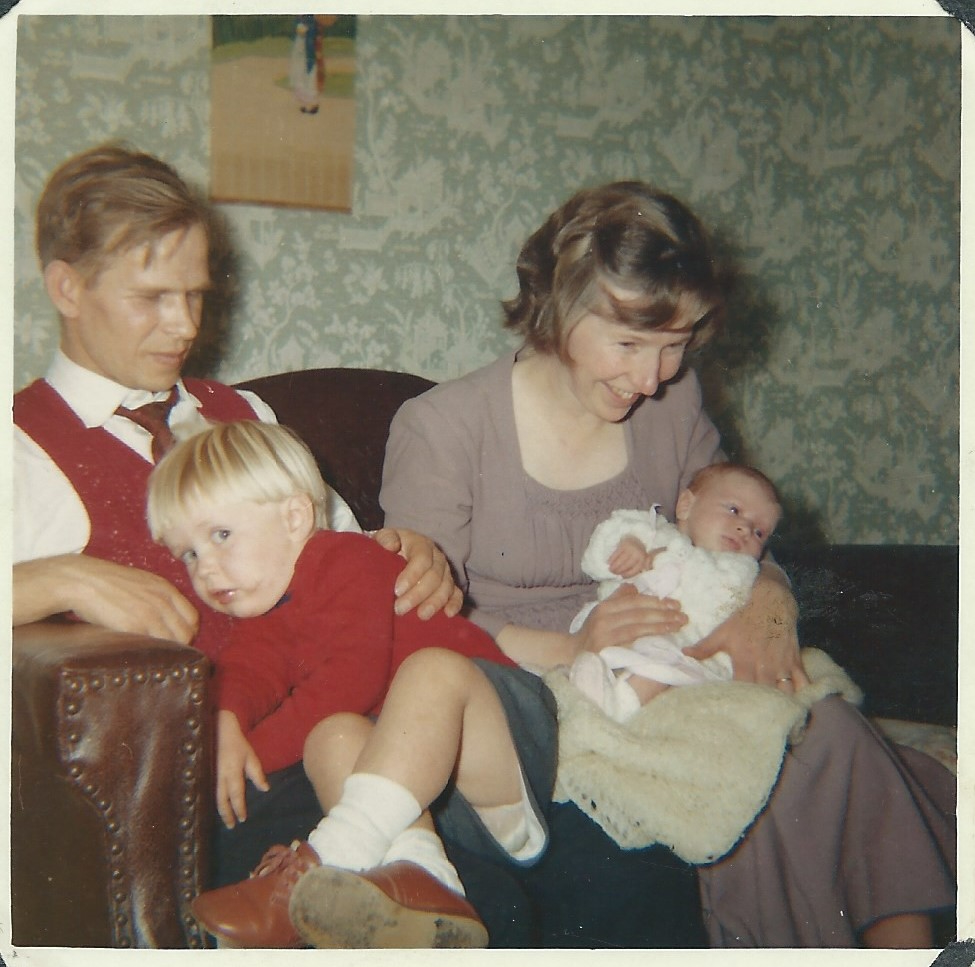
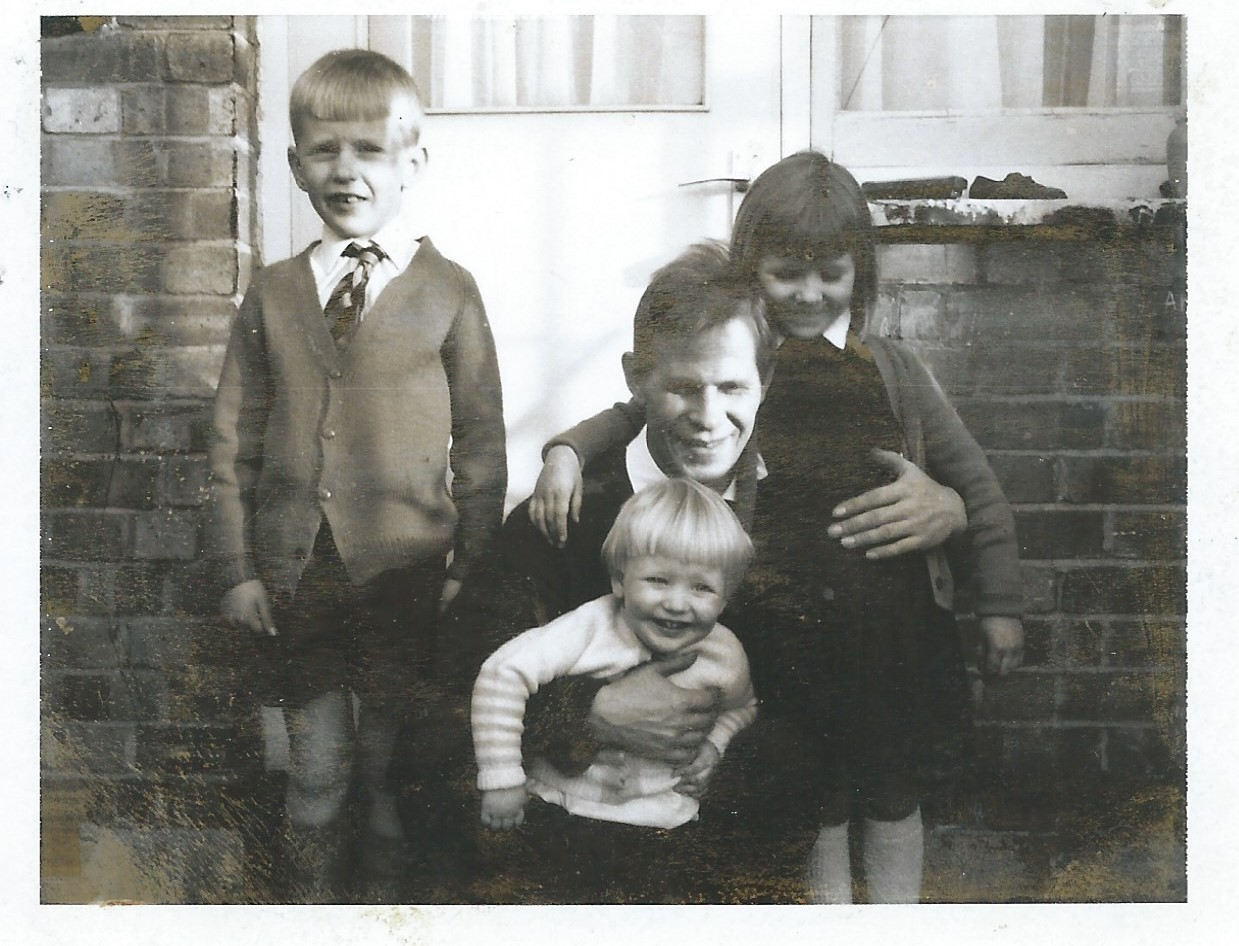
My father was a carpenter and worked for a building company. He spent a lot of his weekends making furniture, and if you asked him what he was making, he always said the door to the forest. So there was a romantic element to what he was making and the way he described it; he was always talking about wolves and bears and forests.
So I think that the combination of an unknown romantic vision of Eastern Europe, and the humour of the English side of the family have combined, and that’s what I’m doing.
Artistic Journey
It’s taken me a long time to find myself within my art. I’ve always been interested in kitsch. A curator in a group show I was taking part in said, ‘We don’t want that kind of thing in here.’ And it got me thinking about where she was coming from on that, and was it something to do with taste? Why was her taste better than the general public’s taste, who seemed to be really enjoying what I was doing?
Angela Lizon
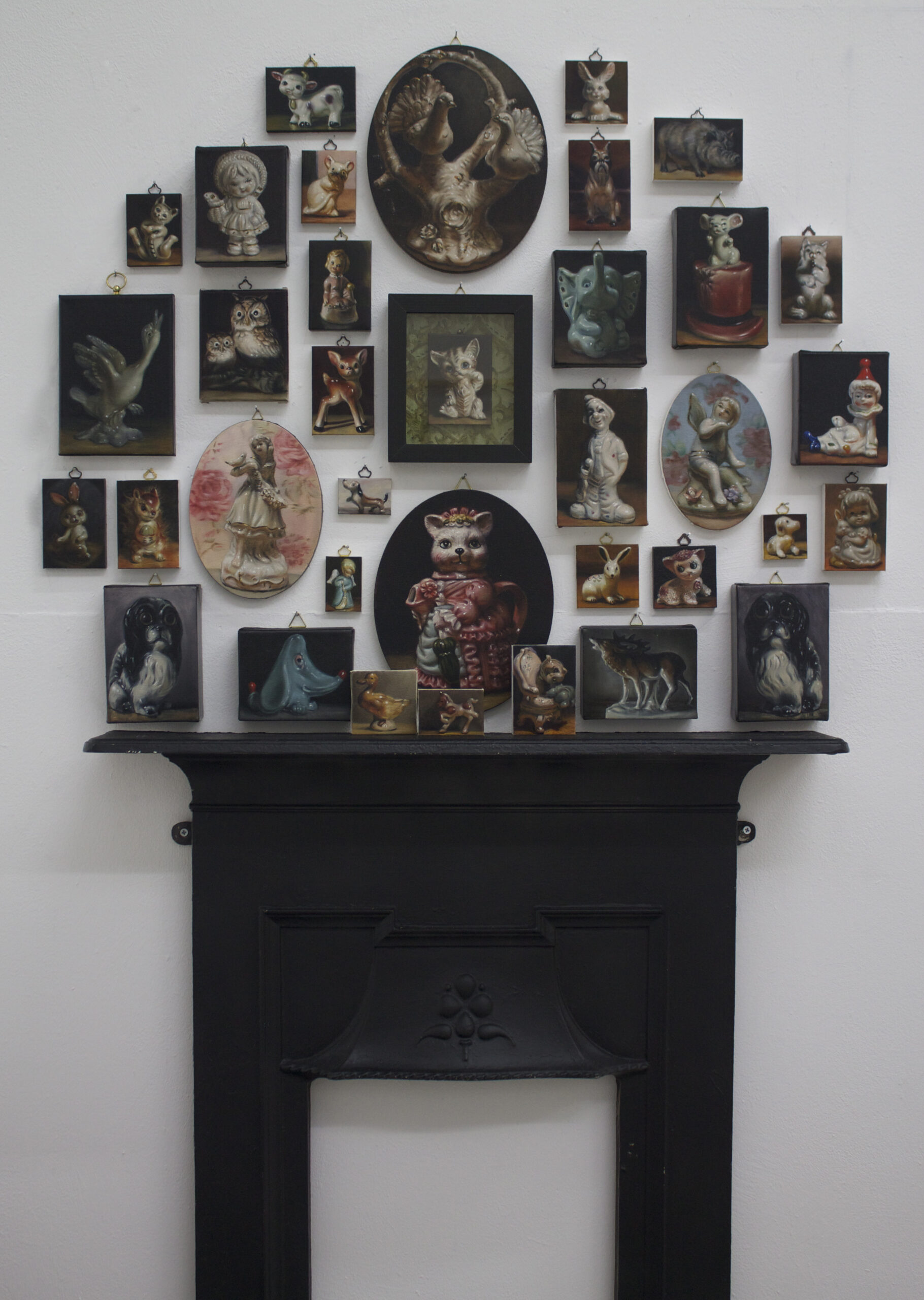
Paintings all oil on canvas with wrought iron fire surround, 178 x 96 cm | 70 x 38 in
I started collecting these little figurines that I would buy from charity shops for 50p or a pound. I was painting them individually, and then I was making installations with them, like above a fireplace. And it was part of that thing about taking really cheap ornaments and making them something valuable. I don’t mind if they’re animals or people, but it’s something about the face and the expression. And when I paint them, I don’t paint them from life. I photograph them under a spotlight. It’s like shining a torch on your face. You can bring out something a bit spooky or dark within something, by the way you use the lighting, which is more difficult to get within the studio setting.
Angela Lizon
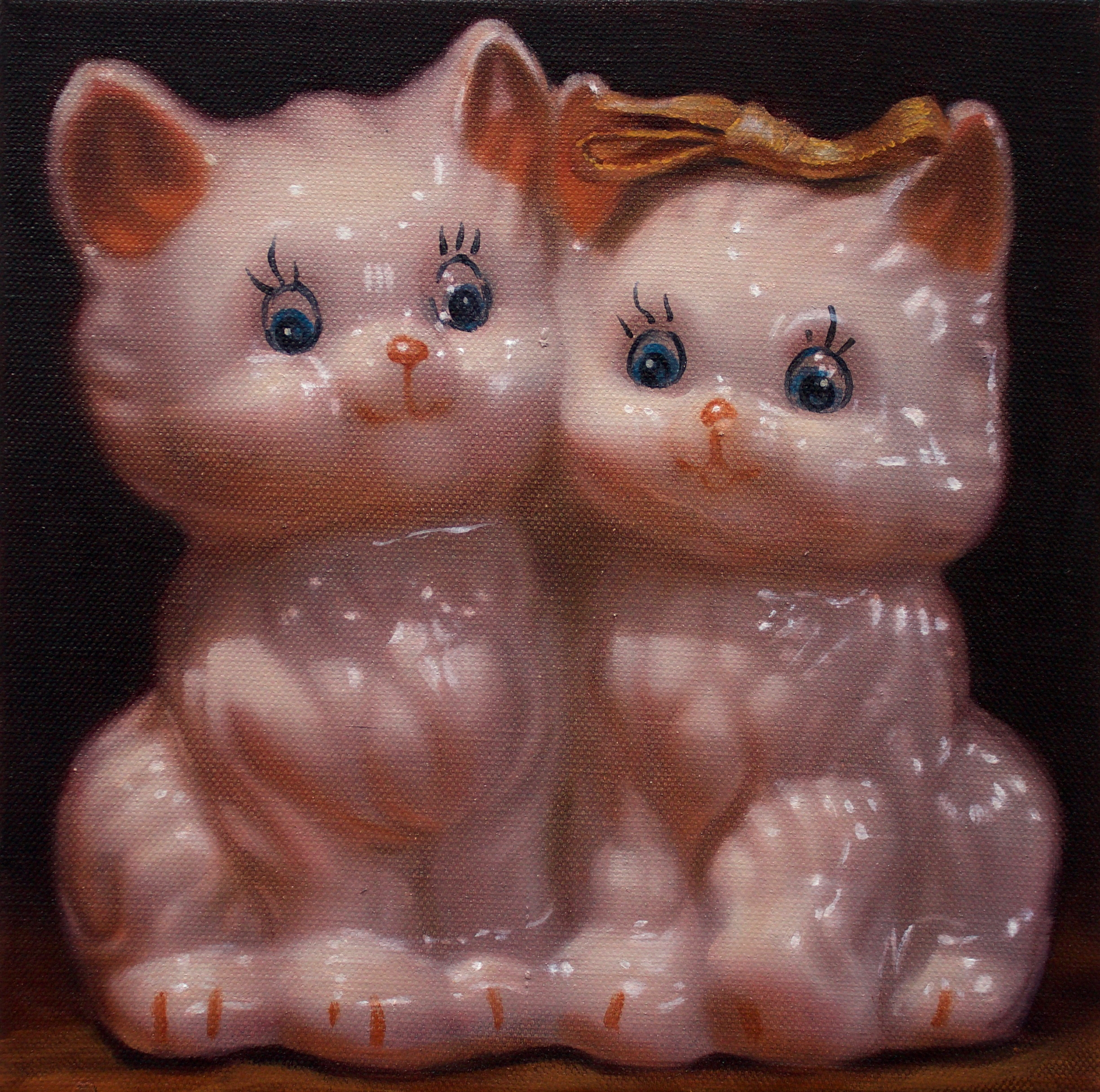
Oil on canvas, 25 x 25 cm | 10 x 10 in
It’s harder to find them, and they’re more expensive because I think a lot of artists are working with them. Often, I’m bidding for them on eBay, bidding against people for them. I think I have 200 or 300 ornaments in my collection now, and that’s been the basis of all my work since then. Then, at some point, I moved on to painting with found photographs. It was the same kind of thing – there were things that you wouldn’t have put on your wall, they were just a disregarded form of photography.
I work quite a lot with 17th-century Dutch art, because I think it immediately lends a painting a kind of air of gravitas, with all its connections with opulence and death. Quite often, it’s a vanitas. You can pull people in, and then you find it’s not quite such a serious painting, after all. But I like the subversion of the original intention of that sort of work, so I don’t deliberately try to subvert things. I’m just using elements that I have and that I’m interested in, like the part of me.
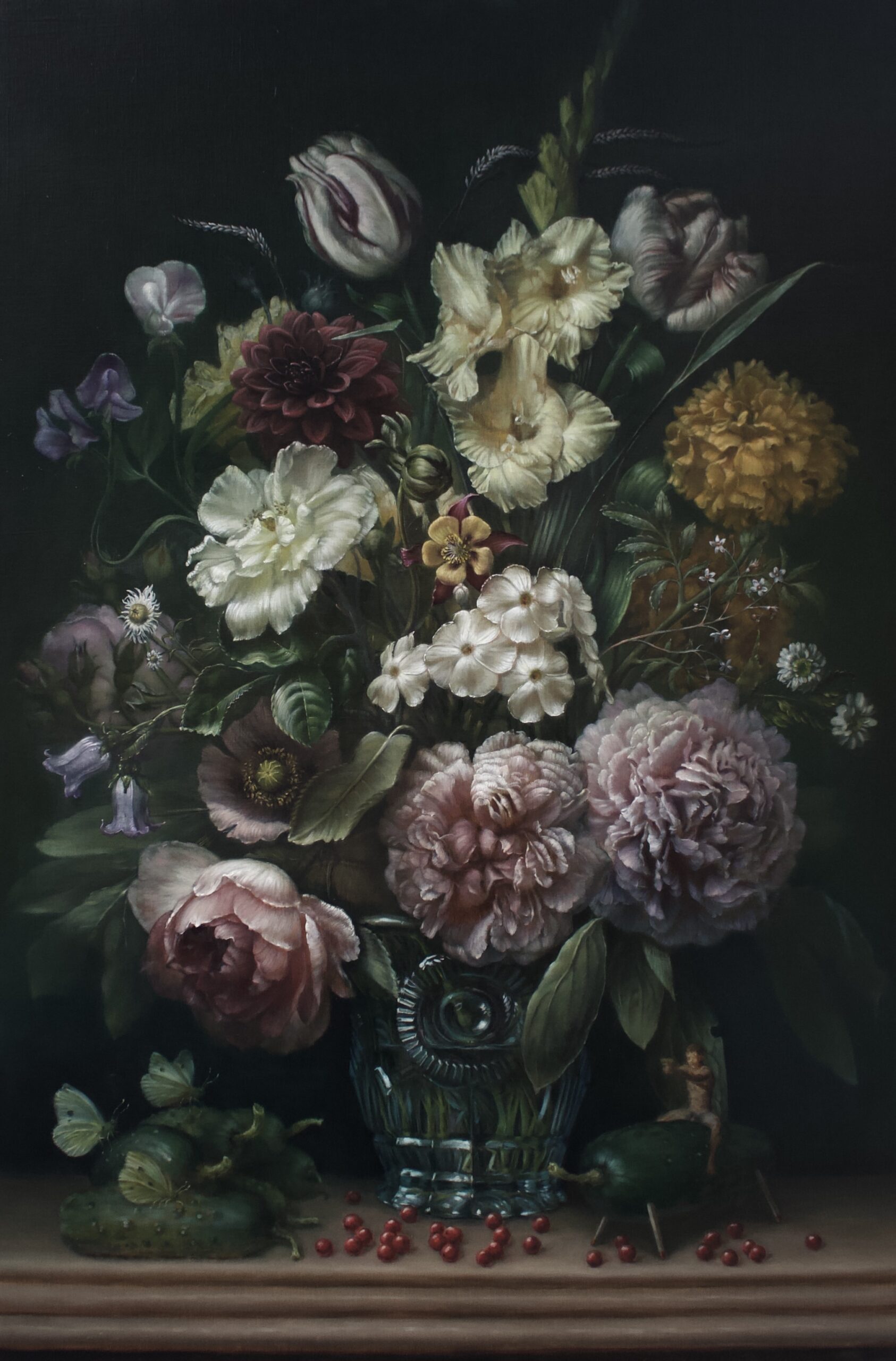
Angela Lizon
Oil on linen, 120 x 80 cm | 47 x 31 in
I don’t remember this, but my mum told me a story about the earliest time she remembered I wanted to be an artist, when I was about five or six. She told me that if I carried on in the way I was going, I wouldn’t have any friends. And I said to her that that didn’t matter, because when I grew up, I was going to be an artist, and artists don’t have other friends; they just have other artists. Which is actually quite perceptive, really, because most of my friends are artists.
I hadn’t considered that it could be a career until I saw other students leaving and going to art college. And then it occurred to me that actually, I could go to art college, and I could do art all day, and it just seemed an amazing thing. But it wasn’t in my background to consider anything like that. But luckily, I had parents who, when I made my decisions, didn’t say to me, ‘You need to get a proper job.’ So, although they didn’t know how to offer me any support, they didn’t put anything in my way of following that path.
I did the foundation course in Watford. I always knew I wanted to be a painter, but it was suggested to me that I could maybe do sculpture, but I didn’t feel it. I have only ever wanted to be a painter.
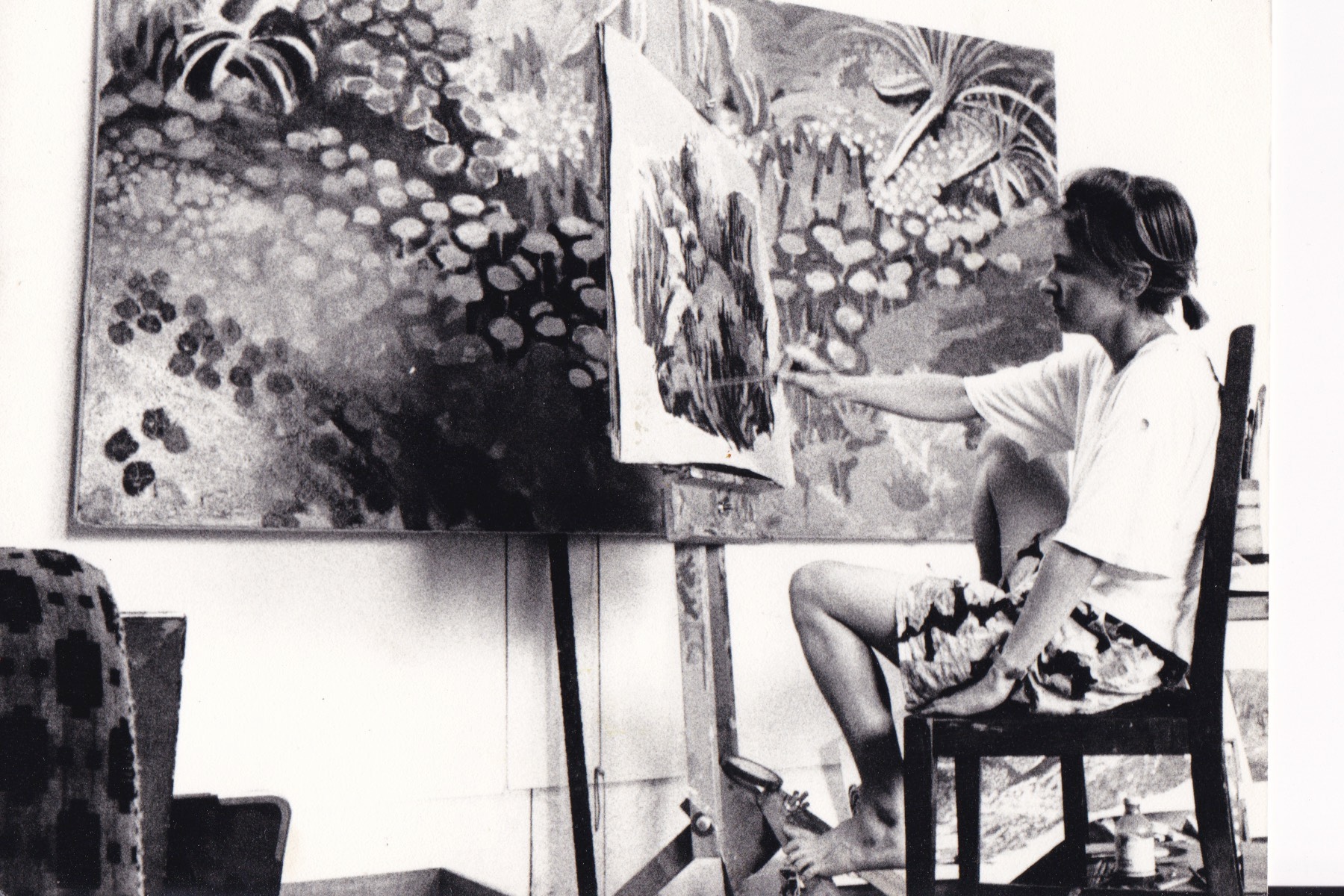
I studied fine art at Bristol Polytechnic. I chose Bristol because, when I visited, there were cows in the field behind, and it felt like being in the countryside, coming from London. The other reason was that they still had quite a traditional arts degree, where it was encouraged to work from the model and learn basic techniques. And that’s really what I was looking for. I specialised in figurative painting, and I combined that with studying the use of colour. We had a tutor who gave us lessons on mixing colour, which was very useful.
When I finished my degree, I applied for a scholarship to go and study at Krakow Academy of Fine Arts. I visited Poland for the first time the year before, and made connections with some of my family members. It was that that made my decision to want to go and study there, rather than anything to do with art. Horses and carts were being used in the streets; it was absolutely gorgeous to see, but very, very hard for the people to live there.
The building that I stayed in used to be the Gestapo headquarters during the war, and it was the place for drama, art, and music students. In the basement of our accommodation, there were over a thousand Polish men who were murdered in the cells where we had our showers. There were always candles outside the building. So, it was a very strange place and a strange time to be there, but very interesting.
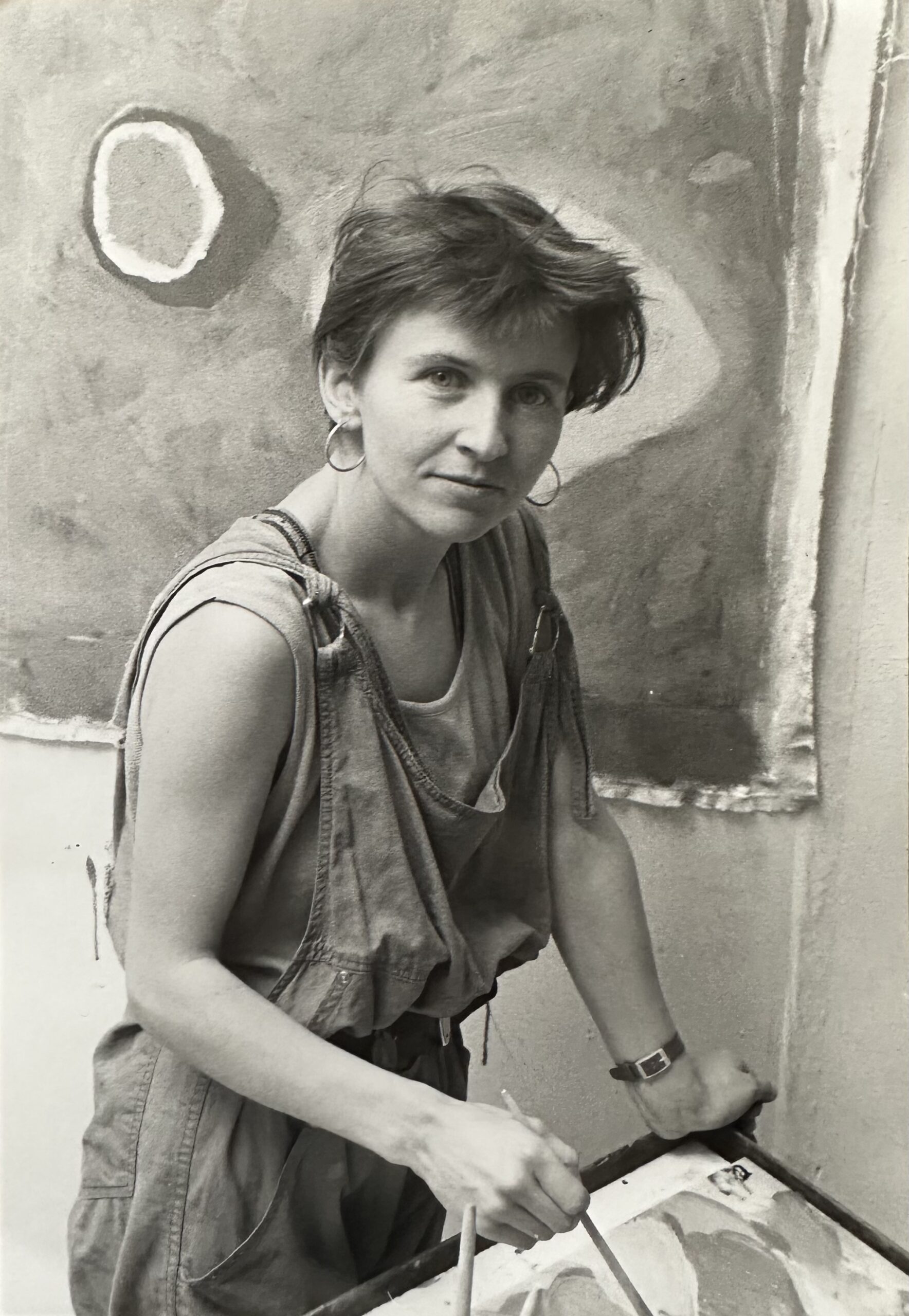
I did intend to go back and live in London, but as I looked around for a studio, I realised that they were all so expensive I would have to spend all week working to be able to pay for a studio. In Bristol, at the time, there were lots of deserted warehouses, because there was a lot of bombing that happened during the war, and it hadn’t been redeveloped. So I came back to Bristol because it was much cheaper and easier to find a studio.
In 2018, I was elected an Academician at the Royal West of England Academy, and then last year I was appointed Vice President of the Royal West of England Academy. It’s a really beautiful building in Bristol, absolutely beautiful galleries. I just feel so proud every time I walk up to the building – I can’t believe that I’m Vice President of that place. They put on some great shows, they do lots of good workshops with children and adults, it feels like a really energetic place to be a part of at the moment. It’s great. I’ve met some really lovely other artists there.
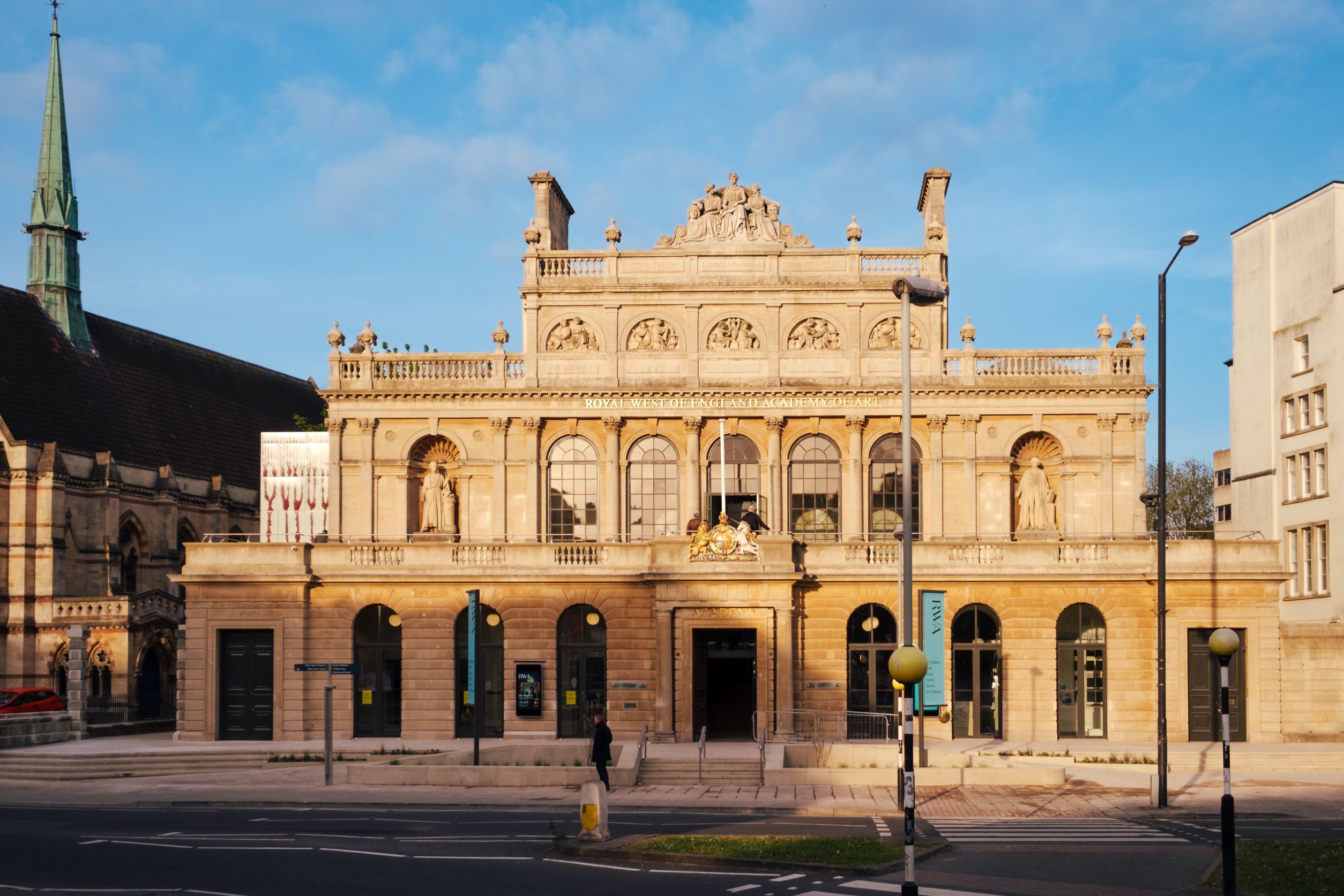
Having practised as a figurative painter, when I left college, I found it too expensive to hire a model. So I started working from still lives. And then I found that the colour in the still life was more important to me than the actual objects, and so I gradually moved to abstraction, which then moved to minimalist abstraction. The paintings were very pale, and they were based on very thin layers of tints of opposing colours layered on top of each other, which had an amazing effect as the light changed during the day, and the cloud would bring out either a warm aspect or a cold aspect of the paintings.
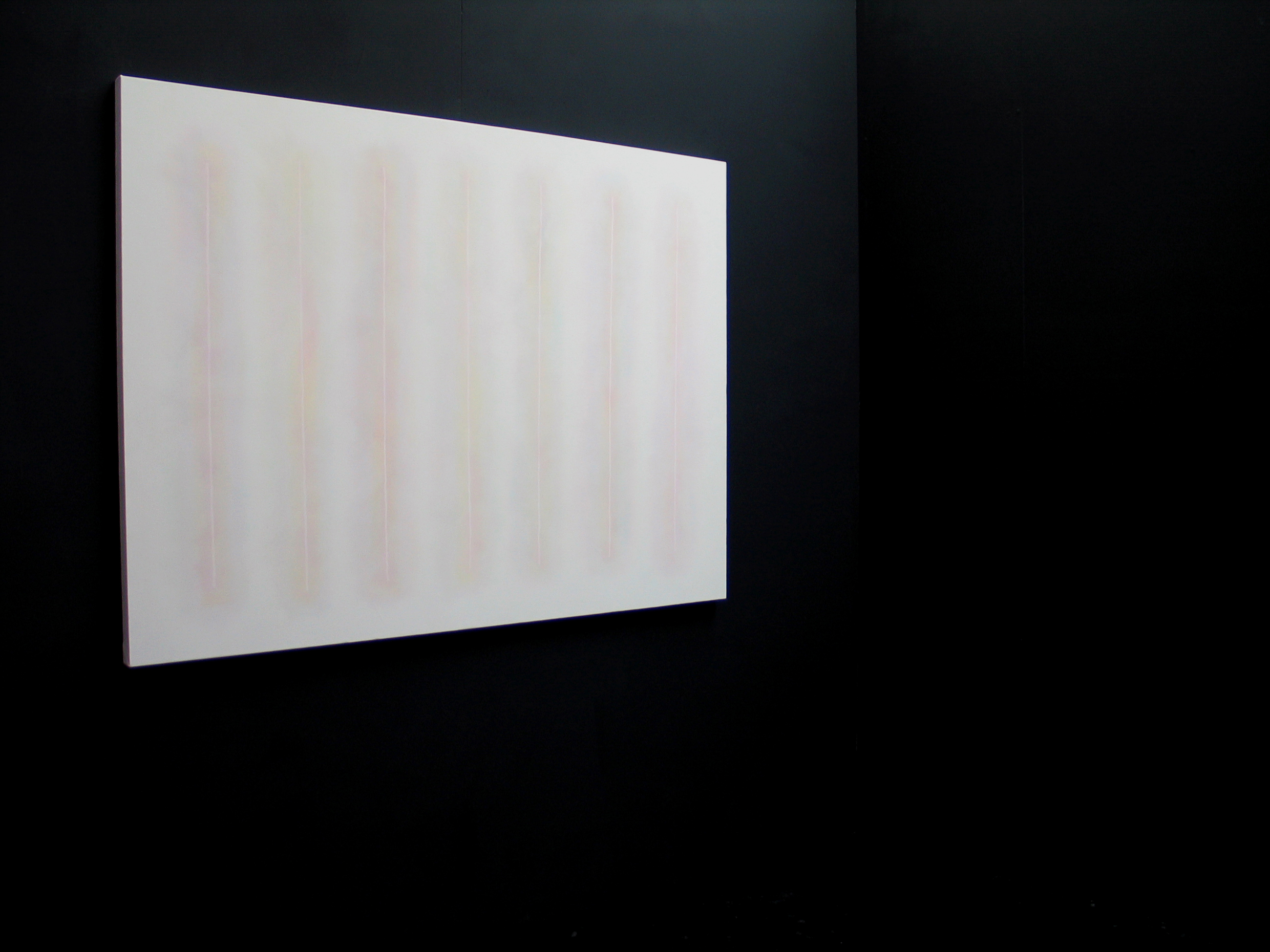
Angela Lizon
Acrylic on canvas, 130 x 177 cm | 51 x 70 in
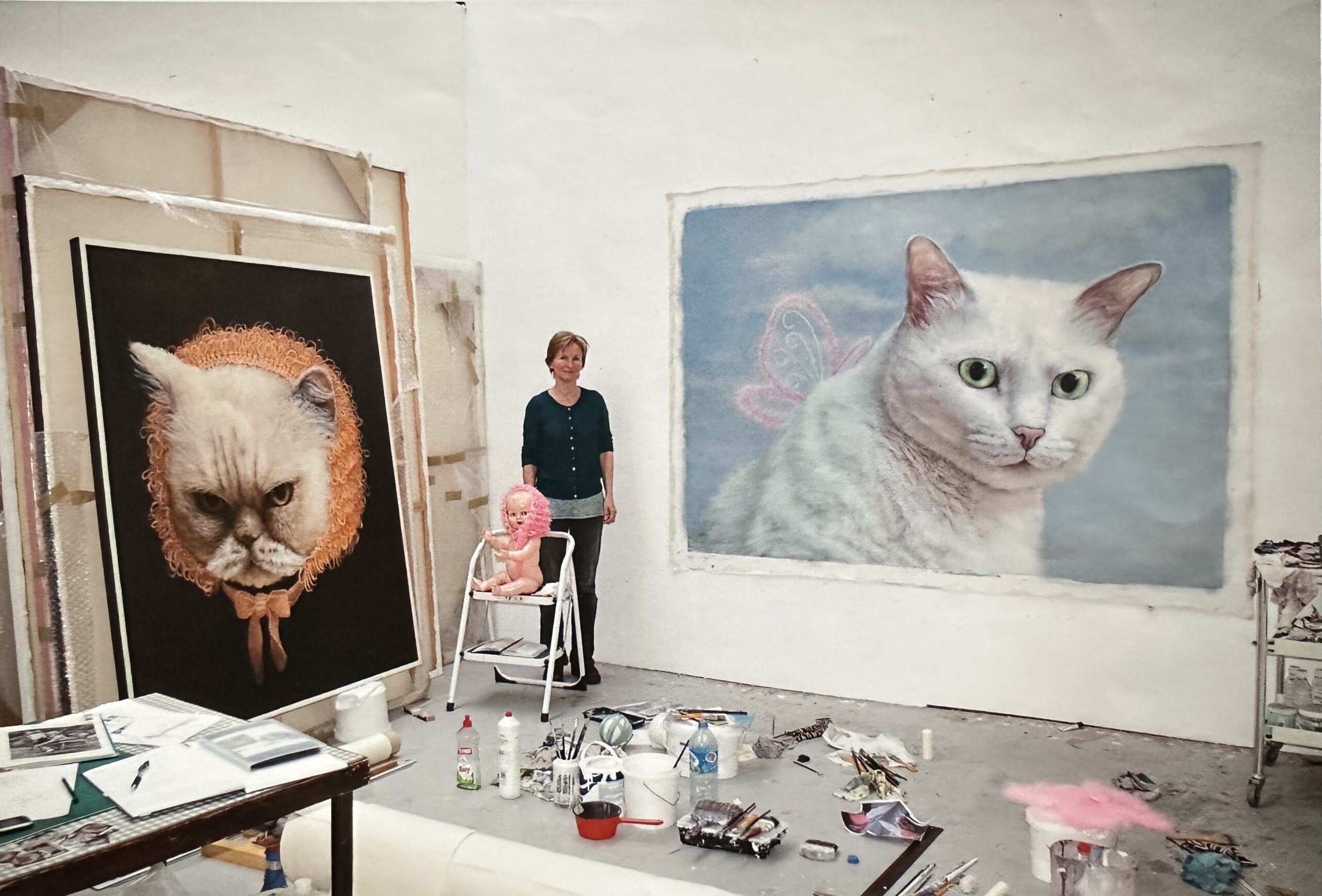
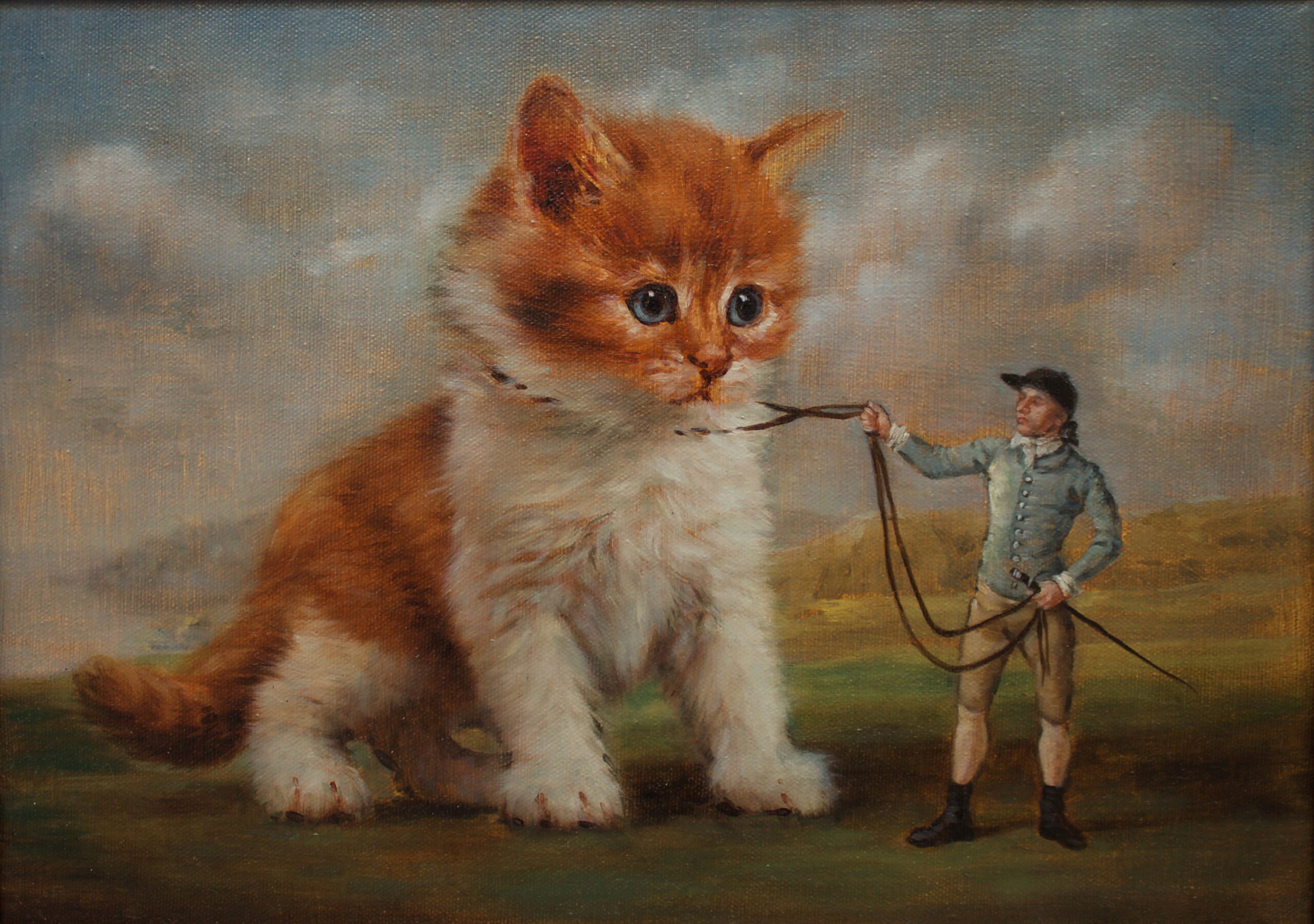
But I found, after a while, that all my paintings were either pale green or pale blue or pale pink, and I couldn’t find a way to move them on. I decided that I was just going to paint anything that came into my head, anything that was around me, and I wasn’t going to worry about it or think about it too much. I was just going to paint. I started picking up apples, fruits, sticks – anything that was around me. At the time, my youngest daughter had an image of a white kitten on a pink background with badly pasted ballet shoes in front of it. I thought, that’s a really great image, but it needs to be eight feet. So within the space of a month, I went from doing these minimalist abstract works to painting an eight-foot white kitten.
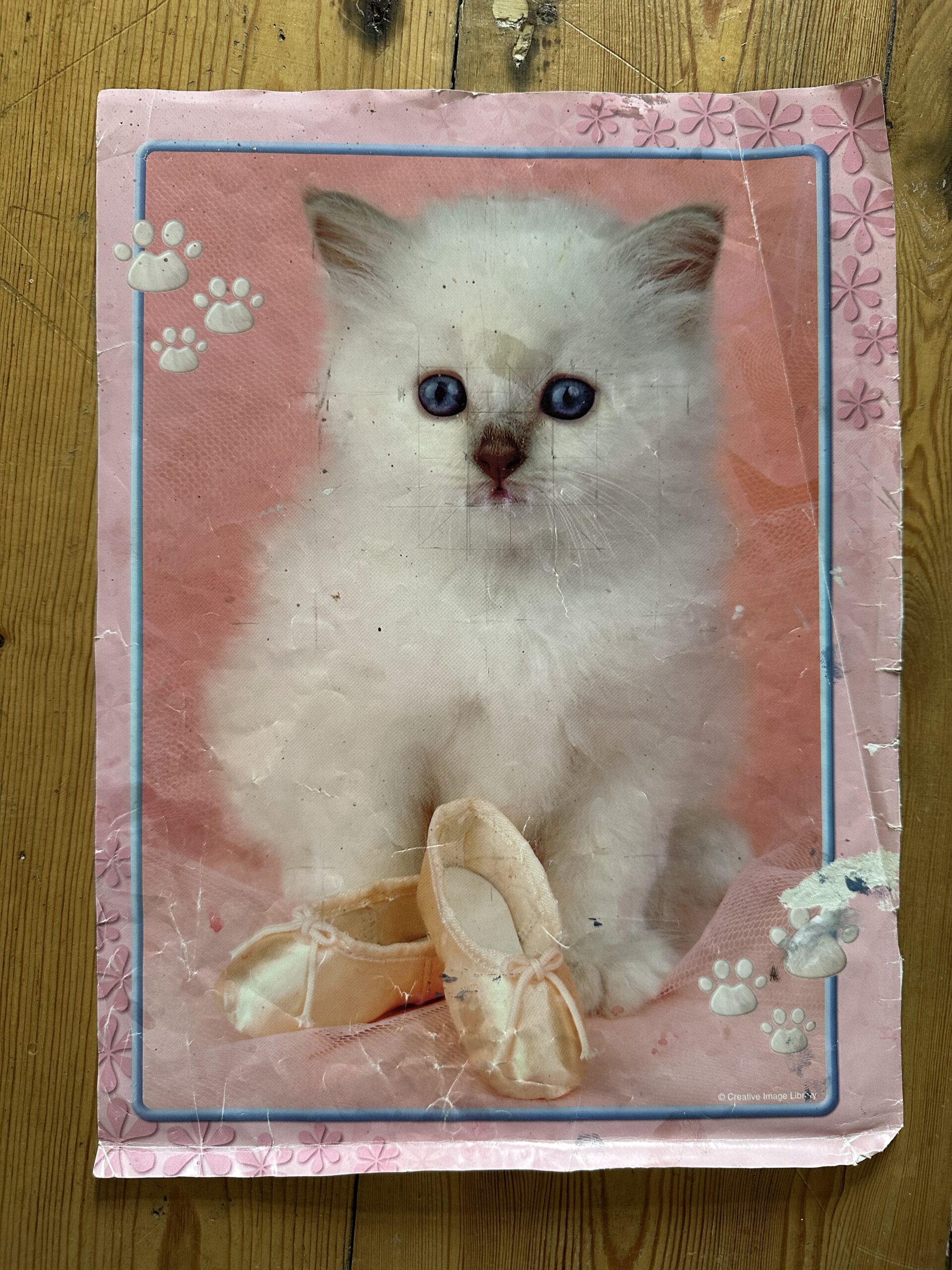
Then we had open studios at Spike Island, which we had 10,000 people through on a weekend, and people came expecting to see my abstract work, and I had a big fluffy kitten! I had such good feedback from most people, really good feedback. But it was actually really good fun and very liberating because my work had become very formulaic in the way I approached it. I liked the idea of interspersing items from my background into what some people would consider better taste. I’ve done a series of paintings using George Stubbs’ paintings with horses, taking the horses out and putting in giant kittens.
Colour and Art Materials
I think that colour is more precious when you use it in small quantities, like a jewel. I work with oil paint – I like its flexibility. And I just love that you can change things, move things around, get softer edges, and blend. I’ve tried so many different mediums by different companies, and I always come back to linseed oil and turps.
I use a mixture of oil paints – Winsor & Newton, Old Holland, and some Michael Harding. So I’ve just got a variety of different paint companies because sometimes the colours vary wildly. For example, Burnt Sienna from Old Holland is very earthy, but from Winsor & Newton, it’s a very orangey colour, so they both have their benefits.
I love colour, but I use very pared-down colour. I feel much more comfortable with a greyed version of a colour than a very bright colour. My palette is a piece of glass, and I like working on that because I can put a piece of paper or card underneath, which will mimic the colour of the ground that I’m working on. So that it gives you a much truer version of the colour that you want. I lay it out with the blacks and the greys, and whites on one side, and then blues and greens through to red. I use a lot of Raw Umber – that’s my favourite colour. And I’ve found that Raw Umber is quite a neutral colour to work on. You can paint an area of painting, and you don’t feel the need to cover the rest of the canvas.
I’ve tried Burnt Sienna, and all sorts of other colours to work on, but they affect everything that you put down next to it, whereas the Raw Umber can sit there and it doesn’t seem to affect the other colours that you put down. It seems to be quite neutral. One of the colours I really like using is Chromium Oxide Green, which is a really, really powerful mid-green colour. You really only need a tiny bit, but it’s so strong, and it’s a very good base colour for painting leaves, and obviously, I’m painting a lot of leaves.
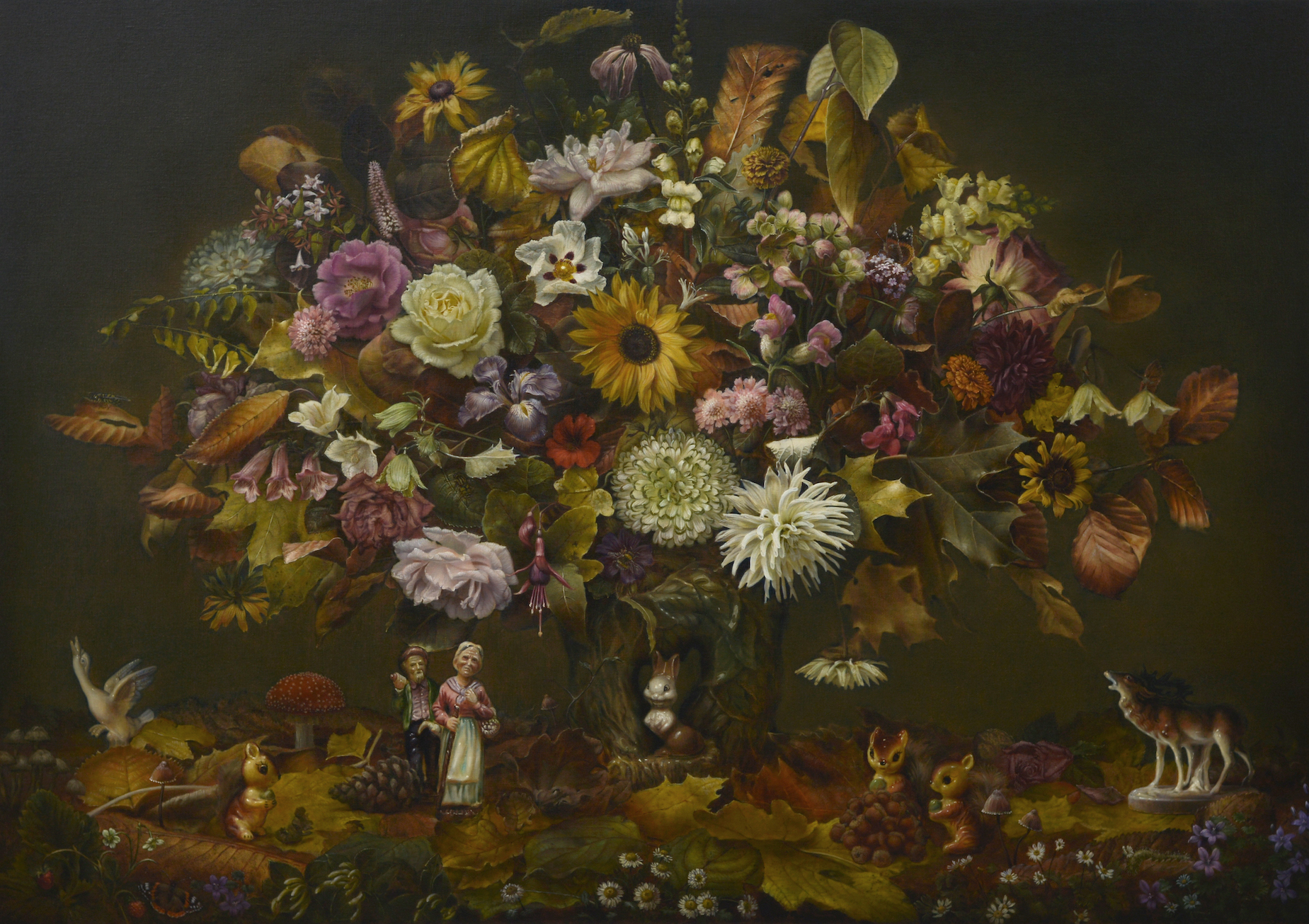
Angela Lizon
Oil on linen, 136x 176 cm | 54 x 69 in
Unifying the whole painting is the trickiest part. It’s kind of like bringing the poetry into a painting, and giving it a sense of it all being there at the same time, and having the same kind of atmosphere.
I’ve always been quite interested in the technique behind the painting, and I like looking at old masters’ techniques; that’s always been quite an important thing to me. Some paintings happen very quickly, like I can do a large painting in a month, and others can take five or six months. Sometimes I really struggle with getting the background colour right, and then if I have to change the background colour, it affects all the colours around it and all the light within the painting, so then I have to change everything. I don’t do that much direct glazing with liquin or something like that over the top. At the end, I quite often put a retouching varnish down to unify the surface. It’s something that you can use within a few weeks of finishing a painting.
I would say that I’m a bit of an arsey painter and I don’t know when to leave things, so I do tend to fill in everything and bring everything up to a total finish. I’m trying to stop myself from doing it, but I find it very hard to leave bits unfinished. That’s probably a fault, I would say, but that’s what I do.
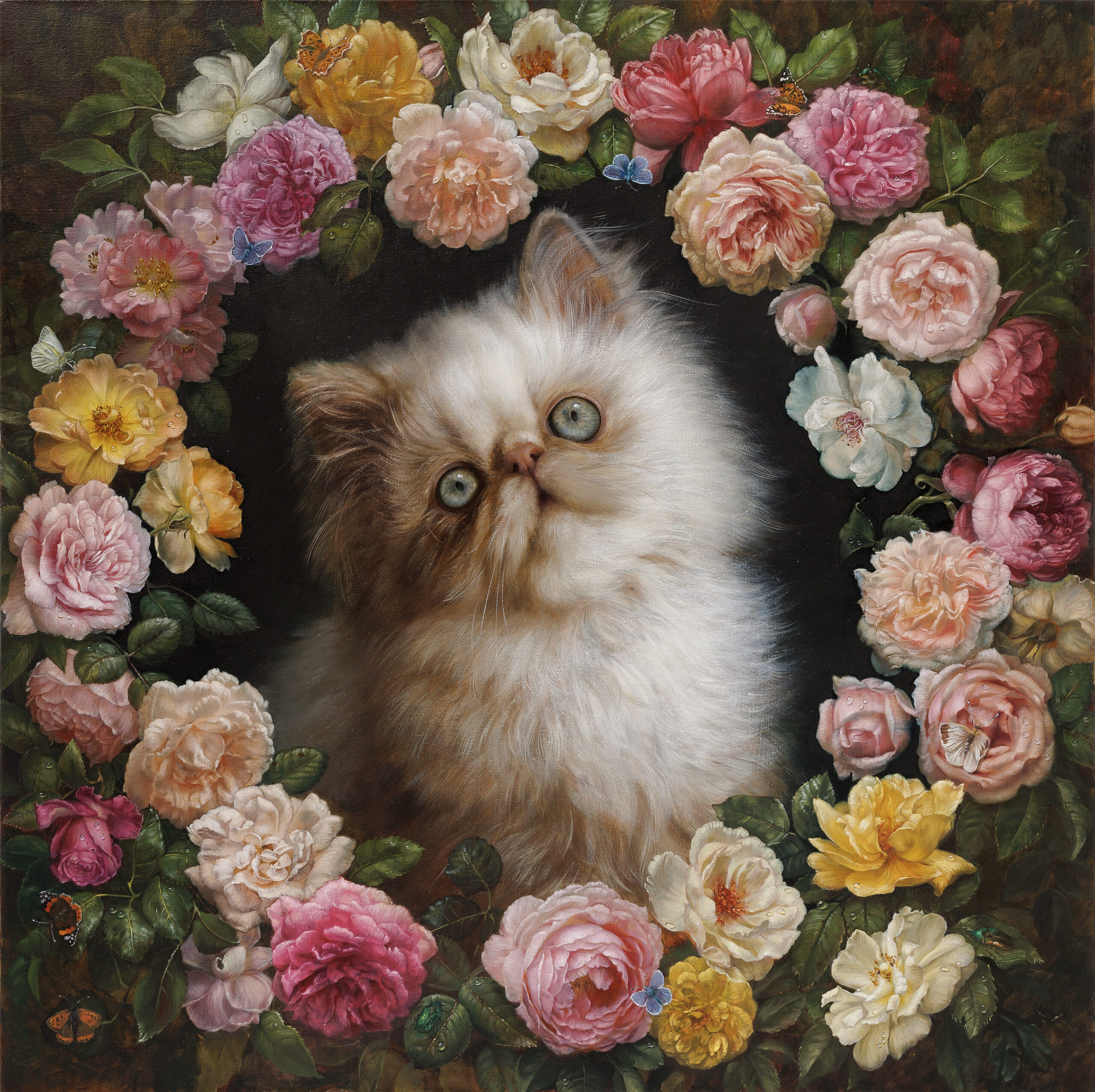
Angela Lizon
Oil on canvas, 130 x 130 cm | 51 x 51 in
Dan Weill Photography
In the floral still lifes that I’m painting at the moment, I use the flowers as a backdrop or a theatre set, really, to stage the things that are happening with the ornaments in front, and I think the flowers have a draw power. They have an appeal; they bring you in to look at the painting, and then you see what’s happening underneath or within the darker elements of the painting. I like that seductive quality the flowers have.
It was helped along by lockdown – I spent a lot of time in my garden learning how to use my camera, and looking at things happening in the garden really closely. I remember finding some caterpillars, and when I looked them up to see what they were, they were from a really beautiful ermine moth, which kind of looks like an ermine cloak. It’s fluffy and white with little black flecks. And it was the idea of what happens in the garden at nighttime when you’re not looking.
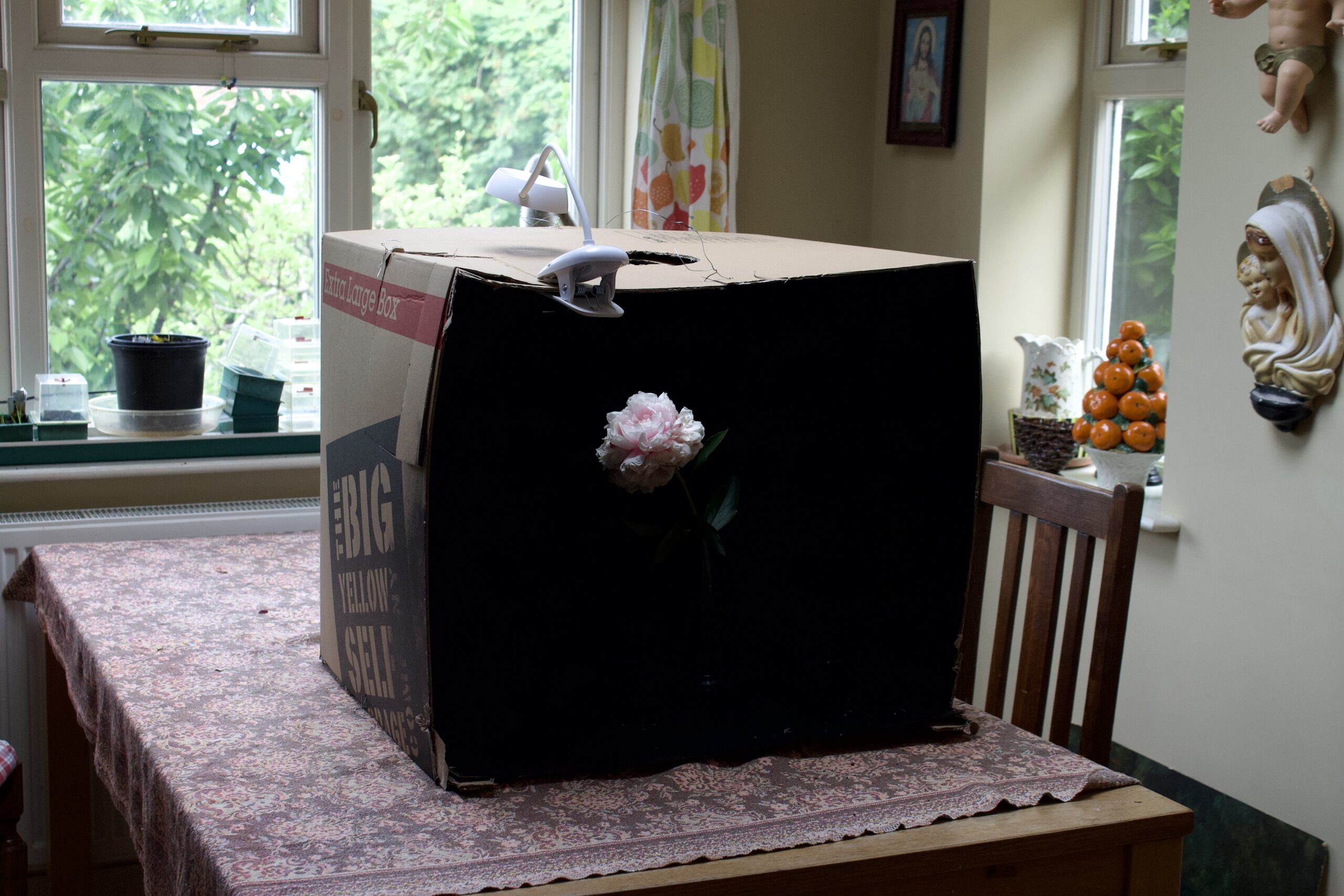
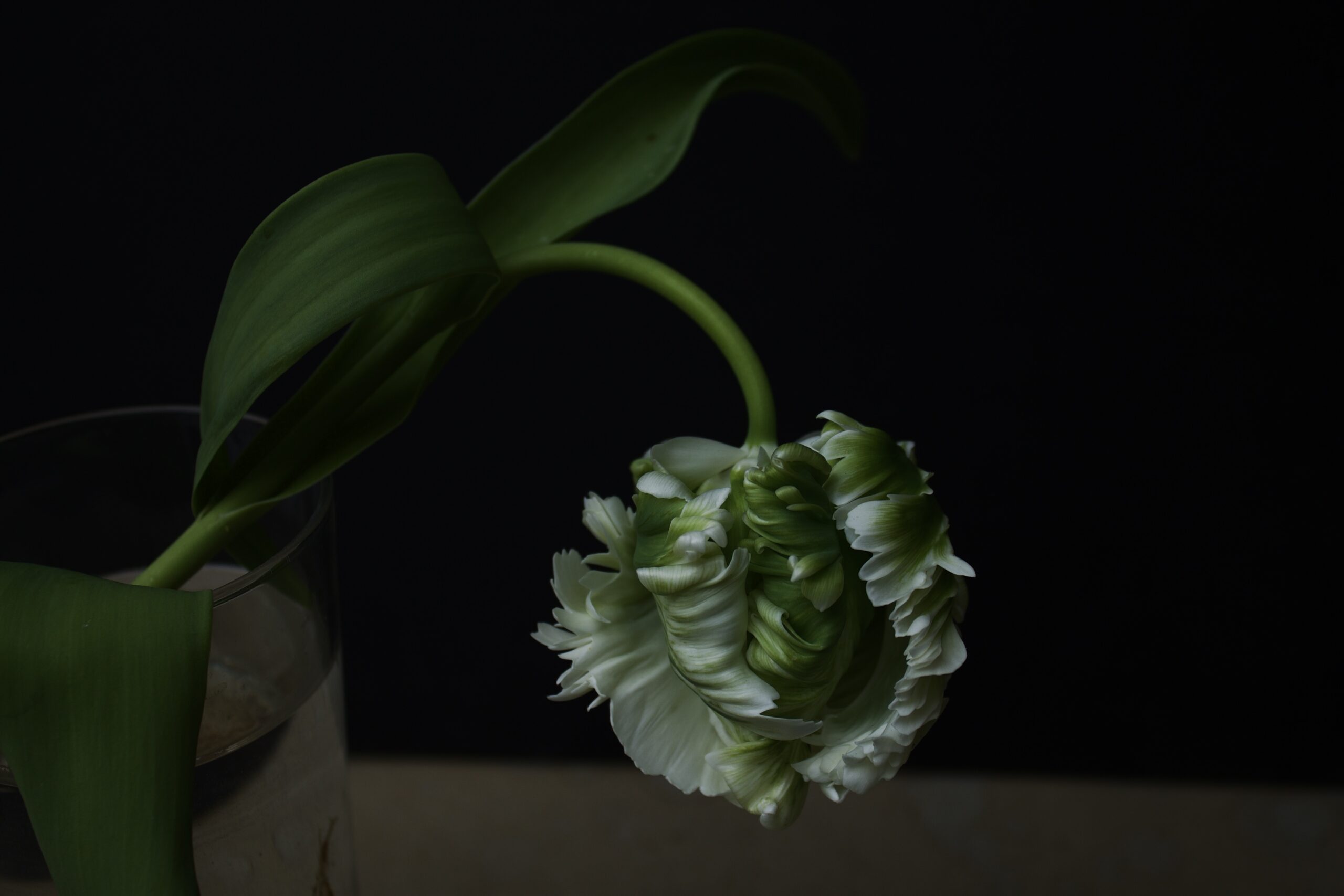
I buy bulbs, and I plant different tulips every year, but I have to put them in pots because they won’t survive in the garden. I don’t look at the labels once I plant them, so when they come up in the springtime (because my memory is not great), they’re always a surprise. And sometimes they’re completely glorious. You just can’t believe some of them, really.
But I have this constant battle with the slugs and snails in my garden. I don’t put down slug pellets, so I have a head torch, and I go out in the garden at night and pick them off and put them in a pot and take them to the local cemetery, give them a new life there. I was out there one night and Take That were playing at Ashton Gate Stadium and the music was coming in on the wind, so I was out in the garden at night with my head torch, picking up slugs and snails, with Take That playing, and it was quite bizarre.
Process
All my work starts with the photographs that I’ve taken – the photographs of the ornaments, photographs of flowers, and I make a digital collage on a computer. It’s a very important part of my practice; the photography and manipulation of the images on the computer. I don’t use Photoshop. I have a free program called Gimp, which I recommend. It’s the same as Photoshop, but it’s completely free. Sometimes I paint the fairies isolated on a small canvas to really show their size, and so that you hone in on them as a single object. But quite often, I will put them within a larger painting where they become a part of a bigger picture or a bigger story.
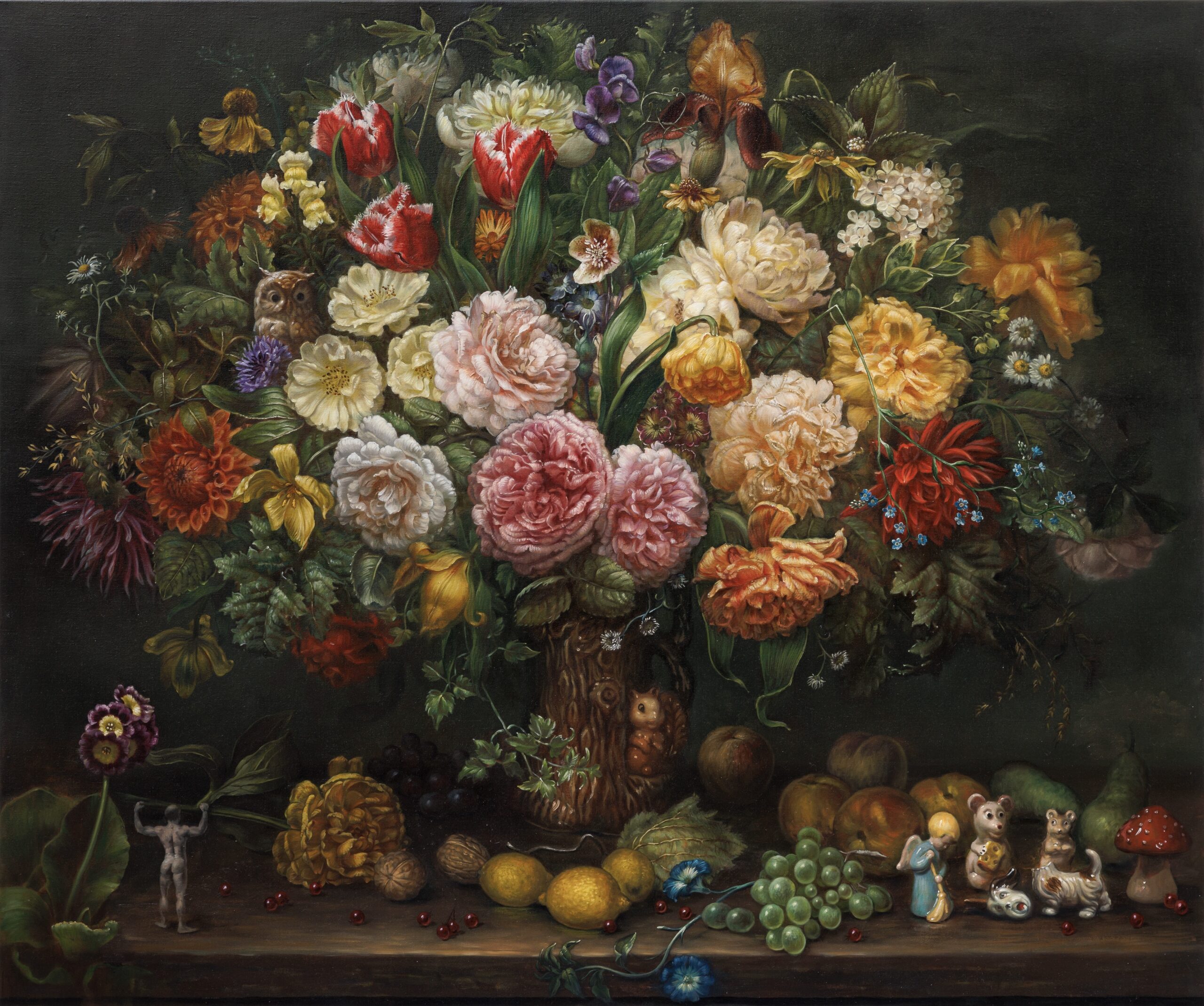
Angela Lizon
Oil on linen, 90 x 120 cm | 35 x 47 in
Dan Weill photography
I source the images I use for my aggressive fairies from a site called PoseSpace. It’s an American website where there are lots of models for use by artists. For about £5 you can buy a pose in the round, so you get 25 shots going around the figure, and you can have a clothed figure, unclothed figure, male or female, with props, without props, and there seem to be quite a lot of men posing with weapons, so it’s been a really useful site for me to use.
I used to print out all the photographs – quite a lengthy process, quite expensive as well because I was printing them out over and over again, trying to get the right kind of colour. But now, I have a little tablet so I can adjust the photographs as I’m working, so if I have a photograph of a flower and it’s too bright, then I can darken it, and I can work from that. It’s just immediate. Then I will use my projector to project the collage that I’ve made. And I will place the lights and the darks to give me a rough idea of where everything’s going to be, so that I don’t have to use a grid system.
Then, I start painting on a Raw Umber background. I’ll just choose an area that I want to start on – maybe they’re the brightest flowers. I’ve used quite a lot of peonies in the paintings. I might just start with that and put them in, and then I’ll move to the edges and maybe start the edges and work my way in.
Surfaces
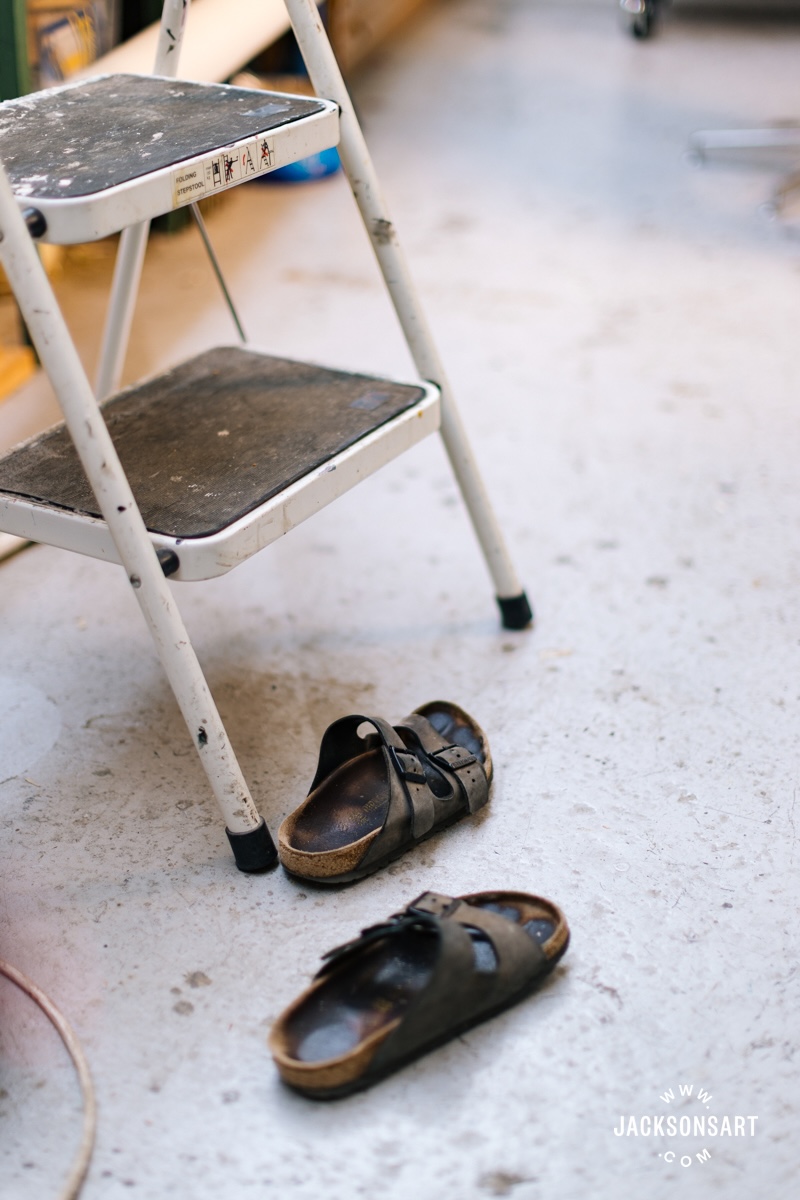
My preferred surface to work on is an oil-primed surface, because it has a bit of resistance. I have done it myself in the past, but I won’t use rabbit skin glue because it smells, and because I’m a vegetarian. I do like a little bit of a weave to catch the paint, so it’s not totally smooth, and the paint doesn’t just glide over. Sometimes, you need it to catch a bit of the paint so you get more depth in the colour, because you’ll get lighter bits where it skims the surface, and you’ll get little bits that go into the weave. So a bit of a structure, but not too hefty and not too smooth.
Brushes
I used to use a lot of bristle brushes, but the synthetic brushes are much finer for the kind of work I’m doing now. I use a variety of sizes of brushes: sort of fine-ish, size 1 to 3, for the more detailed work. But then I have quite wide brushes that I use to smooth my work out quite a lot as I go, and then keep painting into it, bringing the brushmarks back.
Fan brushes are quite nice to use. I use very soft fan brushes, and they don’t have a straight edge. So if you’re working on a smaller area of painting and you want to blend the edges a little bit, it’s a good thing to use rather than a straight edge, slightly harder nylon brush. That’s the process that I use – painting, smoothing it, painting, smoothing it, sometimes over and over again during the day.
Fan brushes are quite nice to use, and this kind of they’re very soft as well and they haven’t got a straight edge. So if you’re working on a smaller area of painting and you want to blend the edges a little bit, it’s a good thing to use rather than a straight edge, slightly harder nylon brush. That’s the process that I use: painting, smoothing it, painting, smoothing it, sometimes over and over again during the day.
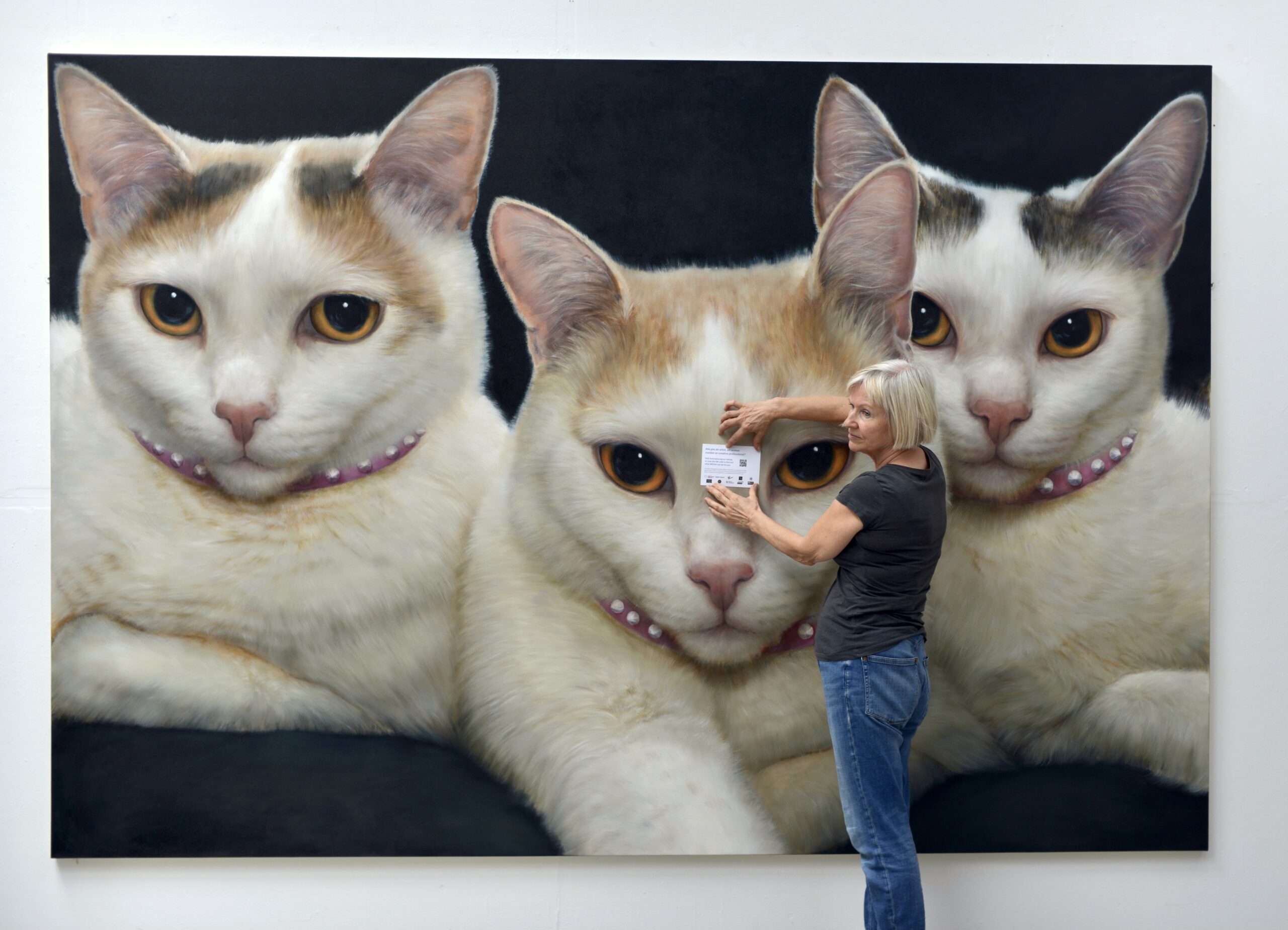
Angela Lizon
Oil on canvas, 201 x 294 cm | 79 x 116 in
Oil
I think with oil paint, mostly you can rescue a painting because you can keep painting over it to a certain degree. At some point, the canvas will stop working in the same way – it’ll become too absorbent, and you’ll get a really horrible, slick surface. At some point, you do have to give up on a painting, and I have occasionally, but I quite like to rescue them if they’re going wrong.
I do have a tendency to overwork a lot of things. That’s one of my faults. Yes, maybe if somebody walked into my studio, they might have thought a painting was finished a month before I’d actually decided it was finished. I think you know (it’s finished) because working on any element within the painting is not going to add anything to the painting; it’s not going to improve it in any way. So then you know that it works as a whole, and you don’t need to change any part of it.
I do have a mirror in my studio, and I think a lot of artists know that looking at a painting in a mirror, you can sometimes immediately see what’s wrong. I also sometimes turn the painting upside down, because that can help you see if there’s an imbalance. I often photograph the painting, and then I take it back and manipulate the the painting on the computer to play around with colours and contrast.
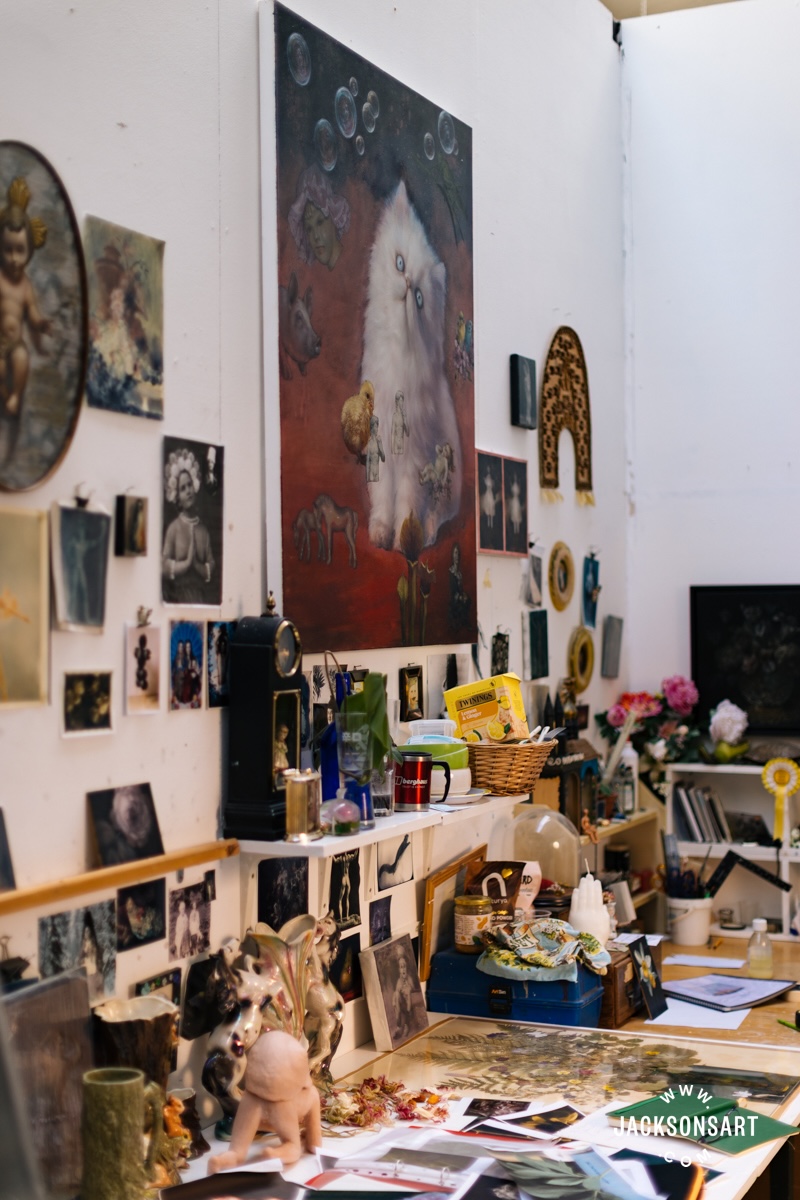
Studio
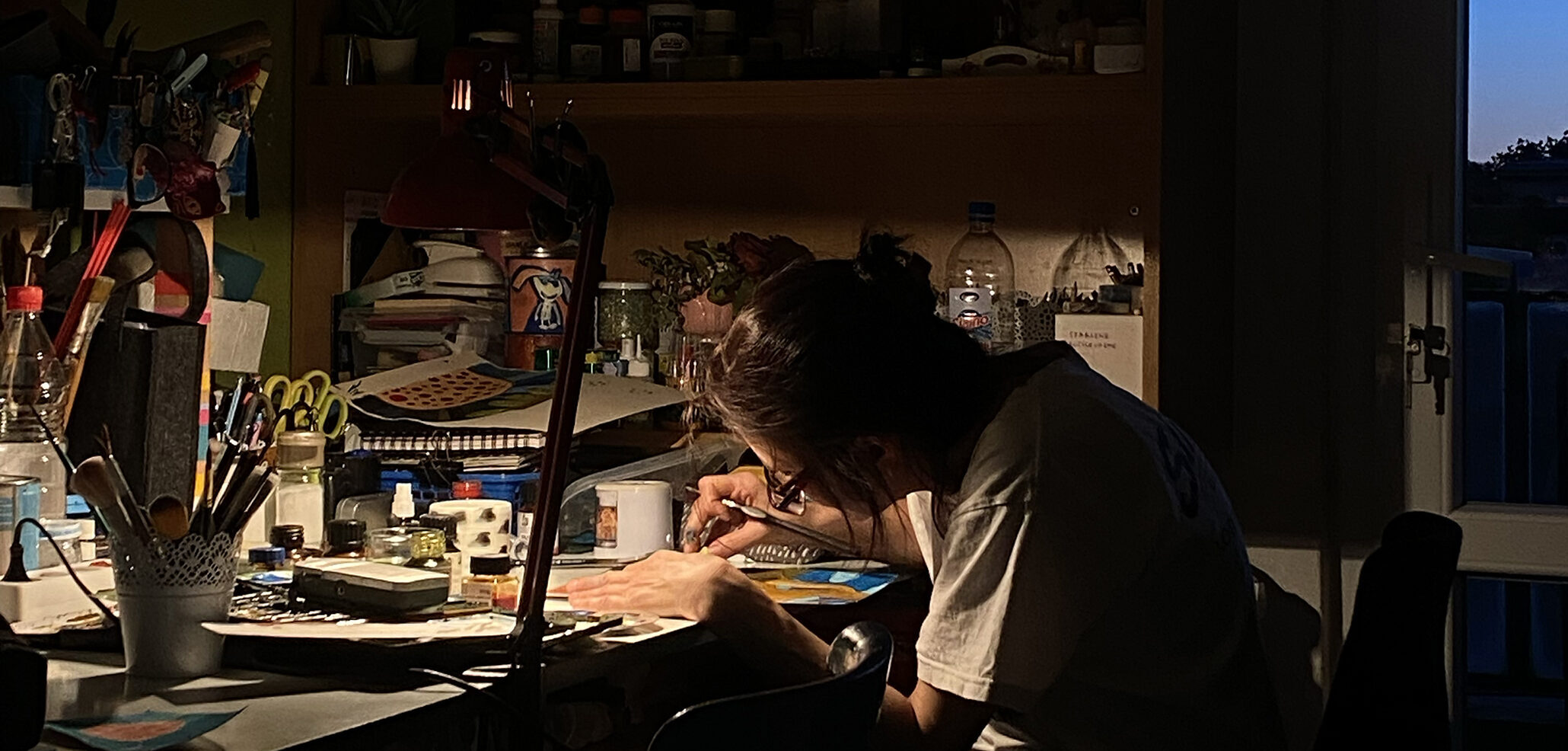
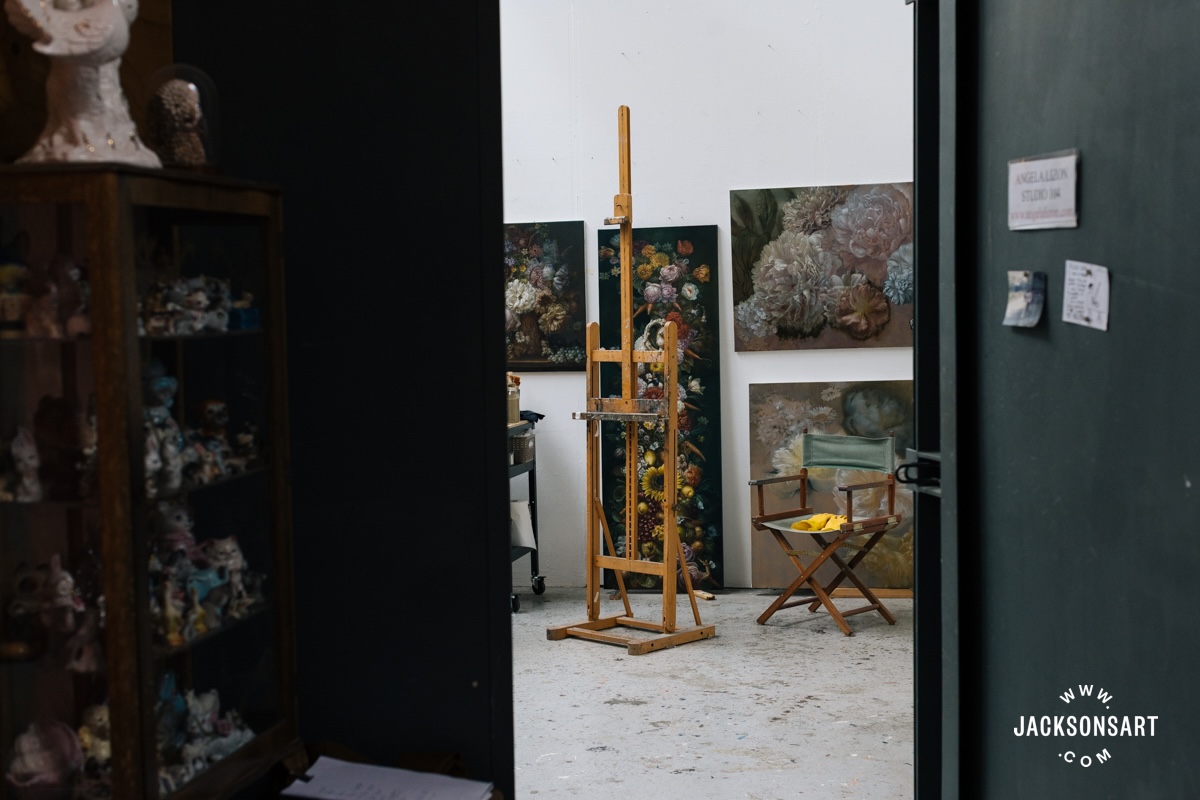
We’re in my lovely studio at Spike Island in Bristol, and Spike Island is a really big organisation now, an international organisation, about 80 studios, I think 100 artists working here. There’s a great benefit to working in what can be quite an isolating practice, but having a studio within a really vibrant environment like we are.
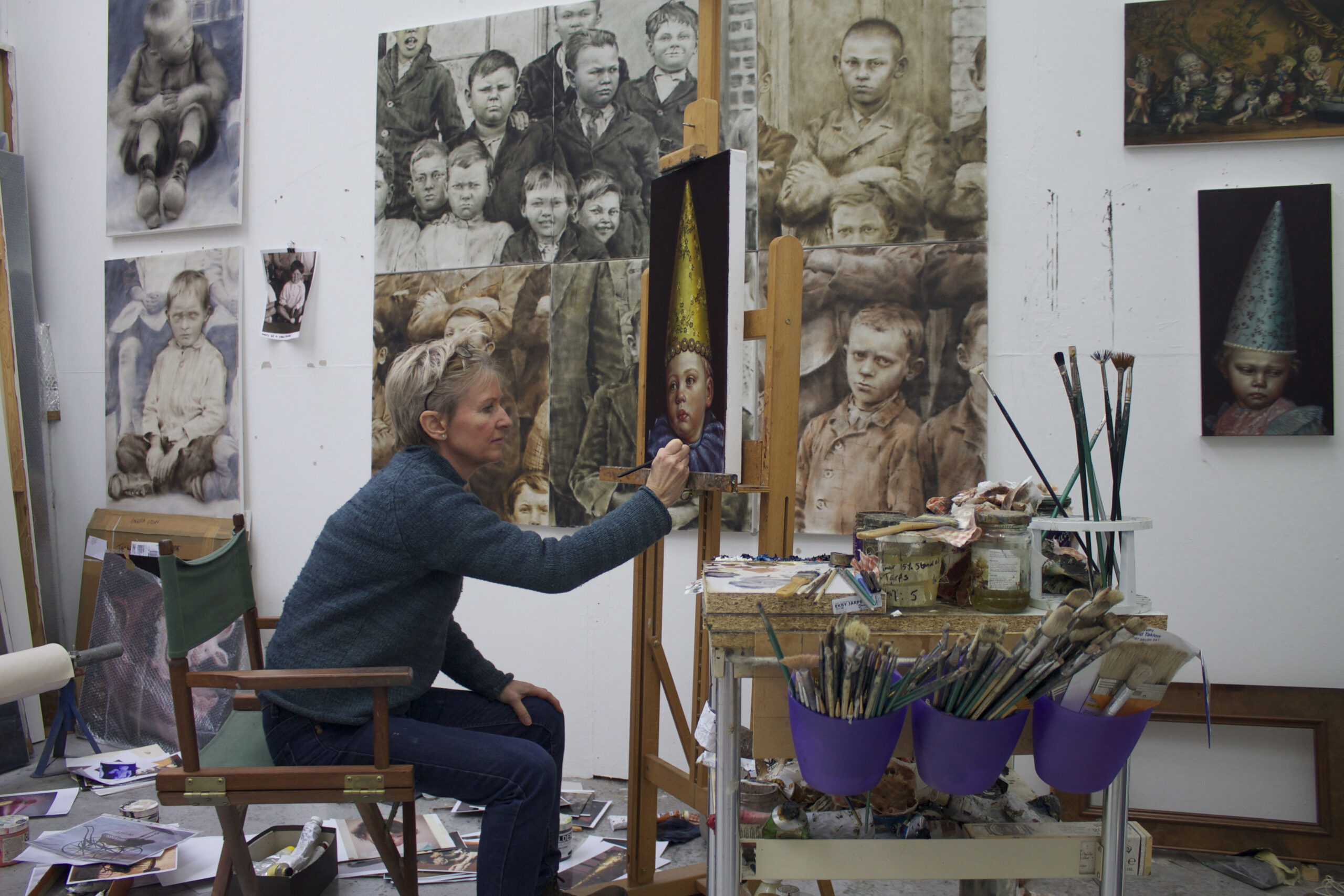
I have a half-hour walk to the studio, and I go past some nice green areas. I tend to take a slightly longer route that’s away from the road, and I arrive in a really good state of mind, having had a nice, peaceful walk in. I spend 10 or 15 minutes looking at what I’m working on and making a plan of action in my head about what I’m going to try and do that day, and then I just launch into the painting.
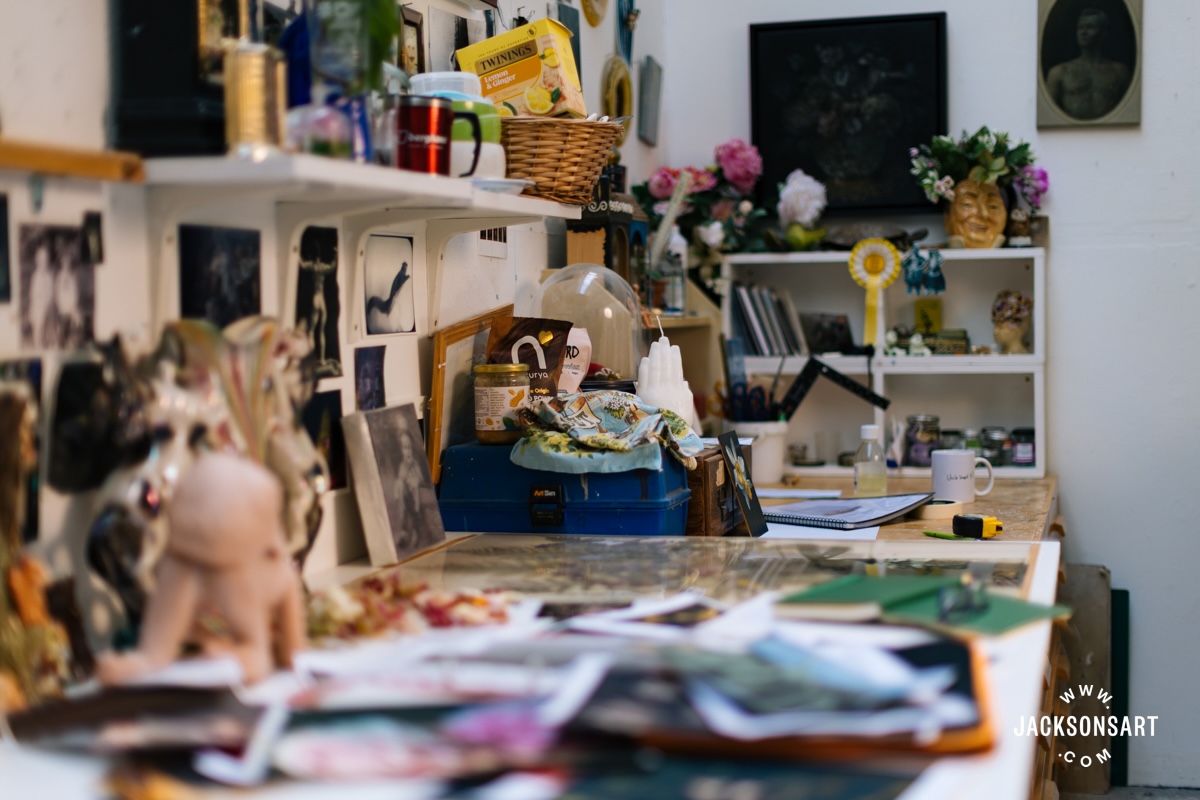
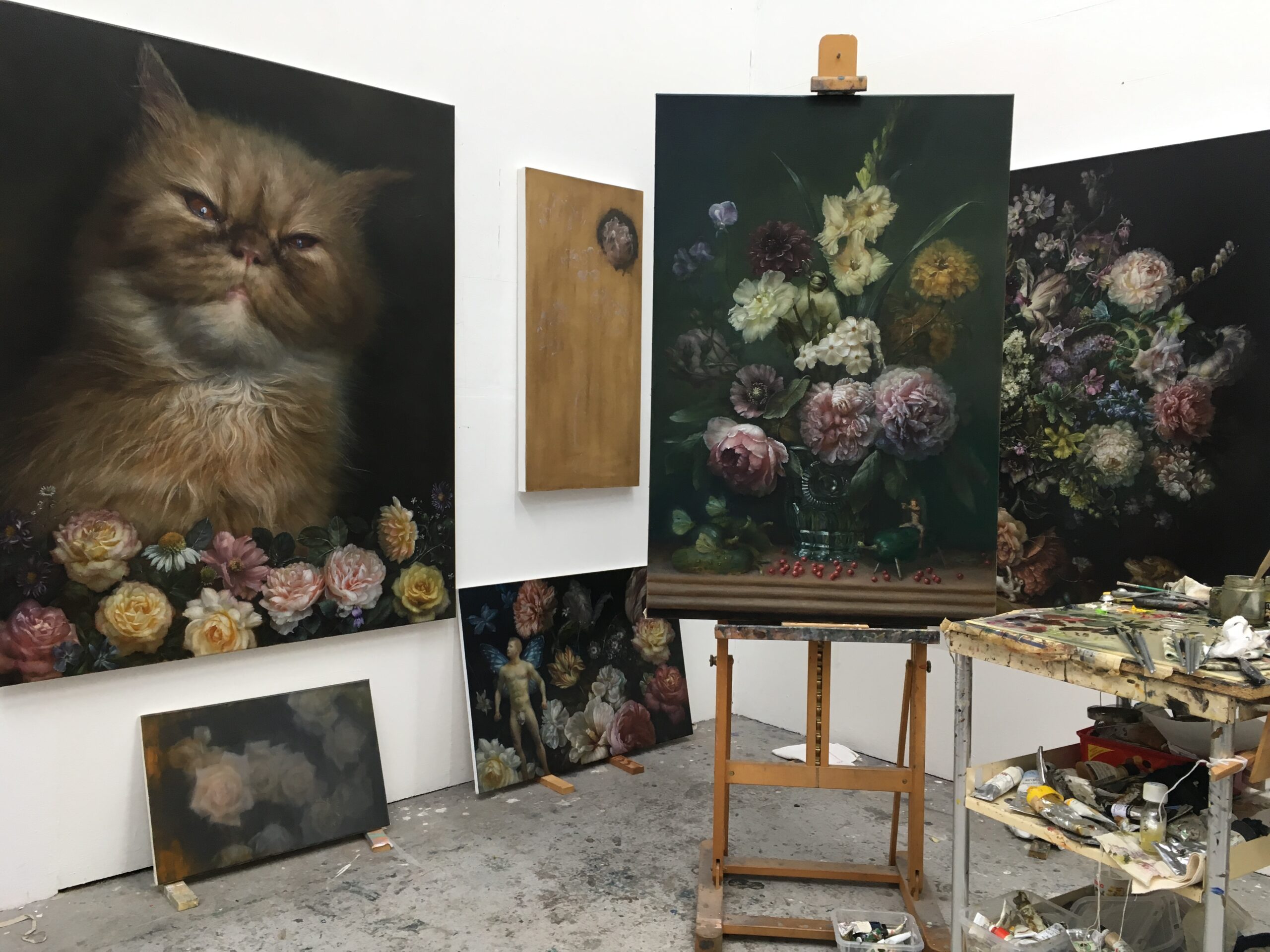
We have a nice setup here now, we all have lunch together at 1 pm for an hour, and I just paint all day, the odd crit here, visiting each other’s studios. The other half of my practice is at home, which is the photography side. In my studio, I’ve got tables that I can work on, a plan chest, some of my vases that I work from with my still lives, and a trolley with all my paints on. I keep all my ornaments here for making up stories. I’ve got my current work out on display, and also I’ve got a selection of older work stacked in the corner. You’ve caught me at quite a good time because we’ve just had open studios a couple of weeks ago, so we had to tidy up our studios and make it safe for the public to come in.
I can reduce myself to a tiny spot in the middle of the floor that I’m working in, and there are lots of trip hazards everywhere. I drop things on the floor, and I’m telling myself in my head, ‘Pick that up!’, and, ‘Why are you dropping that on the floor? Pick it up!’, I just can’t help it, I work like that. I am a messy worker, but I do tend to know where everything is within that mess.
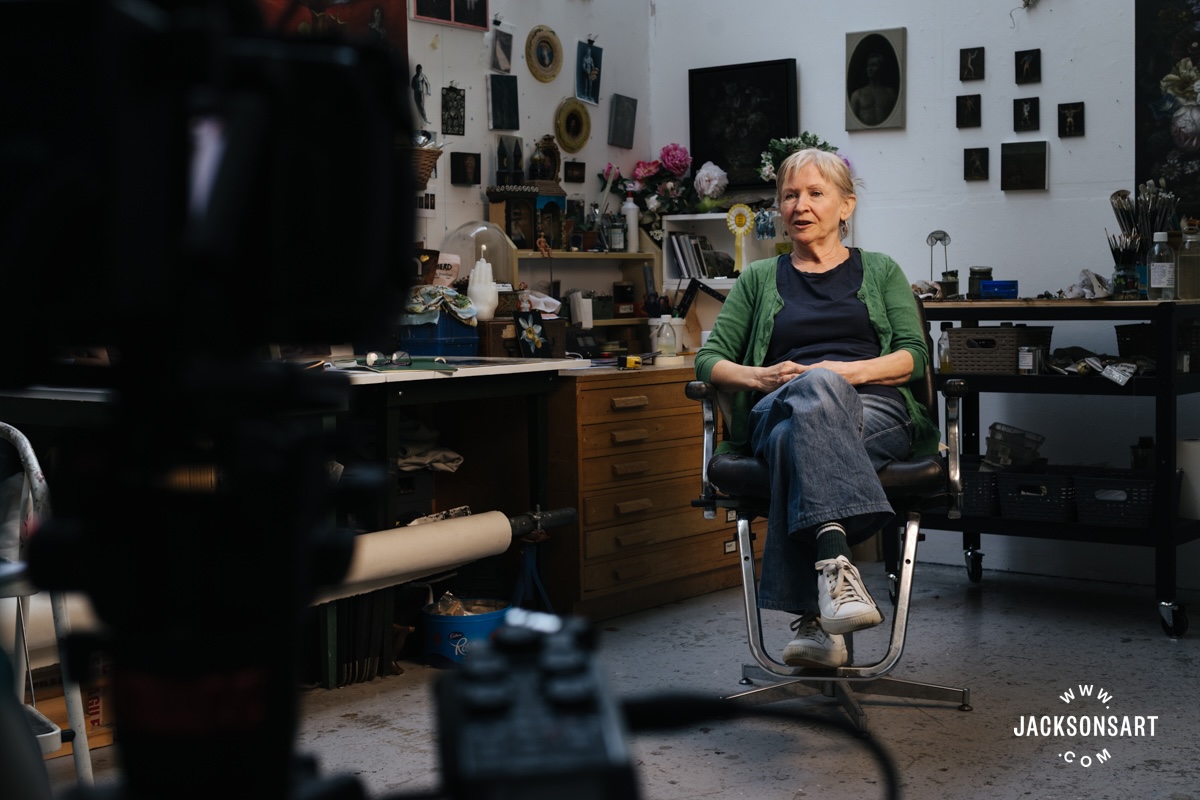
I really like the light in my studio – it’s north light, it’s very good. But we’ve also got daylight bulbs here, which are a fantastic backup if it’s a cloudy day. But one of the things I am going to be investing in with my prize money is a daylight spotlight, because it will be really beneficial, especially when I’m working on dark paintings in the afternoon when the light is a bit more subdued. I’ve been working in Bristol as an artist since 1987 – as I’m getting older, my eyesight is not quite what it was.
Inspiration
I tend to avoid looking at a lot of artists, because if I found somebody who was doing something similar to me, and it was an idea that I had in my head that I might do that, I won’t do it. If I knew someone else was doing it, it would put me off. I’d rather follow my own path. I look at lots of artists, but especially in terms of techniques, I suppose. Velázquez is the artist I admire most for his technique – they look so realistic from a distance, but when you look close up, they just break up into loads of blobs of paint, and it’s just a kind of magic. Rembrandt is amazing. I like Bonnard for his colour.
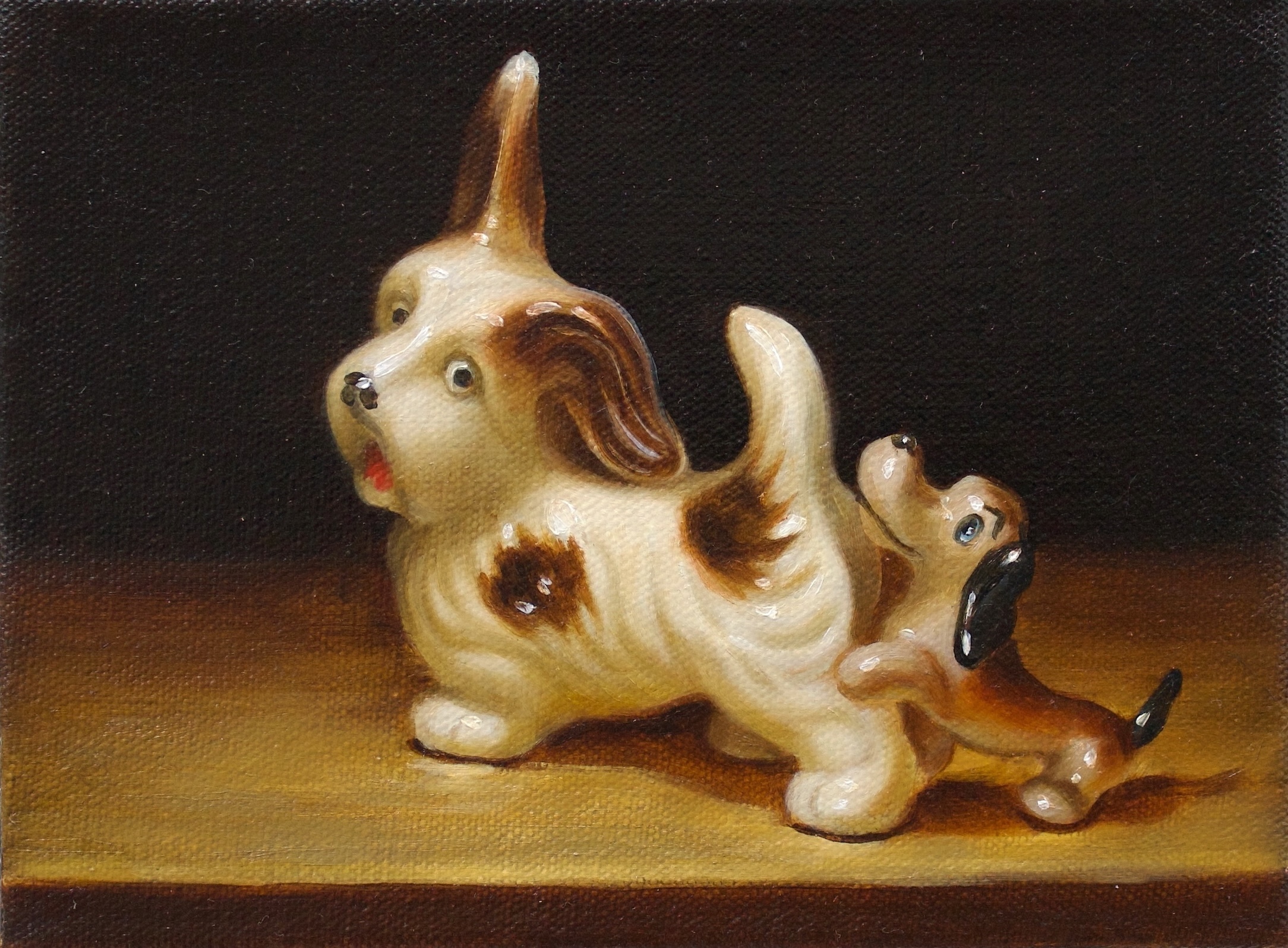
Angela Lizon
Oil on canvas, 15 x 20 cm | 6 x 8 in
When I started doing these flower paintings, the first few that I did, I appropriated some old master paintings by a Dutch master called Jan Van Heusen. I used his paintings, and I adjusted the colour, and I put fairies in them. It’s absolutely amazing the work that he made. And he’s another of those artists who kept his methods secret. He didn’t really let anyone into his studio to find out how he worked.
There are some artists and photographers in Paris called Pierre et Gilles, and they make photographic collages that are quite kitsch. I really like their work. The Cottingley Fairies were some fake photographs set up by two children, 12 and 18 or something like that. Somehow, they managed to fake these photographs of them in the garden with these fairies. Lots of people believed in them at the time.
Cicely Mary Barker illustrated lots of books, and it would be a fairy in a fuchsia plant with a little costume that matched the flowers, or a bluebell fairy. They were really like sweet little illustrations, which my children loved.
One of my other sources of inspiration was a chap called Eugen Sandow, who is the father of bodybuilding. I’ve used him quite a lot – the old photographs of him – because he looked so awkward in the poses. It’s not a critique of bodybuilding as an art form; it’s just the fact that it has to do with showing off your muscles and strength.
Angela Lizon
Oil on linen, 35 x 25 | 19 x 14 in
Entering Art Competitions
I think entering art competitions is a good way to get exposure. I like being in group shows, they’re very mixed usually, and in different places around the country. I think they’re a good thing to do, especially if you win a prize. There’s always that chance. This is my first time ever submitting to the Jackson’s Art Prize. Studio members, we sometimes say, ‘Have you heard that this prize is coming up? Are you going to go enter?’ We like to inform each other about these things.
I’m really looking forward to judging the Jackson’s Art Prize next year. I have judged on a few panels in Bristol, and I like the process. I don’t know if the fun is the right word, but I’m looking forward to it.
Angela Lizon
Oil on canvas, 30 x 40 cm | 12 x 16 in
Advice
I think what I would say to anybody who’s struggling with their art is to just paint and don’t overthink things, because that’s what I found when I made my leap from the abstract work I was doing is I think you can spend too long worrying about whether something is going to be a good idea or not, and I think you just need to do it, because in the doing of doing of it, you’ll have other ideas and you’ll see a way forward.
I think if I had to advise myself, looking back now to when I was younger, I would say to believe in myself. I think that’s what I’ve always lacked, a belief in myself, and that’s what I would say.
Follow Angela on Instagram
Visit Angela’s website
Interviews with Past Winners of Jackson’s Art Prize
Eleanor Johnson, winner of Jackson’s Art Prize 2025
Andrew Torr, winner of Jackson’s Art Prize 2024
Melissa Ling, winner of Jackson’s Painting Prize 2023
Lorena Levi, winner of Jackson’s Painting Prize 2022
Miranda Boulton, winner of Jackson’s Painting Prize 2021
Ruth Murray, winner of Jackson’s Painting Prize 2020
Iain Nicholls, winner of Jackson’s Painting Prize 2019
Shop Oil Painting on jacksonsart.com