



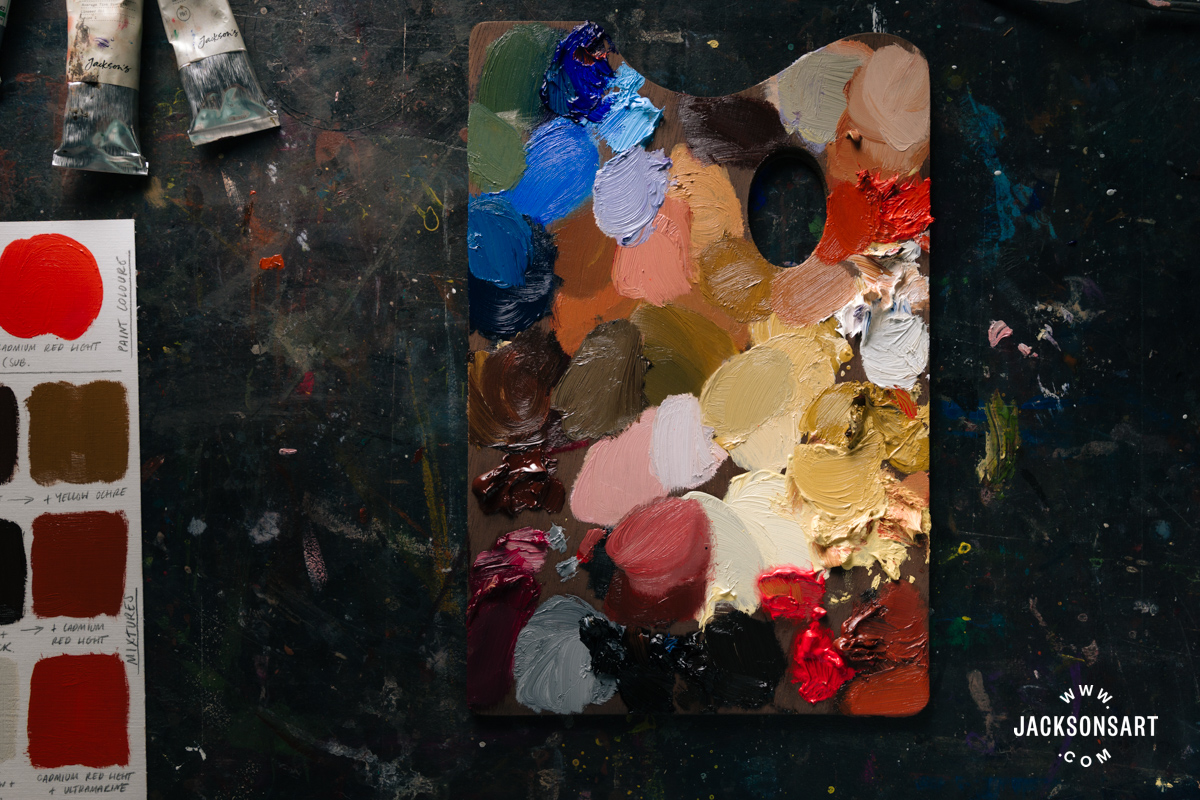
Francisco de Zurbarán (1598-1664) was a paradoxical artist – able to render his subjects with both acute realism and visionary religious fervour. The tenebrism that characterises his work sees figures emerge from total darkness, unavoidably pulling the viewer into reflection on mortality and what awaits beyond the unknowable black. His works assert Catholicism by bringing the ineffable into our world, paired with an eerie edge that verges on Proto-Surrealism, which would later inspire Dalí himself. Beyond the shadows, his palette is characteristic of the Spanish Baroque, with rich earth tones, golds, blues, and reds. In this article, I explore the progression of his career and oeuvre amongst his contemporaries, before recreating the palette of three of his paintings.
Zurbarán’s Life and Practice
Francisco de Zurbarán is largely considered self-taught, although it is known that at the age of 16, he began an apprenticeship in Seville to Pedro Díaz Villanueva, an artist sadly obscured by the course of art history. In this period, it’s thought that he first befriended his contemporary, Diego Velázquez, who was training nearby under Francisco Pacheco. Born just one year apart, they developed independent approaches to image-making, yet maintained a friendship throughout their lives. This meeting came at least a decade before Zurbarán met Bartolomé Esteban Murillo, the artist he would compete with most for commissions. Together, these three artists exemplify 17th-century Spanish painting, producing rich and poignant works within the Spanish Golden Age.
This period stretched from around 1492 to 1659 and saw a surge in Spanish political, intellectual, military, and creative output. It began with the journeys of Christopher Columbus, coinciding with the rise of the Habsburg dynasty and the profits of global colonisation. It ended with the signing of the Treaty of the Pyrenees, which marked the end of the Franco-Spanish War. This influx of wealth and power encouraged a wave of writers, musicians, architects, and artists to create under patronage, with their work still celebrated and admired today.
Unfortunately, no verified portraits of Zurbarán exist, with the exception of his work The Crucified Christ with a Painter, where he potentially cast himself as Saint Luke. Aside from the religious context of Saint Luke being both an artist and doctor, the work can be seen as an assertion of the importance of painting as a vehicle for religious devotion. This sentiment can be interpreted throughout his works, although there are no remaining letters or diaries from the artist that state his personal beliefs. The only documents that survive him are contracts, which convey the lucrativeness of his artistic output at the peak of his career.
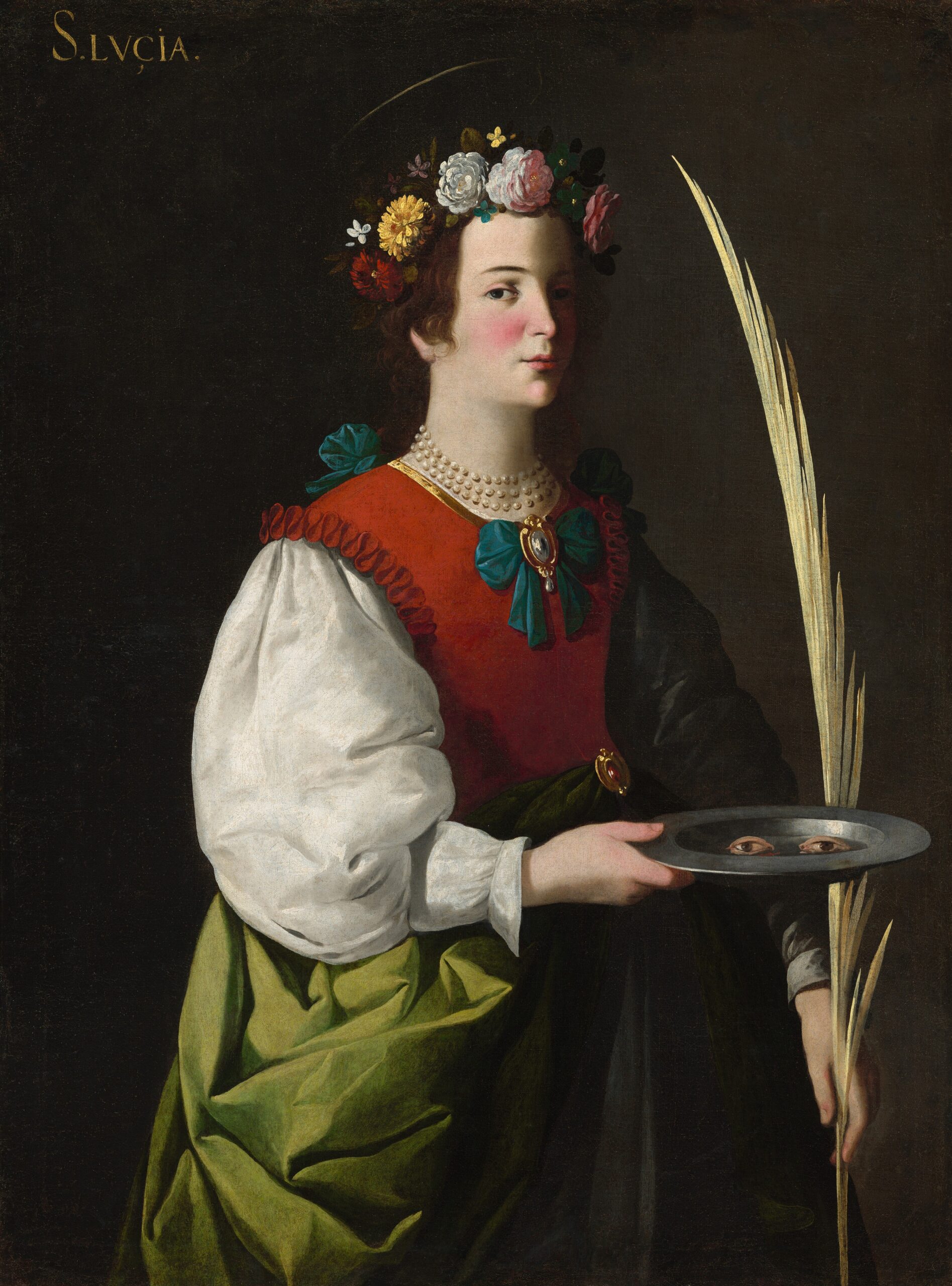
Zurbarán mainly produced paintings for religious contexts, rendered with direct naturalism and deep chiaroscuro. It would be natural to assume he was influenced by Caravaggio’s treatment of light and the figure, but Zurbarán never left Spain, so it’s unlikely that he ever encountered his work in person. Although he was dubbed ‘the Spanish Caravaggio’, he probably felt his influence indirectly by seeing works by other artists inspired by the Italian master.
Zurbarán’s works are distinct for their simple but decisive compositions, often painting the single figure emerging from darkness without spatial devices. Baroque paintings are often characterised by dynamic, sensual, or theatrical figures in action, which he largely resisted in preference for those that are meditative and solemn. Throughout his career, he was dedicated to the aesthetic qualities of tenebrism and stillness, until demand for his work decreased toward the end of his career, and he experimented with greater luminosity and gesture.
Francisco de Zurbarán
Oil on canvas, 104.1 x 77 cm | 39.9 x 30.3 in
National Gallery of Art
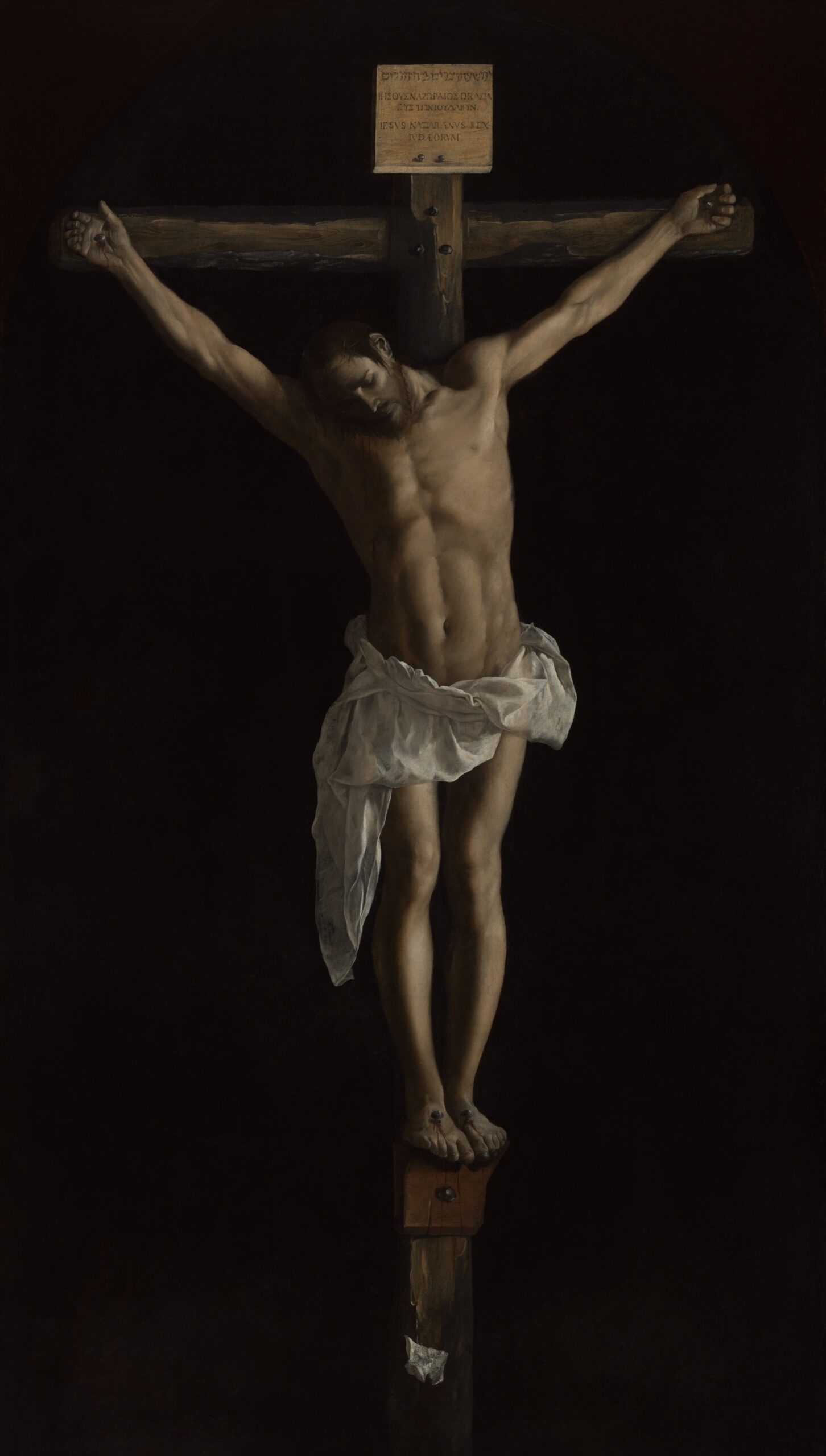
He made a name for himself in 1627 when he painted a series of works for the Dominican monastery of Saint Pablo in Seville, including The Crucifixion below. The painting was praised for its handling of light and form, convincing viewers it was a sculpture rather than a painting in the dim light of the friary. Jesus’ body is pale like stone itself, with tangible pain in his limp head and knocked knees. Between 1634 and 1635, Zurbarán travelled to Madrid to create a series of ten paintings of The Labours of Hercules, and a history painting called The Defence of Cadiz Against the English, for the Buen Retiro Palace at the request of King Philip IV. It’s thought that he was recommended for the work by his friend Diego Velázquez. These paintings are now housed in the Prado and are rare exceptions to his religious oeuvre.
Francisco de Zurbarán
Oil on canvas, 290.3 x 165.5 cm | 114.3 x 65.2 in
Art Institute of Chicago
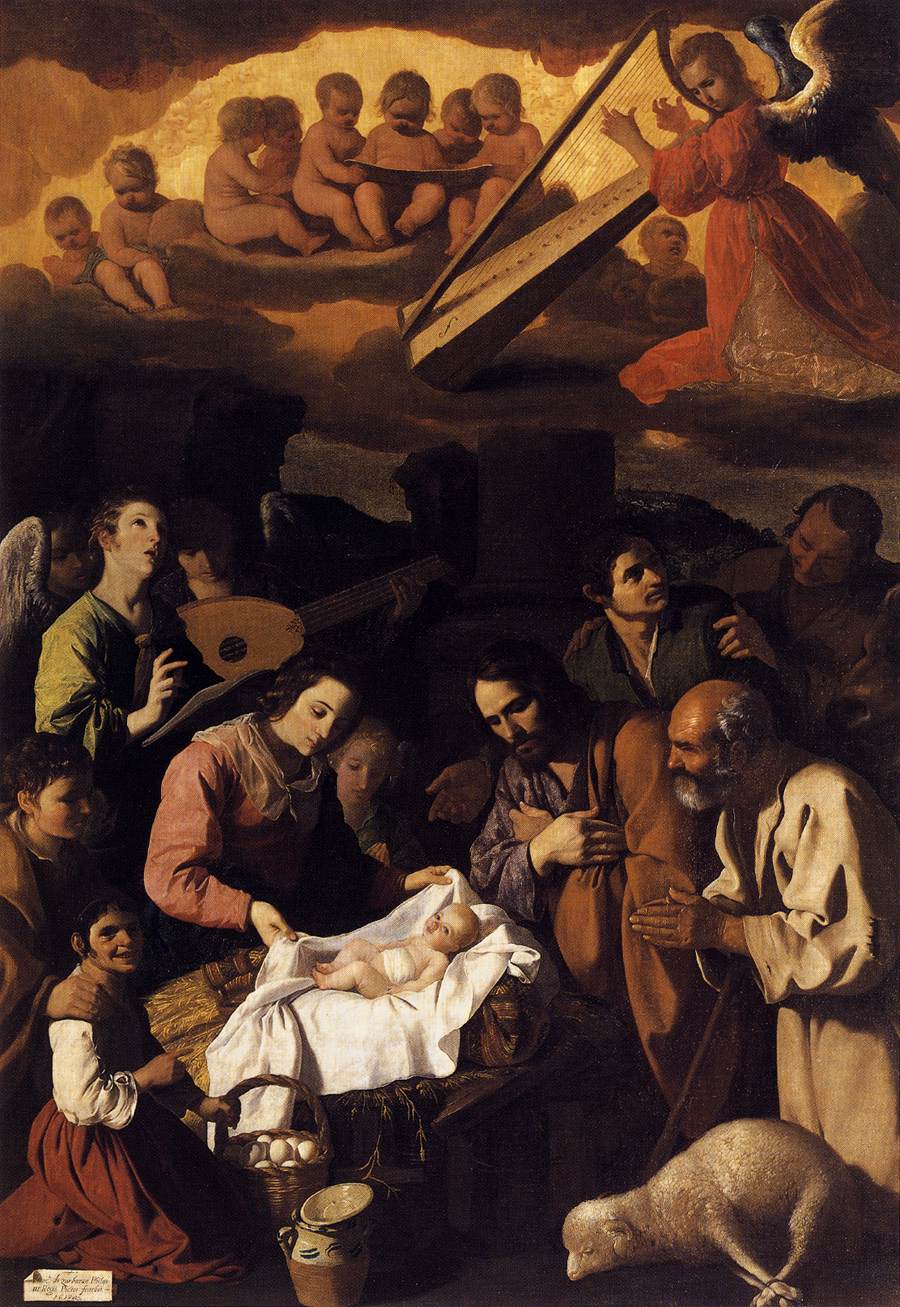
Zurbarán’s painting A Lamb 1635-40, is perhaps his best known for its stark vulnerability and acute realism, invoking ‘the Lamb of God’, mentioned twice in the Gospel of John. It rests still alive but helpless with its feet bound on cold stone against unknowable darkness, inferring its impending sacrifice. The lamb itself has its gaze downturned in quietude with the slight tilt of its resting head, oblivious of what will happen to it, yet seeming to have accepted its fate in its innocence. The lamb with bound feet motif recurs in several of his paintings, including the bottom right corner of The Adoration of the Shepherds, where it’s positioned to allude to Christ’s sacrifice in the future. The combination of the baby Jesus resting on bright white cloth amongst the earth tones of the rest of the work, positioned parallel to the bound lamb, is at once tender and arresting.
Francisco de Zurbarán
Oil on canvas, 266 x 185 cm | 104.7 x 72.8 in
Musée de Grenoble
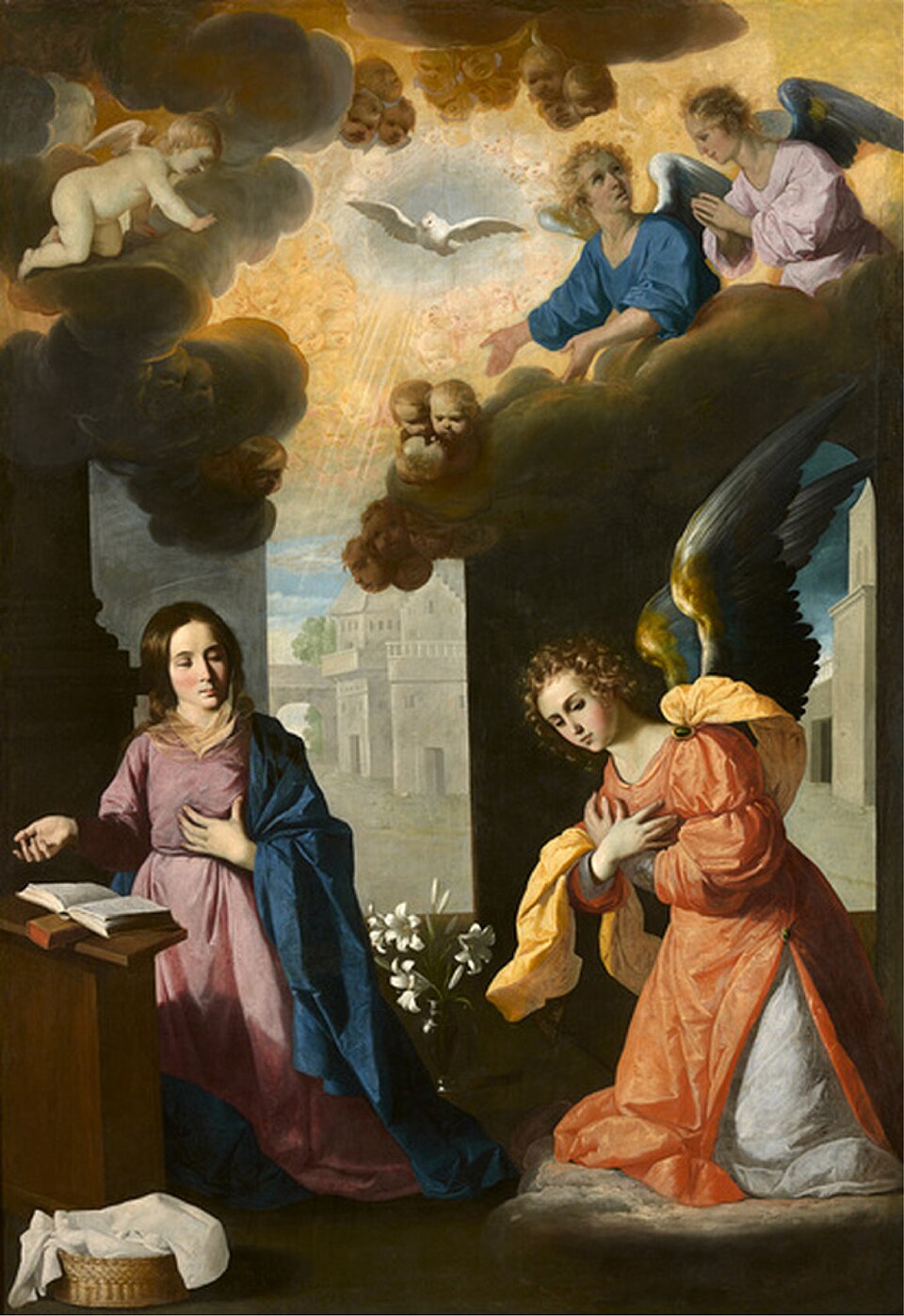
On his return to Seville, he reached artistic maturity at the pinnacle of his career and painted seminal works for the Charterhouse of Jerez de la Frontera and the monastery of Guadalupe. The following painting, The Annunciation, was one of those painted for the latter. It depicts the angel Gabriel delivering the news to the Virgin Mary that she is pregnant with the Child of God. Characteristic of paintings of this genre, this gift is symbolised by the dove shining heavenly light on her, and the inclusion of a vase of white lilies. The clouds from which the angels and cherubs peer down have tangible mass, balanced atop the surrounding walls, creating the sense that the Heavens are close by.
Francisco de Zurbarán
Oil on canvas, 266 x 184.5 cm | 104.7 x 72.6 in
Musée de Grenoble
Aside from his evocative religious paintings, Zurbarán also made several impactful still lifes or bodegóns, such as A Cup of Water and a Rose. Its intimate scale, simple composition, and delicate rendering invite us to appreciate the tangible texture of each object – the hard ceramic, cold metal, and soft organic petals – as the light brushes across them. To the observer of his time, the assembly of these objects would immediately have religious meaning. The thornless rose is symbolic of the Virgin Mary, aligning with the belief that she was without sin, and the cup full of water beside it represents her purity.
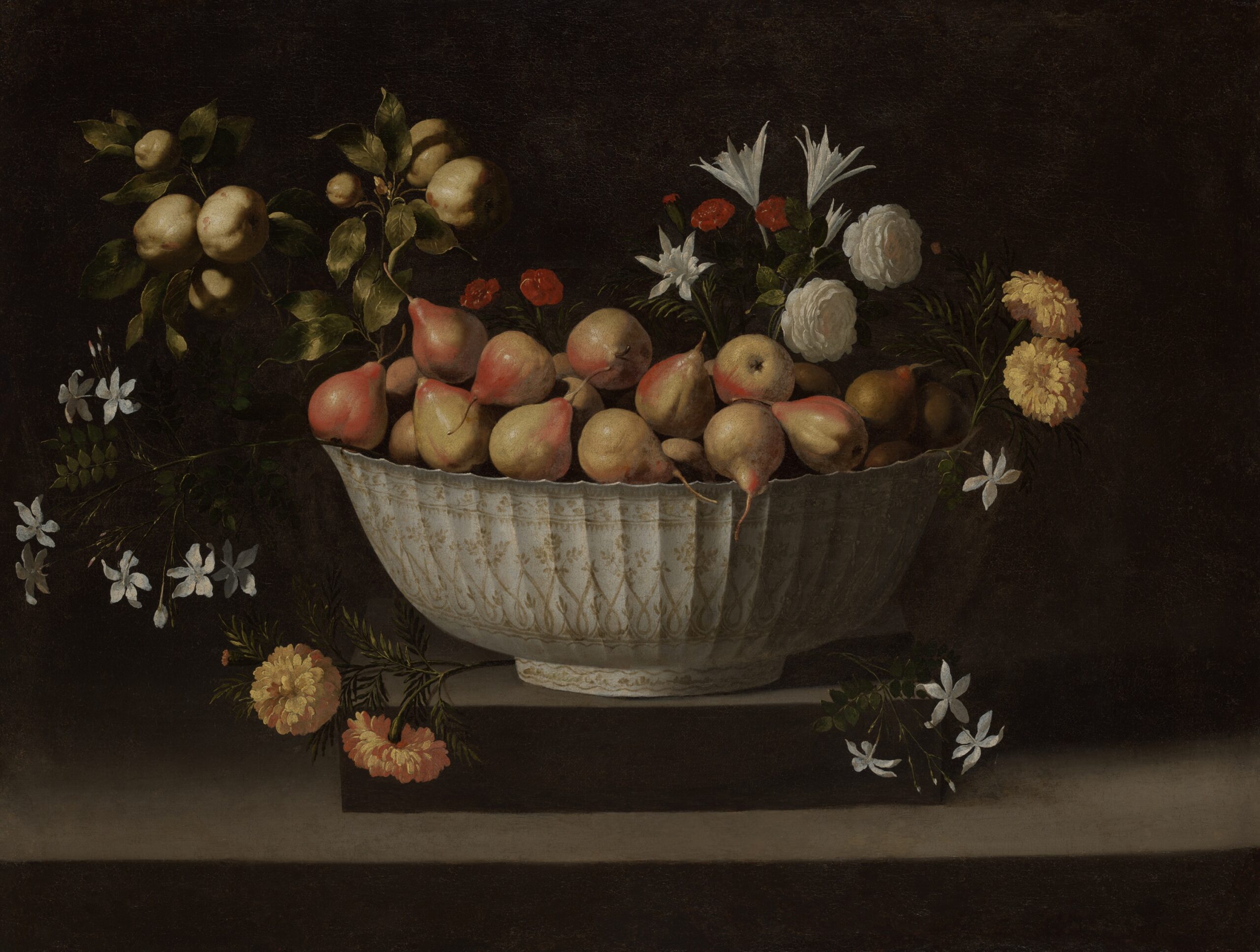
Zurbarán fathered nine known children, although the majority of them died in childhood. His son, Juan de Zurbarán, exclusively painted still lifes in his short career – sadly dying of the plague in 1649, at 29 years old. His works share an aesthetic sensibility with his father, with dark backgrounds and objects utilised symbolically, seen here in Flowers and Fruit in a Porcelain Bowl.
Juan de Zurbarán
Oil on canvas, 82.6 x 108.6 cm | 32.5 x 42.8 in
Art Institute of Chicago
Zurbarán’s work was highly sought after in the first half of the 17th century. His austere style of painting reached the height of its popularity in the 1630s. But it was succeeded in demand by Murillo in the latter half, when his softer approach fell into fashion. While Zurbarán and Murillo competed for the same commissions at home, it’s clear from surviving documentation that Zurbarán had much more demand abroad.
The art and culture of the Spanish Golden Age directly correlated with the colonial expansion of the Spanish Empire in the Americas, Asia, Africa, and Europe. The empire relied on the forced labour of native populations and the Transatlantic slave trade to maintain gold and silver mines and plantations. This coincided with the global spread of Catholicism and the Spanish language, which is inseparable from the obliteration of native populations and culture through systematic oppression, the spread of European diseases, and the devastation of slavery.
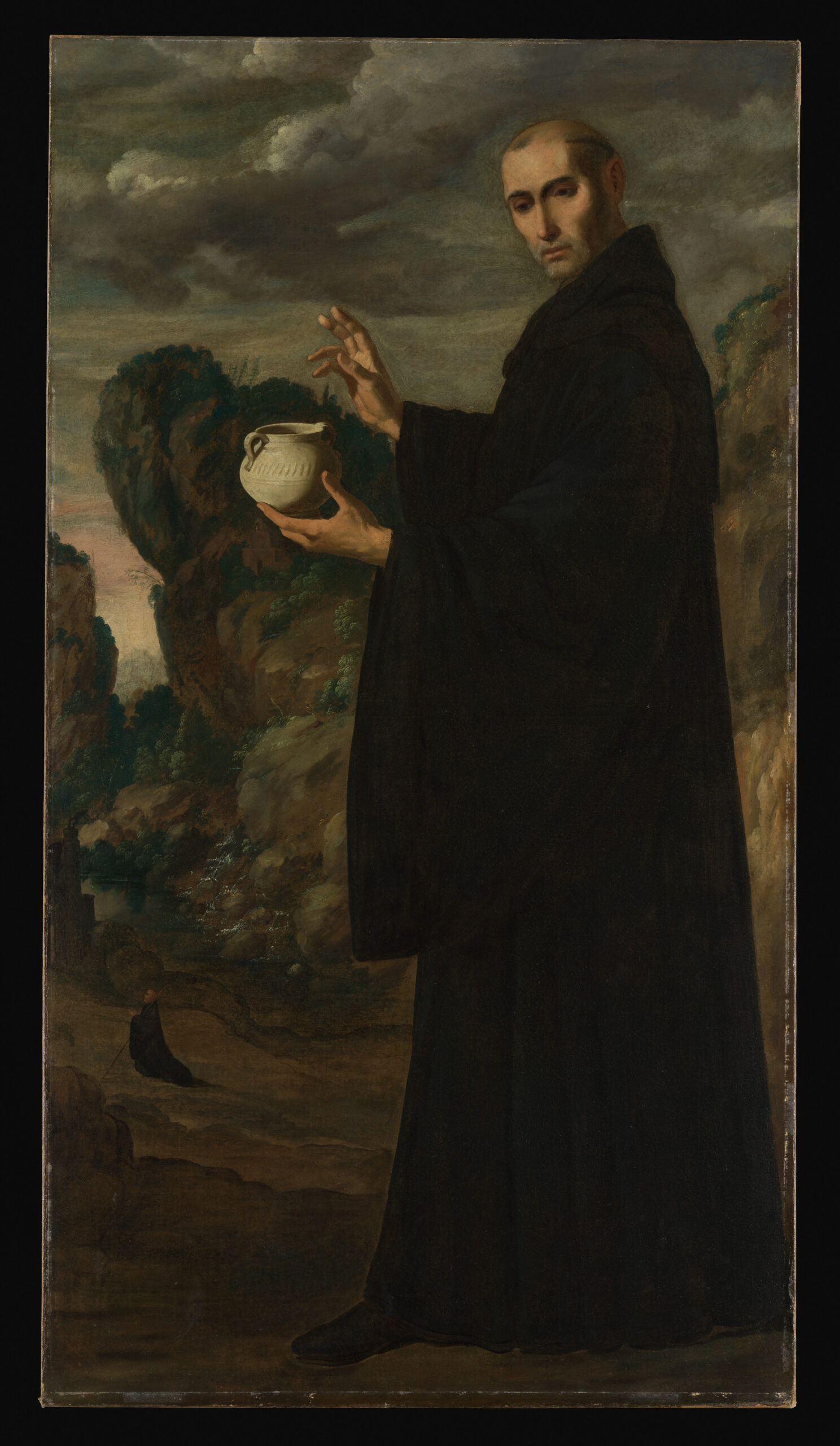
Francisco de Zurbarán
Oil on canvas, 188 x 103.5 cm | 74 x 40.7 in
The Metropolitan Museum of Art
Zurbarán’s studio exported over 200 paintings to Latin America in this colonial period, which were sent to decorate newly founded monasteries and churches. For example, at least two other copies of the painting above, Saint Benedict, were produced by his workshop for export to South America. At the time, paintings were some of the most collectable assets in the Americas, since they were easily transported by being rolled, without taking up much space in shipping vessels. Zurbarán had relatives who worked on trade routes between Spain and the Americas, who assisted specifically in the trade of paintings to Lima in Peru. In 1662, his brother-in-law sought to retrieve 63 missing payments for paintings that were sent to Buenos Aires over ten years earlier, but it’s unknown whether this debt was ever collected.
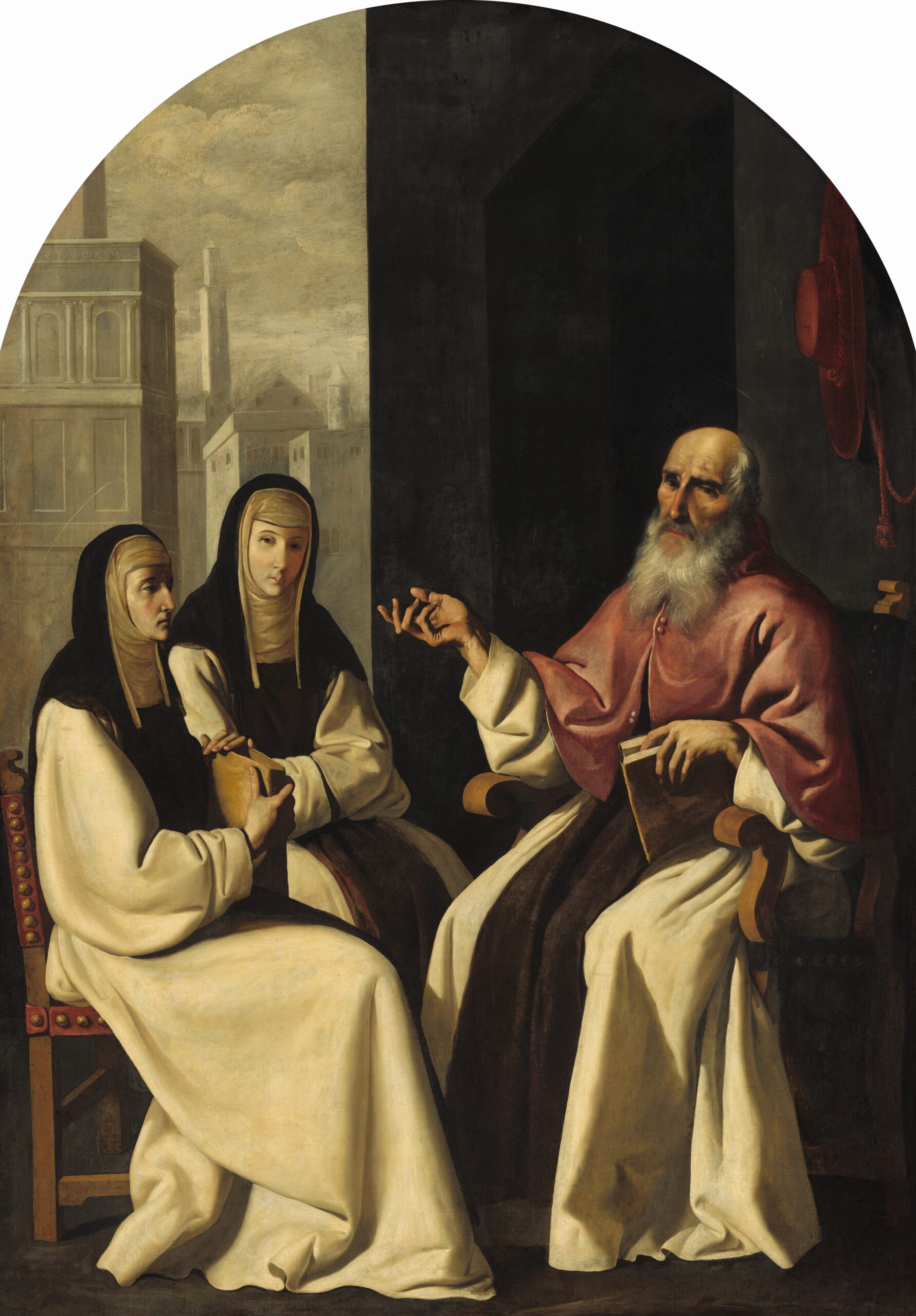
Francisco de Zurbarán
Oil on canvas, 245.7 x 173.5 cm | 97 x 68.3 in
National Gallery of Art
Since his later income relied on exports, from which payment was difficult to secure, his wealth diminished. In 1658, he moved to Madrid to try to revive his career, where he’d live out his final years. However, it’s a misconception that he died in poverty in 1664, since he left an estate of about 20,000 reales.
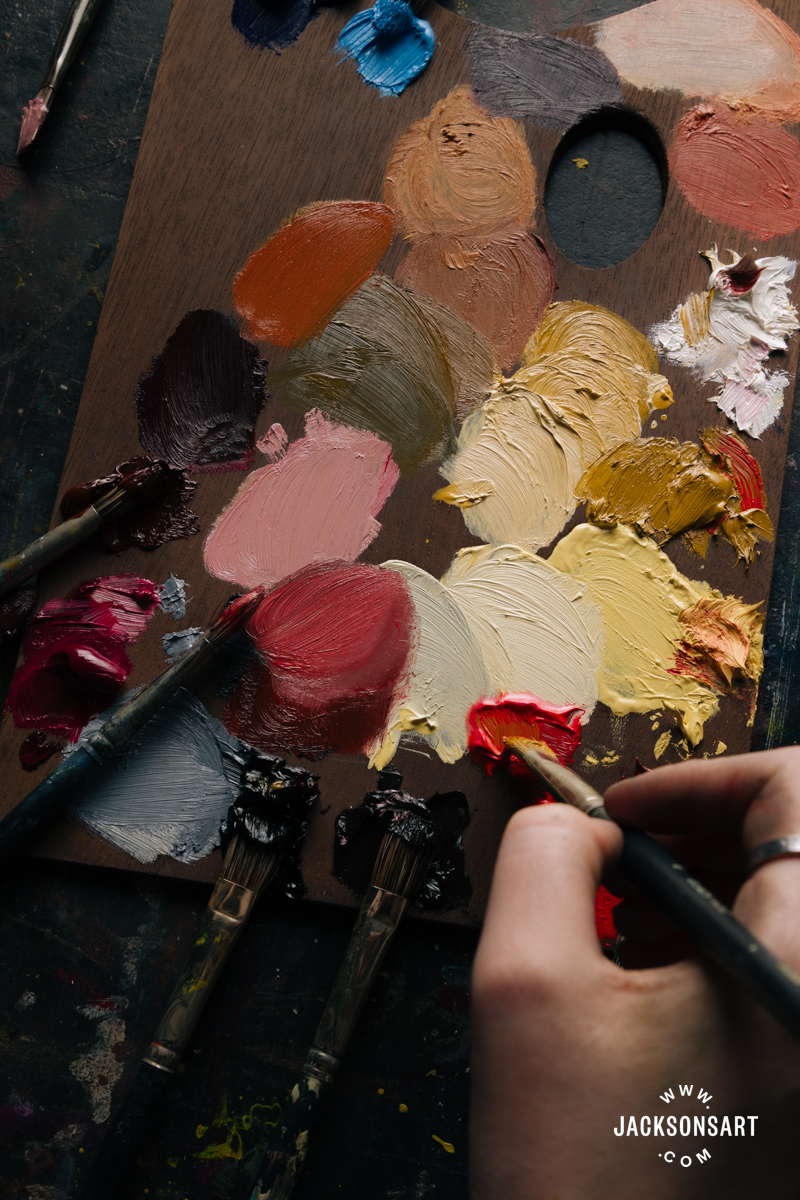
Recreating Zurbarán’s Palette
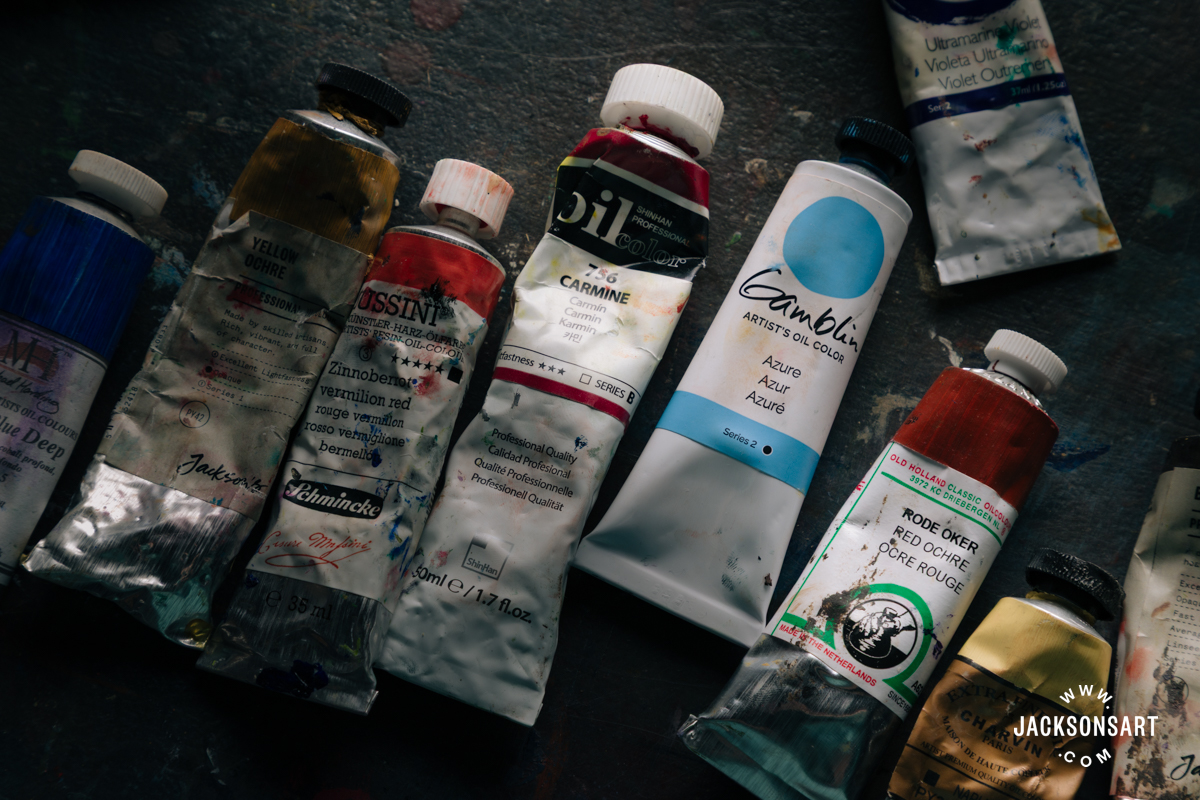
Some pigment analysis has been carried out of Zurbarán’s work, which revealed the following pigments in four paintings: Smalt, Lead White, Yellow Ochre, Lead Tin Yellow, Vermillion, Red Earth, Red Lake, Minium Red, Azurite, Umber, possibly a Burnt Earth, and Bone Black.
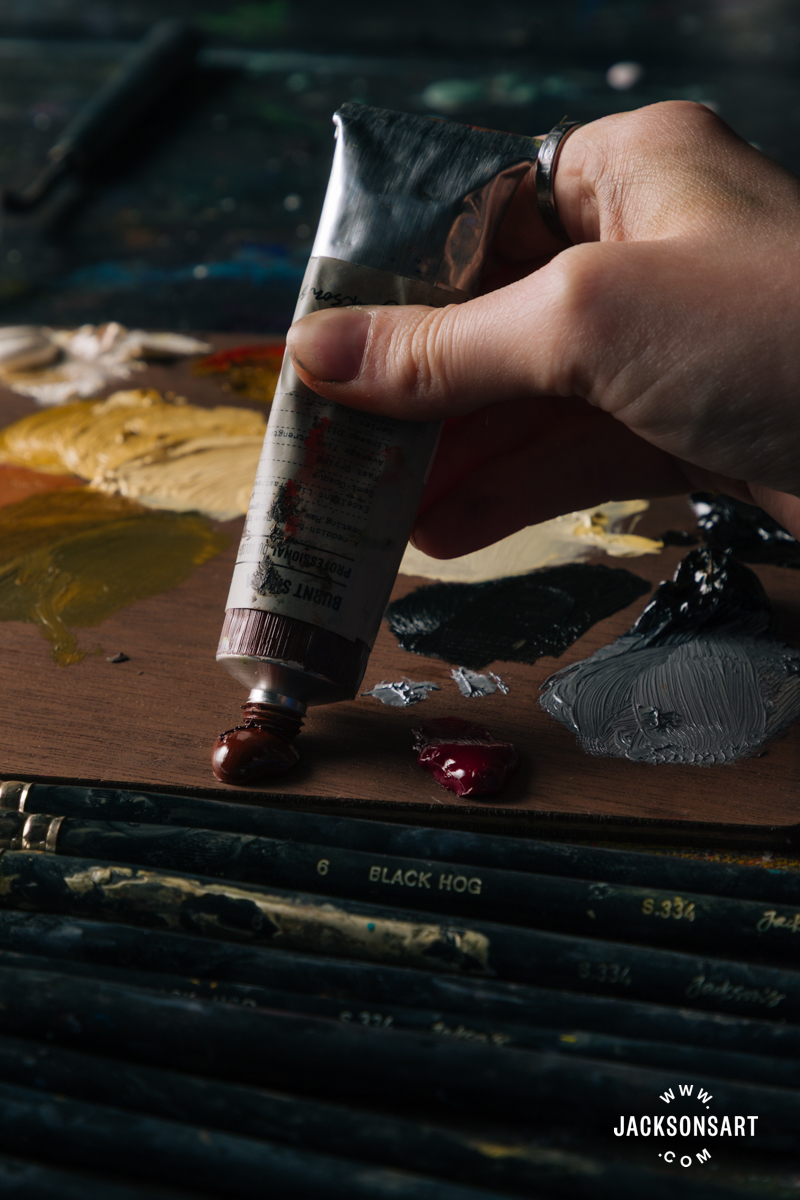
Several of these colours are no longer used in artmaking for different reasons, so I’ve substituted them for close contemporary alternatives. Smalt was a popular blue pigment that degrades poorly over time and browns. As a result, paintings originally intended to have cool, crisp blues now often show grey-brown backgrounds and dull skies. For my substitute, I used a mixture of Cobalt Blue and Ultramarine Violet. Lead Tin Yellow is a hazardous pigment that is no longer in use, but it can be closely substituted with Nickel Titanate Yellow or, my choice, Naples Yellow. Red Earth is a broad term that encompasses several different ‘red earths’, including Venetian Red, Pozzuoli Red, and Red Ochre, from which I used the latter.
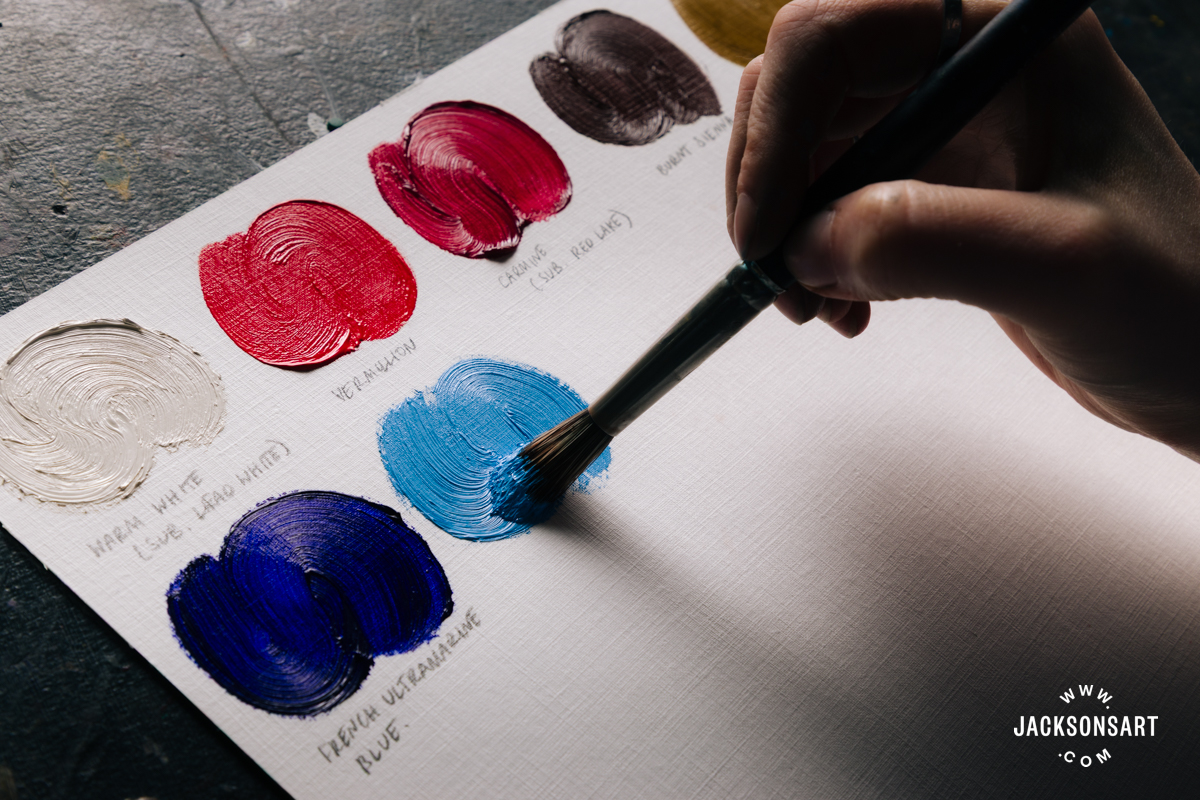
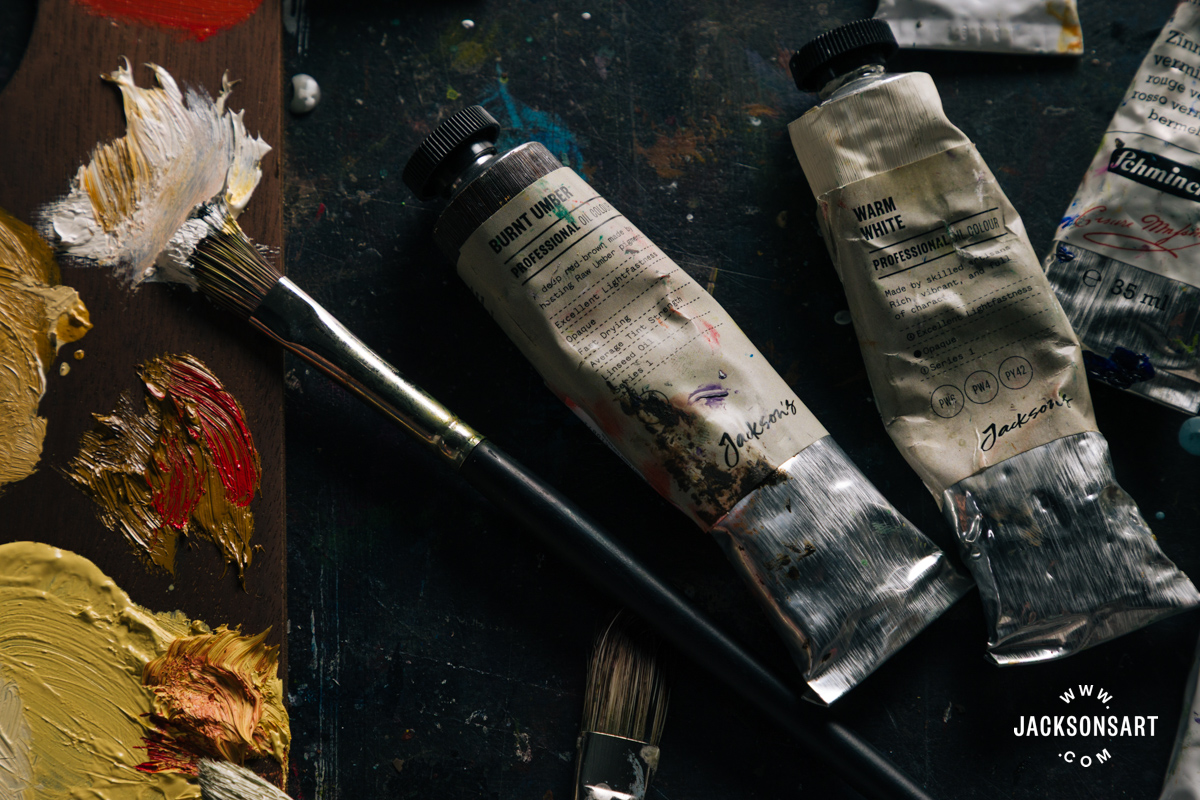
Minium Red is another pigment that gradually darkens over time, which has led to it falling out of contemporary use. Its closest substitute is Cadmium Red Light. Azurite is a mineral pigment that was used prolifically, but is fairly unpopular with paint brands since other pigments can produce a similar or stronger hue. Some brands make an Azurite Hue or Azure which closely imitates the original paint, or it can be swapped for Blue Verditer or Cerulean Blue. Finally, Bone Black was the original title for black pigments made from charred bones, which we’d refer to as Ivory Black today. This colour still contains animal byproducts, so another black can be used if this is a concern. Lead White is another historic pigment that has been replaced due to its toxic properties, whose substitute colour is often titled Warm White by paint brands.
One study revealed that the green in many of Zurbarán’s paintings was not actually produced with a green pigment, but made from a mixture of Azurite, Yellow Ochre, and Lead White. This is a mixture found consistently by other artists of the Spanish Golden Age. Skin tones were mixed with a combination of Lead White with Yellow or Red Ochre, and sometimes adjusted with a small portion of Lead Tin Yellow and a pigment made from ground Copper. The shadows of these faces transition into the Earth, Umber, and Bone Black pigments. The red parts of the face across the cheeks and lips were added in Vermillion.
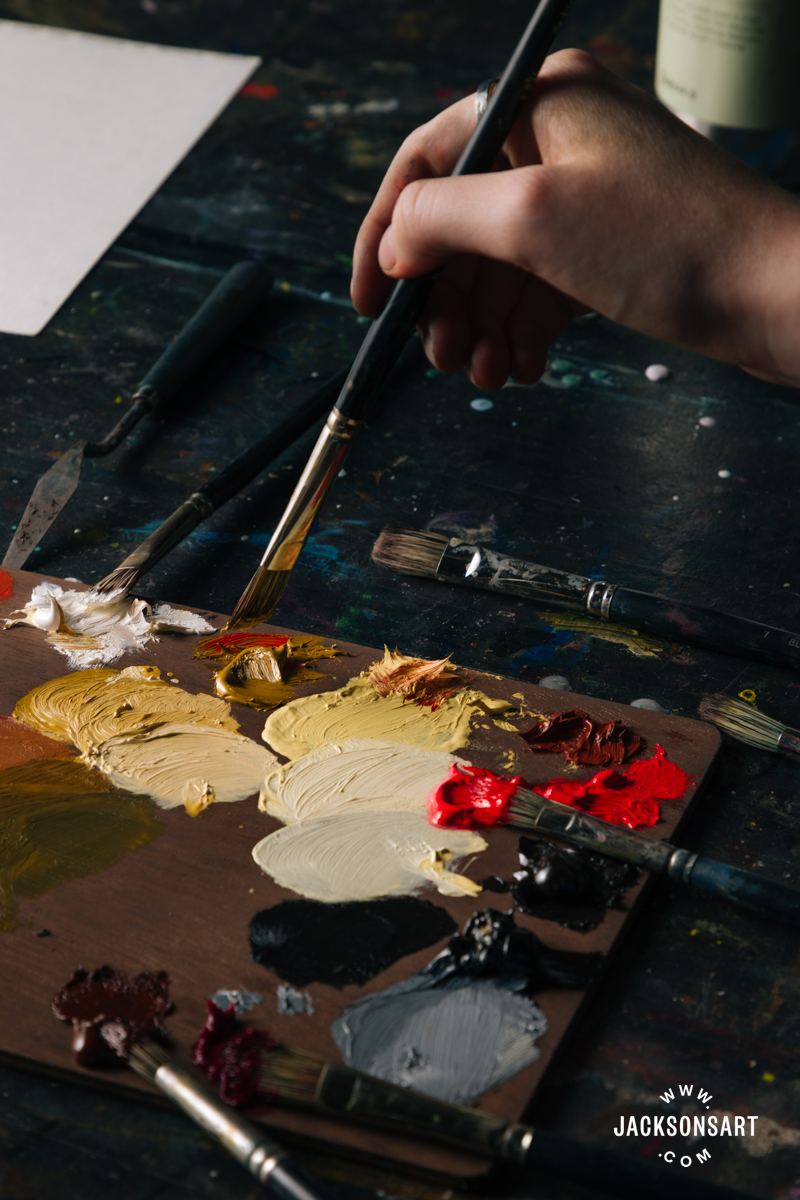
From these pigment analyses, it’s also clear that Zurbarán began his works by creating tonal underpaintings, to establish the deep tenebrist values from the beginning. He often modelled his works from dark to light, by establishing the darkest areas quickly, and working back toward the light. However, these underpaintings weren’t purely monochromatic, since they contain earth pigments, reds and yellows amongst black and white.
Colour Palette One – The Venerable Miguel Gerónimo Carmelo, 1628-30
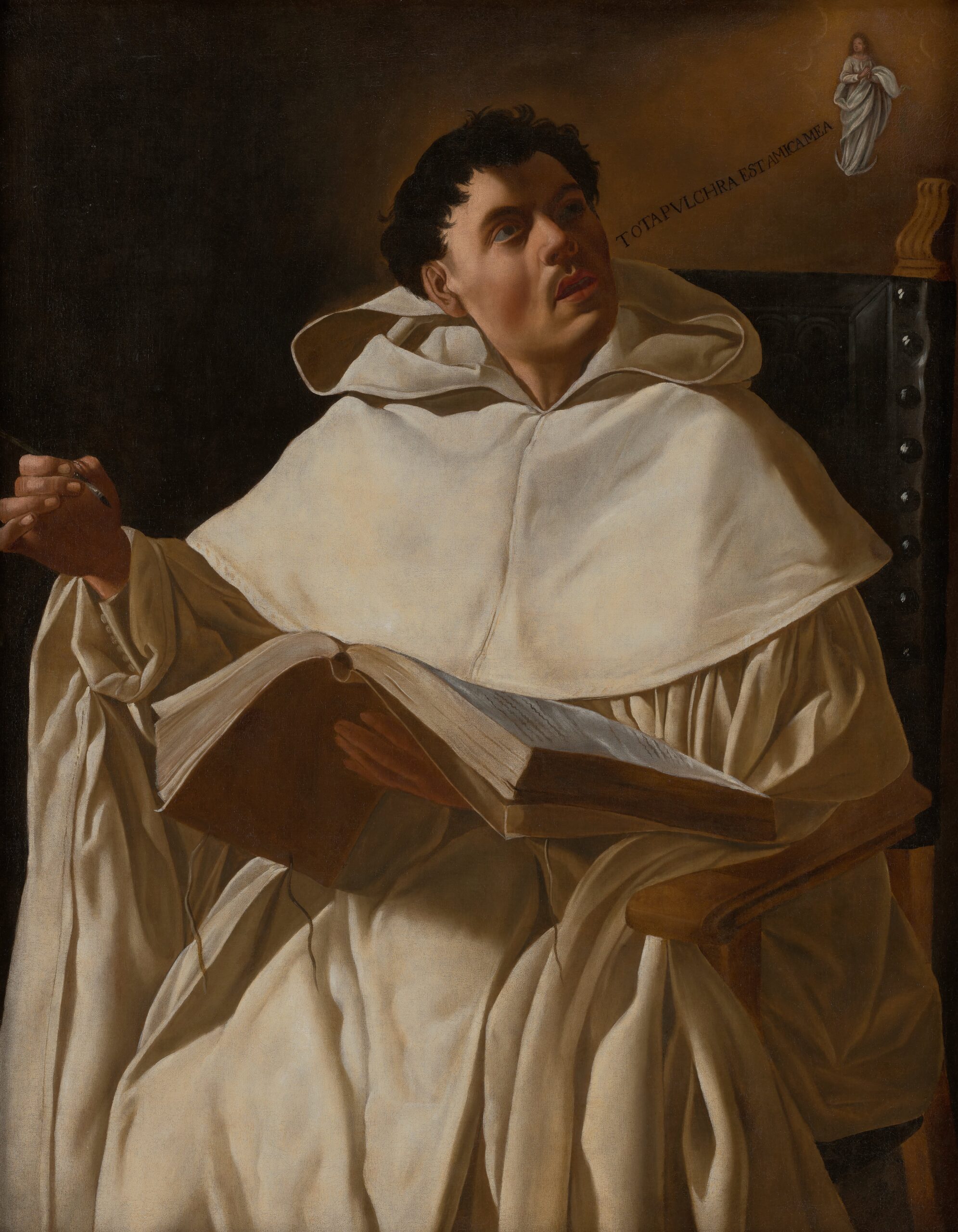
Francisco de Zurbarán
Oil on canvas, 115.9 x 86.4 cm | 45.6 x 34 in
Minneapolis Institute of Art
This painting was lost in the Napoleonic Wars, only to be attributed to Zurbarán again in 2010. The monk Carmelo gazes upwards over his left shoulder to receive a vision from a miniature Virgin Mary, with the words ‘Tota pulchra est amica mea’ escaping from his mouth toward her. The phrase comes from a Biblical poem, The Song of Songs, which he was studying the moment he had the vision, meaning ‘You are all beautiful, my darling’.
This painting is especially prized for the masterful rendering of his robes, made magnificent in the golden light. Zurbarán’s father was a haberdasher and textile merchant, which may be why he was adept at recognising the qualities of fabric. One of the notable qualities of Zurbarán’s work is the range of whites he painted with, mixing them with a range of colours to capture the subtle shift of shadows and reflected colour.
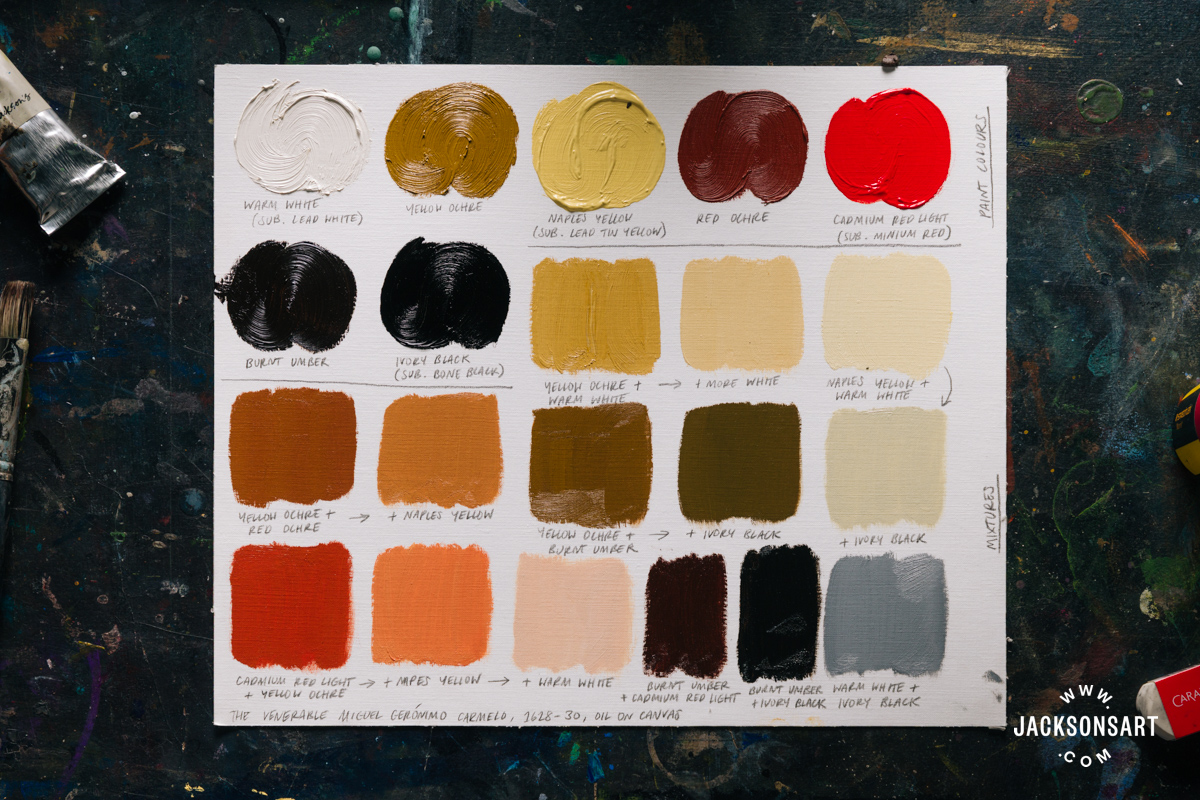
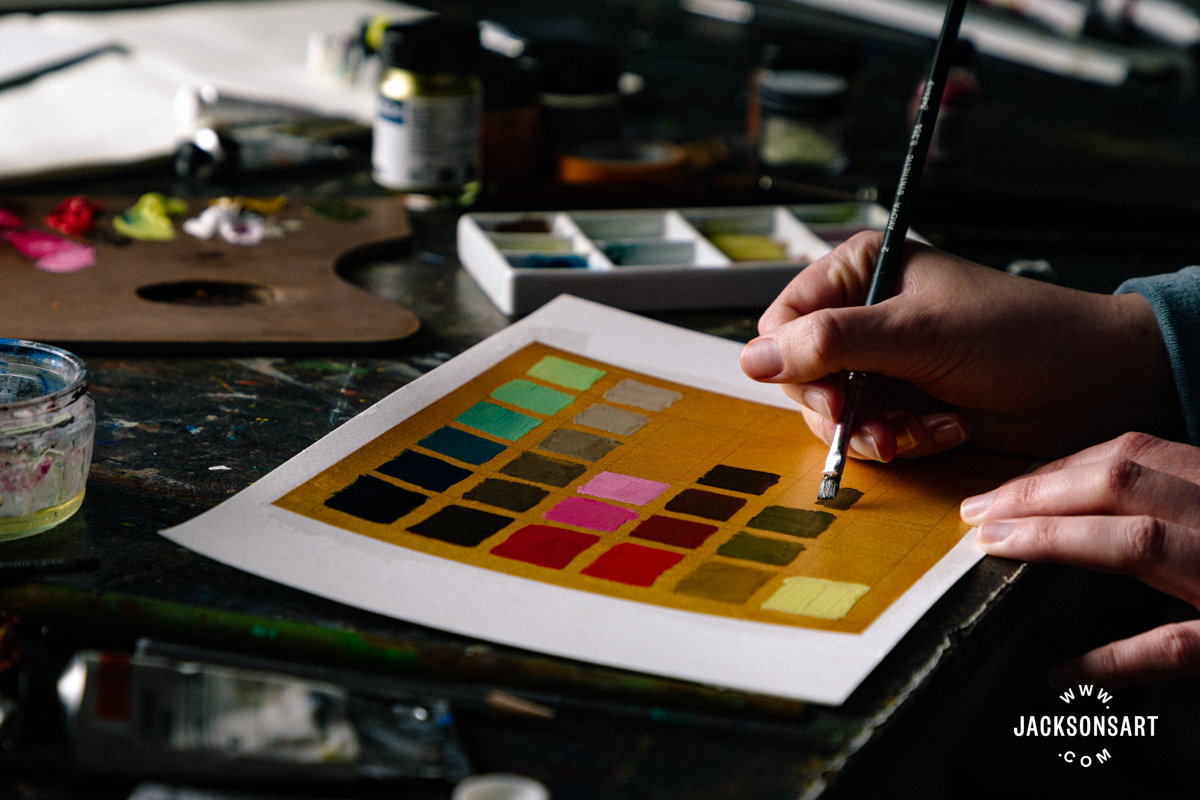
To recreate the palette of this painting, I focused on emulating the warm yellows and browns, by using Warm White, Yellow Ochre, Naples Yellow, Red Ochre, Cadmium Red Light, Burnt Umber, and Ivory Black. I especially enjoyed recreating the orange-browns that populate the entire painting through mixing Yellow Ochre and Red Ochre, before adding Naples Yellow.
Colour Palette Two – The Young Virgin, c. 1632-33
Francisco de Zurbarán
Oil on canvas, 116.8 x 94 cm | 46 x 37 in
The Metropolitan Museum of Art
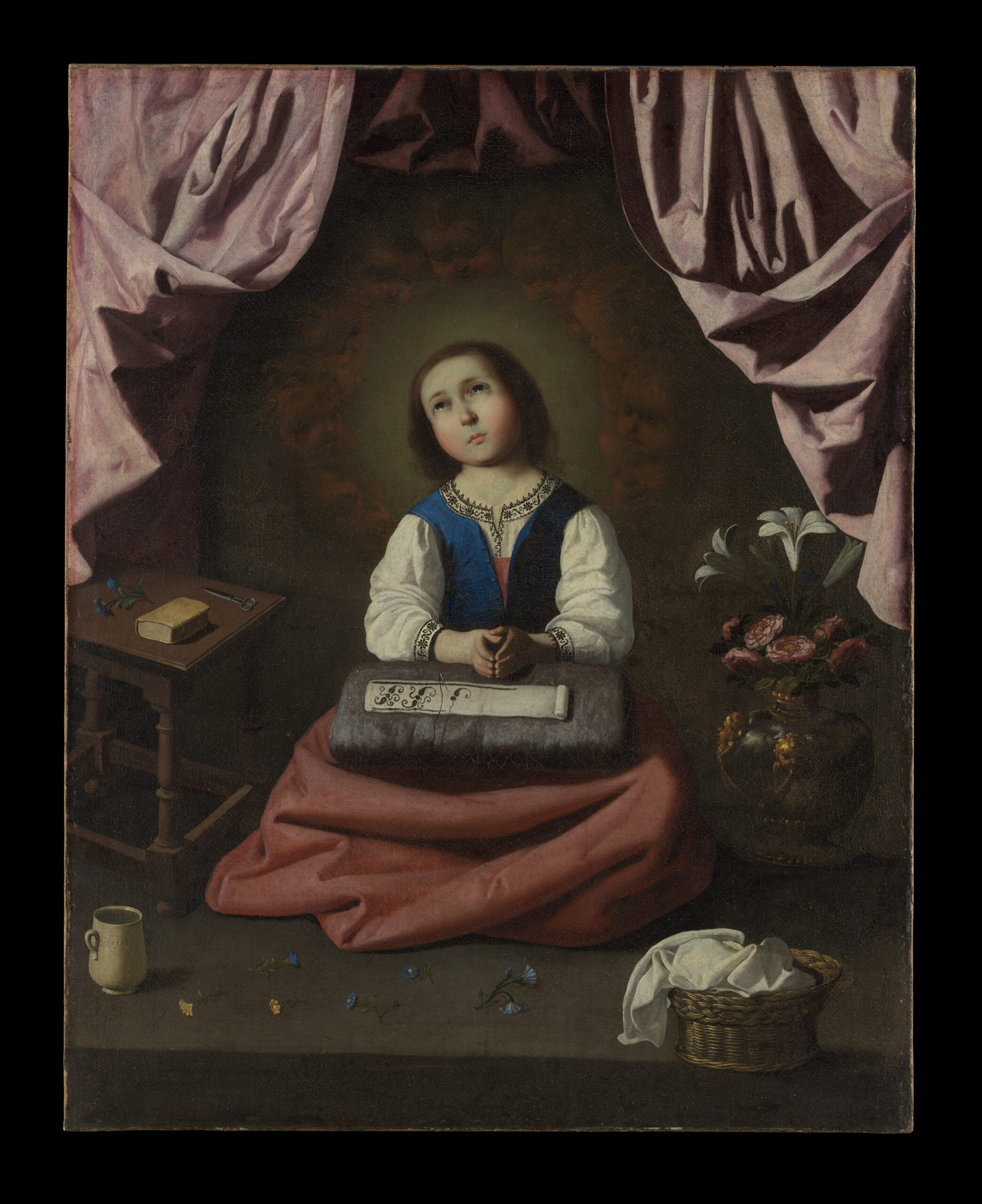
Zurbarán’s mastery of still life is on display in his work The Young Virgin, where we see objects of contemporary life in Seville decorating the environment around a young Virgin Mary. Paintings of this genre of Mary as a child follow a medieval legend that suggested she lived in a temple in Jerusalem and was devoted to her faith from the beginning. These works were designed as embodiments of ideal behaviour for girls, where she is both pious and hard at work with embroidery on her lap. I especially enjoy the ring of cherub heads that crowd around her haloed head, which aren’t immediately perceptible in the dark background.
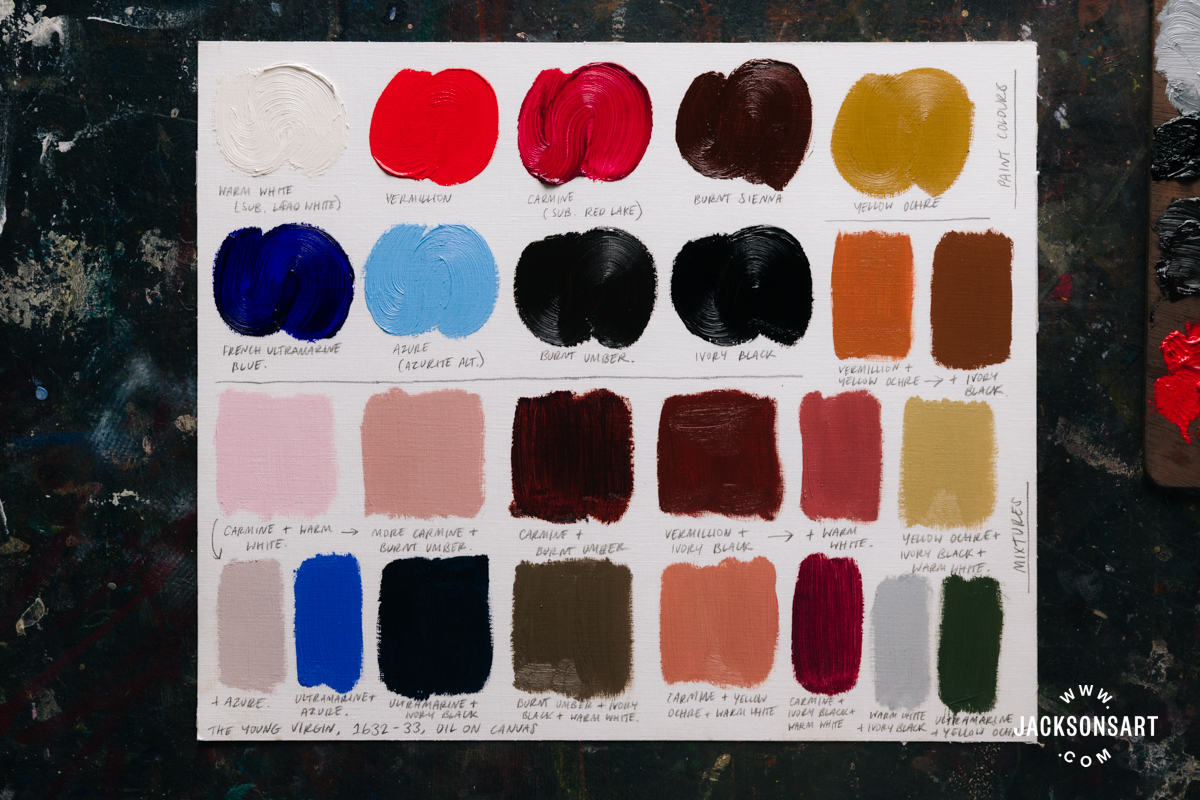
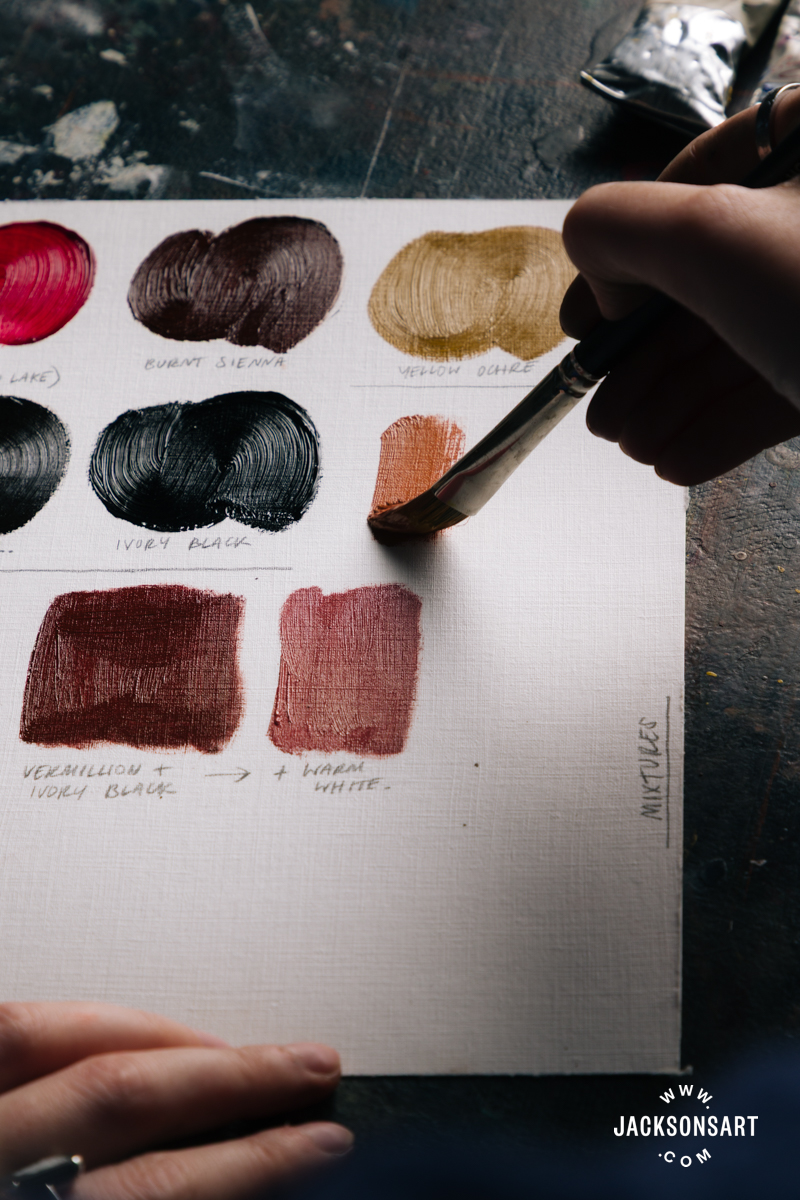
This painting balances the reds and pinks of the fabrics and flowers with the blue of her bodice and the golden heavenly light she exudes by containing them within deep tonal browns. To recreate this palette, I used Warm White, Vermillion, Carmine, Burnt Sienna, Yellow Ochre, French Ultramarine Blue, Azure, Burnt Umber, and Ivory Black. To recreate the pinks in the drapery and Mary’s flushed cheeks, I tested a couple of mixtures with Carmine, which complement the combination of Ultramine and Azure for her clothing below.
Colour Palette Three – Saint Romanus of Antioch and Saint Barulas, 1638
Francisco de Zurbarán
Oil on canvas, 246.5 x 185.4 cm | 97 x 73 in
Art Institute of Chicago
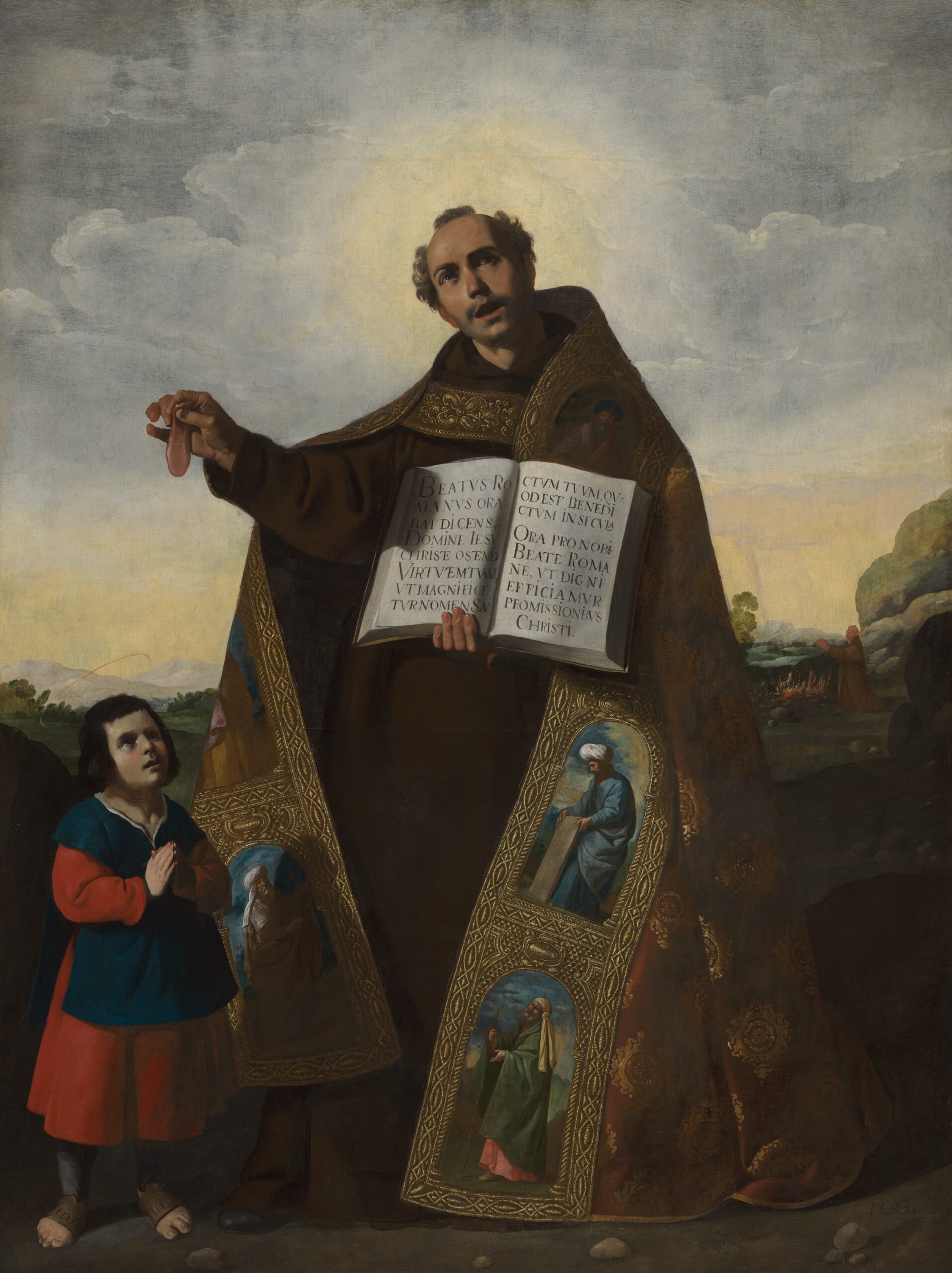
Zurbarán’s painting of Saint Romanus and the child Saint Barulas was one of many artworks made in this era designed to be a humanising portrayal of Catholic figures in the face of the Protestant Reformation. This period saw a broad rejection of the opulence of Catholic art. By bringing these Saints down to earth by placing them in the rugged landscape, the Church hoped to continue to appeal to the public amid the shift in cultural taste. This work was created for the high altar of the church of San Román in Seville, which would have contained several paintings. Now extracted from its original golden context, we can admire the palette of the paintwork alone.
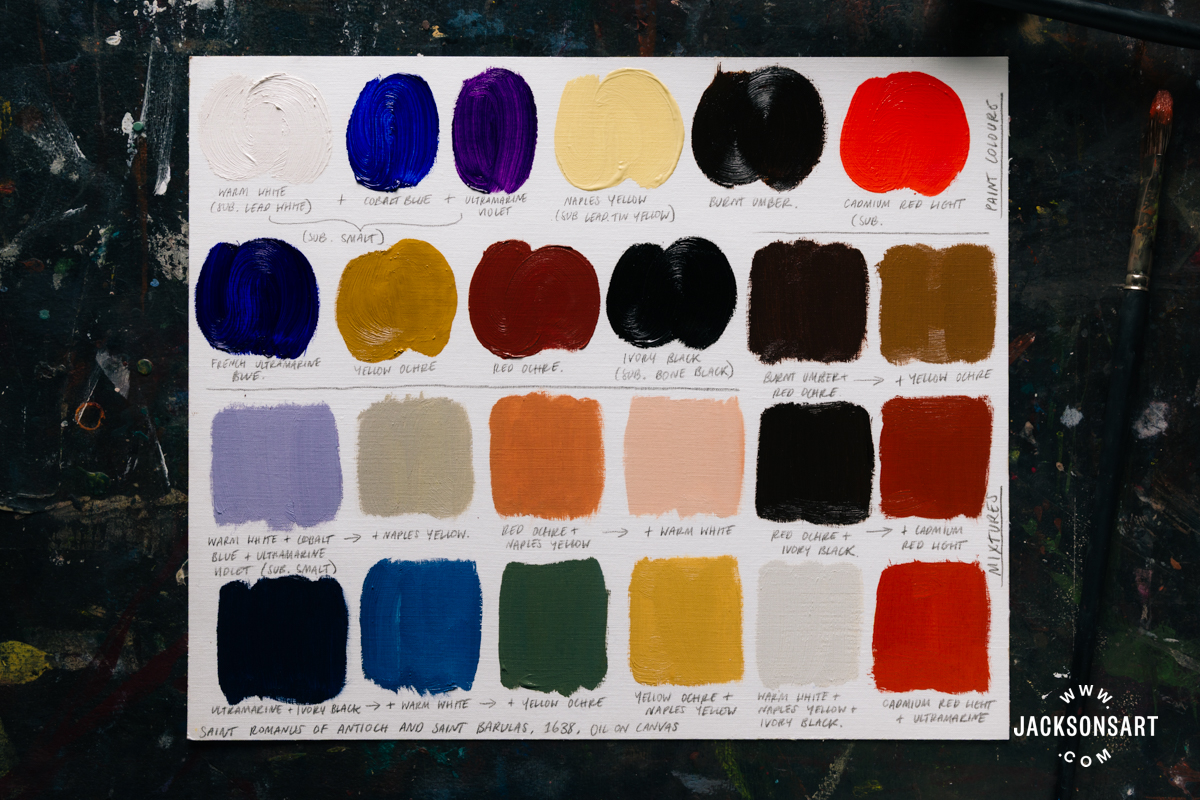
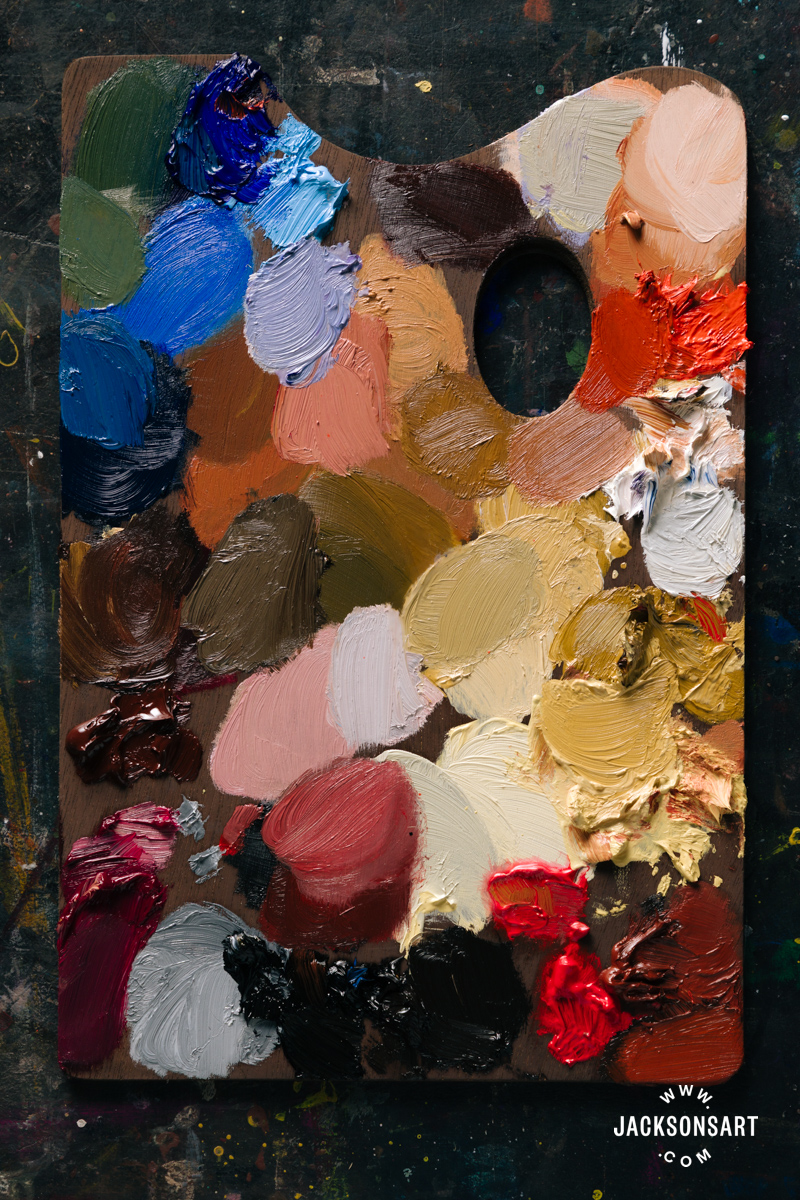
To recreate this palette, I used a combination of Warm White, Cobalt Blue Deep, Ultramarine Violet, Naples Yellow, Burnt Umber, Cadmium Red Light, French Ultramarine Blue, Yellow Ochre, Red Ochre, and Ivory Black. I only used the Cobalt Blue and Ultramarine Violet to emulate the colour of Smalt – not in any of my other mixtures. The grey of the sky in this painting suggests that it might have been painted with Smalt that has degraded over time, so I included it as one of my mixtures. Otherwise, my favourite mixture was Ultramarine Blue and Cadmium Red Light to create the tomato red of Saint Barulas’ tunic.
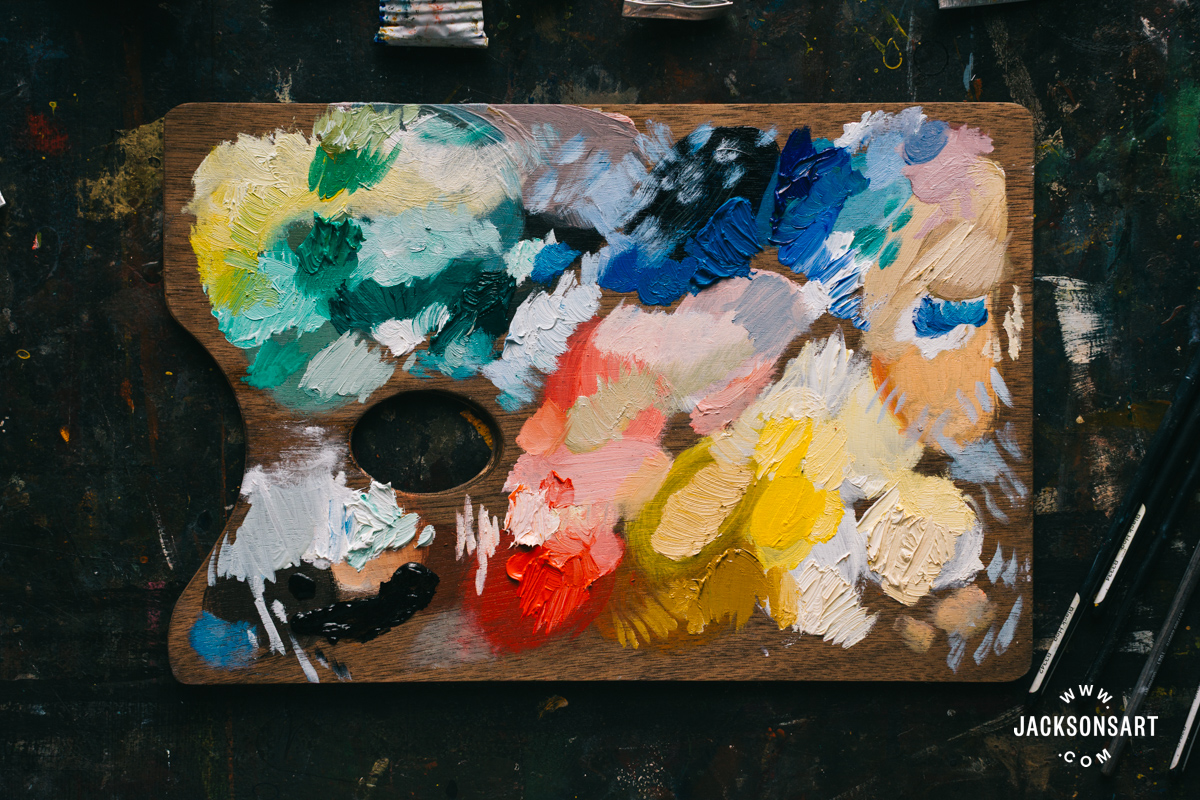
Zurbarán rendered his subjects from shadows by pulling them into the light of faith, bestowing his works with a visionary quality that moves them beyond pure sculptural realism. The meditative quality many of them are imbued with is reinforced by the palette, forming immersive scenes that invite us to contemplate. They prove that deep tonal contrast paired with colour has the potential to heighten emotion – conveying themes on mortality, devotion and mysticism that endure to this day.
Further Reading
Chiaroscuro Techniques for Painting, Drawing and Printmaking
Recreating the Palette of Edvard Munch
Oil Paint Through the Ages: Tradition and Innovation
Recreating the Palette of Francisco de Goya
Shop Art Materials on jacksonsart.com


6 thoughts on “Recreating the Colour Palette of Francisco de Zurbarán”
Saw the phenomenal exhibition at the National Gallery last week. Thank you for an interesting article.
Brilliant, I loved the exhibition too! Glad you found the article interesting
This is most interesting, I would also be interested in seeing a similar effort for Luis Egadio Melendez. He is obviously less famed, but has some interesting uses of color, in particular for his time and place in history.
Thank you for the suggestion, I’ll keep a note!
No mention about the main UK collection of Zuberan paintings at the Bishops Palace, Bishop Auckland, Nr Durham.
Unfortunately the images of those paintings aren’t in the public domain so I couldn’t use them – they are incredible and I loved seeing a couple of them in the National Gallery exhibition!
Comments are closed.