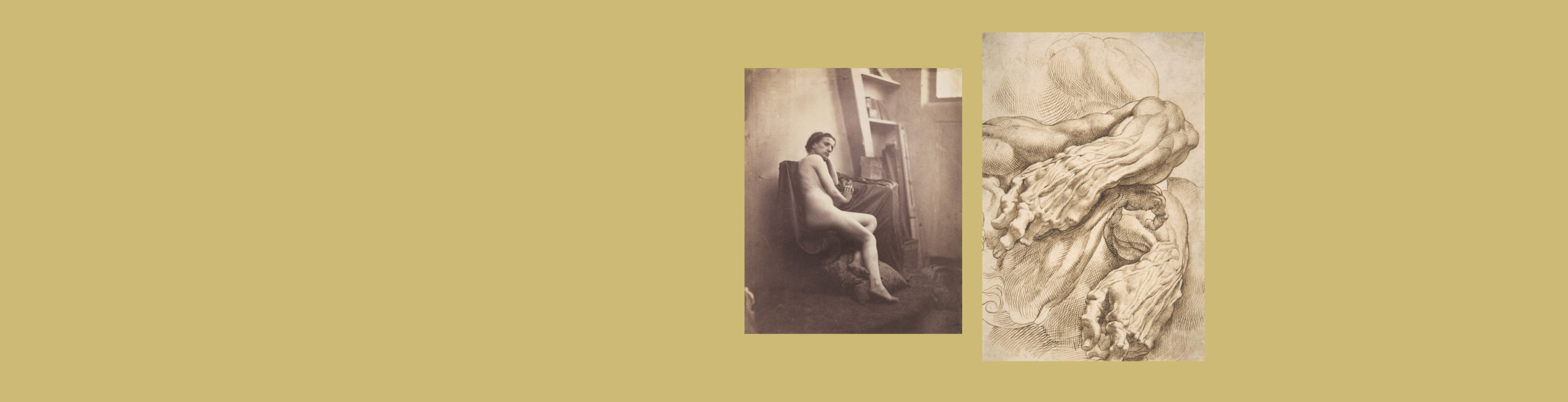
After seven years of concentrated collaborative effort between Pablo Picasso and Georges Braque, the Cubist movement was founded – shattering the established traditions of Western art. In this article, I chart the history and global influences that converged to inspire the development of Cubism, before describing methods for creating your own Cubist artworks.
Articles in the Techniques Series define the meaning and context of art making processes and give practical tutorials on how to work with them.
Definition: Cubism was devised in collaboration by Pablo Picasso and Georges Braque in Paris between 1907 and 1914, inspired by forms in African and Oceanic art, Cezanne’s paintings, and an experimental desire to create a ‘new art’. Their works disrupted the conventions of space and form to emphasise the two-dimensionality of the surface, by depicting their subjects from simultaneous fractured perspectives and planes and abandoning linear perspective. Works from the movement are divided into two sub-categories – analytical (pre-1912) and synthetic (post-1912). The aesthetic of the movement was carried forward beyond Picasso and Braque by artists sometimes referred to as the Salon Cubists.
What is the Effect of Cubism?
Cubism liberated Western art from the conventions of linear perspective that had dominated since the Renaissance. By shattering figures and objects, it emphasised the two-dimensionality of the picture plane. The movement is an essential precursor to the development of abstract art that came later. The Cubists’ pioneering efforts weren’t just compositional but material. For example, when they began collaging everyday materials like newspaper clippings into their works, this was the first step toward the collages of the Dada and Surrealist movements. The Constructivists were directly inspired by Picasso’s Cubist works when one of the founders, Vladimir Tatlin, visited Picasso’s studio in 1913. Piet Mondrian undeniably owes inspiration to the Cubists too, when he pioneered Neo-Plasticism by distilling the picture plane to straight lines and flat colour.
Like many pioneering art movements, although the aesthetics of Cubism were innovative and surprising at the time, Cubist elements in contemporary art recall the past. Since the movement is best known by its two founding artists, Picasso and Braque, it can be challenging for Cubist artworks today to avoid appearing as a direct homage to them. Despite this challenge, many artists continue to draw on the movement’s core principles in fresh ways. Examples include George Condo’s fragmented portraits and Danica Lundy’s paintings, which use shifting, simultaneous viewpoints to depict interiors, figures, and objects.
The History of Cubism
Georges Braque first met Pablo Picasso when he visited his studio in 1907, beginning a collaborative artistic effort that would revolutionise Western art making over the following seven years. The artists shared an intense friendship and sometimes rivalry during their development of the Cubist style. They challenged, criticised and shared ideas, living as neighbours in Montmartre. In this period, they visited each other’s studios each evening to review the day’s work. Braque wrote about the experience, saying:
“In those years Picasso and I said things to each other that nobody will ever say again, that nobody could say any more… It was rather like a pair of climbers roped together.”
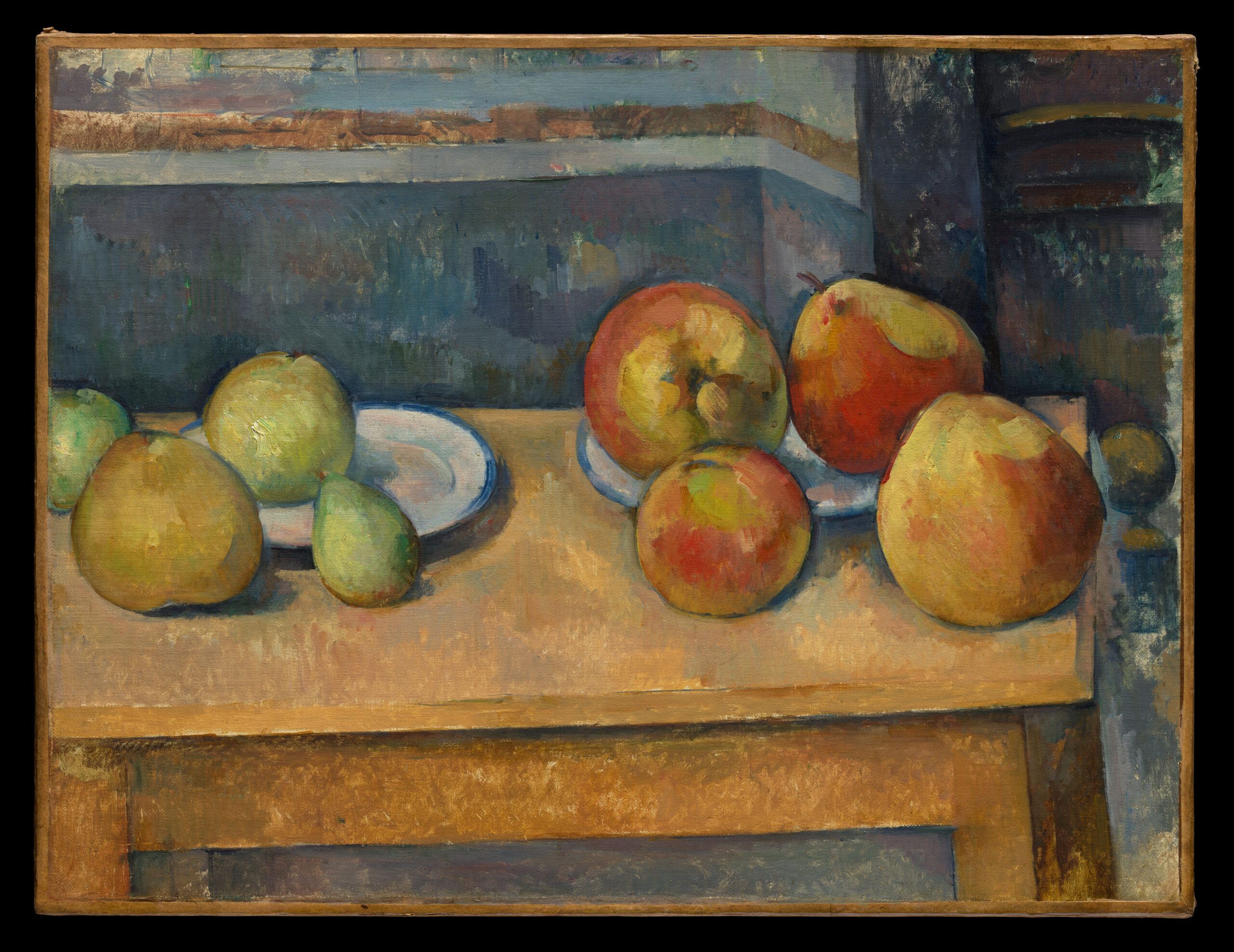
Paul Cézanne
Oil on canvas, 44.8 x 58.7 cm | 17.6 x 23.1 in
The Metropolitan Museum of Art
Both artists shared an admiration for Cézanne, whose late work is considered the bridge between Impressionism and Cubism. In his works, he captured figures, objects, and the landscape from observation with simplified forms, bold lines, broad colour, and sometimes without linear perspective. By abandoning the single vanishing point, he sought to represent reality by presenting several different viewpoints in the same image. He also created volume through geometric form – often seen in the direct application of colour with square brushes.
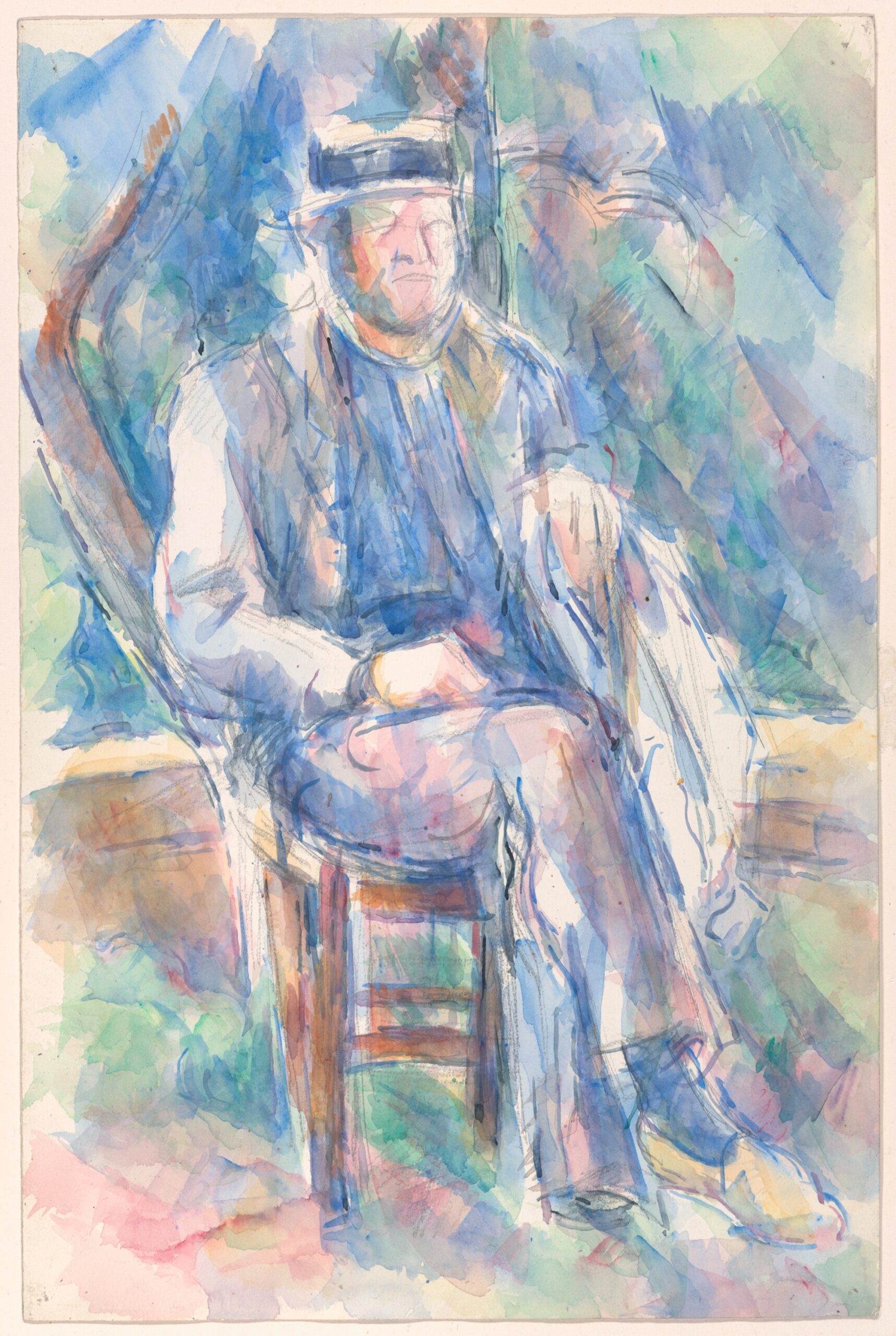
Paul Cézanne
Watercolour with graphite on paper, 47.9 x 31.5 cm | 18.9 x 12.4 in
Art Institute of Chicago
Picasso saw African art for the first time in 1907 – at the beginning of his experiments in Cubism – at the Ethnographic Museum in the Palais du Trocadéro in Paris. At the time, an influx of African artworks was being brought to Paris because of the expansion of the French empire. We see the influence of these sculptures and masks particularly in his figurative works, where the proportions of the face are non-representational, and forms are angular or elongated. He wrote himself, “a head is a matter of eyes, nose, mouth, which can be distributed in any way you like.”
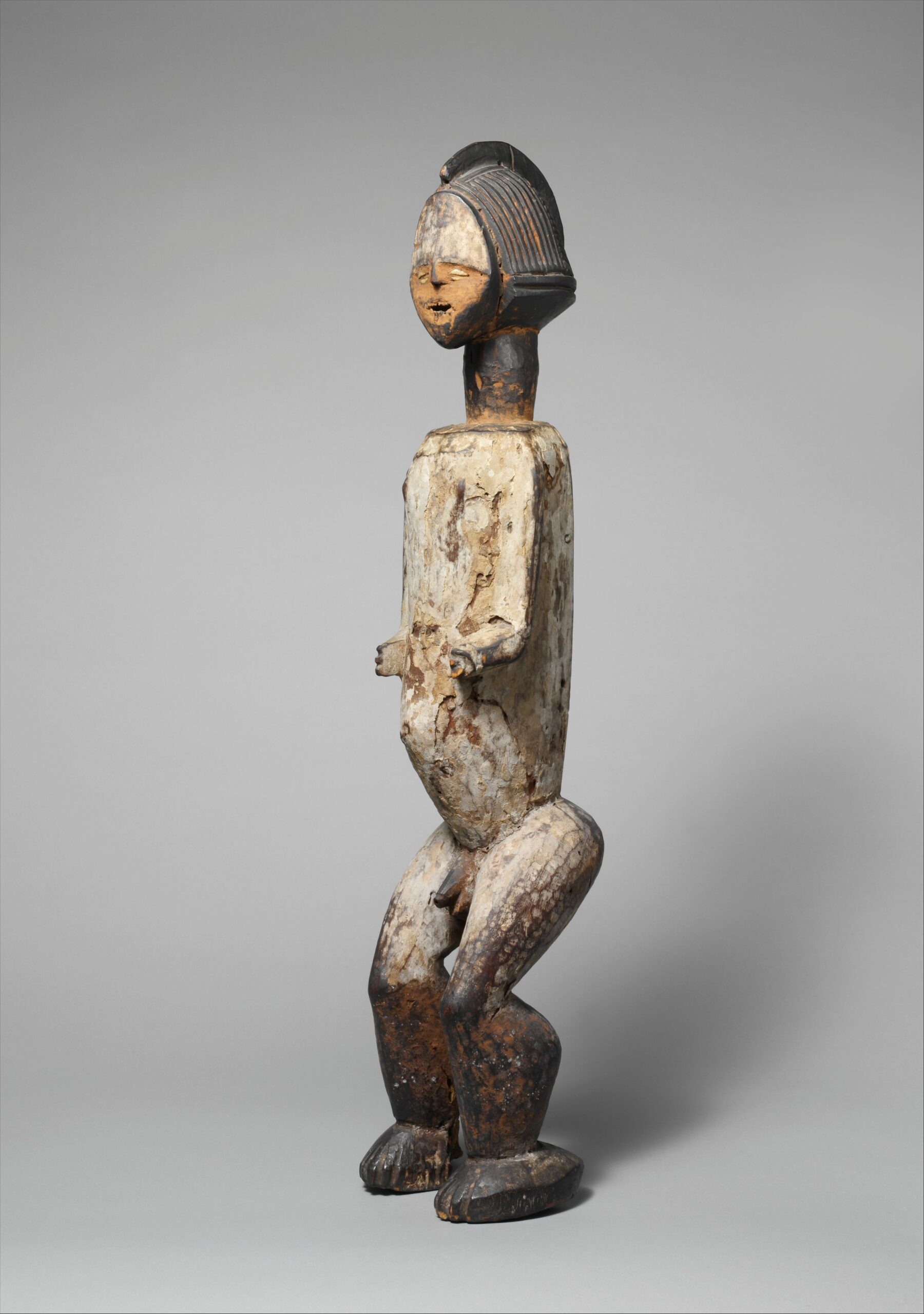
Mbete-Kota artist from Gabon
Wood, pigment, metal, and cowrie shells, 81.9 x 19.1 x 18.1 cm | 32.2 x 7.5 x 7.1 in
The Metropolitan Museum of Art
Within the Cubist period, art historians have also noted Picasso’s own African Period from 1907-9, when its influence was most noticeable. This includes his famous work Les Demoiselles D’Avignon, 1907, which is considered by some to be the birth of Cubism. Although his work clearly displays inspiration from African and Oceanic art, Picasso controversially denied the connection himself. This inability to acknowledge the culture, tradition, and visual language of African artists is racist and inseparably associates these works with colonial appropriation. At the time, the works were considered ‘primitive’ or ‘savage’, despite the sophistication in their design and craft, and the cultural significance of their use. His denial is made more ridiculous by the fact that he began collecting African and Oceanic art in 1907, and gathered over 100 masks, sculptures, and instruments throughout his lifetime. He notably owned Fang Ngil, Baga Nimba, Baule, Dan, and Grebo masks, and Kota reliquary figures.
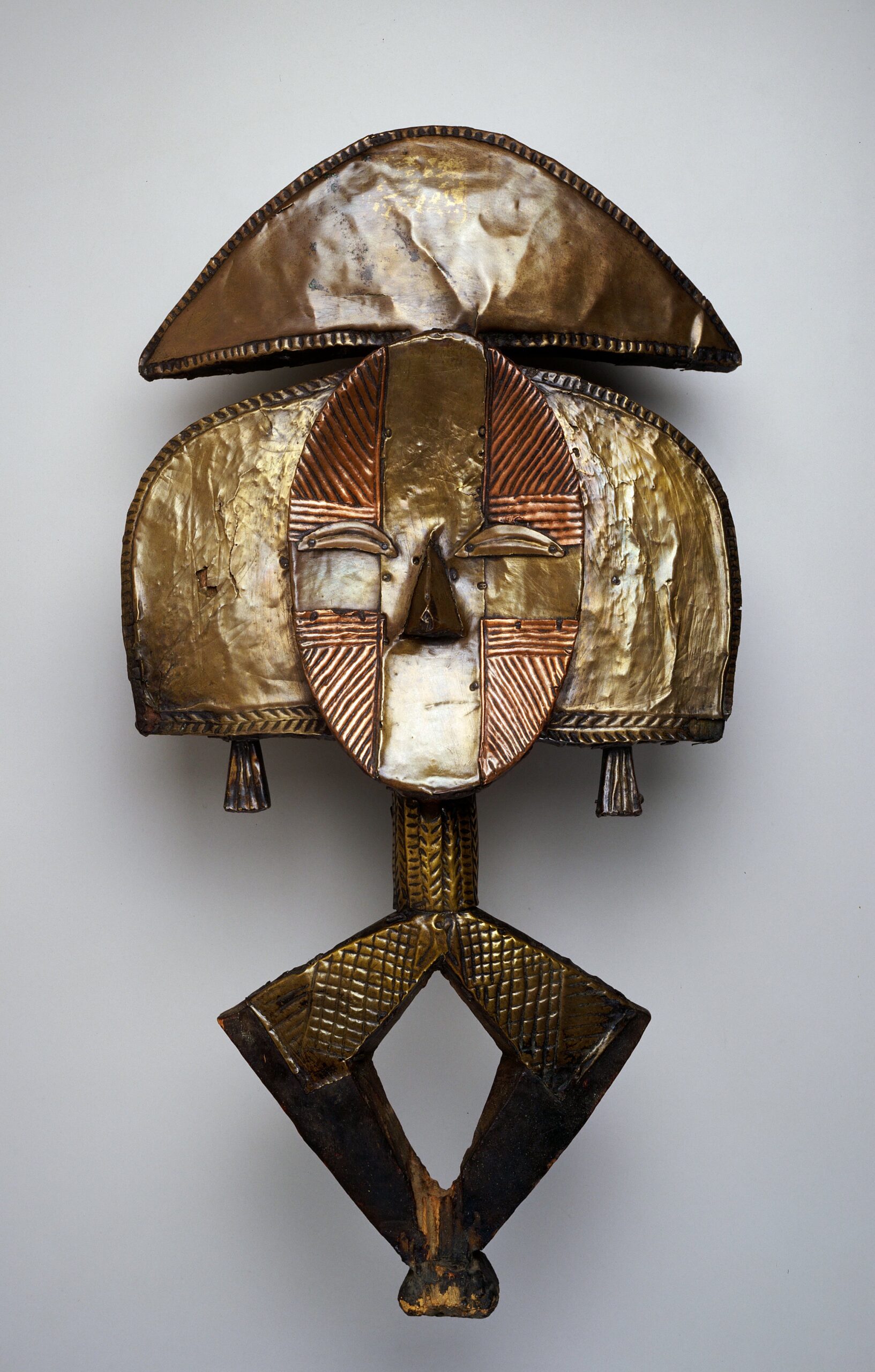
Kota artist, from Gabon or Democratic Republic of the Congo
Wood and copper, 55.9 x 29.5 x 5.1 cm | 22 x 11.6 x 2 in
Minneapolis Institute of Art
The term ‘Cubism’ was coined by the art critic Louis Vauxcelles after seeing landscapes painted by Braque exhibited in Paris in 1908, which he called ‘bizarreries cubiques’ or ‘cubist oddities’. Later, Picasso and Braque’s art dealer, Daniel-Henry Kahnweiler, wrote about his theoretical perspective on their Cubist project. In 1912, he published a book titled The Rise of Cubism, where he documented their struggle and their achievement of developing this new approach to art making. He asserted that traditional art making was ‘merely visual’, in that it only depicted reality from one angle. To him, Cubism wasn’t so far removed from tradition since it still relied on geometry – however, he suggested it might be even more honest in its attempt to translate the three-dimensional experience of forms. He refuted the claim that their works were merely distortions, arguing that ‘These images construct the finished object in the mind.’
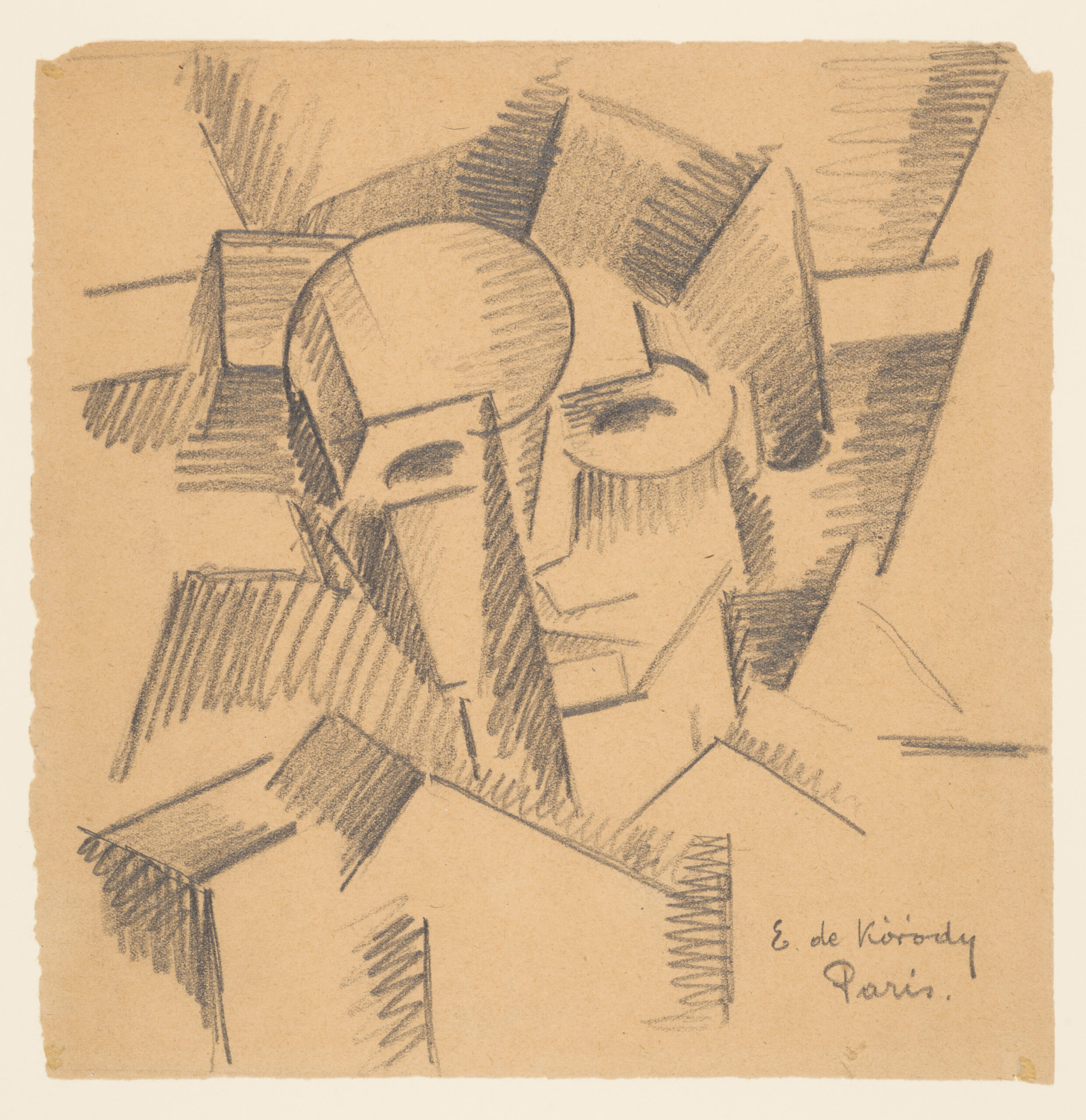
Elemér de Kóródy
Graphite on paper, 23.2 x 22.9 cm | 9.1 x 9 in
The Metropolitan Museum of Art
The beginning of Cubism marked a key departure in Western art from depicting reality from a fixed single viewpoint with linear perspective, which had endured since the Renaissance. The Cubist movement is split into two distinctive periods – analytical and synthetic. Analytical Cubism was its earliest iteration and was prevalent up until 1912. Representations of people and still life objects were dissected and reassembled from different angles, and rendered in monochromatic browns, greys, and blacks. In these paintings, objects were broken down into analytical planes and depicted from different angles within the same picture plane, suggesting rather than replicating their three-dimensional appearance. The interweaving of planes paired with the muted colour palette of analytical cubism gives it a more severe appearance than later versions of the style.
From 1912, both artists created papiers collés – collages that suggest the form of objects, and combined painting and drawing. These works have much shallower space than the previous Analytical paintings, with less suggestion of three-dimensional space and greater abstraction of form. These papiers collés developed into the movement’s second iteration, Synthetic Cubism, marked by the use of brighter colours, simpler shapes, and the inclusion of collage, which encouraged greater expressions of texture and pattern. By including ‘real life’ objects like newspapers and clippings in their collaged works, the Cubists made an important step into a facet of modern art – the inclusion of non-art materials.
Picasso and Braque had to stop working together in 1914, when Braque was enlisted into the French army at the outbreak of World War I. Picasso never fought in the war, because although he was living in France, he remained a Spanish citizen, which was a neutral country in the conflict. Braque became a highly decorated infantry officer and was awarded for his bravery in trench warfare, but was severely injured in 1915 when he was hit by shrapnel in the head. He was left to die in ‘no man’s land’, before being miraculously discovered a day later, still alive. After years of rehabilitation and surgery, he was able to paint again in 1917, but moved away from his pre-war Cubist style toward more fluid forms and interlocking planes of colour.
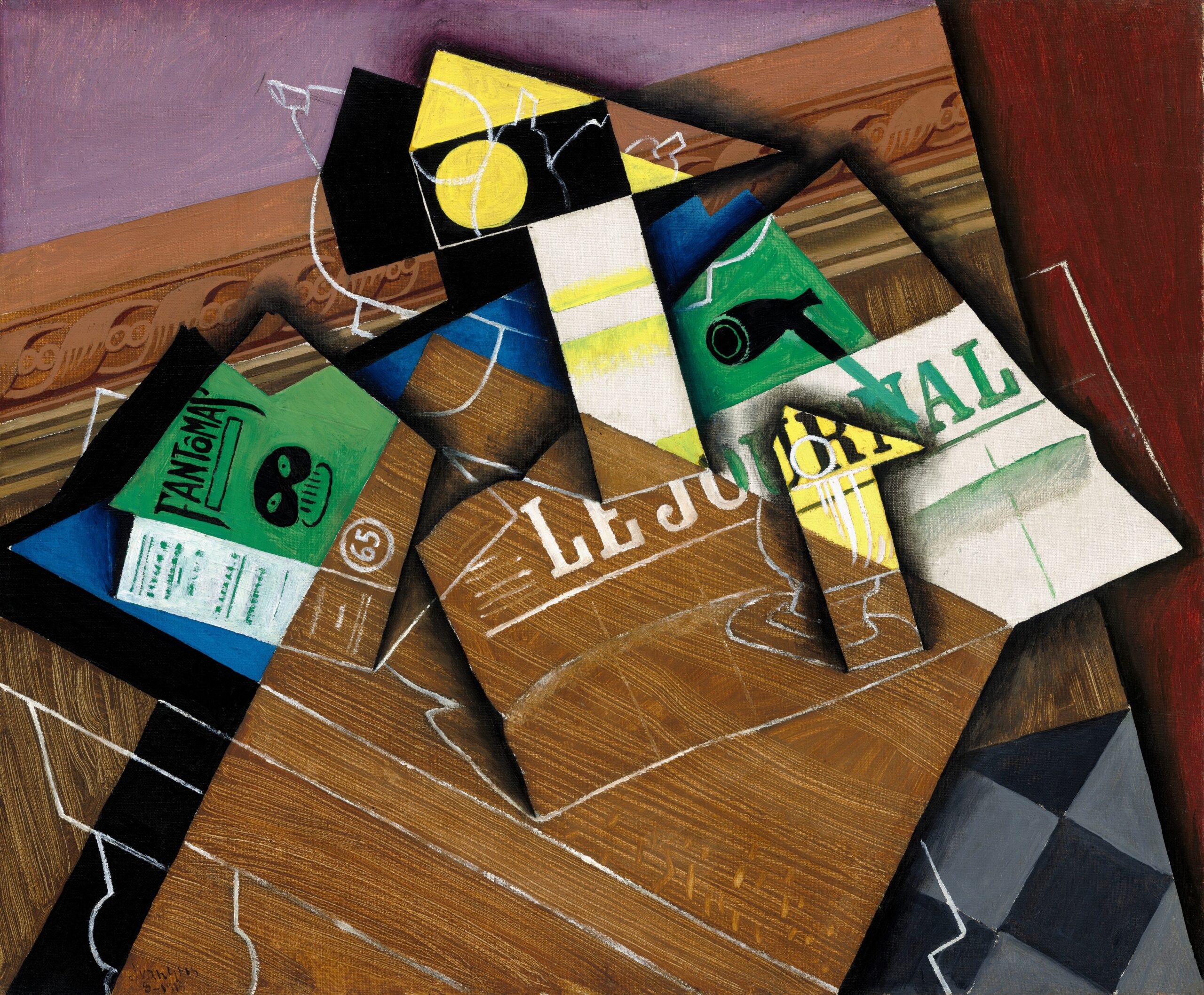
Juan Gris
Oil on canvas, 59.8 x 73.3 cm | 23.5 x 28.9 in
National Gallery of Art
In the same year, Picasso debuted his final Cubist work and his first foray into the performing arts, the ballet Parade, choreographed by Leonide Massine – for which Picasso devised costumes and sets. The poet Guillaume Apollinaire described the piece as ‘a kind of surrealism’, three years before the Surrealist movement would have its inception. Beyond 1917, Picasso abandoned the stylings of Cubism, having already established his name, to move into his Neo-Classical phase. Neo-classicism saw a revival in this era, interpreted as a comforting ‘return to order’ after the horrors of the First World War.
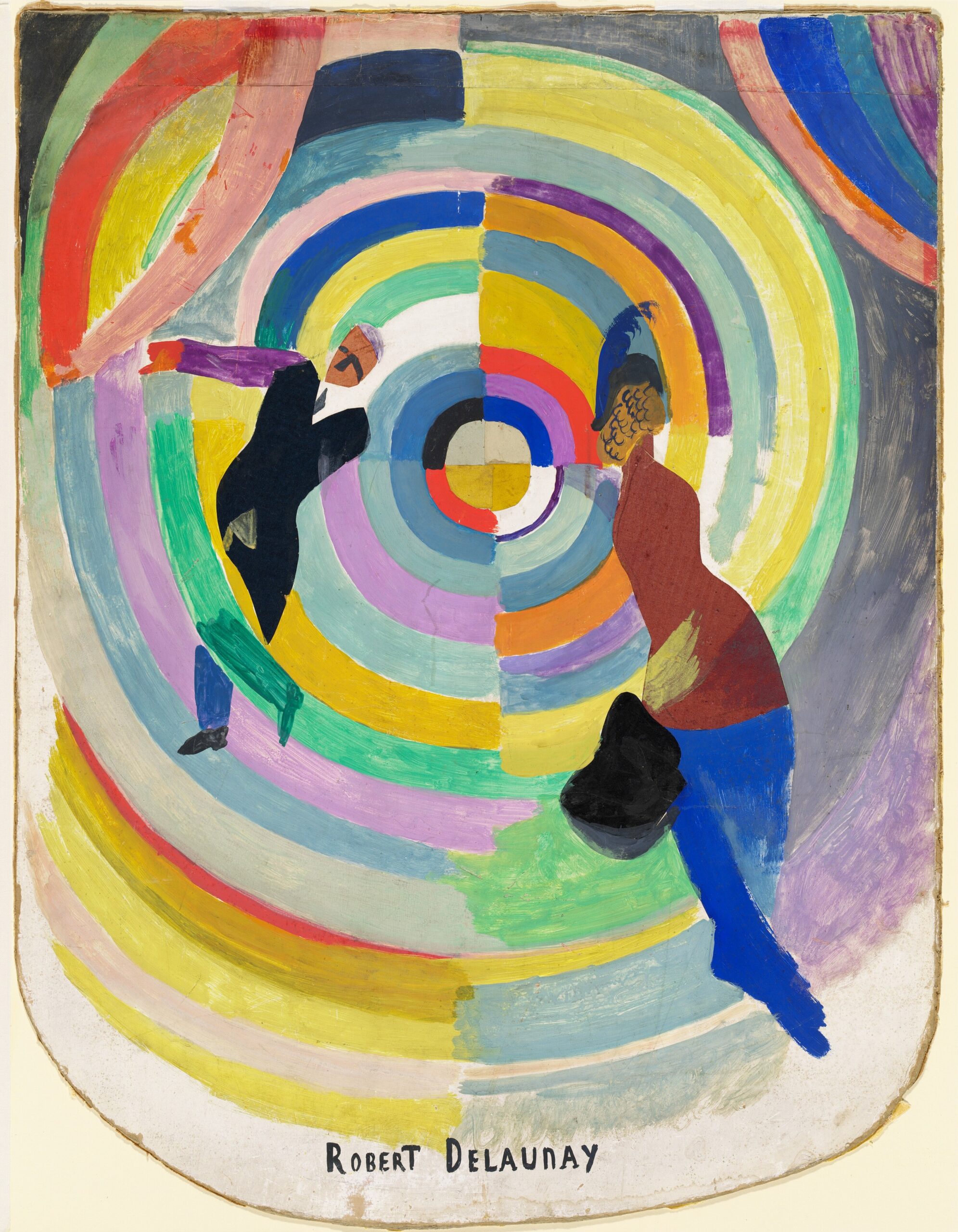
Robert Delaunay
Oil and collage on cardboard, 88.7 x 67.3 cm | 34.9 x 26.5 in
National Gallery of Art
Beyond Picasso and Braque, the language of Cubism was adopted and developed further by painters who saw it as a style for the new century, sometimes referred to as the Salon Cubists. Although their individual outputs vary in style, they were bound together by the pursuit of creating a visual language that was ‘entirely new’, as described by the poet and critic Guillaume Apollinaire in The Cubist Painters (1913). These artists included Fernand Léger, Robert and Sonia Delaunay, Juan Gris, Marcel Duchamp, Albert Gleizes, and Jean Metzinger. The movement also made an impression on sculpture, including works by Alexander Archipenko, Raymond Duchamp-Villon, and Jacques Lipchitz.
Demonstration of Cubist Painting, Drawing, and Collage Techniques
Demonstration of Analytical Cubism
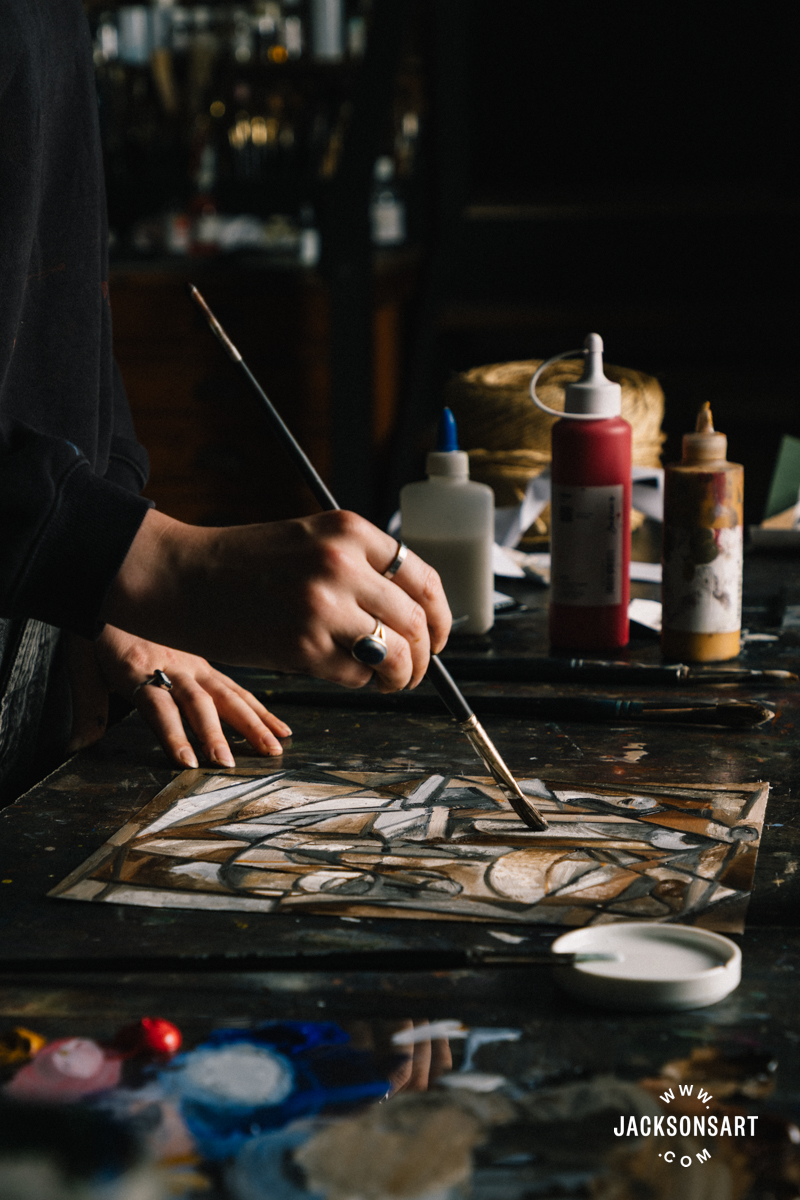
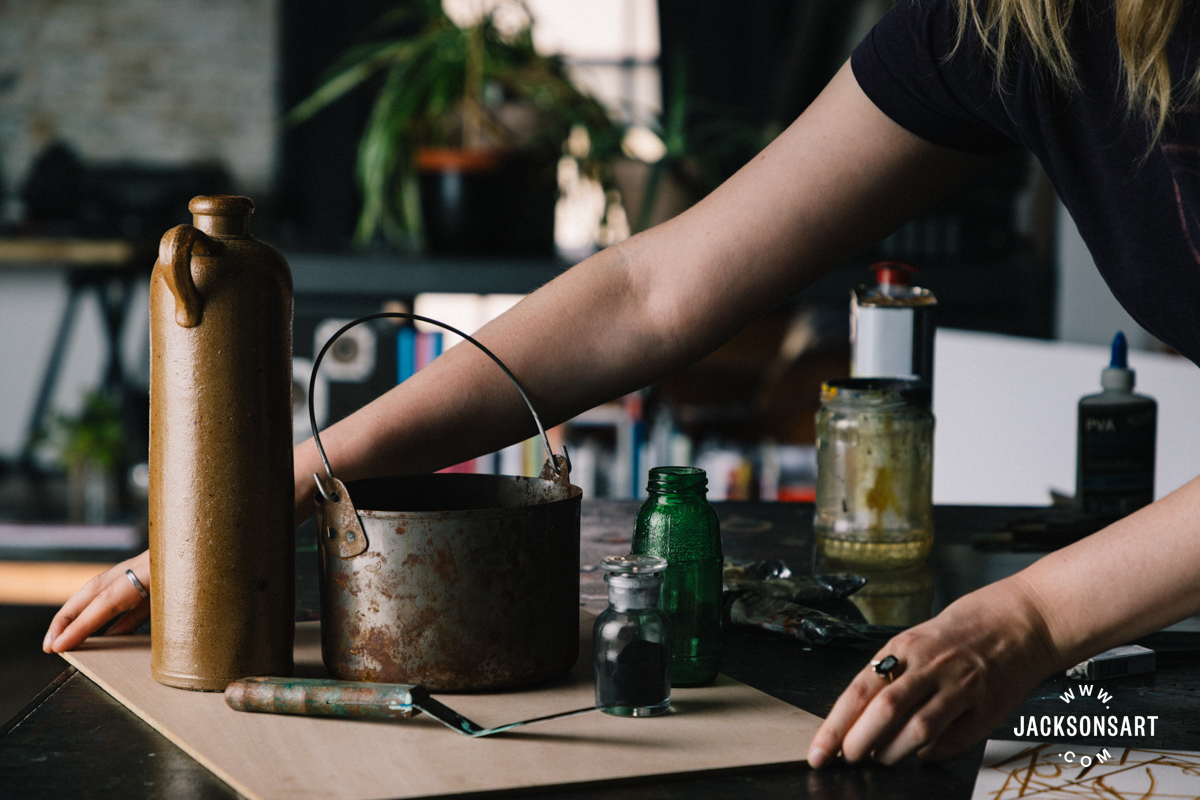
Analytical Cubism saw still life objects dissected and reassembled from multiple viewpoints, all rendered in a muted grey, brown, and black palette. For my example, I was particularly inspired by Still Life with Clarinet by Georges Braque. To begin, I arranged a selection of still-life objects on a wooden board that I was able to rotate as I worked to include different viewpoints of the objects on the same surface, rather than move my body around it. I painted in a restricted palette of six Jackson’s Professional Oil Colours, in Warm White, Transparent Yellow Oxide, Lamp Black, Burnt Umber, Burnt Sienna, and French Ultramarine Blue.
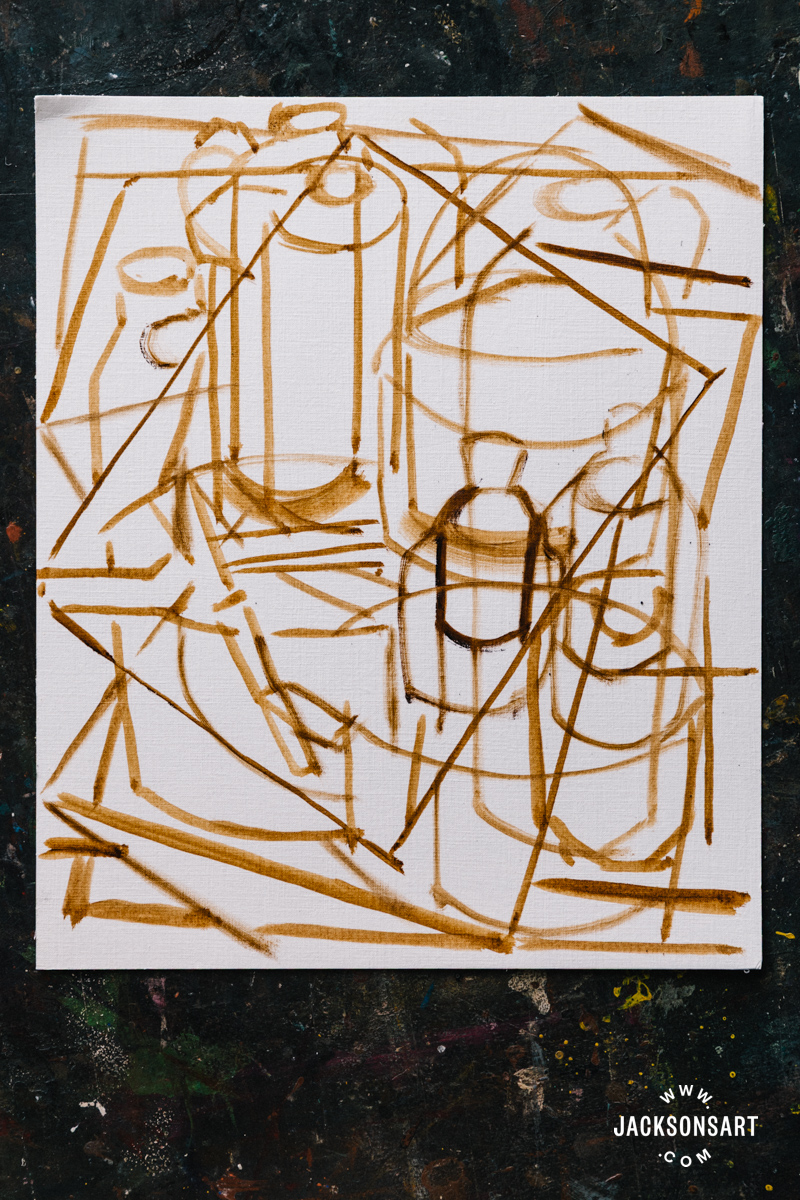
I drew with my paintbrush to render some of the forms of the objects in front of me, before rotating the board and drawing on top of the first layer. I repeated this process several times, adding elements methodically across the entire surface.
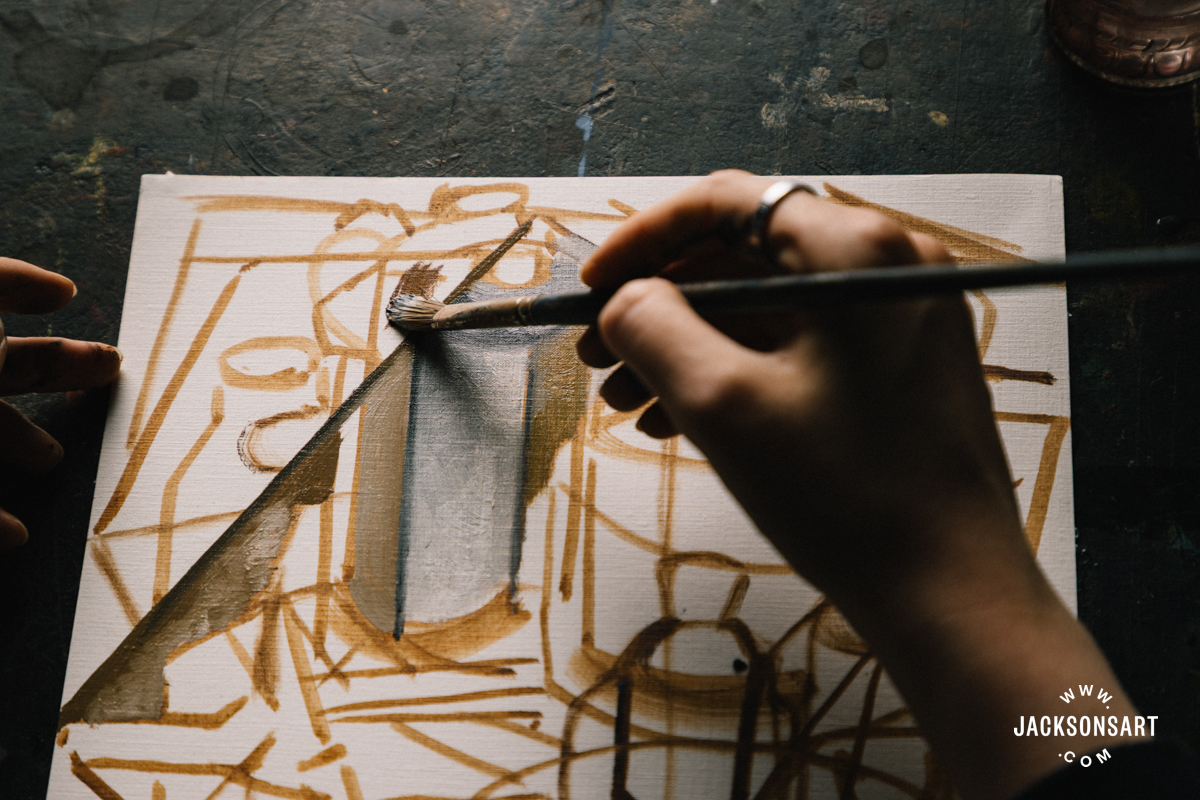
Next, I began adding colour to my underpainting, making sure to add tone with light cast from various directions in the Cubist style.
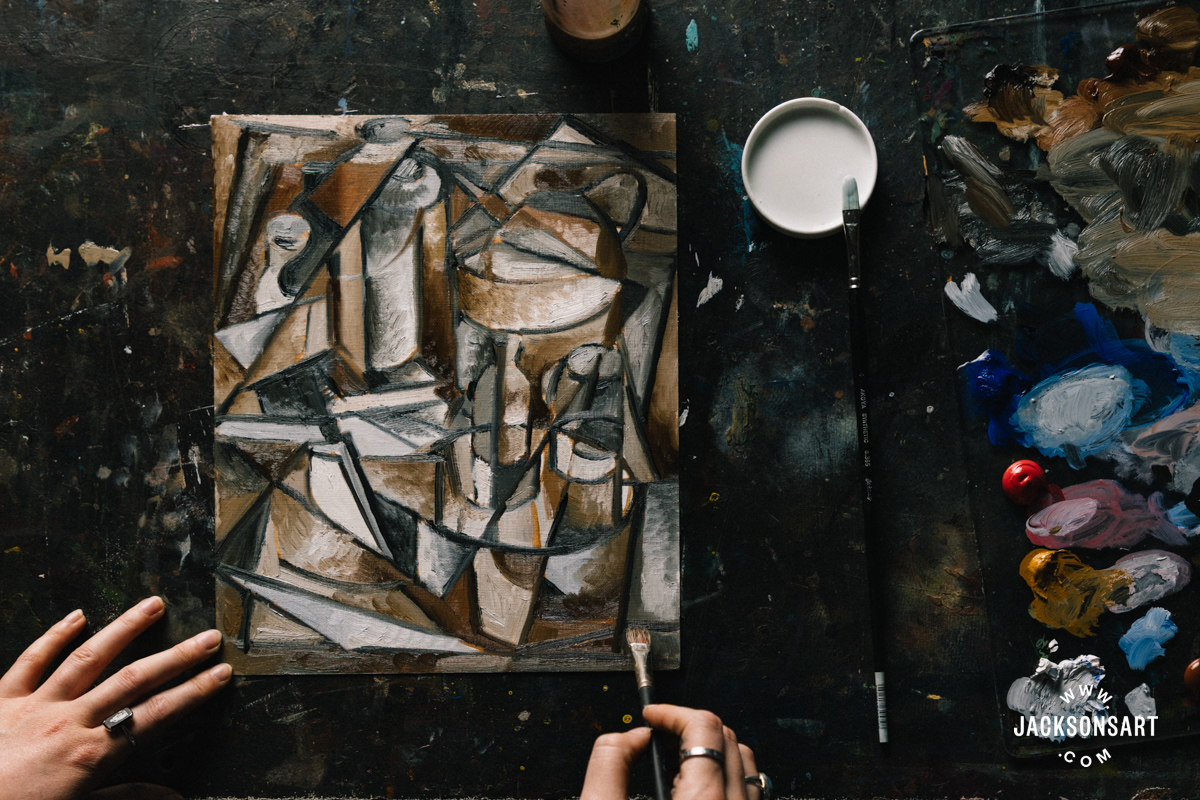
I completed my analytical cubist painting by refining the linear elements of the painting, by reinforcing the angles I added from turning the board, and outlines to some of the objects.
Demonstration of Papiers Collés
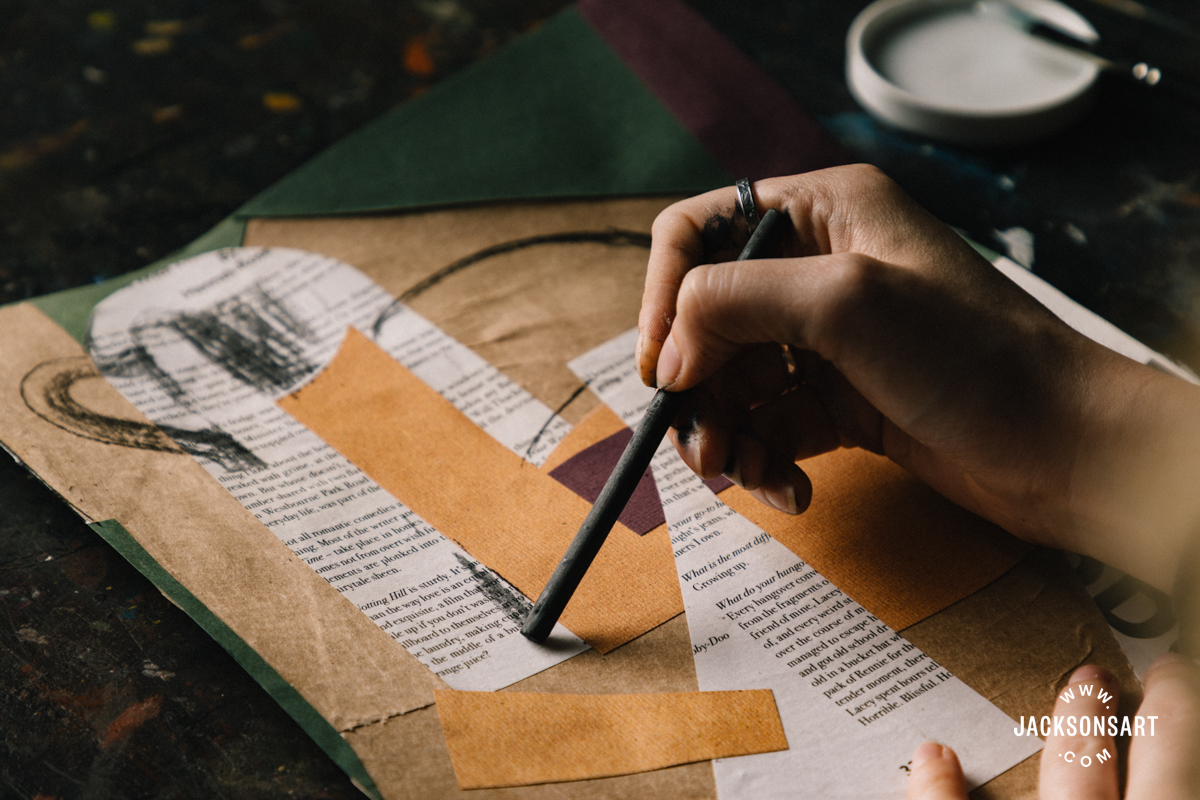
Collaging everyday materials into artworks was an innovation of the Cubist movement, which allowed artists to suggest form through shape, colour, and texture – to draw or paint on top of later. This can be seen in artworks like Bottle of Rum and Newspaper by Juan Gris. For my example, I used a newspaper, brown packaging paper from a Jackson’s package, and a couple of sheets of coloured paper.
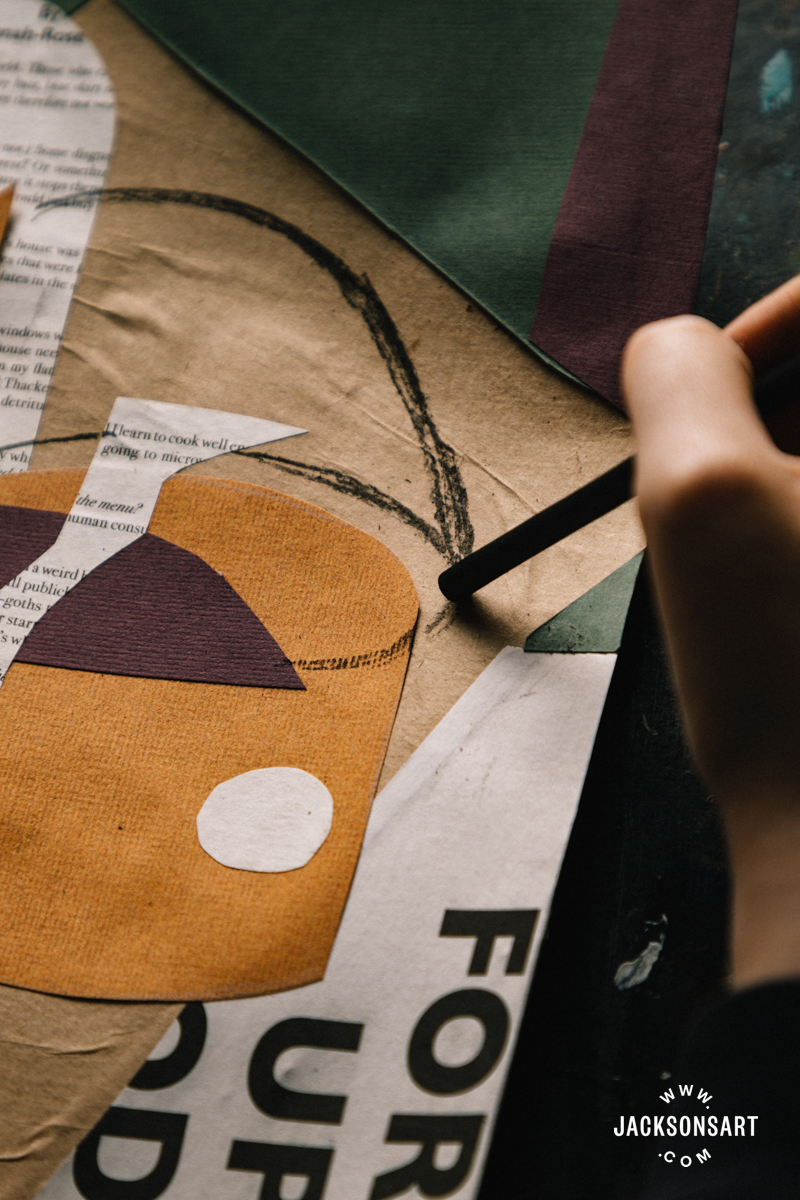
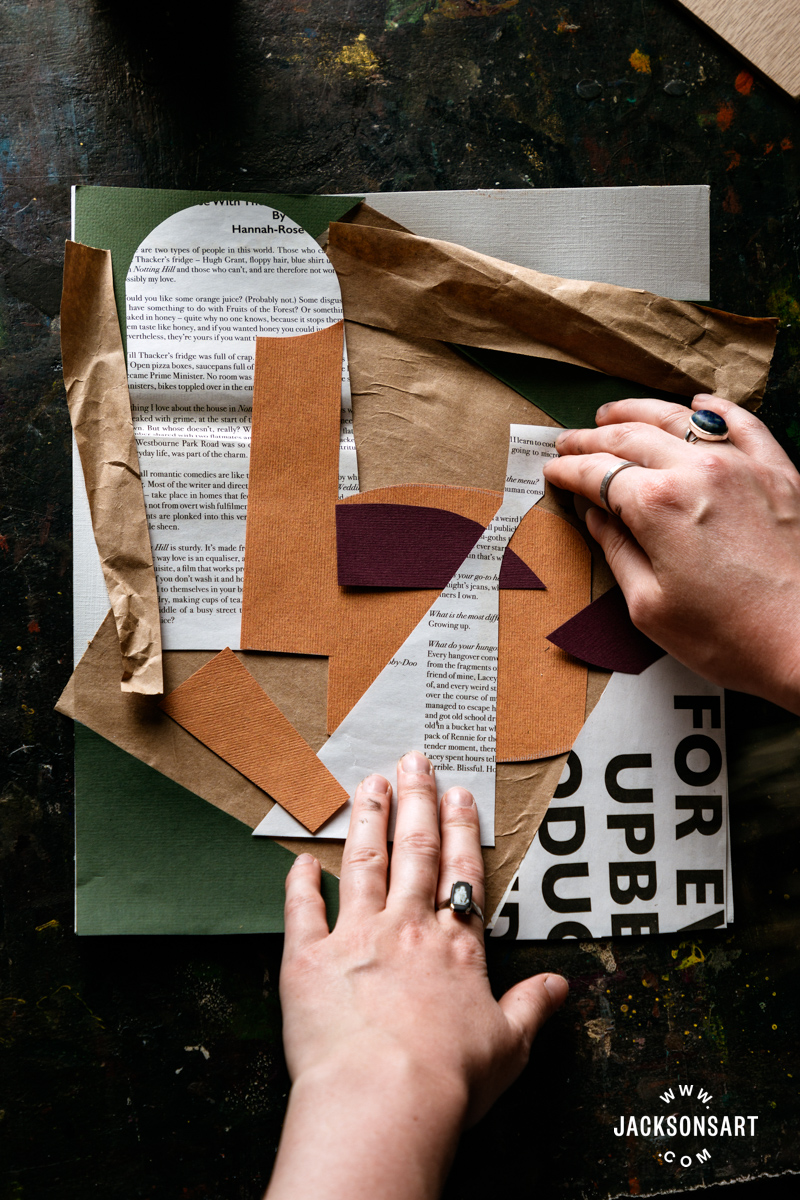
I worked from the same still life set up from the previous example, this time beginning by cutting out shapes to suggest the form or contour edge of each of the objects. Once I’d cut a few shapes, I rotated the board and adjusted some pieces of my cutouts. This took some trial and error to arrange a satisfying composition, especially to place the newspaper cuttings, since they initially demand the most visual attention.
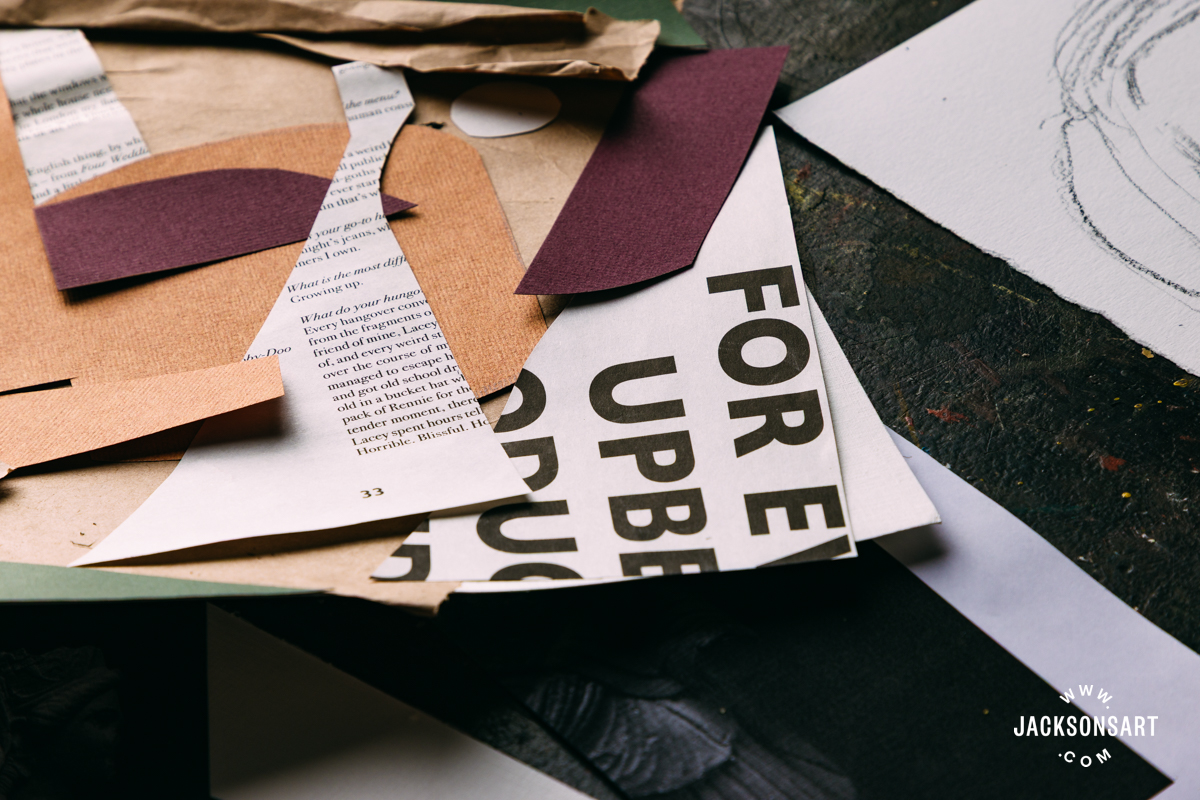
Once I’d arranged my collage, I began glueing the shapes down with Loxley PVA adhesive to a sheet of Jackson’s Fabriano Watercolour paper.
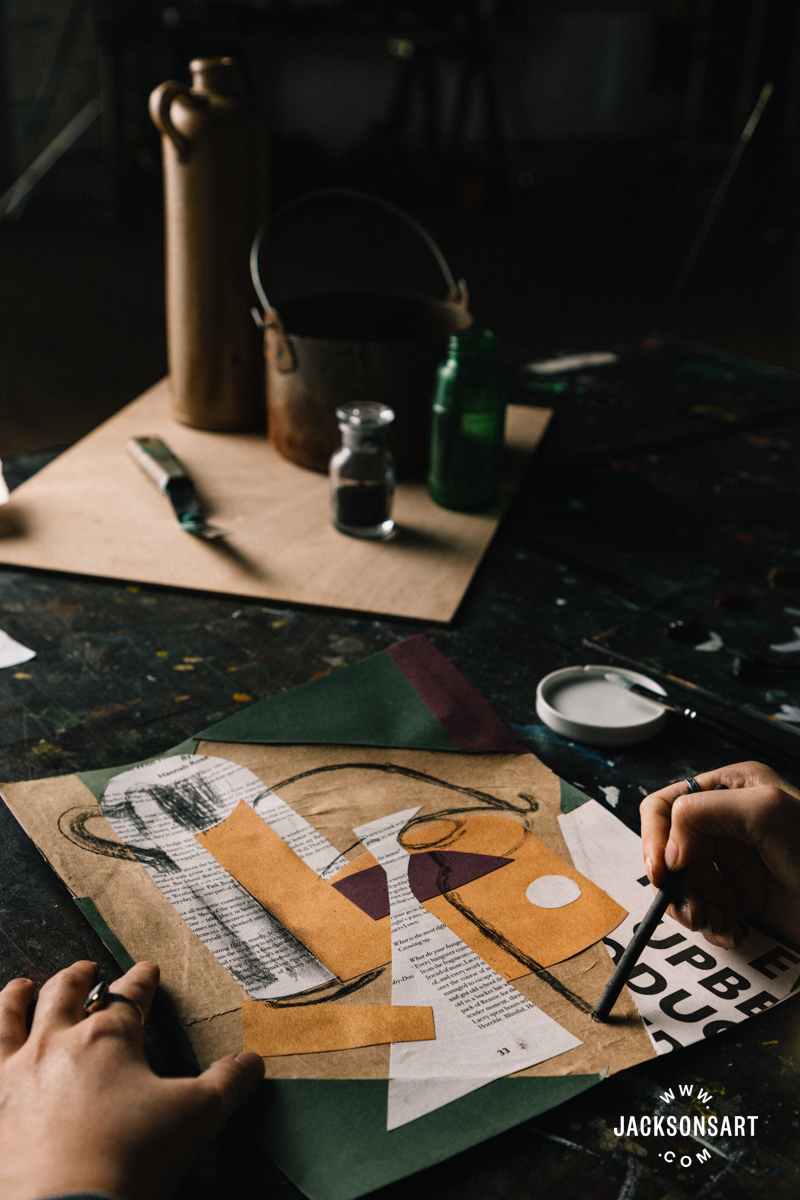
Then I drew on top of the dry collage with charcoal, picking out details like the handle of the jug, and contouring the edges of some of the objects.
Demonstration of Synthetic Cubism
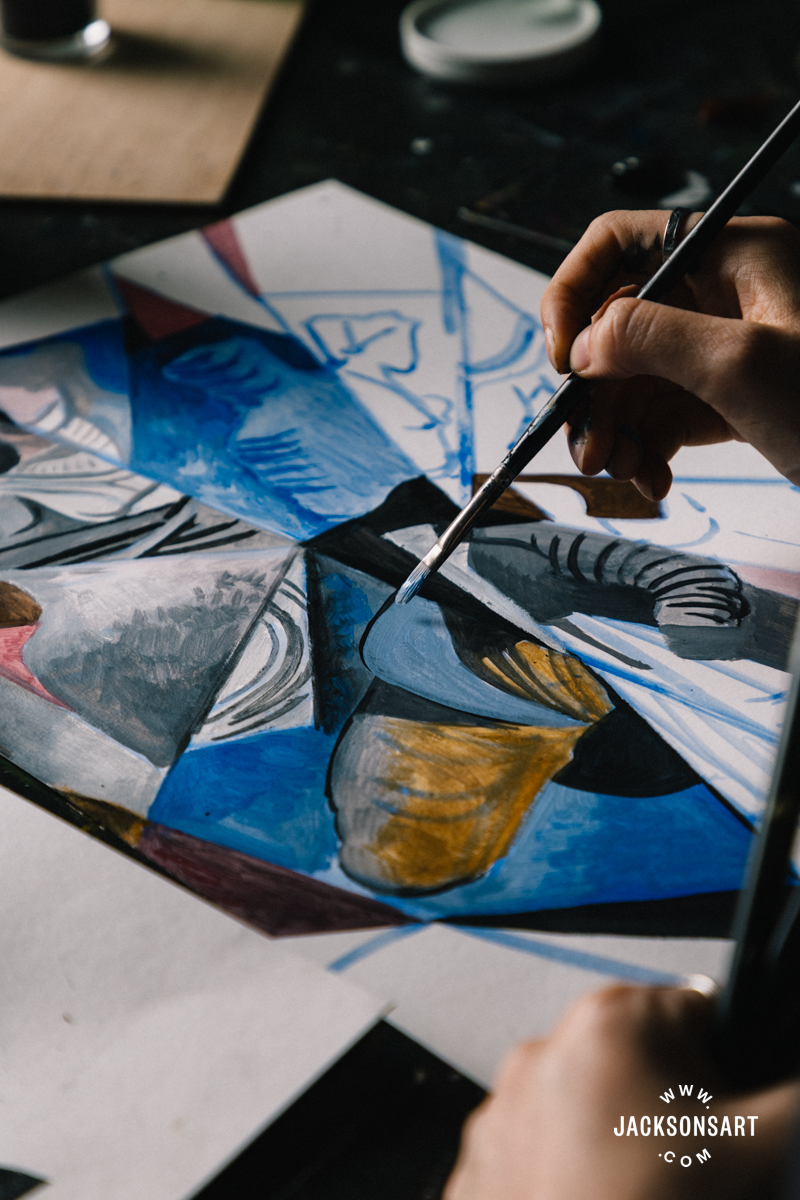
I was inspired by the strong colours and shattered figure in The Musician by Louis Casimir Ladislas Marcoussis. So I wanted to devise a simple means to create my own fragmented figure, but without a model to draw from. I painted with a small palette of acrylic paints, in Crimson, Ultramarine Blue, Burnt Sienna, Raw Sienna, and Titanium White.
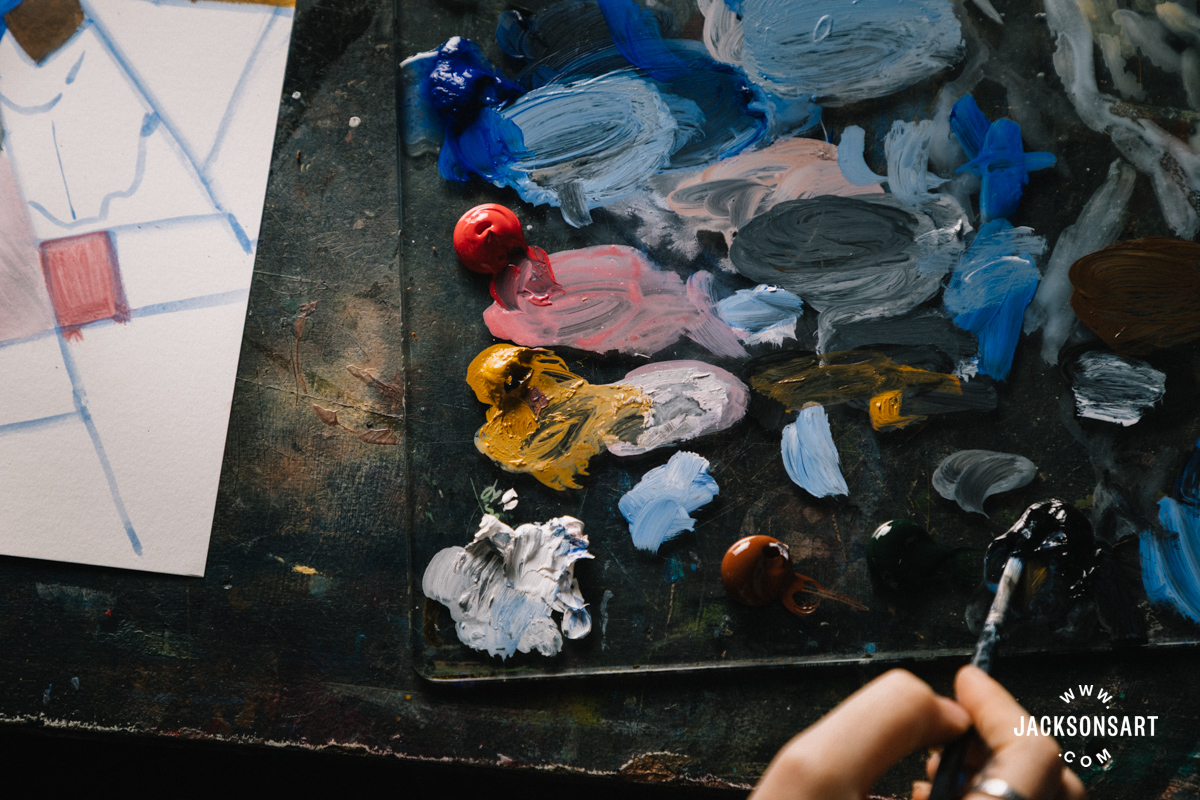
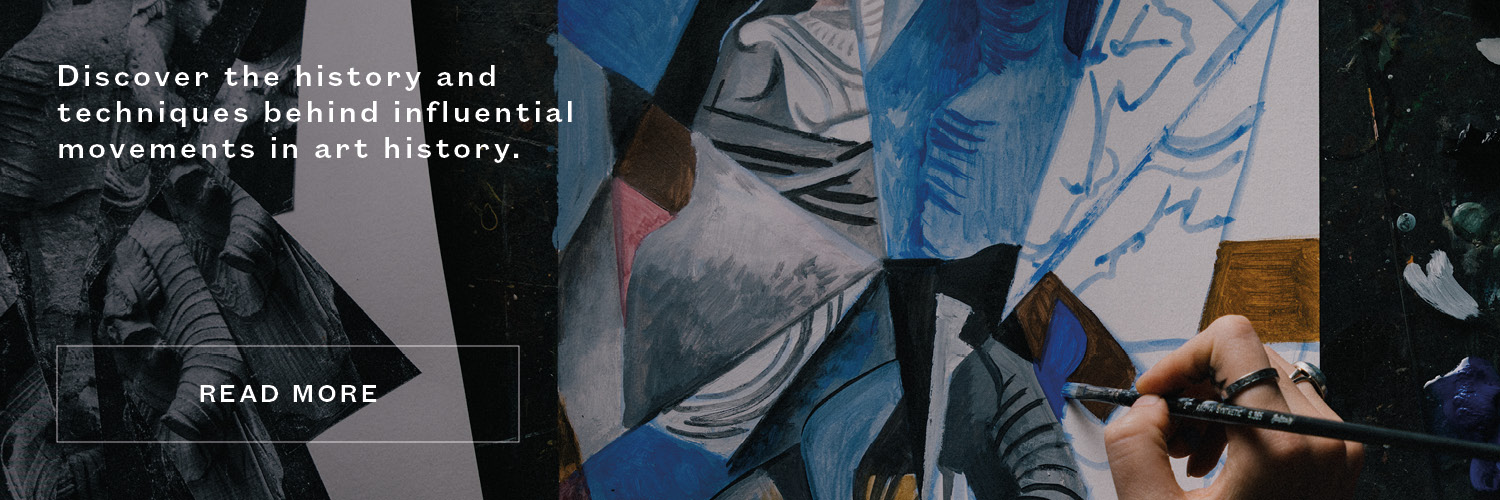
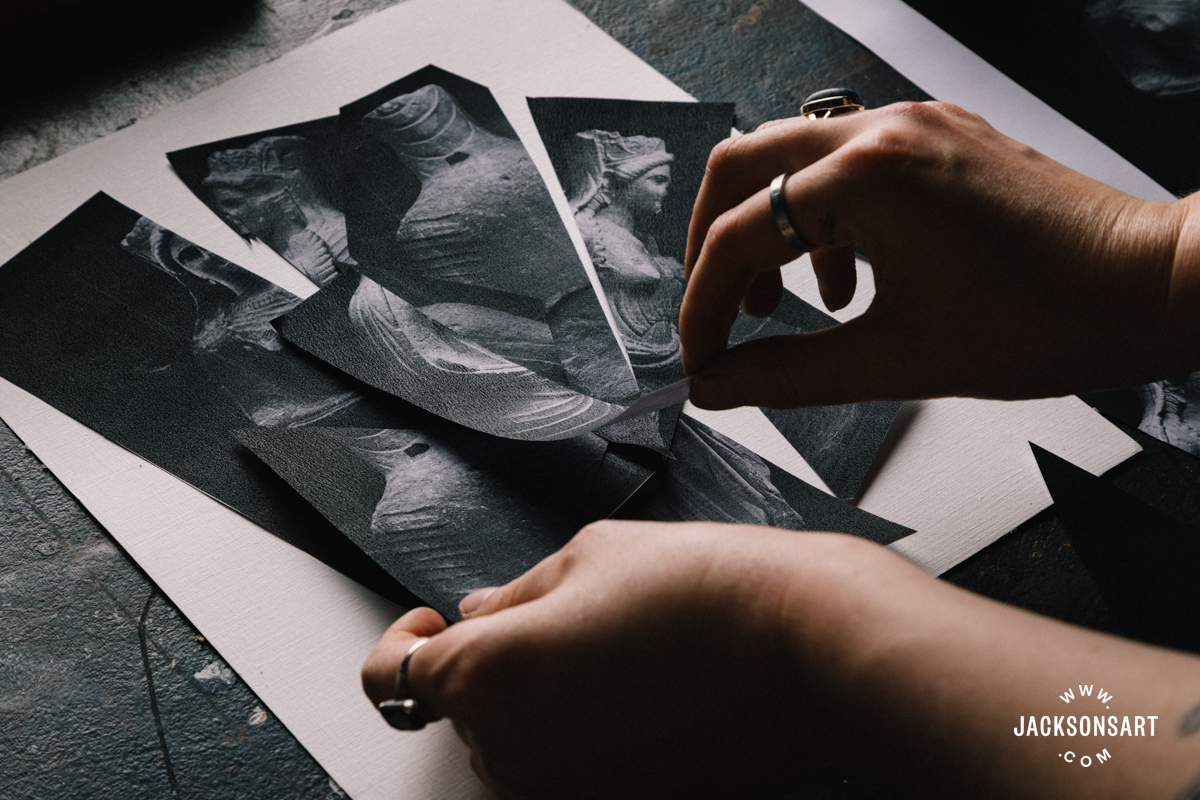
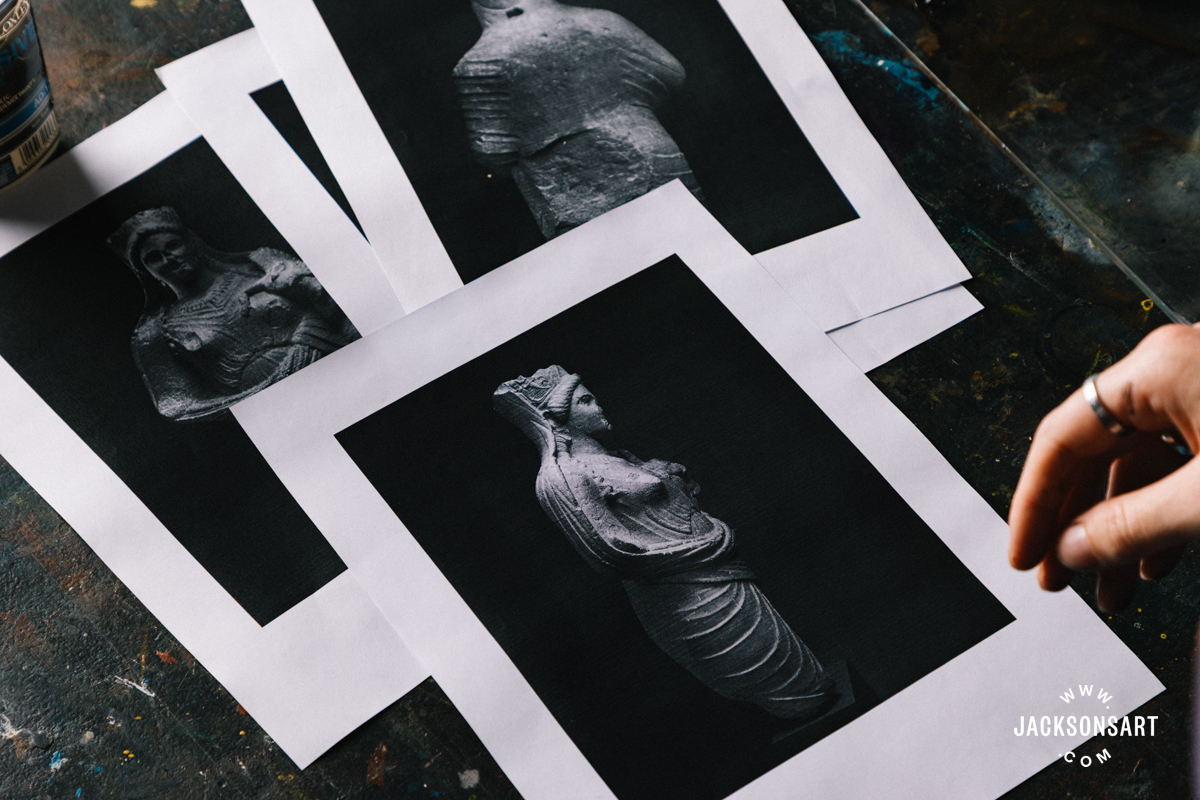
Many museum websites today have images of sculptures from different angles, or 3D models you can revolve. To begin my work, I printed out four views of Limestone statue of Aphrodite holding winged Eros, and cut the images into angular shards. I reassembled the shards, adjusting my cutting as necessary to make the shapes fit together, to create a direct reference of the figure from multiple angles to paint from.
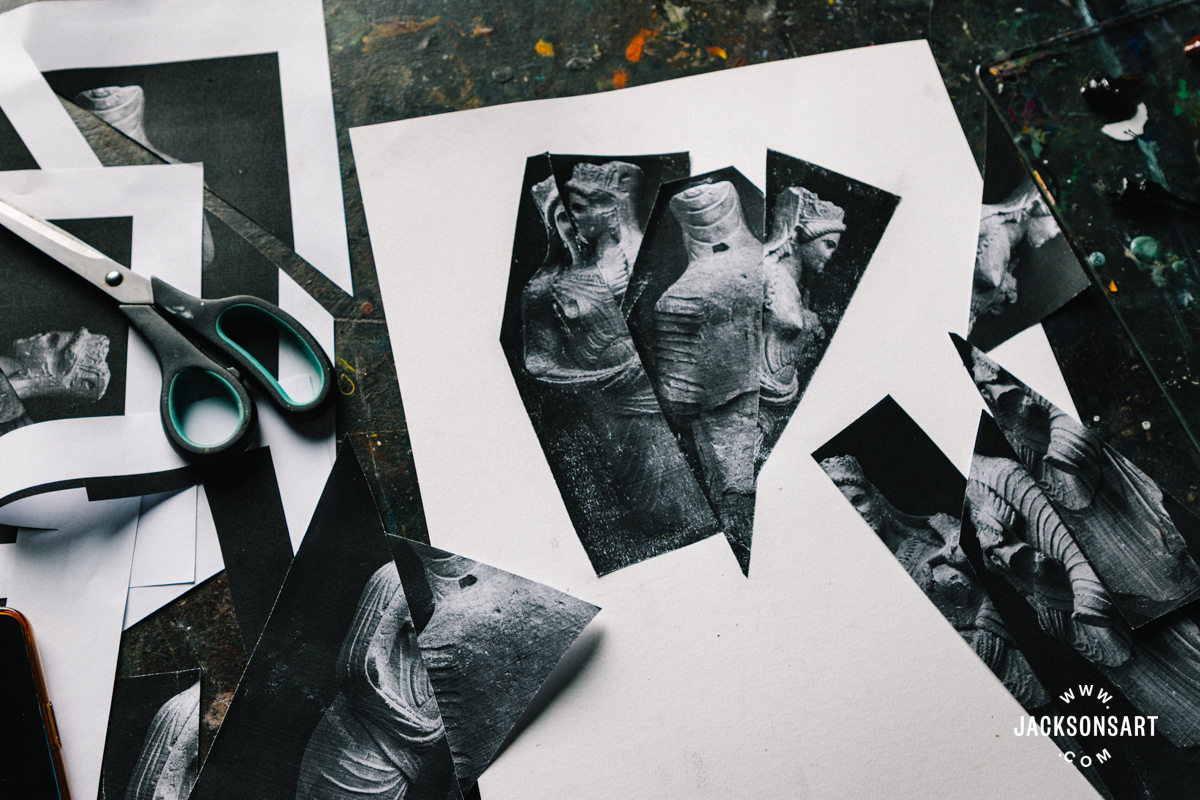
Next, I made an underpainting working with my photo collage as a reference, and extended the angles of the shattered shapes to the edges of the sheet.
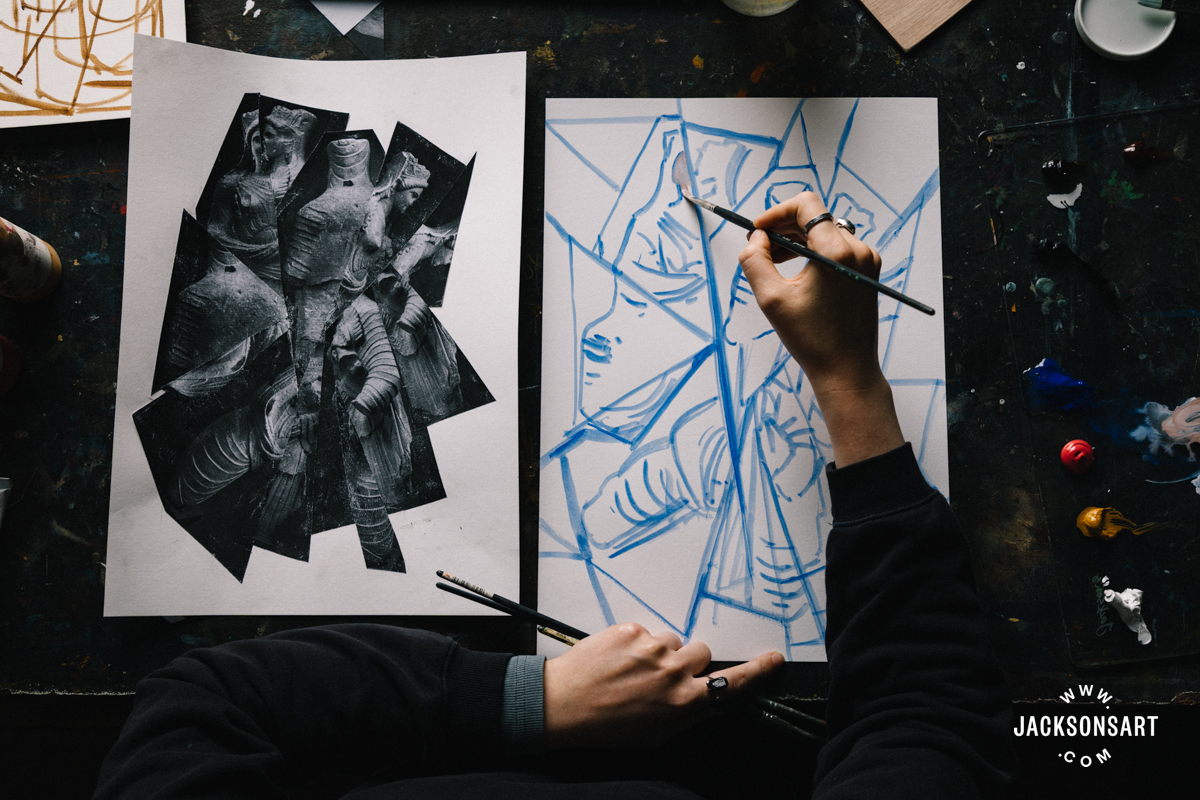
Then I worked my way around the painting, placing the colours with balance around the work, and being selective about how much detail to render in each fragment to emphasise the flatness of the surface.
Demonstration of Drawing a Cubist Portrait
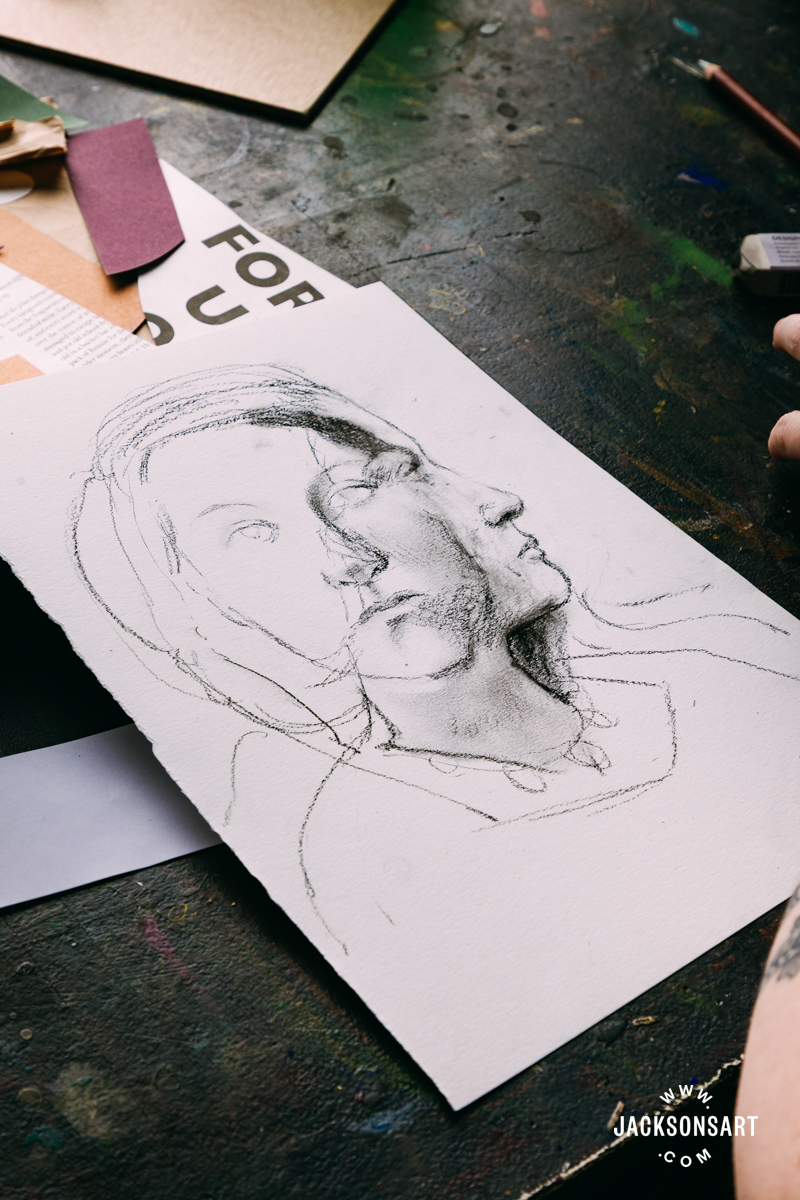
Finally, I wanted to devise a simple means to make a Cubist portrait, including different angles of the face with distorted features. This time I worked from two photographs of the same model – one facing forward, and the other turning to the side. These were Mary Hillier with Two Children, and Sappho, photographed by Julia Margaret Cameron.
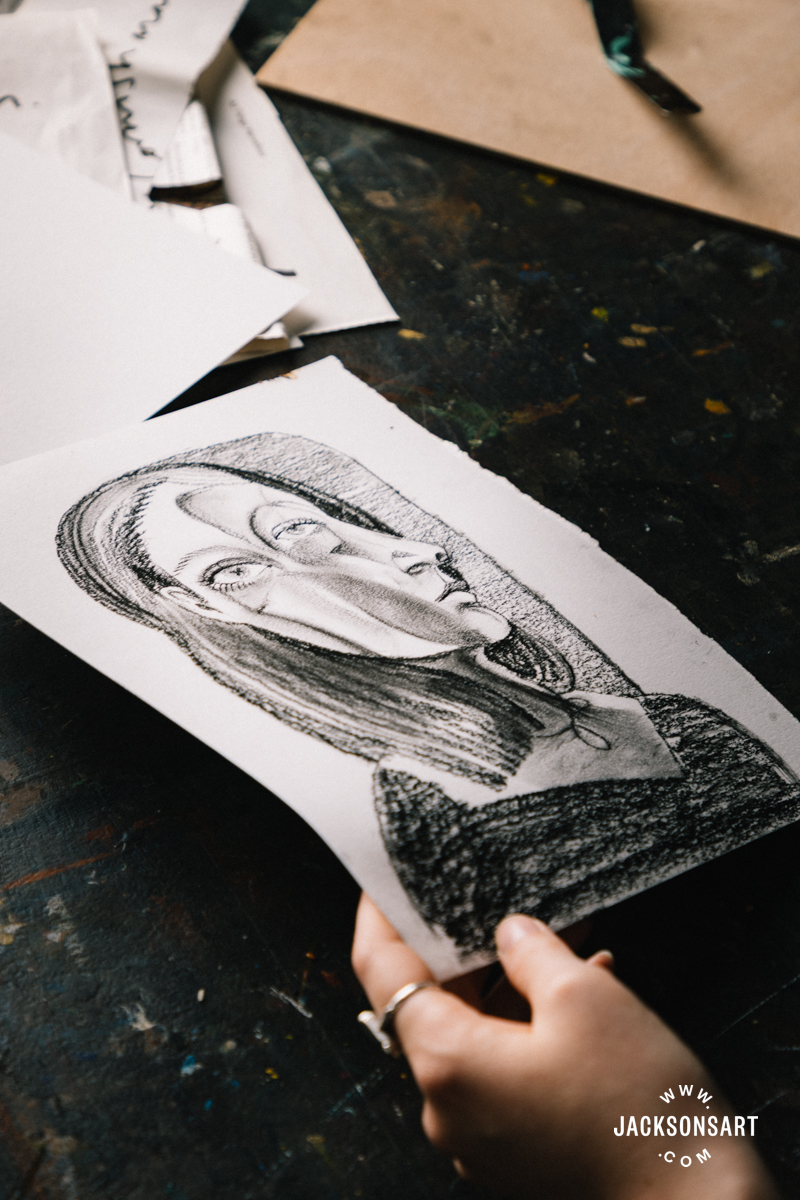
I made a simple drawing with a black coloured pencil from each of the photographs. I started with the subject facing forward, and then drew her profile directly on top. Already, you can begin to see how combining elements of the face from different angles might appear in the final work.
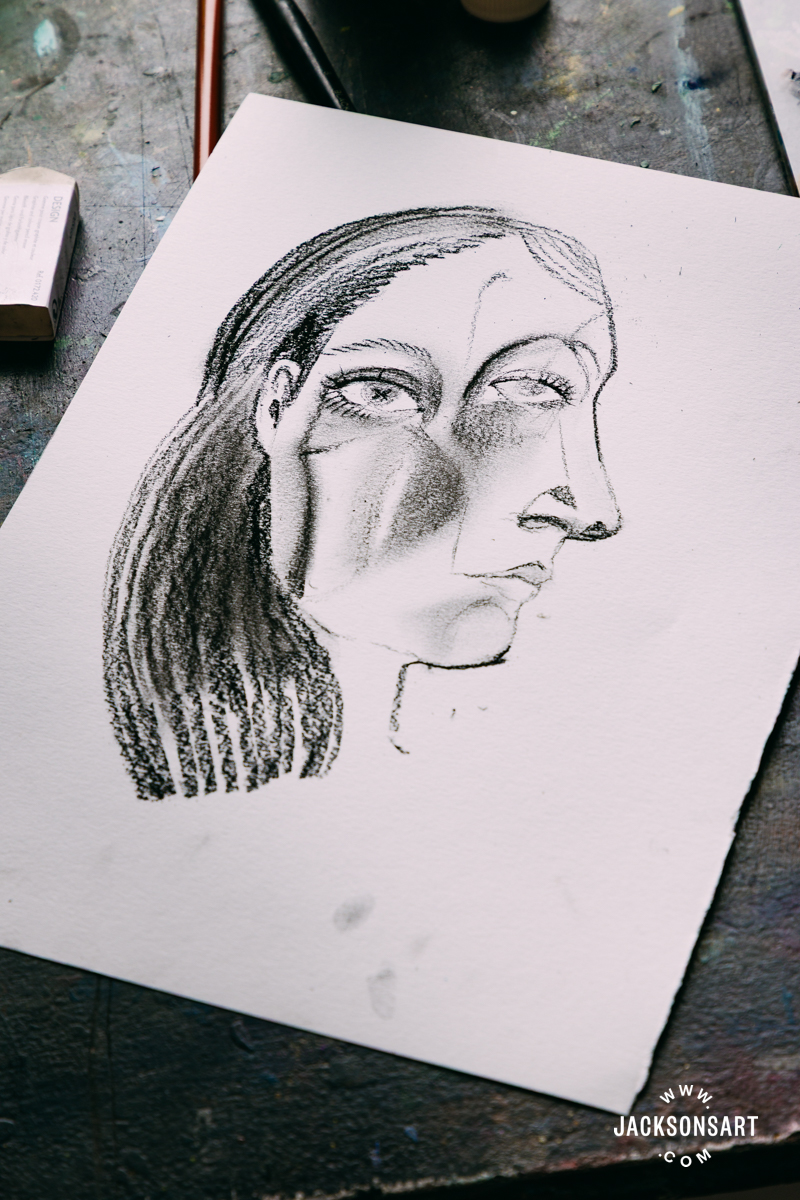
On a new sheet of paper, I worked from my first drawing by selectively redrawing the features in Cubist style, with less regard for representational proportions of the face, instead placing the features like elements of a design.
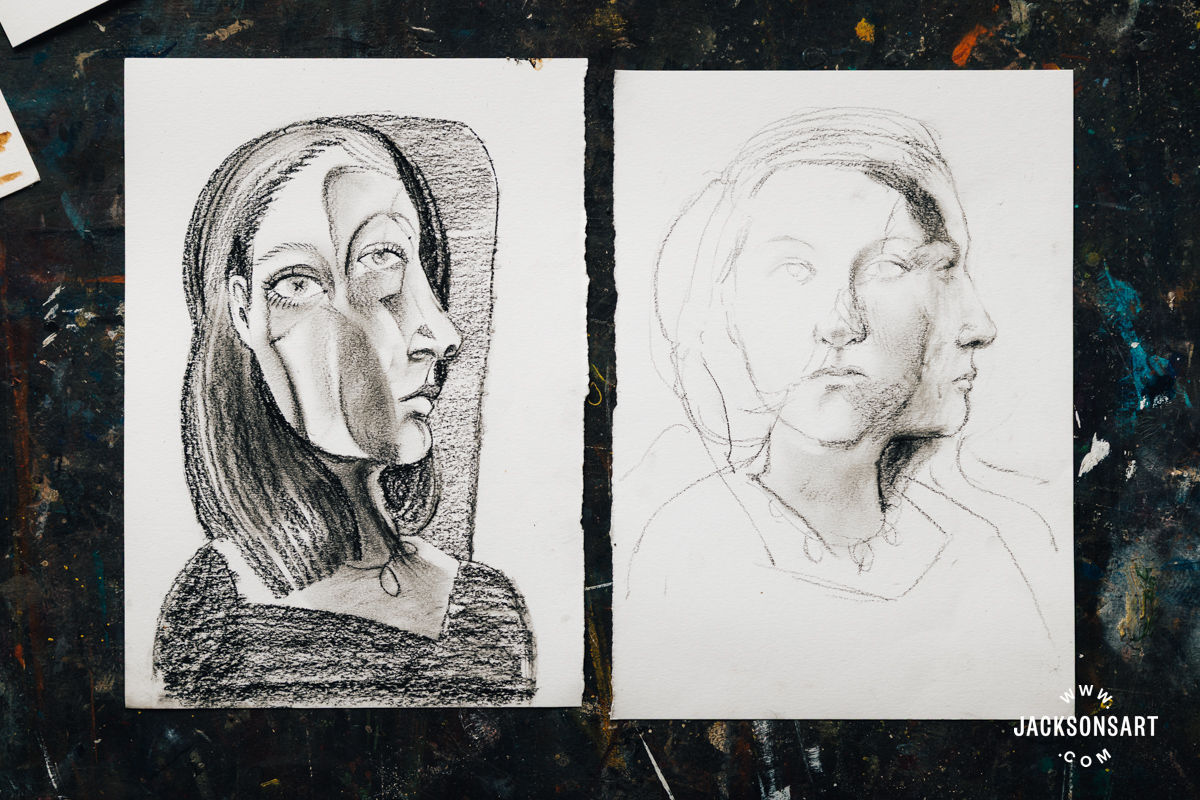
Side by side, you can see the leap between realism and the Cubist distortion of the face.
Further Reading
Behind the Movement: Art Nouveau
Collage for Beginners – What You Need to Get Started
Composition Throughout Art History
Behind the Movement: Northern Renaissance
Shop Art Supplies at jacksonsart.com