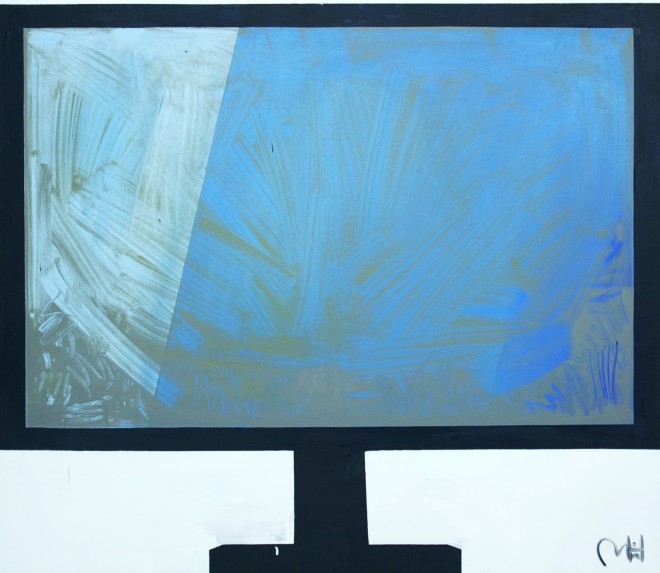
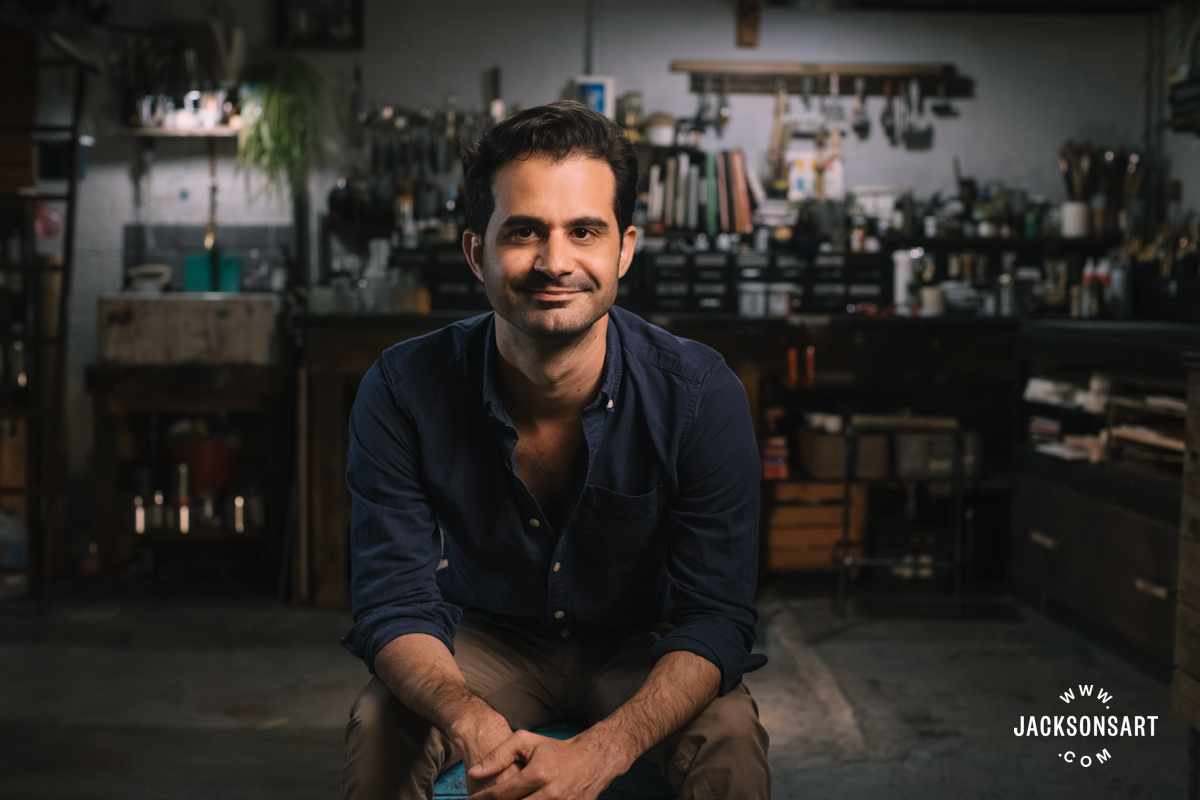
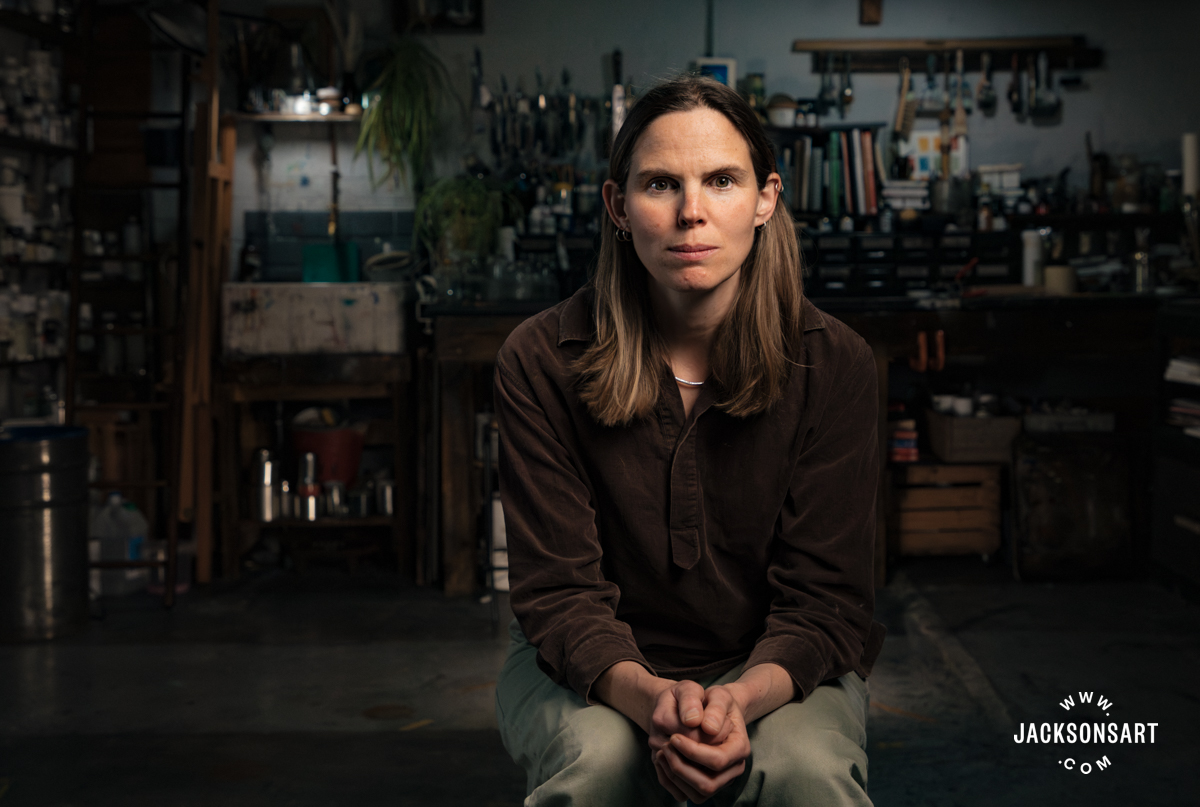
Rae Hicks paints colourful paintings that draw their inspiration from the landscape and mass media culture. Nods to surrealism, pop art, cartoons and advertising present us with pictures that leave us questioning what messages they are attempting communicate, if any at all, and does it really matter anyway? We asked Rae to try and define his practice in words and we were rewarded with his fascinating answers.
Lisa: How would you describe your paintings?
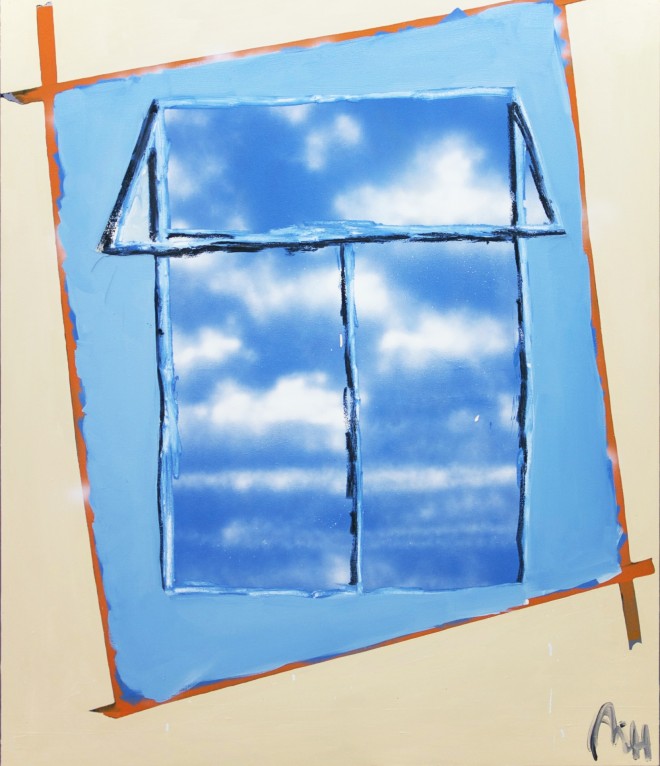
Rae: That’s always a hard question, and the one most often asked. I find it’s best just to say the first things that come to my mind. Recently they’ve been brightly coloured appropriations of landscape, taken from examples in packaging and mainstream design, but more disjointed; it doesn’t make as much sense when you actually see them because I muddy those equations with my own tastes.
Lisa: Are the titles thought of before or after the paintings have been made?
Rae: I can think of them at any point, although usually if one hasn’t occurred to me soon after the making of the work then it won’t ever. I have to be careful not to just name them all after songs or albums, as they always sound so apt in the moment. I suppose the simple answer is ‘during’.
Lisa: How much time do you usually spend on a canvas?
Rae: It can be anything from 3 hours to 3 weeks. Like the titles though, if it doesn’t happen within a window of time then it usually doesn’t at all. There have been a couple which I worked on, on and off for a few months, erasing and re-working but those never worked. For me painting is all about playing with ‘contrivance’ and I like the idea of really forcing a conclusion by a repeated rolling of the dice. It teaches you a lot because you can’t change the parameters, you just have to work with the limitations provided you’ve given yourself. For this reason the small works always take longer and I reach the brick wall many times before it’s either ditched or ‘finished’.
Lisa: How do you know when a painting is finished?
Rae: Things can only be as finished as they need to be, and it’s important to understand that there’s no such thing really as finished. But if you do any more than essentials then it starts to become a different work. There’s a sort of sensation when something is headed towards something new and complex. It’s like the feeling of having something in a trap, then it’s just a matter of tying up ends and sealing it in. The beginnings of the ‘finished’ feeling is located in this first sensation, then once there is a basic coherence, it’s as finished as it needs to be.

Lisa: What was going to art school at Goldsmiths like? Was it as challenging as its reputation suggests?
Rae: Yes, but probably not in the way people expect. The challenge was that I was very puritanical when I arrived, about nearly everything. I couldn’t process things which were mixed or contradictory. I saw oxymoronic relations as self-cancelling rather than productive, as if they were chemicals. But all of culture’s progression is rooted in this differentiation. I felt that desire as part of the making process was invalid, because it is morally indifferent. And with this, all that motivated me was invalidated. But things kept me in practice such as being lucky with my tutors who were really enthusiastic with me, and very generous with their time. Also I think a lot of others were in the same situation as me. It was a mixed-up experience, but I think it ought to be really.
Lisa: How do you keep the momentum in your studio going?
Rae: My process is in part based upon the actual lack of momentum, as this is an inevitable situation. It goes back to this thing of ‘forcing’ that I mentioned in question three. Conclusions and directions are often formed in a moment of mild hysteria, and I know this is useful but there’s something strongly akin to religion in this fermented state, and I also know that’s terminally unsustainable. I want production to come out of the nothing-chaos and give that a voice, because that’s how things are. It’s also one of these ‘constraints’ like a painting’s size, that ends up defining the work rather than carrying it. So apart from coffee and beer, I do very little to keep the momentum up.
Lisa: I’m told you paint with Jackson’s oils. Which range do you use and what do you like most about them?
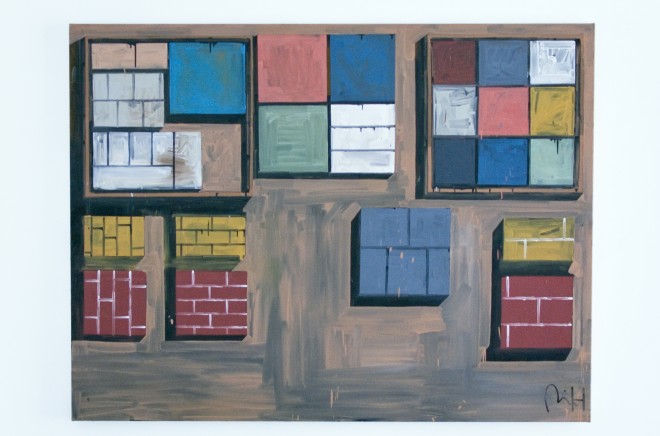
Rae: I use the professional range of course! Pigment is, very surprisingly, important to me, and they have a nice, bright, home-made feel like one of those rustic curries where you can actually see the different ingredients. Like “there’s a prawn, and that’s a pepper”. I’ve learnt not to use bad ingredients the hard way. They have a chunky paste like Turner’s dad blended them.
Lisa: You’re already a John Moore’s Prize Winning painter and you have exhibited in a number of prestigious galleries including the Saatchi gallery and the Royal Academy of Arts. But which moment in your career so far do you consider to be your proudest?
Rae: I don’t want to be sound glib but there have always been a lot of co-organised projects and exhibitions that I’ve done in various partnerships, and they are the fondest memories. They just resonate better over time, that’s just the way it’s turned out to be. Weird projects where you travel and pay loads of money and work really hard, get massively exhausted in a kind of kamikaze way. Looking back, actually recognised ‘achievements’ are quite adrenaline-y, and sometimes feel a bit like affairs. Although these instances such as the John Moores can put you in touch with lots of great people, and being in the environment can be an important experience that I couldn’t have given myself. That was the first time I went to Liverpool properly and it was absolutely boss.
Lisa: What are you working on at the moment?
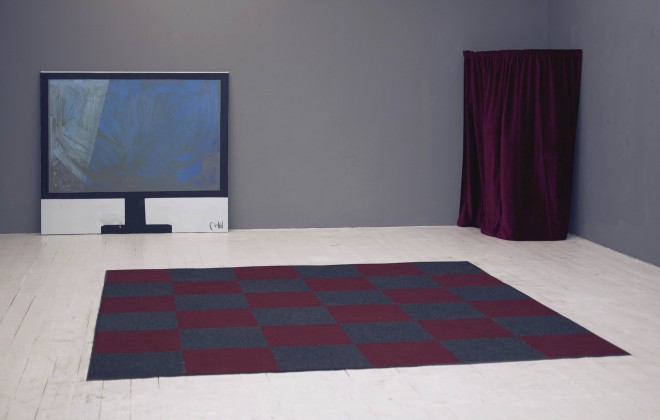
Rae: At the moment I’m working on a series of mid-size paintings based on logos with architectural pretensions. They are for exhibitions which will happen in the next few months. The source images provide a way to breathe life into some unadulterated colour fields and take on a lot of surface materiality. I love how the corporate colour schemes are embodied by something luxuriant like oil paint which takes away their flimsiness but leaves a lot of the zealous optimism intact. It’s a bloody weird combination, although an ancient practice.
Lisa: Where online or in the flesh can we view more of your work?
Rae: My website is raehicks.com. Currently my work is on show at Pi Artworks, London until September the 5th. Next up is the START art fair at the Saatchi from 10-13th of September where I’ll be showing on my own, on behalf of Canal Projects. My presentation will be entitled ‘Premium Projects’. After that is the Sluice Art Fair with Slate Projects, which will be in mid October. It’s a group presentation and I believe the title is ‘The Grammar of the Hardware Store’.