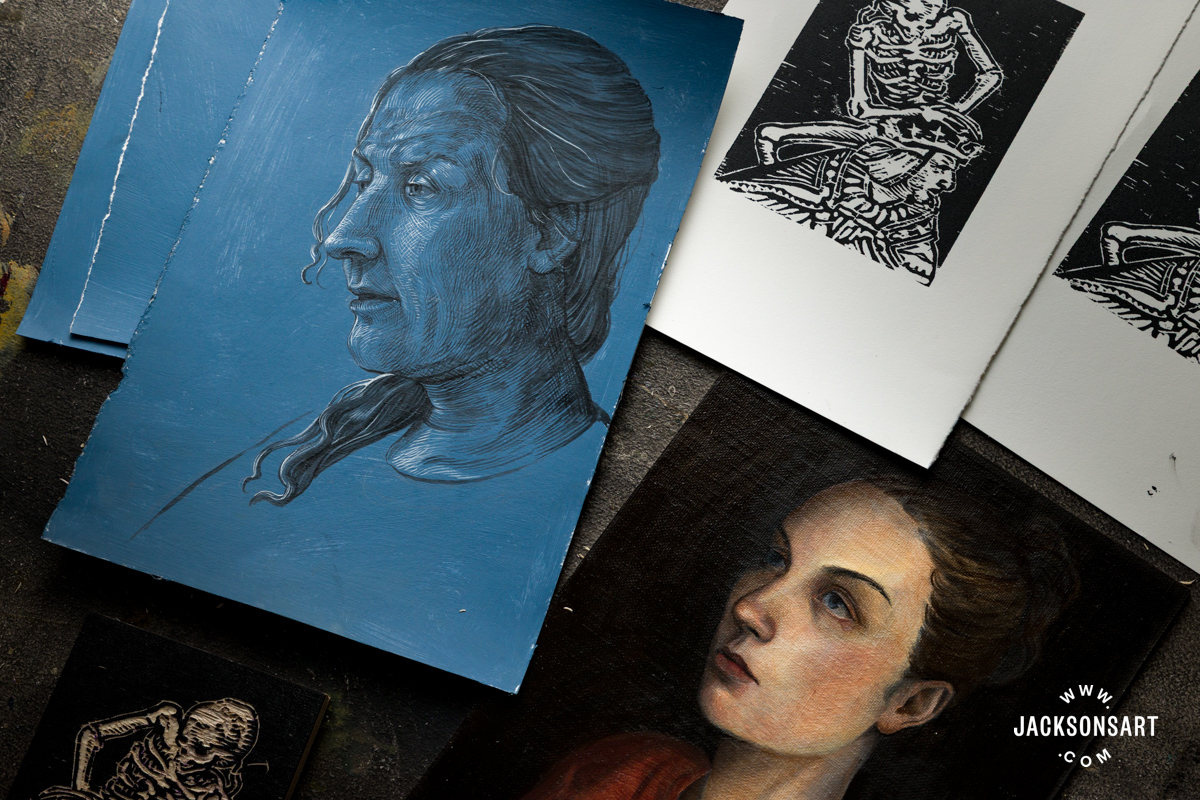
Wood Engraving was pioneered in the late-Eighteenth Century by British artists such as Thomas Bewick and William Blake, who used the technique to produce illustrations for hand-printed books. Using a tool called a burin, the engraver cuts a reversed design into the surface of a block of end-grain wood. The block is then rolled up with an oil-based ink and printed from: where incisions have been made into the surface of the block, the paper will remain white; where the engraver has left an area of the block intact, it will print black.
Wood Engraving and Linocutting by Anne Hayward is a handsome, densely-illustrated manual for artists wishing to learn how to engrave on end-grain woodblocks. The first thing to note about this book is that its title is misleading. Aspiring wood engravers will find chapters on materials, artistic composition, cutting and presswork in this book, but for lino, all of this material is condensed into the fifteen pages of the ‘Linocutting’ chapter. There are a number of design principles and practical techniques which apply to linocuts as well as wood engravings, of course, but Hayward doesn’t often mention Lino outside her dedicated chapter on the medium. I would recommend that artists and students who are interested in linocutting look elsewhere (possibly to Nick Morley’s recent book), because this is, first and foremost, a book about wood engraving.
As such, it begins with a brief cultural history of the medium. The opening chapters on ‘Wood Engraving in Context’ and ‘British Wood Engraving in the Twentieth Century’ are excellent, especially the former, which contains a sensitive account of the combination of Christian and Pastoral imagery in six of Edward Calvert’s engravings (including ‘The Chamber Idyll’, pictured above). Also welcome is the brief attempt to trace the influence of William Blake and his followers ‘the Ancients’ upon contemporary wood engravers.

These art-historical chapters do a good job of preparing the reader for the purely instructive sections of the book which follow. These pages are densely illustrated and lucidly written. Where contemporary engravers have come up with varying solutions to the same problem, Hayward gives a range of advice, which is generally a strength (though it’s frustrating that she ducks the question of which tools the beginner should purchase first by giving a synopsis of other engravers’ opinions on the matter). It is interesting that Hayward takes the reader through the process of squaring-up which must surely have suggested the compositional divisions evident in her recent work such as ‘January Afternoon‘ and ‘As the Light Changes.’
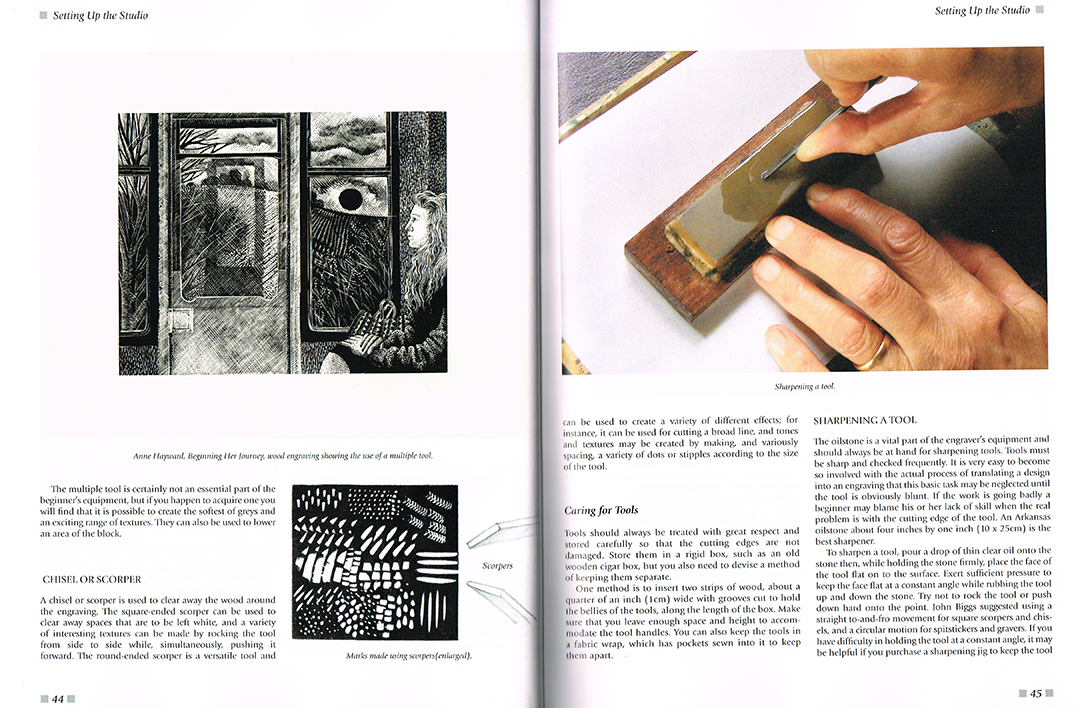
There are images of finished engravings (mostly Hayward’s own) throughout the instructive sections of the book, so that the reader can flick between photo-demonstrations of the type of cut a certain tool can make on a woodblock, and the use of that texture in a finished engraving. These images are the book’s real strength. Wood engravings are normally printed in a rich, matte black ink, and never look their best on a glossy page, but the usual complaints about shiny or greyish blacks cannot be levelled at this book. The images in Hayward’s book compare favourably with those in other recent wood engraving manuals such as Simon Brett’s Wood Engraving: How To Do It. It almost has the appearance of a coffee-table book.
Anne Hayward’s ‘Wood Engraving and Linocutting‘ can be bought at Jackson’s, as can ‘Lincocut for Artists and Designers’ by Nick Morley. You can read a recent review of Linocut for Artists and Designers on our blog.