



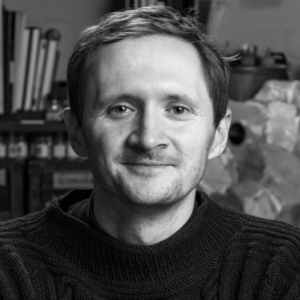
Since taking the decision to concentrate on his art more fully back in 2015, Jamie Sugg has made a name for himself as a painter of landscapes in acrylic, focusing on the vast, open skies of East Anglia. We spoke to Jamie to find out more about his working practices and the materials he uses.
Duncan: Hi Jamie, thanks for taking the time to talk. I wonder first if you could you talk us through your artistic background and your current practice; how you became an artist, what media you use, your subjects and your inspirations.
Jamie: I’ve taken the long way round to becoming an artist. I started studying art at 6th Form, but my circumstances changed when my parents moved from Norfolk to East Cambridgeshire when I was 18. I never completed my studies, so started full-time work, first in reprographics, then construction. I’d always enjoyed painting over those years and sold a small handful of traditional watercolours, but it was always a hobby. In 2011 I joined the National Trust as a Premises Manager – a wonderful job at a beautiful estate.
In July 2013 I became ill and could no longer work. I subsequently recovered to get back to work full-time for a short period, before I was signed off work again in March 2014. At first, this was just supposed to be for a few months but eventually I never returned full-time. I spent my time convalescing by watching hundreds of hours of YouTube painting videos – demos, documentaries, plein air, contemporary, traditional techniques. I learnt so much but wasn’t strong enough to put it all into practice as much as I wanted to.
Diagnosed with M.E., I was dismissed on grounds of ill-health in June 2015, a few weeks before I had agreed to take part in Cambridge Open Studios for the first time. It was a huge effort, but we managed sell more than twenty paintings across two weekends. That was the turning point, and we haven’t looked back.

I use acrylics on canvas for the majority of my work. I love the vibrant, strong colours that dry really quickly – it allows me to complete paintings in one sitting, which helps me to pace myself and not push my health too much in one go.
I focus mainly on the landscape around us here in the Fens of East Cambridgeshire. Because of the flat landscape, there are two focal points wherever you look: firstly the huge skies which can be filled with storm clouds in the east but a colourful sunset in the west, all visible in one vista; and secondly objects that puncture the horizon, such as church towers, trees and telegraph poles.
I’m inspired by the works of a number British landscape artists – Fred Ingrams, Chris Prout, Neil Pinkett, Peter Wileman. Bold and expressive marks, depicting the varying British landscape.
DM: You paint a lot of landscapes and views of skies in the Fens where you live. Do you paint en plein air, or do you work from sketches and photographs? I notice from your website you have painted a number of watercolour views of Cambridge – how do these works fit in with the rest of your practice?
JS: I create mainly in the studio, though I have recently started painting en plein air as my strength and stamina has increased. These paintings tend to be more ‘traditional’ in the sense of more brushwork than palette knife and more muted colours.

I have a small local following of collectors and patrons who like my watercolour paintings which depict village life, well-known landmarks and landscapes. These always prove popular, and make good commissions for those that want to capture their garden or house in a particular season. This is a good source of income for those months when I’m not exhibiting or at shows. The bills need to be paid!
DM: The painters you cite as inspirations all display quite vigorous mark making, as do your own acrylic landscapes. You mentioned earlier that you tend to paint with palette knives in the studio, rather than en plein air. How do you combine palette knives and brushes in your work?
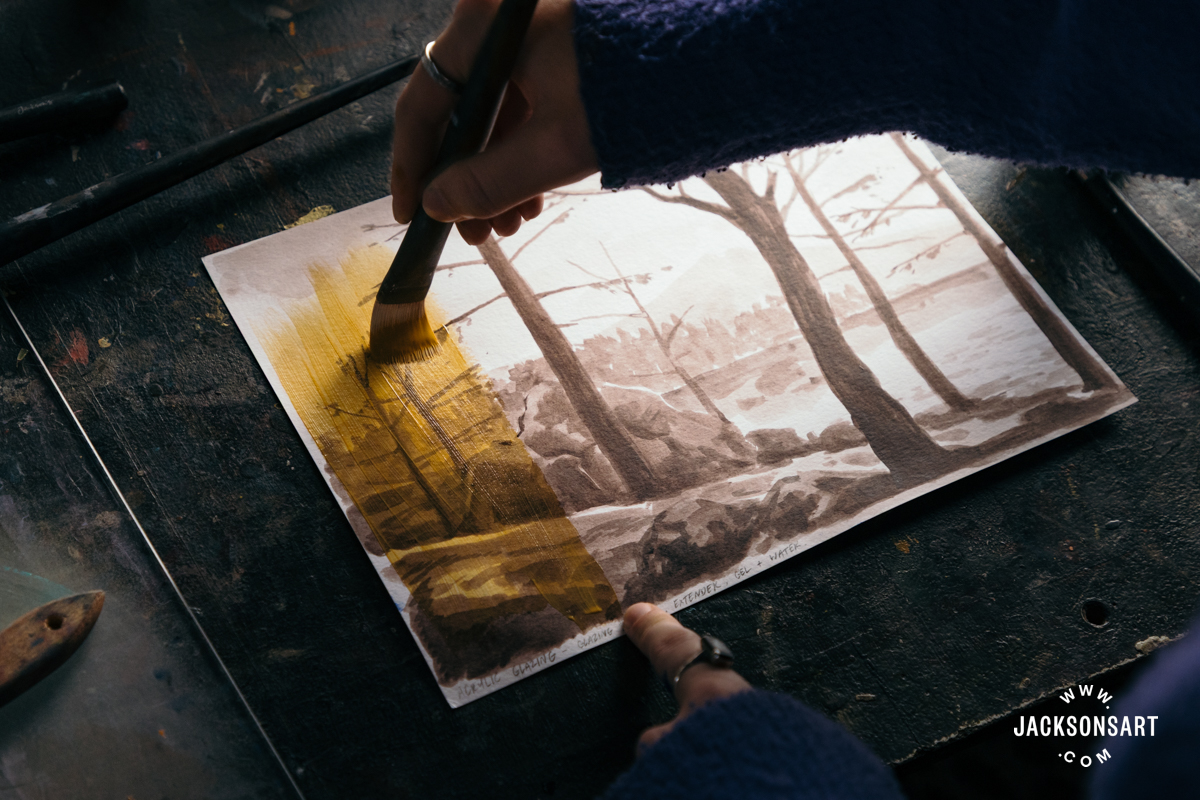
JS: I block in the main composition and colour with brushes – large areas of underpainting, plus any small details that may not be easy to create with palette knives. I then accent the underpainting using the palette knives. This tends to be based on the underlying colour but with variations of strength and tone to create depth, distance and perspective. Any small details are then carefully added with a single mark from the palette knife. En plein air I use brushes to create the underpainting and detail, highlights etc., and sometimes I may add a bit of palette knife work as a highlight, but it’s just another thing to carry around!

DM: We noticed recently that you left a review on the Jackson’s website praising the Shinku range. What was it about the Shinku brushes which spurred you to review them? Are there any tasks which you think they are especially well-suited for?
JS: The Jackson’s Shinku brushes were the first set of brushes I purchased that I found did exactly what they said on the tin. They have a firmness that allows plenty of paint to be held, but a springiness that leaves a lovely mark on the canvas. I can push the paint around or gently highlight an area with one stroke depending on the pressure I use. The larger brushes are great for blocking in as they hold so much paint that releases slowly, and the smaller brights have a wonderful sharp top to the bristles which are great for creating marks such as tall grasses or fields of crops.
DM: Is it a constant struggle, using different marks and textures to record aspects of the landscape? Do you attempt to consciously push forward and break new ground with each painting?
JS: It is always a struggle to capture the landscape both as I see it, and as I see the finished painting in my head! Sometimes the painting comes together very easily, is finished in a few hours, gets framed and looks great. Often, it’s hard work to make it all come together. I’ve not settled 100% on a method of painting that I’m comfortable with – it’s always an experiment and in that respect I guess I am always looking to improve and push things with each new painting.
The Jackson’s Shinku Red Synthetic Bristle Hair Brush Set contains two Shinku Rounds (size 0 and size 6), one Shinku Bright (size 8), and one Shinku Filbert (size 4). Jamie’s original review read as follows:
‘I have tried many brush ranges, from many top art producers, but none compare to these Shinku brushes. Firm yet flexible, they hold acrylic paint really well and allow me to make brush marks not achieved before. After a few weeks of heavy use there is no sign of wear or losing shape, and they clean up very easily, even after paint has dried on (whoops). The No.6 round is my favourite – huge brush strokes and very thin, sharp lines from the same brush. Nice one Jackson’s!’
The image at the top of this article is ‘Birds on a Wire’ by Jamie Sugg (acrylic on Jackson’s 19mm premium canvas). You can see more of Jamie’s art on his website, and view or purchase his paintings at The Darryl Nantais Gallery, Linton, Cambridge.


2 thoughts on “Jamie Sugg: Fenland Skies in Acrylics”
Thank you for interviewing me, I’m very grateful for the
interest in my work. The top four paintings are all available to
buy from The Darryl Nantais Gallery, Linton, Cambridge
(www.nantais-gallery.co.uk).
Beautiful work. You capture the fen
landscape in all it’s glory.
Comments are closed.