



‘Drawing and Painting The Landscape’ by Philip Tyler will shake up how you see the act of creating landscape drawings and paintings. This book questions what a landscape is. What do you want to say with your landscape painting and how will you say it? This book review by Lisa Takahashi describes why this book might just entirely change your approach to painting and drawing for good!

What’s the format of the book?
‘Drawing and Painting The Landscape’ by Philip Tyler is described as a ‘course of 50 lessons’. The book is a thorough look at many aspects of painting or drawing the landscape. The opening chapter offers readers a comprehensive look at the drawing and painting materials you might use. It also covers the surfaces you might work on. The text is technical and in-depth (not unlike the content of one of our catalogues!) and accompanied with clear photographs. There is even instruction on how to make your own stretched canvas from scratch.

It’s a very good point of reference, especially if you are unsure about trying a certain material for the first time. Following this chapter are sections covering ‘Linear Drawing’, ‘Perspective’, ‘Tonal Drawing’ ‘Mark-Making’, ‘Composition’, ‘Painting’ and ‘Colour and Ideas’. Within these chapters are an introduction to relevant concepts with illustrations. Readers will also find one or more ‘lessons’ that invite you to put what is being taught into practice. You will find many quotes, illustrations and observations of the work of other painters. These include Louise Balaam, David Atkins, Richard Whadcock and Harry Stooshinoff.

Who is the Author?
Philip Tyler is a practising artist who teaches at the University of Brighton. His work is represented by several commercial galleries. In recent years, he has focussed on painting his local landscape of West Sussex. He has also written ‘Drawing and Painting the Nude – a course of 50 lessons’. I first came across Philip’s work when he took part in an episode of ‘Sky Arts Portrait Artist of The Year’. Consequently I began to follow his Instagram account. It was there that he charted his accomplishment of painting 100 portraits in 100 days.

The amount of consideration for every subject covered in the book came as no surprise to me. Philip Tyler is clearly a highly knowledgeable, intellectual and dedicated painter. Evidently his passion courses through every sentence of the book. It is clear he spends much of his time thinking about painting. He is inspired by the myriad forms it can take. Philip Tyler is interested in the reasons why painters paint.
Readers will find images of paintings by some of the author’s favourite painters – both historical and contemporary. These are paired with his observations, serving to highlight the fact that all landscape painters are different. Their motivations to paint are not the same. Nor their approaches to picture making. Consequently this is a book that celebrates this diversity of painting. It is a book that suggests rather than prescribes the ways you might respond to a landscape.

Who is the book aimed at?
This book is aimed at those with some drawing and painting experience. Readers who are serious about developing their own individual practice will benefit the most from this book. I would hesitate at recommending this to an absolute beginner. The density of information and lack of step-by-step instruction may prove impenetrable. It’s a serious painting workshop laid out in a book form. The drawing component goes some way to teaching how to complete a finished work of art in ink charcoal or graphite. However there is often emphasis on drawing being used to develop ideas to formalise in paint.

What will the book teach you?
Readers will be taught to understand their materials and their motivations to paint. Tyler demonstrates how you can utilise this information to create strong paintings. He introduces and explores key principles behind composition, mark-making and colour. A number of playful experiments and projects help with idea development and take your work into unexpected and exciting territories.

Do I agree with the Author’s Point of View?
This book is packed full of brilliant ideas to broaden your practice. Some ideas will seem relevant and some not so relevant. It will depend on who you are and your current creative concerns. This is a great book to keep in your studio and dip into from time to time for inspiration. It would take time for some of these ideas to percolate through and inform the work I make. Therefore I wouldn’t religiously follow each lesson on a weekly basis. It’s important to not feel overwhelmed by advice!

How would I describe the style of writing in this book?
The book is informative and practical, without ignoring the need to express emotion when making pictures. It draws on the personal experiences of the artist as well as his observations on the work of others. As a result it considers both the scientific and the romantic. Where the text becomes hard to follow there are excellent photographs that go some way to explaining the concepts.

Trying Out Lesson 1 of the Book
Lesson 1 is titled ‘The Evocation of memory’. The lesson places emphasis on the fact that it doesn’t take much to create a simple image that evokes the sense of a landscape. A horizon line is all you really need!
The first practical exercise in this lesson is ‘Invented Landscapes’. This involves drawing a series of rectangles with a graphite pencil. A horizon line is then added. After this horizontal lines should be drawn that get further apart and darker as you go down the rectangle. This gives a sense of perspective. The next exercise involves drawing more expressive, irregular lines. Readers are encouraged to allow each line below to follow the shape of the line above, exaggerating the angles more and more each time. After this Tyler suggests trying the exercise combining various media, before working into the drawings more.

I thought this was a really interesting introduction into drawing the landscape. It never occurred to me to try creating imaginary landscapes. I would have always begun by drawing from a photograph or a view. Readers are encouraged by the exercise to combine media in unusual ways. The exercise illustrated how easy it is to evoke the sense of a rocky terrain just with a few lines. I found it difficult to work into the graphite line drawings because I felt out of my comfort zone. Attempting to add detail just wouldn’t look convincing. I added watercolour to one. The results were more pleasing as soon as I freed up and let the watercolour lines ‘dance’ a bit more.
There’s a lot of encouragement to get out of one’s comfort zone in this book! Which is a good thing – readers learn more when they are really pushed to challenge themselves.

Collage
The second half of the lesson involved collage. First of all Tyler suggests cutting a number of rectangles all the same width but of differing heights out of different coloured paper, and pairing them up to make simple landscapes. For this I used some old envelopes and an old clothing catalogue. It really worked! It was lovely to see how effective hand tearing the paper was to make the results look more organic. He then suggests working into the collages. I used coloured crayon to work into mine, although the book suggests chalk and layering tracing paper over the collages to make them look misty. As with the previous exercise I found the looser I was with my mark-making the more inspiring the end results.

I really enjoyed the lesson, occasionally thought ‘what’s the point of this?’ but by the end felt that it was successful in encouraging the act of play and craft. Readers are likely to end up with a handful of ideas that could be developed into larger paintings by working in this very un-precious way.

‘Drawing and Painting the Landscape’ by Philip Tyler is available at jacksonsart.com – where the large selection of books for artists is always discounted off the cover price.
The author:
https://philip-tyler-artist.squarespace.com/
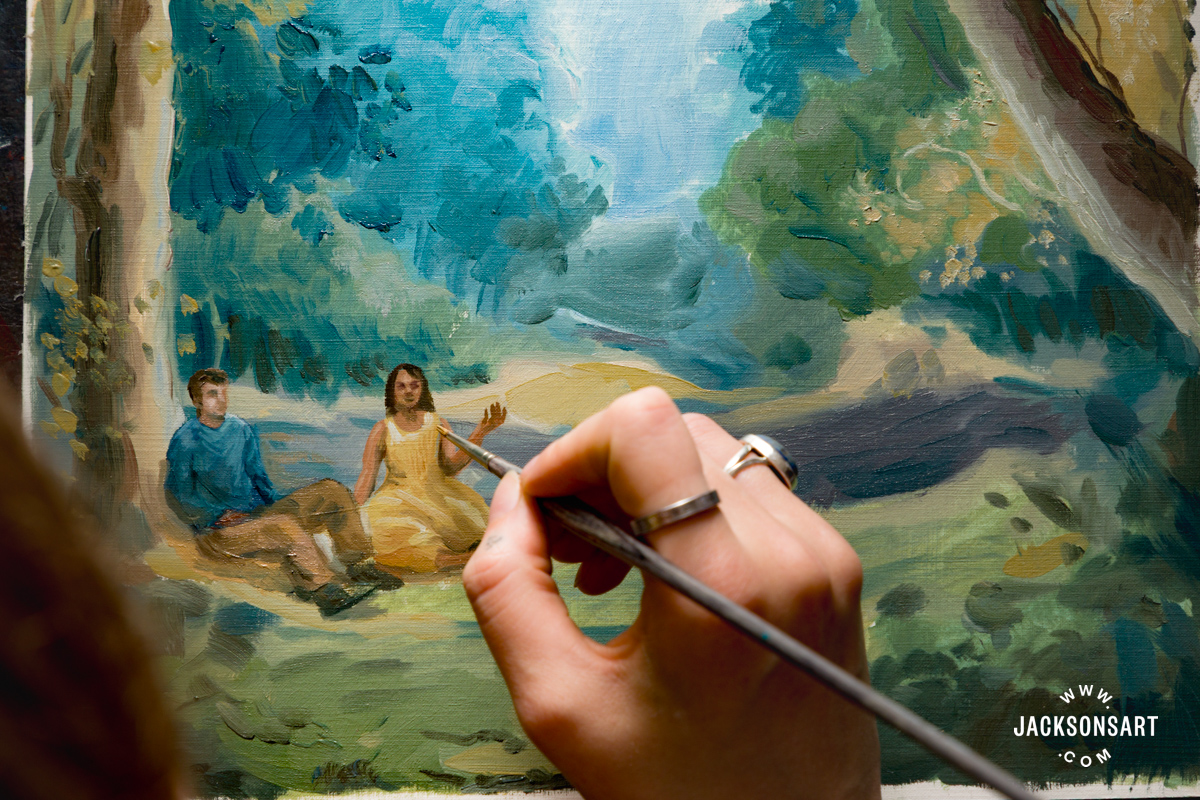
Header Image: A landscape painting by Philip Tyler


2 thoughts on “Book Review: ‘Drawing and Painting The Landscape’ by Philip Tyler”
Thank you for your very helpful review. I have decided
this title is for me on the basis of how you engaged
with it. I am also very taken by Philip Tyler’s work as
illustrated in the book
Hi Peter,
Thanks so much! So pleased you found the review helpful. Hope you enjoy working through the book!
Best wishes
Lisa
Comments are closed.