



Palette knives can be used to develop your style in a new direction, to add a different type of mark into a brush painted piece or as a way to create swathes of texture, as well as being useful to lay down underpaintings. As approaching a new tool can be daunting, artist and tutor Zsuzsanna has shared with us her top tips for using palette knives as well as how to begin working with one.

How to Use Palette Knives for Painting
by Zsuzsanna Pataki
How to Paint With Knives?
Painting knives are fabulous tools. They expand an artist’s repertoire, with marks adding depth and dynamism or the finest clear-cut lines. They also keep you from getting lost in unnecessary detail: ever had that feeling of ‘it was much better 10 minutes ago, before I did?’ Well: the painting knife might be just the tool for you. Once mastered, it is a very rewarding experience, speeds up your work process from back-breaking fiddling to bold, expressive painting.
I work my cityscapes and landscapes with a range of knives, using them to build up shapes and add definition in the second part of the painting process. Buildings, water reflections, boat masts, all benefit from fine lines placed with a knife. And as for texture: the broken colour effect that comes from multiple layers of acrylics applied with a swift loose hand is something no other tool will give you. So if you have not done it before, try it and learn to use it, your paintings will be the better for it!
I recommend using the largest tool you dare first, then work your way down to smaller ones if needed. I built a Wishlist from JAS tools and materials for my students; their new long-neck knives are especially useful to keep your knuckles well away from your work. My favourite blade (RGM 103) is a 2-in-1 tool, with a longer and a shorter edge. Whatever your knife, be sure it is flexible, and a painting knife, not a palette knife.

So, How to Use a Palette Knife?
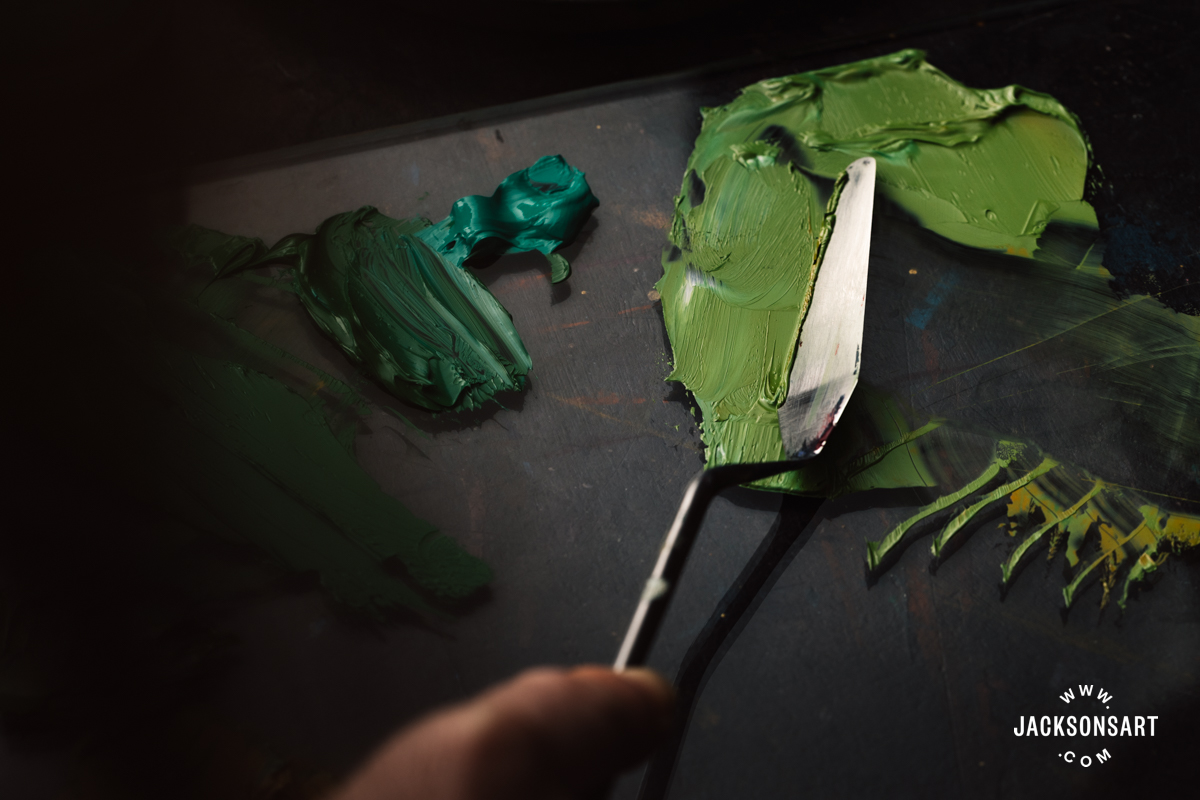
1. Hold the working edge of your blade at about 45 degree angle (as if icing a cake, not slicing) and pick up (wipe up) some paint from the palette. Paint should be on the bottom of the blade, facing the palette.
2. Place blade, paint side down, same angle, against the canvas. For fine lines, just touch down and lift up the blade: printing, really. For a wider mark, pull knife sideways on the surface, as if icing a cake. You might slowly lower (flatten) the blade against the canvas as you spread the colour. Expect a ragged edge there: something you will need to learn, how much paint to pick up for how wide of a mark. Again, practice.
3. When you run out of paint, be sure to wipe the blade clean before picking up more. This will ensure smooth, even marks, without blobs or frustrating dry specks. You will find it takes practice to get the desired effects, but don’t give up, keep at it until you conquer!

A Few More Tips for Using a Palette Knife
Choose your knife according to the size of mark you need to make: the straight edge of the blade will be your ‘working edge’, count on the marks being the same length. Start with larger marks and work your way towards shorter, fine lines.
Spread the colour as an even layer on your palette, before picking it up with the knife.
Practice on a spare sheet. There is more than one way to do it well: curvy petals and leaves, windows and skylines, shutters, or trees and grass. Experiment before committing to one way of painting it.

About Zsuzsanna Pataki
Zsuzsanna Pataki is a London based painter and tutor who works in acrylic. Her subjects include waterways, interiors and the scenery that she comes across in her daily life. She is an advocate for using palette knives as a main painting tool and her unique vibrant style stems partly from this method.

Further Reading
Recreating the Colour Palette of Claude Monet
Oil Painting Solvents: What is the Difference Between White Spirit and Turpentine?
Tips for Setting up an Oil Painting Palette
A Guide to Mediums for Water-Mixable Oil Paint
Shop Palette Knives on jacksonsart.com


2 thoughts on “How to Use Palette Knives for Painting”
I was struggling for months with a
palette knife, but finally got the hang of
it! I agree, well worth the effort, I love it
now. Also saves me a fortune, as
brushes wear out in oil paint, I’m
constantly replacing the dam hog haired
gits
😀 Thanks so much for your comment Daniel, made me laugh!
Many thanks
Lisa
Comments are closed.