



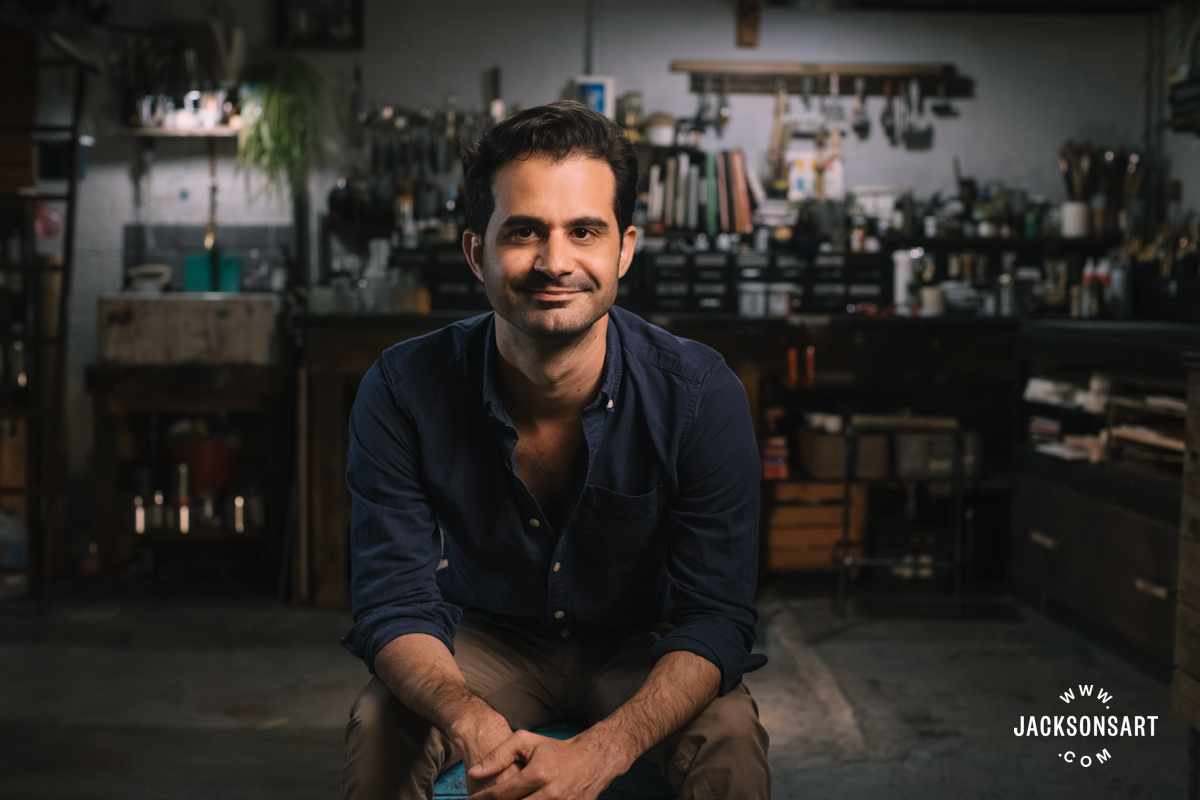
Jonathan Dickson is a Kildare based artist who was born in Dublin in 1970. His painting At nightfall, they arrive everywhere and all at once, pictured below, was shortlisted for the Jackson’s Open Painting Prize 2019. The painting invokes the atmosphere and visual intensity of the forest that Jonathan regularly frequents, inviting viewers into a textured landscape that’s captured through his meticulous all prima technique. We caught up with him to learn more about this process, the materials he uses, and how he develops his work.

Jonathan Dickson
Oil on canvas, 80 x 60 cm
Daniel: Tell us a little bit about your artistic background/education.
Jonathan: I originally opted to do art in secondary school simply as a means of getting out of having to study French – it certainly wasn’t for a love of painting or drawing. It all changed one day in art class when I was 12. I drew a plant pot at a windowsill and I was absolutely thrilled by it, it wasn’t particularly good but I was mesmerised by the thought that I could learn to draw things that looked relatively realistic. That was it, I got absolutely hooked and spent pretty much all of my spare time learning how to draw and paint.
After secondary school, I was accepted into the National College of Art and Design in Dublin. After completing foundation year the intention was to apply for a Fine Art Painting degree but I was discouraged by a lecturer whose particular method of “encouragement” was rather negative, so I diverted to Visual Communication thinking I would have a better chance. I was accepted and got my degree.

Jonathan Dickson
Oil on canvas, 80 x 60 cm
I also completely stopped painting and drawing around this time. After college, I worked in a number of design and advertising agencies and had a blast (it was in the early 90s there were lots of parties and client socialising). To get more experience I got a job with an in-house design studio for a large multinational and got into branding and the like. It felt like I was getting farther away from what I had originally started out wanting to do.
Eventually the call of painting came back, quite specifically (and rather comically in hindsight) 13 years ago. One evening I was sitting watching TV and had a light bulb moment – my exact words were ‘what the hell am I doing watching TV, I’m supposed to be a painter.’ The next day I bought a pile of art materials and every evening after the day job I painted as much as I could. The first attempts were abysmal but I kept at it. I started to make some progress and kept going.
I was offered a solo exhibition in 2015, which was both terrifying and exciting, and that year I also made the decision to leave the design industry behind and commit full-time to painting. I’m still playing catch-up, having stopped painting for so long, but I’m happy enough with that.
Daniel: How would you describe your practice?
Jonathan: I usually start at 8.30am and get emails and messages out of the way. I paint from about 11am onwards (earlier if I can, sometime later if admin goes on). I stop at around 5.30pm for a few hours and resume in the evening, finishing up whenever concentration starts to wane. I love painting late at night so I keep going as long as I can. I like to have a very structured working day and keep to regular start and break times, it’s what I’m used to from my previous working life.
I also spend a lot of time in the forest that I’m working on at present, sometimes drawing and taking photographs and sometimes just looking and being there. I’m getting drawn in by the forest floor and my radar is moving towards things left behind by people, storms and the seasons.
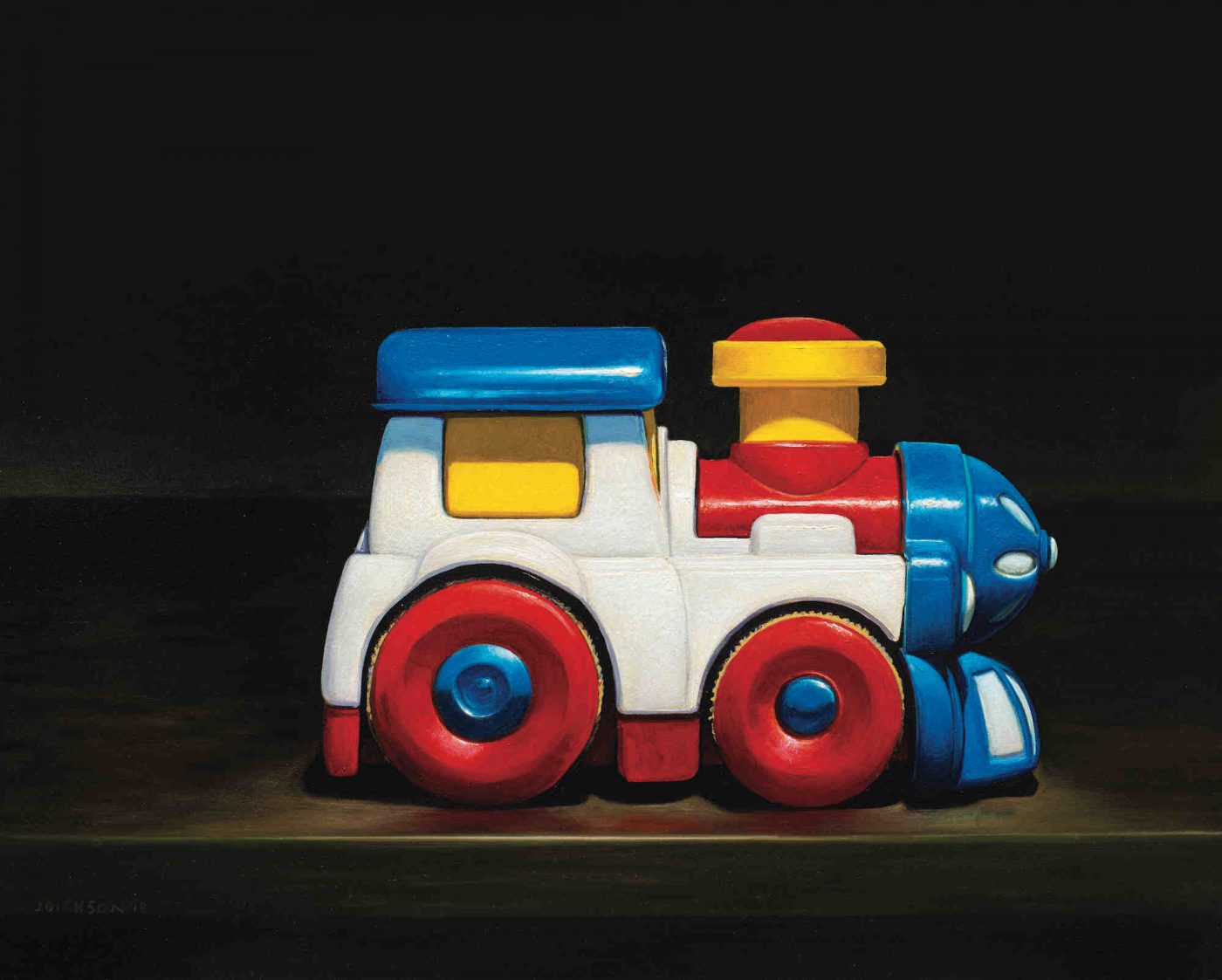
Jonathan Dickson
Oil on wood panel, 51 x 41 cm
Daniel: Your process for making your forest paintings is particularly interesting. Could you tell us more about it?
Jonathan: I use photographic references along with drawings and sketches. I also spend a lot of time in the forest just looking, without a camera or sketch pad. Whatever area on a painting I’m working on, I’ll go to the location in the forest and spend time analysing it. I find it helps to leave the camera and sketchbooks at home for this as I can concentrate better, otherwise I would spend time criticizing my drawing skills and the camera can’t get all the visual info I need.
For the paintings themselves, I print out a photograph the same size as the canvas and stick it to the studio wall beside the easel. I grid up a canvas in 40mm squares and start on the top left square. I don’t do any underpainting or drawing. I work down five squares at a time and move right to do the next five – when I make it across the canvas I move down and do the next five and so on.
I also use a piece of card with a 40mm square window so I can only see a small part of the photo at a time. This makes each square appear like a small abstract image as I’m never painting anything other than small marks or blobs. I also use as much pure colour as I can in a kind of divisionist technique. I also break shapes up along with colour.

Jonathan Dickson
Oil on canvas, 80 x 60 cm
I’m trying to invoke what it feels like to be in the forest as much as what it looks like. There’s so much information and I’m trying to get across that visual intensity. I didn’t originally intend to paint like this, it just seemed the best way for me to be able to get what I am after.
When I was a teenager, I was trying to do an observational painting of two crushed paint tubes and was finding it very difficult – it was just a mess of lines and shapes. To help, I cut a window in a piece of card and placed it on the part of the tubes that I was having difficulty with. I saw an abstract arrangement of shapes and colours and I painted it just seeing this. I remembered this and tried it for the forests.
It seems a kind of ridiculous way of painting but if it gives the desired results, why not! This way of painting is affecting my other work also as it forces focus. Even when I’m painting in a conventional manner it makes me look harder at the component parts of texture and colour.
Daniel: How do you deal with the intensity of this type of painting?
Jonathan: If you mean is it head wrecking, well then I guess I’d say part of me enjoys it as I enjoy the friction of a challenge and the challenge of concentration. Another thing I use is music while working – it pulls my head out of it just enough to maintain concentration. At night time I like darker and more intense music and during the day I listen to more varied stuff. It has to add to my work though, so it has to work with where my head is at and what I’m painting.
I also paint other subjects in a conventional manner to get a break and stretch out a bit, although the forest technique is creeping into this work. I don’t mind that at all though, it’s part of the learning.

Jonathan Dickson
Oil on canvas, 100 x 70 cm
Daniel: What is it about a subject that defines whether you paint alla prima or use more conventional techniques? What are the benefits of each for you?
Jonathan: It’s purely got to do with the way the subject needs to be painted. The benefits for the forest paintings are getting the intensity I want to achieve. I still have a way to go with them yet and they need to get a heck of a lot bigger, I’ll never be happy! The other paintings benefit from conventional techniques as they just work better that way. I really try to paint the objects or places in the way they need to be painted.
A part of my technique is based on having no formal training in oil painting so I do a lot of it by feel. I don’t really want to shoehorn an image into a technique I’ve learned – when I move on from forest paintings I most probably will leave that technique with them and find new ways (for me anyway) to paint new subjects. I enjoy that learning part of painting also. I just really love oil paint and what you can do with it; I was hooked the first time I smelled linseed oil, I probably should have gone out more as a youth!
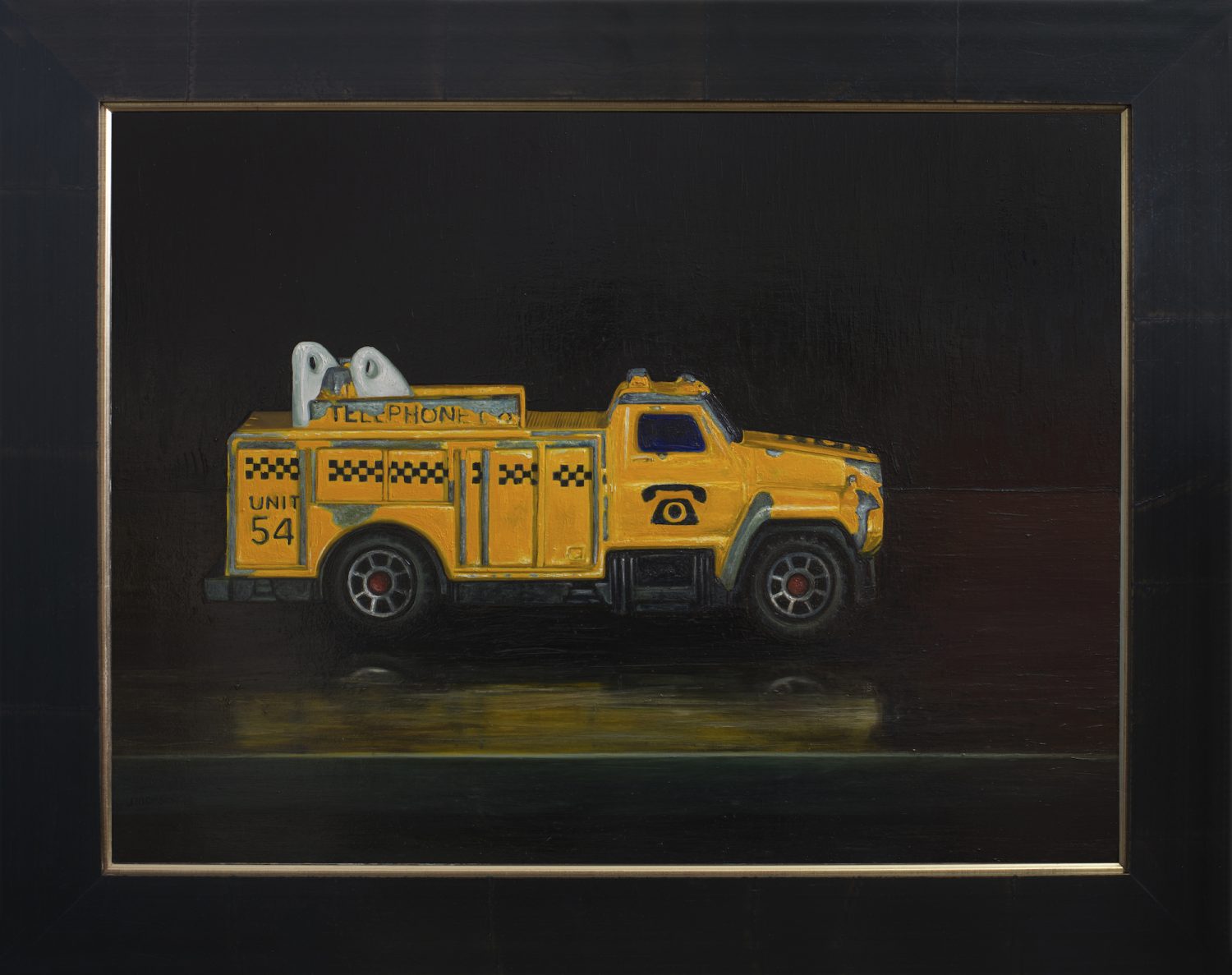
Jonathan Dickson
Oil on wood panel, 61 x 46 cm
Daniel: Do you find it important to maintain a practice of sketching, despite working without any underdrawing in your forest works?
Jonathan: Yes, absolutely. I bring sketchbooks with me and sit down and just draw what I see in front of me. I tend to draw close-up parts of trees or knotted roots or leaves and debris on the forest floor, mainly to force me to look harder and not get distracted by an overview. It also helps to get the atmosphere of the forest more intensely. Being honest, I simply don’t draw enough, I go through phases where I draw every day and then lapse a bit, usually when I’ve misplaced my sketchbook, or pen, or both!
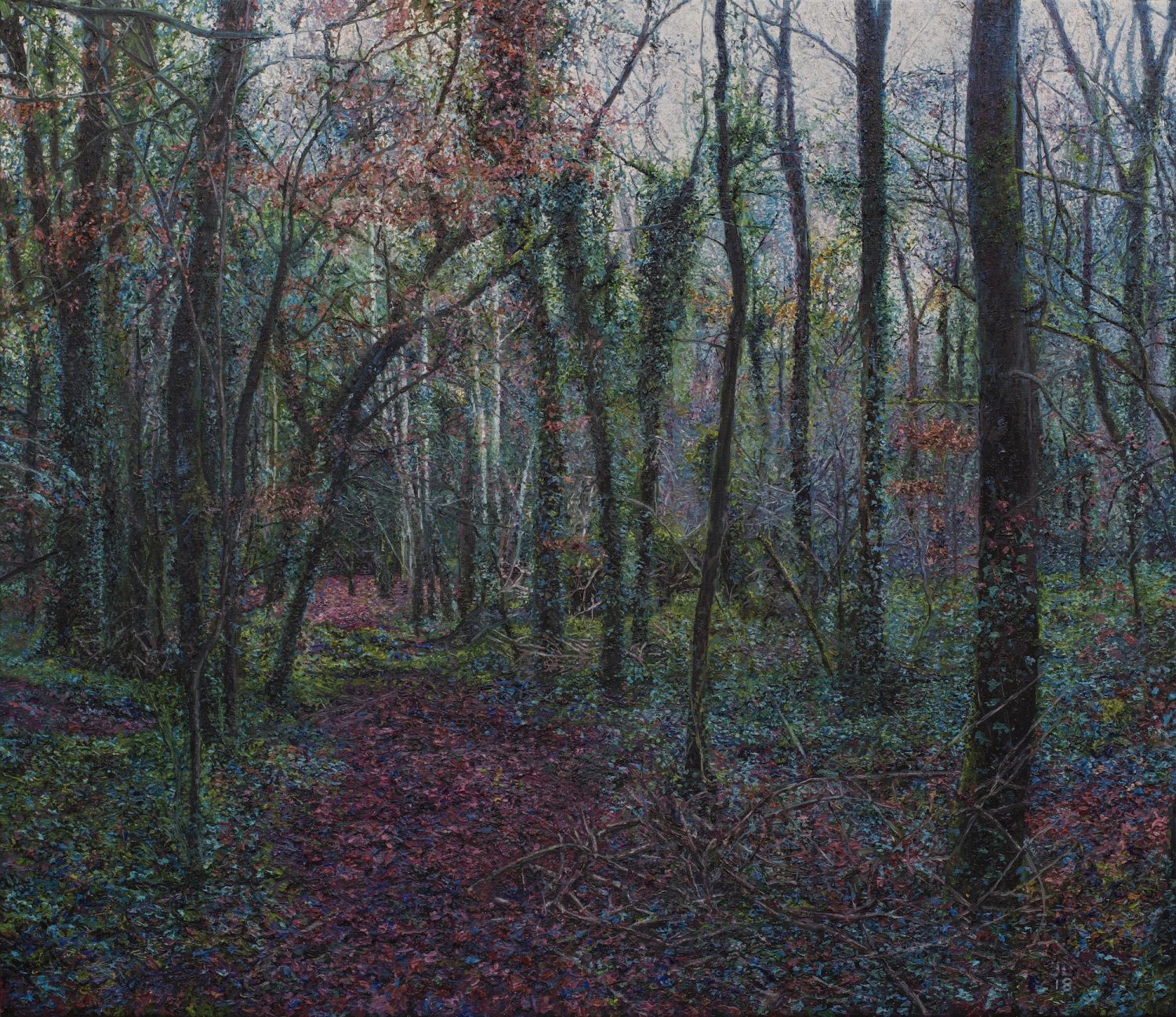
Jonathan Dickson
Oil on canvas, 70 x 60 cm
Daniel: How important are your surroundings when painting?
Jonathan: As I paint mainly in the studio I have it set up in a particular way, mildly chaotic at best, I think. I have no internet or smartphone in the studio. I have one easel, two tables, one larger one for tubes of paint, mediums and jars of brushes – I have a thing for brushes! I have a small table beside me for paint tubes that I’m using on a particular painting with a large pile of rags underneath.
It can get very untidy as I get into a painting, but I don’t see it until I’m done. I also have a Hi-fi in the studio which I do my best to keep paint off, not always successfully.
When I’m in the forest, the time of day and year is as important as the location. These paintings are all done from December 21st, minutes before, during, and after sunset. The change in a forest from day to night is something I’m exploring as a metaphor for the goings-on inside my head, hence the titles – more on that another time.
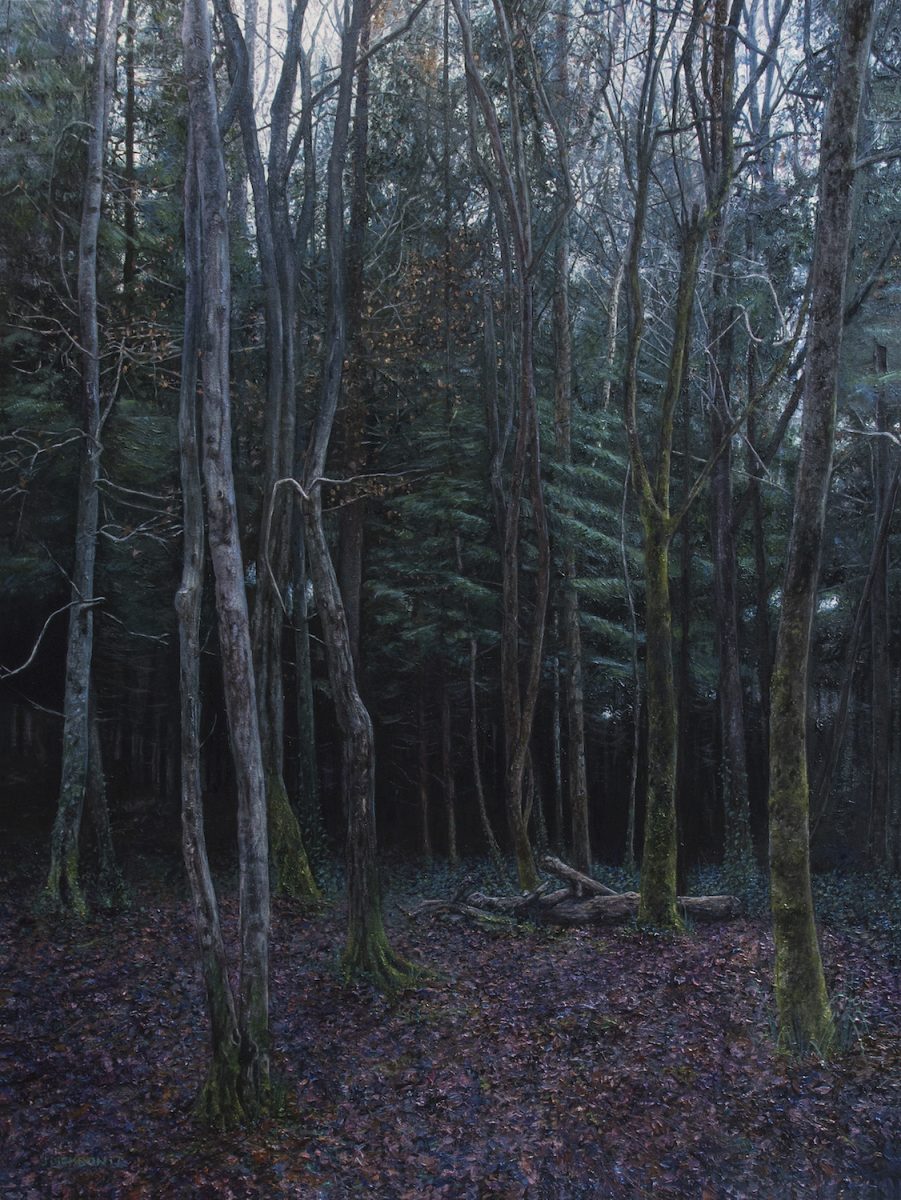
Jonathan Dickson
Oil on canvas, 80 x 60 cm
Daniel: What are your most important artists’ tools? Do you have any favourites?
Jonathan: This question I could really ramble on with as I love materials. I love Winsor and Newton Artists’ Hog Brushes – they are well worth the extra money as if you look after them they really last and they are really well balanced. Cosmotop Spin Synthetic Rounds are also brilliant. If they lose shape I briefly dip them in a pot of boiling water to soften and reshape them. Escoda Versatil Synthetic Kolinsky brushes are also superb and long-lasting.
My favourite tool at the minute though is an old brush with no hairs on it that has had its end sharpened to a point – I push paint around the canvas with it. It’s great for scraping through layers of paint for thin branches and highlights on foliage.
I’m also a big believer in buying the absolute best paint I can afford. Some earth colours are fine in student quality but for whites, saturated colours and cadmiums it really is worth the extra as they go a long way and make a massive difference to how the paintings work. They also handle easier.
For Ultramarine Michael Harding is my choice; I’ve tried a lot of others and even sometimes make my own, but to see how good his is you just need to mix in a dot of Titanium White to open it up and watch it sing. I use different brands for different colours as I’m used to how they work and handle, and yes, Jackson’s Professional Oil’s figure in there too.

Jonathan Dickson
Oil on wood panel, 51 x 41 cm
Daniel: What is a good day in the studio for you?
Jonathan: Up at 8am no admin, breakfast, into the studio, a pile of music and a painting that is one-third of the way through and with no end in sight. Put on headphones and get completely lost in it to the point that I don’t realize when a CD has finished playing. Stop for lunch for a quick bite then back to it. Stop at 5.30pm for a break, food and back to it at 8.30pm. Paint until I’m too tired to continue and look forward to doing it again.
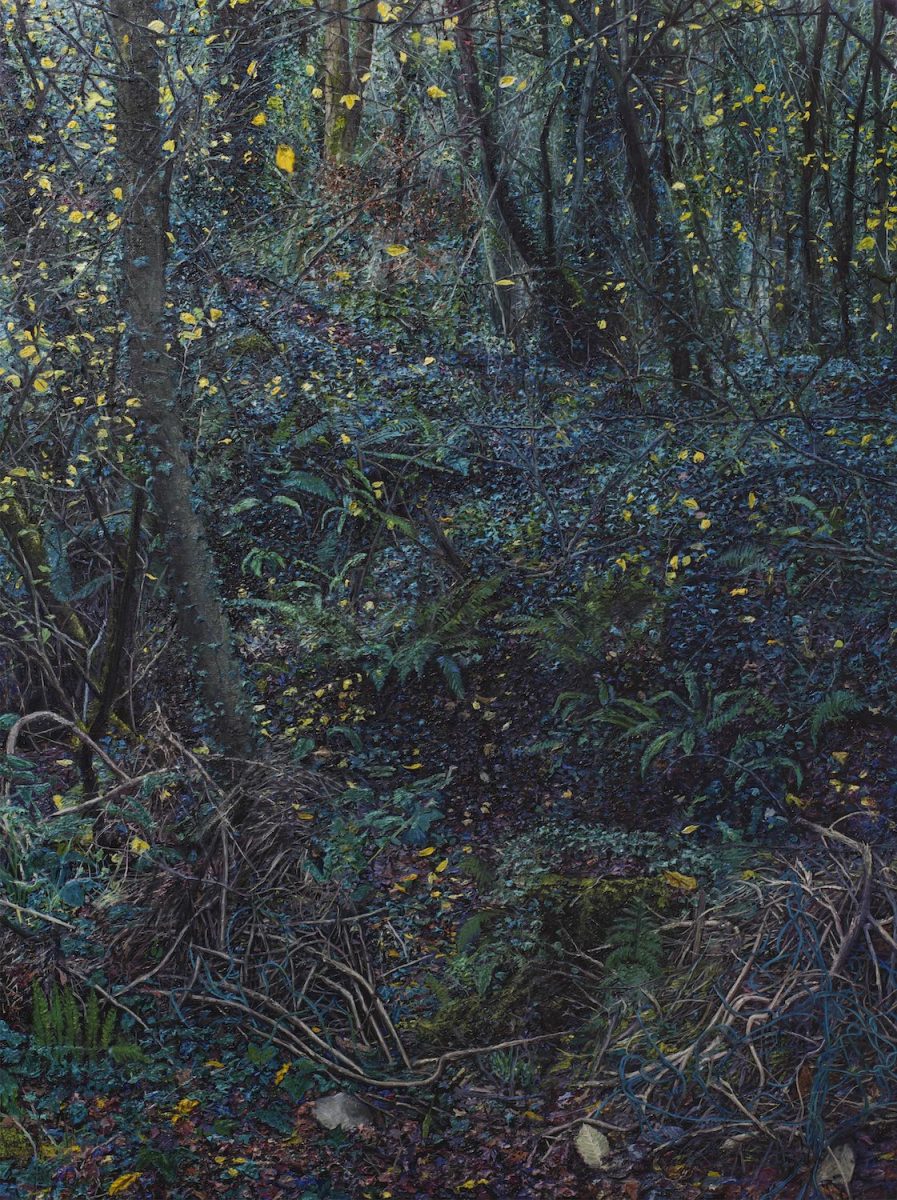
Jonathan Dickson
Oil on canvas, 80 x 60 cm
Daniel: What are your artistic influences? Who are your favourite contemporary artists?
Jonathan: This question could become a very long list indeed, I’ll whittle it down as best I can. Artistic influences: Vincent van Gogh, Lautrec, Lucien Freud, Francis Bacon, Frank Auerbach, Monet, Degas, Cezanne, Rembrandt, Titian, Vermeer, Dali, Picasso, Gabriele Münter, Hopper. I think I could write a hundred more, I get excited even typing their names!
So contemporary artists, I have to also include musicians in this as I see little distinction between visual and aural art: Steve Reich, Philip Glass, Thom Yorke, Radiohead, Underworld, James Leyland Kirby (the caretaker). In regards to visual art: George Shaw, Meadhb O’Connor, David Hockney, Ann Gale, Melissa Scott-Miller. I know he polarizes people but also Damien Hirst.
It blows me away to see new work online almost every day, it’s actually quite dizzying and probably why I don’t have connection to the internet in my studio. I need to keep my head down and not get too into how much is out there, otherwise I could get influenced into artistic paralysis.

Jonathan Dickson
Oil on wood panel, 61 x 61 cm
Daniel: What is coming up next for you and where can we see more of your art in the flesh or online?
Jonathan: I’m currently in a group show at Lauderdale House, Highgate, London until 2nd September. Then again on 27th November – January 6th at the same place.
I’m represented in Ireland by The Kildare Gallery and The Chimera Gallery. You can find me on social media through the following links: Instagram, Facebook, Twitter.
Here you can see a video of me talking about a commissioned piece I did two years ago.
I’m currently preparing for a solo show next year with the forests and I’m also working on a website – that will be up and running as soon as I can stay out of the studio long enough to get it done.
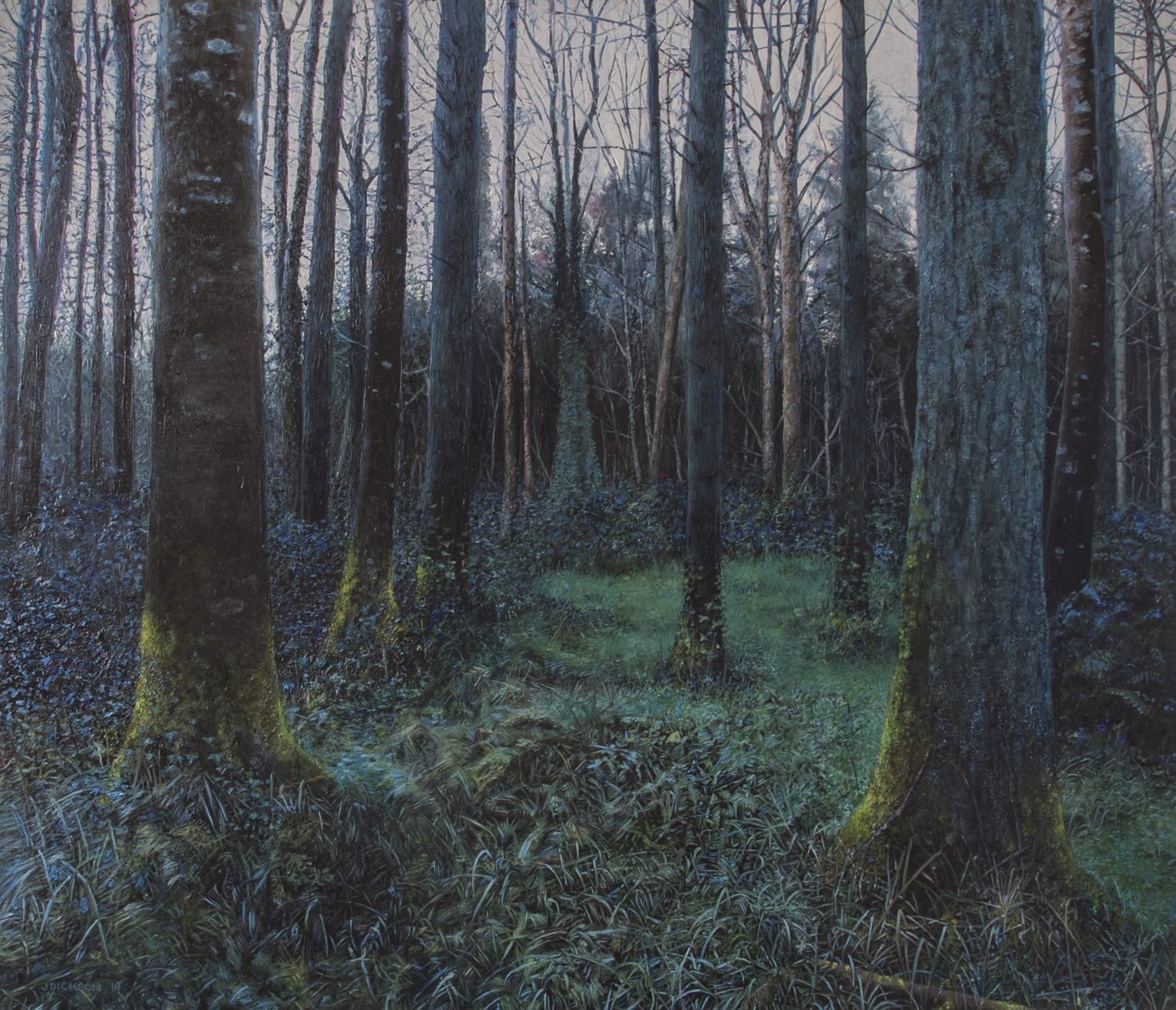
Jonathan Dickson
Oil on canvas, 70 x 60 cm
2 thoughts on “Jonathan Dickson: Alla Prima Forests”
Oh how I love trees! Jonathan Dickson’s trees are spectacular and so beautiful. Although my mother was born in the Forest of Dean it was there I became aware of trees and fell in love with them. However, it was not till I was six that I became aware of those beautiful creations having been brought up till then in Springburn in Glasgow. Tree portraits like Jonathan Dickson’s really inspire me. My main subjects in watercolour are usually trees from the New Forest nearby.
Thanks Andrew, that’s great to hear and I’m glad you find Jonathan’s work inspirational!
Comments are closed.