



Expressing emotional responses to scientific facts is at the heart of Suzi Morris’ painting practice. Having lived with Keratitis (a disease that affects vision) since the age of 16, Morris developed a fascination with viruses, their behaviours, and developments in how they are treated. This has informed her work since she began painting full time. In this interview Suzi reflects on the ideas that fuel her work, her work as an ambassador for Schmincke and da Vinci brushes, and what it’s like to be a London based painter in Covid-19 lockdown.

Chromatin Loops, 2020
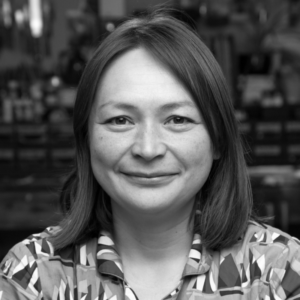
Suzi Morris
Oil on aluminium, 80 x 60 cm
Lisa: Please could you describe your route to becoming a practising artist?
Suzi: I left Scotland when I was 18, and like many young artists, I had to undertake a variety of day jobs and evening jobs to support my practice and my studies. After I graduated I worked in a design consultancy in London for a while, as my first degree was in Illustration and Design. Kingston University was a wonderful place to begin my art career. I look back and appreciate all the encouragement that I received there, endorsing me to undertake a scholarship at The Royal College of Art after I graduated. It was the eighties and I was trying to survive in London so rather than undertake a postgraduate degree, I accepted a job as a graphic designer with a design consultancy in London. In hindsight, it was a greatly missed opportunity. In my late teens and early twenties, I longed to escape from what would be regarded now as ‘below par’ rental accommodations and find a proper home where I felt safe. Working in design wasn’t fulfilling my desire to paint so I left and began undertaking private commissions painting trompe l’oeil which had made a comeback in the eighties. In the years that followed, I spent time travelling with a paint box, teaching art to underprivileged children, and eventually working in art direction for film. Along the way, I undertook volunteer work in animal sanctuaries and an HIV children’s orphanage in India.

The Progeny Virion, 2016
Suzi Morris
Oil on aluminium, 61 x 46 cm
Da Vinci Art Collection
Looking back at those times, travelling embodied extraordinary situations, often rather harsh realities of a visceral and sensual world. It was a humbling experience and I can see how my interest in the sublime experience began. It was while I was working in film that I was finally in a position to re-engage fully with my painting and become a full time practising artist. I then undertook an MA in Fine Art at the City & Guilds of London Art School, and then a Professional Doctorate in Fine Art Painting at UEL. An affiliation with Imperial College enabled me to meet scientists and learn about developments within healthcare. Thus, began a fascination which has inspired and informed my art ever since.

Birth of Pandora, 2017
Suzi Morris
Oil on aluminium, 190 x 115 cm
Lisa: Your work is very closely related to scientific research of viruses… is this subject the reason why you became a painter, or something you became entranced by while on your creative journey?
Suzi: My interest in viruses arose out of a legacy of repeated attacks of HSK or Keratitis: a disease where the cornea becomes inflamed as the result of a virus. If left untreated or misdiagnosed, Keratitis can cause blindness. Every time the virus flares up it can cause further loss of vision and unfortunately, it’s a virus that integrates into our DNA, so once infected it’s for life. Over 80% of us are carriers of this virus however many of us will be asymptomatic. I had my first flare up when I was 16 and have been at war with this virus ever since.
During my practice-based professional doctorate at UEL, I realised to what extent my paintings were the result of bodily experience, mingled with what I was researching at the time. It transpired that managing the ongoing medical interventions necessary and understanding the therapeutic language used in the process of restraining the virus responsible for all my eye problems, was subconsciously nourishing my imagination and my painting practice. In The Naked Virus the ‘line’, which is fundamental to my work, is adversely a slim rather frail and translucent run of paint that I intended to edit out. On reflection, while painting this piece I had felt terrified post a medical examination of my eye. The fragility of the line evoked everything of the all-encompassing emotions that accompany awareness of the privilege of sight.

The Naked Virus, 2017
Suzi Morris
Oil on canvas, 190 x 120 x 4cm
In 2016 I discovered how scientists were harnessing the power of viruses in finding cures for cancer. I realised then that I had a moral responsibility to take my natural interest in virology and genomics and address the wider concerns surrounding how medicine is changing our understanding of disease. I felt the need to use my painting to help engage public understanding.

A Genus of Viruses, 2017
Suzi Morris
Oil on polyester and aluminium 120 x 210 cm
Lisa: On your website you describe your work as an interpretation, rather than illustration. How much of the creative decisions you make with regards composition, colour and brush marks are a direct reference to scientific fact, and how much is more looking inwards at your own feelings about viruses and the work you are inspired by?
Suzi: The paintings are a culmination of personal bodily experience, art history, theory and new sciences that come together in creating them. Primarily my painting relies on inner methods led by what are often subconscious images and thoughts of the body. My use of colour is more intuitive than formulaic, depending on what I want to say, and mark making, a gesture that embodies my imagination’s relationship with what I experience in my body. Creative decisions can often evolve out of simply being very inspired by something that I have learnt.
The paintings are more of a response to scientific fact rather than a direct reference. The influence of the new sciences and genomics of this era is as key to situating my practice as the discovery of microbes, x-rays and unseen energies was for artists such as Odilon Redon and František Kupka at the origins of abstraction in the nineteenth century.
I’m interested in the problems of ‘being’ in the body which hosts a virus that terrifies me, and the problems of painting. Both viruses and paint share the capacity to be highly unpredictable in positive and negative ways. Art has many functions, and I have increasingly come to understand to varying degrees, that my paintings are the result of a process of embodying my imagination’s relationship with what I experience within my body.

The Capsid, 2015
Suzi Morris
Oil on canvas, 190 x 130 cm
On Loan to Imperial Arts Collection, The School of Medicine, Imperial College
Lisa: Do you feel any kind of sense of moral, social or political responsibility with your work as an artist?
Suzi: Art has long contributed to culture, history and science through offering a window to experience or to influence society by changing opinions. So, yes I do feel a sense of moral and social responsibility as an artist. Sharing my thinking and raising consciousness through the paintings is important to me. As I observe my own creative process seeing the way that I see and being led by inner images and the subconscious to an extent, I’d like to elicit that fundamental sense of self in the viewer. Every exhibition offers a social contribution and the opportunity to raise questions and heighten important issues, which reflect the times in which we live. Ultimately, my paintings are a response to the science of my time in an age where scientists are harnessing the power of viruses in cancer treatments; a time of genome sequencing and artificial intelligence. Until now orthodox medicine has tended to treat the symptoms of diseases as opposed to seeking out their underlying causes and eliminating them. As new technologies are revolutionising medicine through genomics and virology, society needs to understand how medicine in mainstream healthcare is changing.

Making small works for the Artist Support Pledge
Lisa: The Covid-19 lockdown has impacted upon all artists, but for you I imagine it is a double edged sword. Not only will lockdown have impacted on you practically in terms of your day-to-day working life, but I imagine the virus itself may have crept into your concerns in your creative investigations. Is this the case?
Suzi: Like most artists, I’ve had upcoming projects postponed, but in many ways, the lockdown has enabled me time to focus on my painting. Self-isolation is normal to an extent for me. My painting process is slow due to working in layers of oil glaze, so I’m enjoying the pause from the otherwise fast pace of London life. At the moment the entire top floor of my home acts as one studio space so I can continue working. I’m so grateful to my art material suppliers that include Jackson’s, for keeping up with online orders for all of us artists.
Viruses and the wider implications of them are an everyday concern for me because of the constant fear over my eyesight. When the lockdown started I was researching the virus that triggers Leukaemia for a future anticipated project to help raise awareness of blood cancers. While I’m staying on focus with that I have felt a natural curiosity as to how coronavirus has brought the entire world to a standstill. This global pandemic quite literally epitomises my proposal of the Viral Sublime in 2017. One of many objectives in revealing the Viral Sublime is to expand the dialogue between science, medicine and art to initiate change in society’s perceptions of disease, particularly viruses. I believe that COVID-19, this once in a generation pandemic in 2020, is not only altering society’s values, for the better I might add, but also their perceptions of viruses. Suddenly we are forced to see the ‘unseen’ and understand how easily infection occurs. Most of us are now familiar with ‘R’ values used to rate a disease’s ability to spread, where we would previously never have heard of the term, and of the importance of handwashing and mask-wearing to protect others. I wanted to somehow make a difference so I decided to make a short film introducing the Viral Sublime to call attention to the scientists working behind the scenes to engineer a vaccine. The frontline NHS workers are completely heroic in their work, but so too, under intense global pressure are the scientists trying to engineer a vaccine. I had enjoyed reading your interview with Mathew Burrows talking about how he founded The Artist Support Pledge. It’s such a simple idea but genius. I saw the pledge not just as a chance to support my fellow artists, but an opportunity to give something back to Imperial College through donations to their COVID-19 Response Fund. The paintings are small works on board made specifically for the ASP so they must be no more than £200. When I reach five sales I pledge to support another artist through buying a piece of their work and donate 50% of any proceeds from my paintings to Imperial. One or two of the small paintings that I’m creating for the pledge seem to evoke a sense of isolation and fear of being overwhelmed by the virus. In the case of the Tondo pieces, there lies a notion of the laboratory petri dish holding strands of DNA. COVID-19 has indeed crept into my investigations.

da Vinci brushes in Suzi Morris’ studio
Lisa: Does it matter how much understanding your audience has of the scientific work that you paintings are inspired by?
Suzi: The paintings have to be capable of standing alone and are ultimately to be felt and experienced. Viewers will always ascribe their own meaning to the works regardless of what I may intend. Art is never just one thing and I don’t believe that if a viewer is unaware of what underpins the work that it makes the work any less valuable. I think painting can humanise and enhance scientific content, infusing scientific findings with empathic understanding. Different audiences bring disparate interpretations. I was invited to have a solo show as part of the Imperial Festival and it was interesting for me to hear the response to my work from scientists and members of the public with an interest in science. Then there were some viewers who responded to the work purely at emotional and spiritual levels. What matters to me most is when I hear how a reader of the painting has connected with the work and developed an understanding of their own relationship with it.

Installation Shot, Birth of Pandora, Corporate Collections
Lisa: You have in the past worked with Schmincke and Da Vinci brushes. Could you tell us about the work you did with these two art materials manufacturers?
Suzi: What I share most in working with da Vinci Artists’ Brushes and H. Schmincke & Co is an appreciation of the hand made and the desire for a work of art to outlive me through using quality materials. In the seven years that I have been an ambassador for them, I have come to feel like part of the family. I first met with Schmincke in 2012. I had problems with the drying times of Cadmium Red on a painting 250 x 160 cm which wasn’t drying fast enough to be able to include in my MA show. At the time I was delving into the alchemy of oil painting in greater depth and Schmincke’s technical department was extremely helpful. I used to work as an art director in film with Fact Not Fiction Films, so one thing led to another and before long we were making short educational films about their oil painting products. My connection with da Vinci Artist’s Brushes developed at the same time. I became involved in the DUROPLUS commercial; a clever system devised to ensure longevity in an artist’s brush.

Suzi Morris making a film with da Vinci
The Meyer family (who run da Vinci) are incredibly supportive of the Arts. If an artist needs a unique type of brush, which is not available commercially, the team at da Vinci will make a speciality brush for you. Anything is possible. Based in Nuremberg they run the Marianne Defet Artist in Residency Program. I had an idea in mind to create an opportunity for emerging artists through running an artist’s residency out in Nuremberg. I approached five of the most highly regarded art schools in the UK; Kingston School of Art, City & Guids of London Art School, The Glasgow Art School, Royal Academy Schools and Royal College of Art. Each school was to offer the opportunity for one successful artist to attend the 11-day artist residency which would culminate in an exhibition within the Institut für moderne Kunst Nürnberg in Atelier- und Galeriehaus Defet. Da Vinci generously covered all expenses from arrival in Germany. Not only was I a participating artist, but I also lived on site working alongside the public relations team and Fact Not Fiction Films in making what became an award-winning documentary ‘The Residency’. I learnt a huge amount from the project. It was a challenging experience and looking back I am eternally grateful for all the support from the Meyer family at da Vinci. After the residency, I was completely honoured when they took me by surprise and presented me with a limited edition of my favourite mottler brush named the Series 538 Suzi Morris.

Special Edition Suzi Morris da Vinci Brush Series 538
Lisa: How do you start a painting?
Suzi: My strategy for starting a painting is deliberately not a preconceived one. Ideas are often triggered by something that I’m drawn to develop in an earlier work. The movement of the body that comes from dancing freestyle in my studio space is one of many ways that I delve into my imagination and the inner body. It’s rather like a moving meditation, a way of focusing at the same time as reflecting on paintings in the studio. I want to express inner experience, evoking emotion without having to describe a physical reality so I begin with colour and staining the canvas. Oil paint acts as an extension of the body offering a bridge from the inner world. After several years of reflecting on the nature of the creative process and life experience, I have learnt that painting has a force of its own and the less that I meddle ensures that the work will be authentic. It’s about recognising and choosing which marks to keep and build upon and those to negate. In ‘The Fertile Motif and the Happy Accident,’ Ehrenzweig describes how ‘taking back from the work on a conscious level what has been projected into it on an unconscious level is perhaps the most fruitful and painful result of creativity.’ (Ehrenzweig, A. 1970. p.72) Whatever I’m reading for research or experiencing in my body will inevitably seep into the painting, so if the work is for a specific project there is a rigour to my research, as I want that to come through in the painting. There are other occasions when I feel that I have absolutely no idea so I’ll just embrace that feeling and start painting.

Work in progress at Suzi Morris’ studio
Lisa: Can you give us a glimpse into your creative world – your favourite paints/brushes, other materials, any particular preferences you have with regards when or where you like to make your work and what you like to work with?
Suzi: At the moment I have a rooftop studio. It’s a wonderfully bright space attached to my home and I value the fact that it is as permanent as I want it to be. In terms of my everyday creative life, good natural light and having quiet to work alone is fundamental to my practice. I like to wake up early and make the most of the daylight. My day is always about finding a balance between marketing, admin and making work so I have a quick look at emails which may need immediate attention and try to get away from my desk as quickly as possible. I work with a gallery and a wonderful team of art consultants. If I have a show coming up it’s much harder to allocate studio time as there’s so much to organise. Hence, the lockdown has been beneficial in many ways. It’s offered me time to experiment with mixed media and working on different formats like the ‘tondo’. I work in a fairly organised way starting with mixing oil colour. I’m slightly obsessed with the luminosity of Schmincke’s transparent MUSSINI colours. I also like to experiment with natural pigments. Colour mixing can take considerable time as I’m also thinking about the work and going within myself. I love music as a means to focus or sometimes complete silence depending on how I feel. The ontological nature of time is something that fascinates me while painting; how I can lose several hours in a day when I’m painting and be somewhere completely beyond the physical body. This ability to go to a different place is what makes me feel whole as a person. Some of my best painting happens during those times. Of course, not every day is like that and there are times when painting is a painful struggle. The latter part of the day is my time for reading and research into forthcoming projects and relaxing. London is a wonderful place to be an artist. I feel incredibly privileged to have made it my home, and would always want to keep my studio here. Being within forty minutes of some of the world’s greatest galleries such as The Royal Academy and Tate Modern is something that I treasure.

Suzi Morris in the studio
Lisa: Where online or in the flesh can we view more of your work?
Suzi: You can find more of my work at ARTIQ, Noon Powell Fine Art, my website at suzimorrisart.com , and on Instagram @suzimorrisart.

Suzi Morris reflecting in the studio
Header image: Tondo I, 2020 by Suzi Morris, oil on board, 30 cm diameter, painted for the Artist Support Pledge
4 thoughts on “Suzi Morris: Expressing Inner Experience”
Lisa, this interview with Lisa Morris is incredible, it offers so much substance and directions for thought, it is profound, succint, and at the same time both interesting and soothing, it rings the bells both for work and for hope. The works are also beautiful leading to the conclusion that the strict line between art and science need not exist. Each can exist within the other.
Thank you so much for your thoughtful comments Gihan, much appreciated.
Best wishes
Lisa
Forgive my mistake is Suzi’s name.
Looking forward to more such talk.
No problem, many thanks!
Comments are closed.