



Alex Tzavaras is a portrait and figure painter who believes passionately in the importance of keeping alive centuries-old knowledge of realistic drawing and painting techniques. His work demonstrates a fundamental understanding of the human form while communicating the emotions of his subjects. In his teaching he has gained a reputation for clear explanations of how to describe weight and volume through tone and colour. And at the heart of all his work is the belief that we never stop learning and that practice is the key to progress.

Self Portrait, 2014
Alex Tzavaras
Charcoal on paper, 30 x 40 cm
Lisa: When you went to art school, were you aware of what you wanted to achieve in your studies or did your time at Central St Martin’s somehow spark a eureka moment when you thought “I really would just like to learn how to paint properly”?
Alex: I knew, right from the start of my foundation at Central St Martin’s in 1994, that I wanted to learn how to paint properly. However, as soon as I got there I remember sitting down with one of my tutors and being told that drawing was no longer relevant. It was disappointing, I used to go around art galleries looking at old paintings and wonder how on earth they were able to achieve what they did. After my experience of art school, it felt as though the human race had forgotten how to draw.
There were a few things I did on my foundation which I found interesting, but nothing I wanted to pursue. So, after my foundation I left art school. I’d like to be able to tell you, that I was determined to set out on my own and learn to paint, but it wouldn’t be true. For whatever reason, whether it was disillusionment or a lack of motivation, I did very little drawing for the next ten years.
At that time, I didn’t know such things as the Royal Society of Portrait Painters or the Atelier schools in Florence even existed. But around 2003 or 2004, with greater access to information online, I became aware that there were artists out there, who still specialised in working form life. I eventually found a teacher here in the UK and started attending evening classes. It soon became apparent, that if I really wanted to get good at painting I would have to dedicate a lot more time to it. As this was something I had always wanted to do, I gave up my full-time job and started training properly.

Stages of a portrait study, using Titanium White, Burnt Sienna and Ultramarine Blue
Alex Tzavaras
Oil on canvas
Lisa: What is it about painting portraits that you find so alluring?
Alex: Growing up, my favourite works of art were always portraits. I remember seeing these incredibly life like paintings by Holbein or Velázquez and finding it utterly fascinating that I was looking at a very real person from 400 years ago. I think it’s probably the closest experience we can actually have to time travel.
The thing I found so alluring, not only about portraiture but also realist painting in general, is its magic. How, just by placing coloured shapes on a canvas we can recreate such a real experience of what it’s like to be with a particular subject, a person or a place. For me there is something particularly profound about portraiture as a subject because it represents the experience of one human consciousness interacting to another.
Lisa: Where do you stand on painting portraits via Zoom in these times of social distancing? Have you tried it yourself? What are the limitations?
Alex: I think we’re very fortunate to have all this technology at our disposal, so we can keep painting despite everything that’s going on at the moment. I think it’s really important during these times, for sake of our well-being, that we maintain some sort of regular practice. Also, its great because it allows art groups and schools to keep function to some degree.
It’s not the same as working from life, but its preferable to working from photos. As you still have the challenge of your sitter moving, like they would if you were with them. It does share some of the draw backs of photography, in that the tonal values and colours do not appear the way they do when working from life. In fact, the image quality of most video streams will be much poorer than photography. Which gives it an advantage over photography because it will force to invent more, rather than slavishly copying photos.
I’ve not yet tried it myself, though the Dulwich Art Group where I teach has recently started doing life drawing sessions on Zoom. So, I’ll be giving it a go. I expect I shall find it quite challenging.
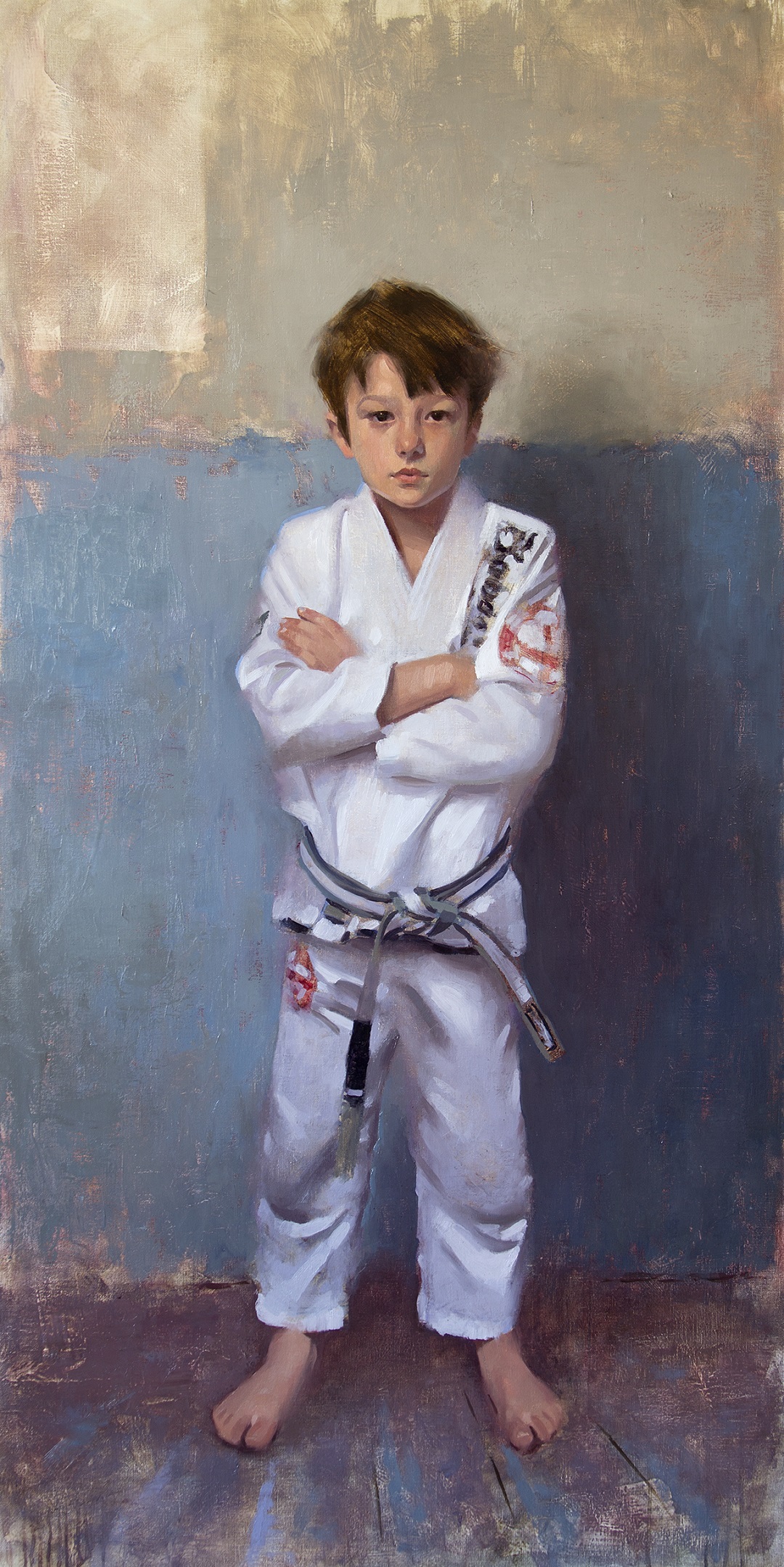
Boy in a White Gi, 2019
Alex Tzavaras
Oil on linen, 140 x 70 cm
Lisa: Can you tell us about the colours you use? What is your absolute essential palette of colours for painting a portrait?
Alex: You can paint absolutely any subject, with just the three primaries and white. A really good variation of the three primaries for portrait painting, is Titanium White, Yellow Ochre, Cadmium Red Light and Ivory black. Think of black as a warm blue. This combination of colours is known as the Zorn palette, after the Swedish painter Anders Zorn. It is very convenient for mixing flesh colours and has become very popular in recent years.
Another limited palette you can use for mixing flesh colours, is Titanium white, Burnt Sienna and Ultramarine. This is a really basic palette with just a warm dark, a cool dark and white. I’m a firm believer in teaching people to mix colours using a limited palette, because it forces you to think about value and temperature relationships. Instead of having to match colours exactly. Once you understand colour temperature, I find adding more colours to your palette is quite straightforward.
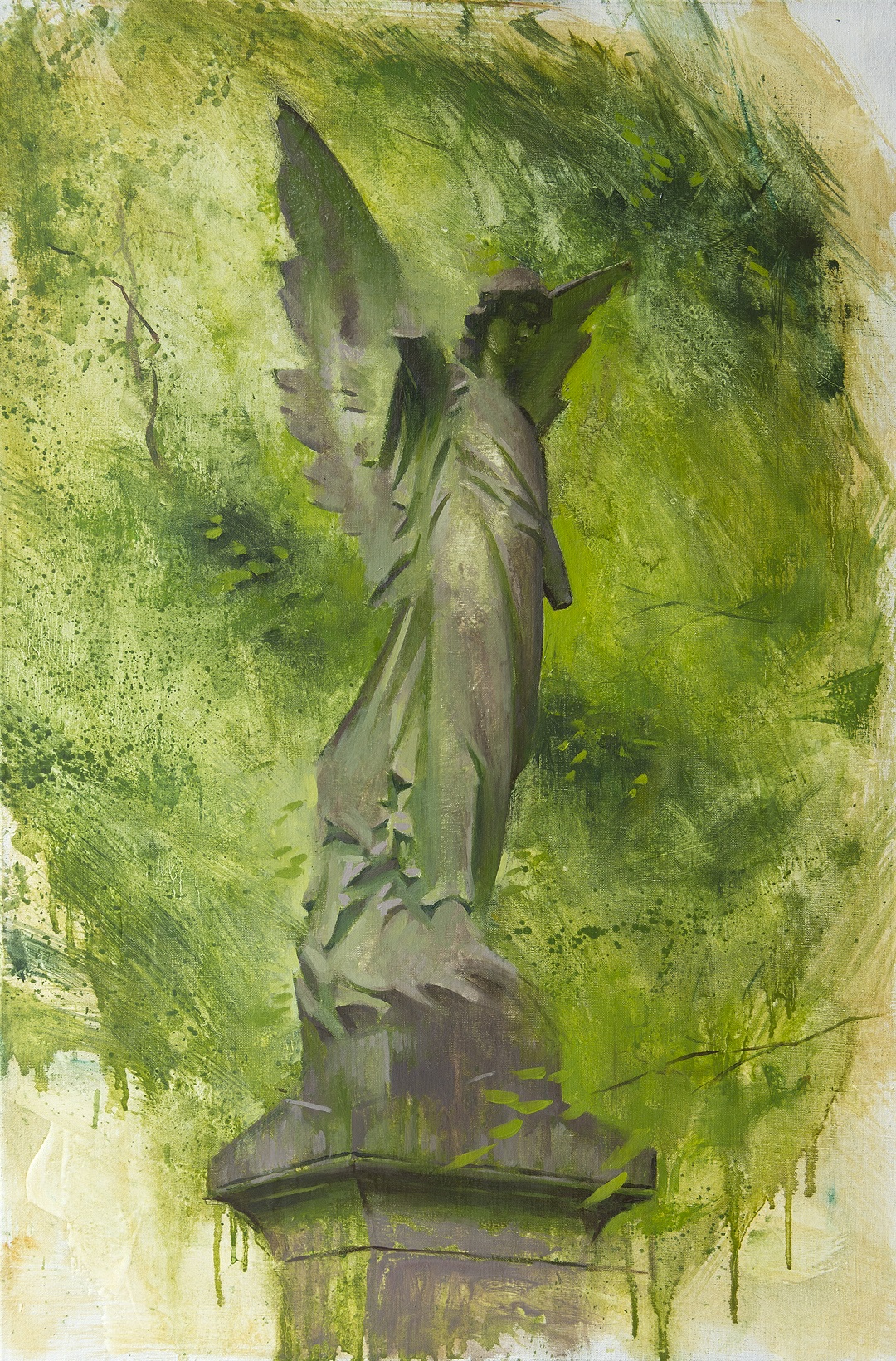
Angel, Nunhead Cemetery, 2017
Alex Tzavaras
Oil on linen, 50 x 75 cm
Lisa: And aside from paints, what kinds of brushes, canvas and other art materials would you recommend having to hand in your studio?
Alex: There seems to me, to be two opposing schools of thought when it comes to art materials. The first approach, which I’ve seen promoted by a lot the Atelier schools that offer “classical” training, encourages students to use only the finest materials. The other, based on the assertion that no amount of money spent on materials can make you into a good painter, stubbornly stick to using the cheapest materials they can find.
I fall somewhere between both camps. Art materials are definitely not secret ingredients that will make you into a better painter. While you are still learning about the fundamentals, form, light and colour, it’s probably best to save your money. But from my own personal experience there comes a time, when really inferior materials will hold you back. Particularly when it comes to pigments and painting surfaces. I think the main thing, is to find materials that you like and learn to control them so you can achieve the results that you want.
I’m a little ashamed to say, I’m very extravagant when it comes to brushes. I always like to have a clean brush on hand so I use quite a few while I work. I use many different kinds, bristles and softer haired brushes, flats and filberts. I also tend to prefer longer haired brushes. However, you certainly don’t need a load of expensive brushes, in order to paint. There are many artists who do fantastic work, with just a couple of cheap brushes.
My painting surface is very important. I have a range of different surfaces which I prepare myself. I prefer less absorbent surfaces so I use Roberson’s Oil Primer either on raw linen or panels.
The one question I get asked more than any other, is what medium do I use? I use hardly any medium. As much as possible I try to use paint out of the tube. If I need more fluidity, I mix more paint. I sometimes use a little medium when I come back to a painting after it has dried. For this, I use a mixture of Stand Oil mixed with rectified spirit of turpentine.
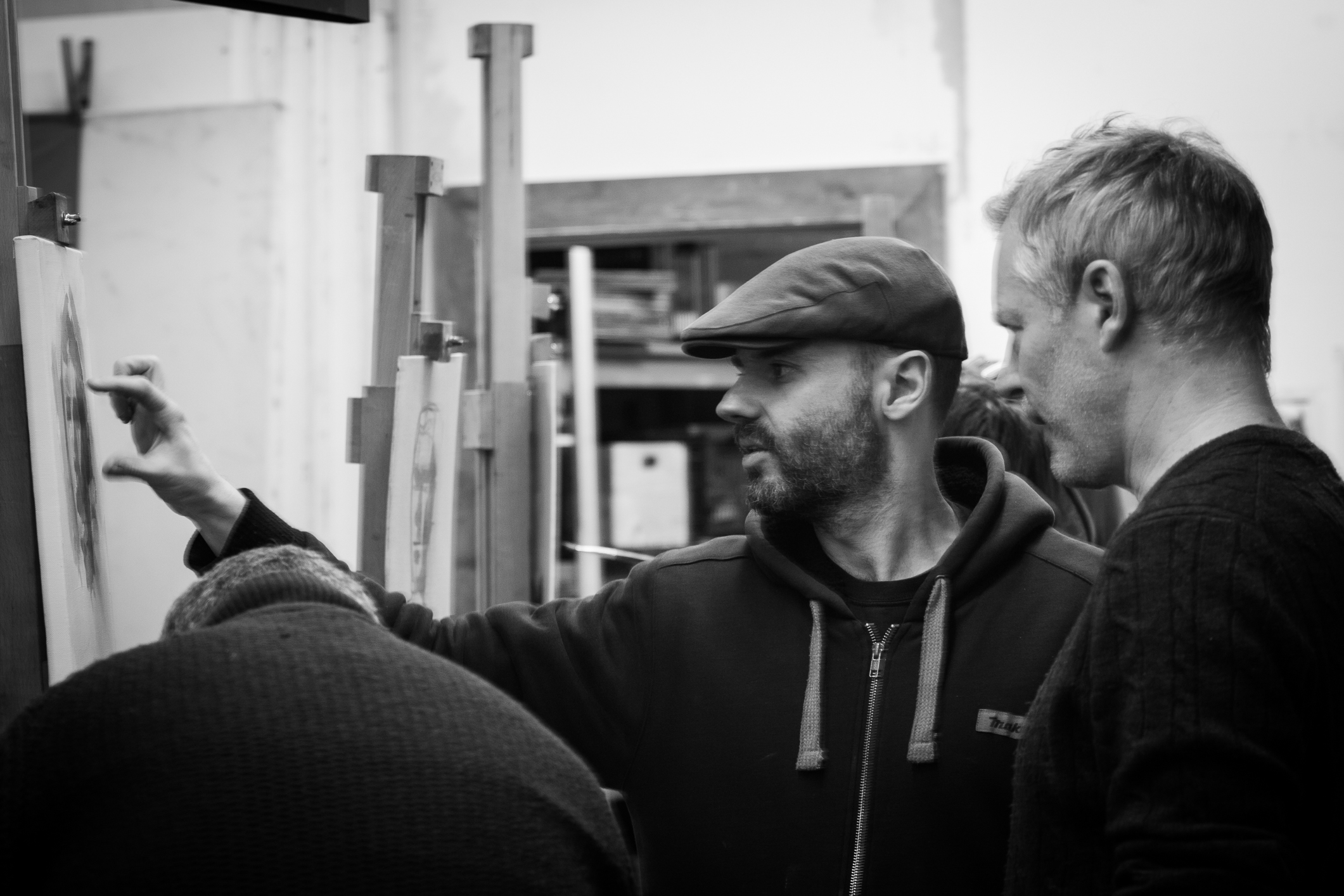
Alex Tzavaras teaching
Lisa: You are very generous in your teaching – both in person at the Dulwich Art Group, and also through your many YouTube videos. How important is passing on your knowledge about painting to you?
Alex: After my experience of art school and the frustration I felt at not being able to find any help learning to paint, I feel it’s very important.
Over the centuries, artists had discovered ways of depicting the world with breath taking realism. Up until the 20th century all this know-how and experience, formed the mainstay of art education. But when representational art went out of fashion, it stopped being taught in art schools.
I’m not saying that drawing and painting from life is superior to other forms. I just believe that this wealth of knowledge, gathered over many hundreds of years by some of our greatest artists, needs to be preserved for people who want to learn to paint from life.
Lisa: How do you balance your painting time with your teaching – is it hard to fit everything you’d like to do into the time you have?
Alex: Filming and editing videos takes up a lot of my time, so it can be a struggle to fit in my own painting. Even more so since I set up my Patreon Channel, where I offer much longer tutorials.
The reason it takes me so long, is I always have to put a lot of thought into explaining things in a way that’s clear and easy to understand. Talking about painting is difficult. You’re trying to describe something that is purely visual and I find it’s very easy for what you mean to become confused, as you translate what you’re doing into words. Harold Speed uses a great analogy, he says it’s like describing the taste of sugar to someone who has never tasted it.
From the feedback I receive, it would appear that my clear explanations are the main reason people have been responding to my videos.
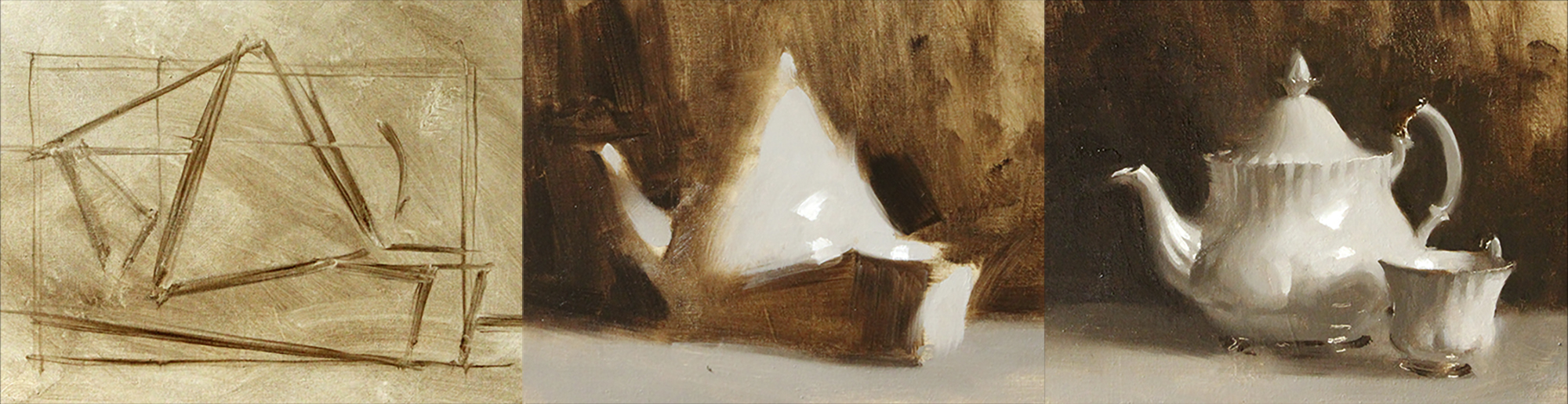
Stages of a monochrome still life, using Titanium White and Raw Umber
Alex Tzavaras
Oil on canvas
Lisa: What advice would you have for any painters who feel that they would not be able to paint a realistic portrait – are there any simple tips to help you on the right track?
Alex: Portrait painting is one of the most challenging subjects a realist artist can face. We all struggle, so if it feels impossible when you first start out, don’t be discouraged. Just like with any other demanding activity, like learning to play a musical instrument, it requires lots of practice. If they’re willing to dedicate enough time to it, there is no reason why anyone can’t learn to paint really lifelike portraits.
If I were to offer any advice it would be, don’t expect to run before you can walk. In most art classes today, you’re likely to be placed in front of a live model with little prior instruction. Given how hard portrait painting is, this is like being expected to pay a Chopin concerto on your first piano lesson. You need to spend time learning the scales first. I believe the key to success in painting lies in gaining a thorough understanding of its basic principles. How to draw, how to understand light and dark tonal values and colour. The best way I know to learn the fundamentals of painting, is to start practising with more manageable subjects, like still lives or plaster casts. Once you can do a really lifelike painting of a cast, you’ll be much better prepared for a live model.
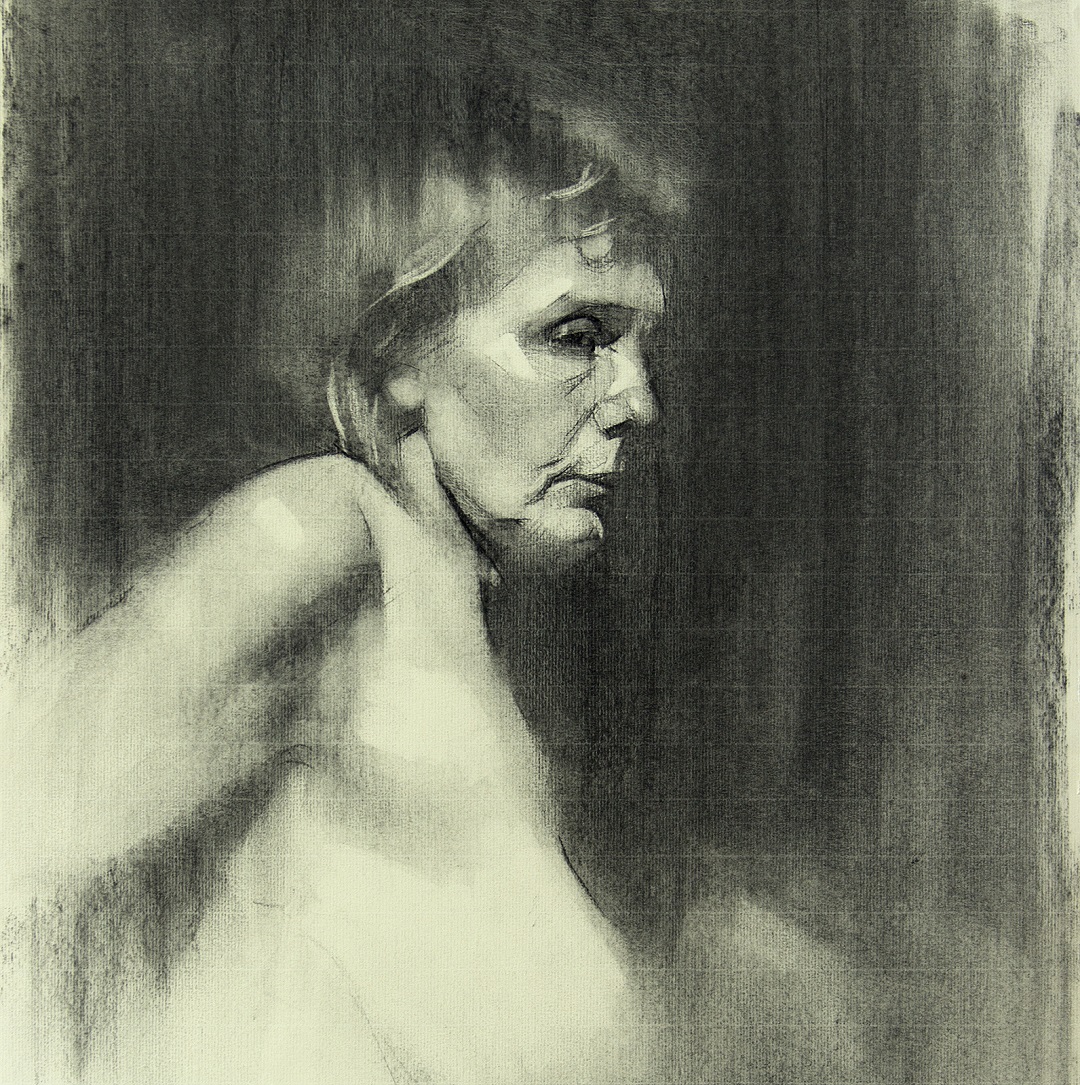
Portrait of a Naked Woman, 2019
Alex Tzavaras
Charcoal on paper, 50 x 50 cm
Lisa: Where online can we view more of your work and keep up to date with all your teaching and exhibitions?
Alex: My website is www.alextzavaras.com
Instagram: @alex_tzavaras
Youtube Channel: SIMPLIFY Drawing & painting
Patreon: simplifydrawingandpainting
5 thoughts on “Alex Tzavaras: Keeping Traditional Portraiture alive”
Alex,
Your tutorials are fantastic. I am a teacher
here in Vienna or was before the
pandemic.
I am trying to do tutorials. I am not techy
and have my own sight-size/proportion
ration way. Thank You for the inspiration!
I love Alex’s You Tube videos. His
journey is fascinating and teaching
excellent. I am not aiming for realism
myself but he is teaching fundamentals
that once grasped can benefit any type
of visual artist.
Lovely blogs and tutorials. I would love to
see some on painting with watercolour.
Thank you! Yes, we have a shortage of recent articles on watercolour, apologies for this. There should be some watercolour related posts on here in the next week or so, stay tuned!
Many thanks
Lisa
Hi Alex, interesting read and everything you
said about art school telling you realism and
painting wasn’t relevant resonated with my
own experience when on my Fine Art degree.
We even tried to set up our own life classes
at our own cost and were banned in no
uncertain terms so it’s great to see how
other painters feel it’s still an important and
relative option to learn even if later they
don’t utilise the same skills on future
projects. I’ll be looking at your Patreon to
subscribe and learn. Thanks to the
interviewer Lisa Takahashi and interviewee
Alex Tzavaras for a good read.
Comments are closed.