



Bryony Benge Abbott’s oil paintings, community murals and self published zines all celebrate the healing power of nature. Through depicting complex plant structures and patterns in exotic, multi-layered, transparent colour, she creates pictorial idylls that invite us to revel in their soothing qualities. In this interview Bryony shares some of the ideas behind her work, including how environments can shape our identity, and the benefits of engaging with the natural world, from both physical and psychological perspectives.
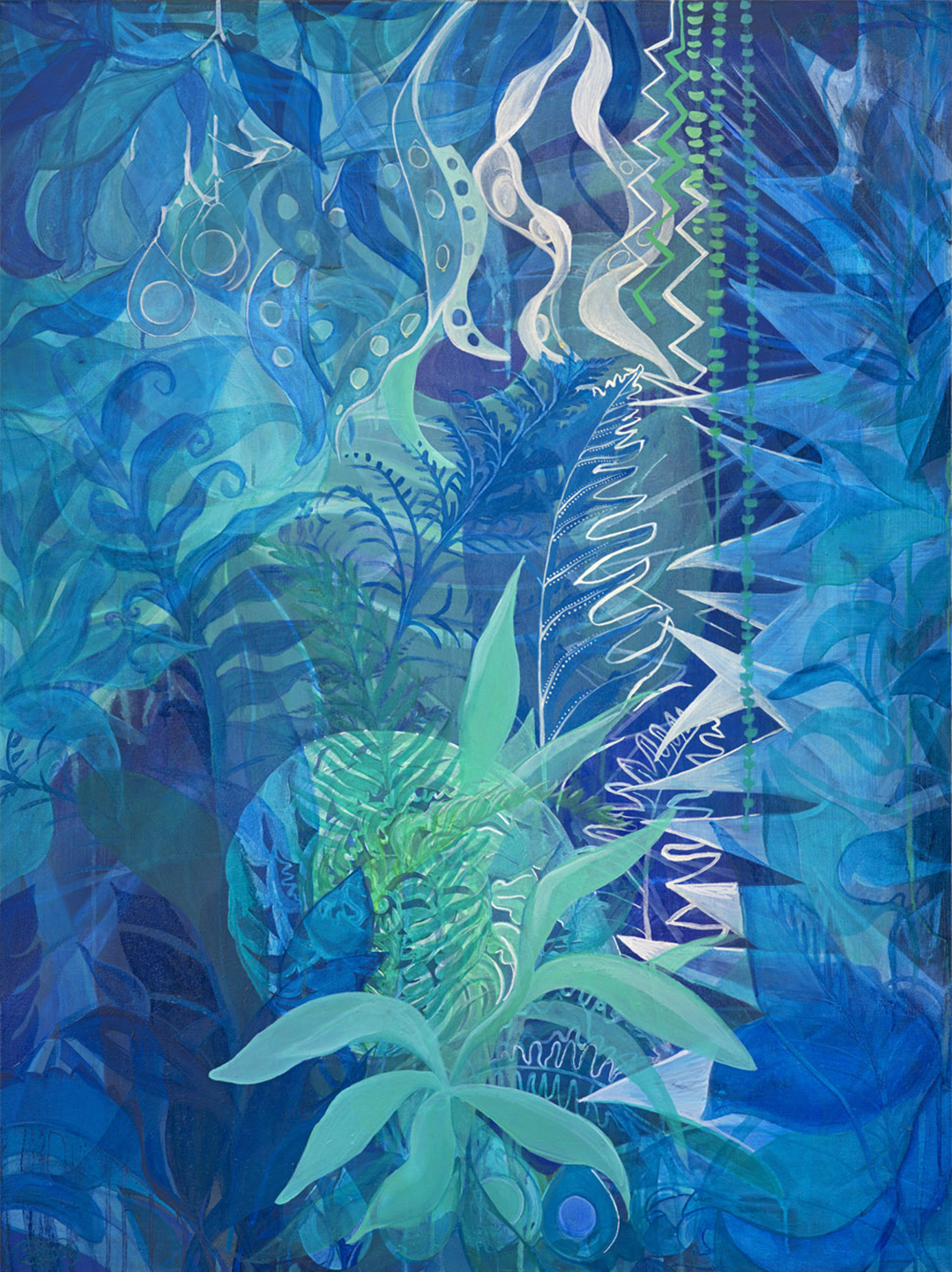
Bryony Benge Abbott
Oil on canvas, 80 x 100 cm
Lisa: Everything seems to meet in your work – there’s a real melting pot of ideas coming together, from raising awareness of ecological issues, to the bringing together of people, mindfulness, botany, pattern and colour! Where do you find your inspiration and develop your ideas?
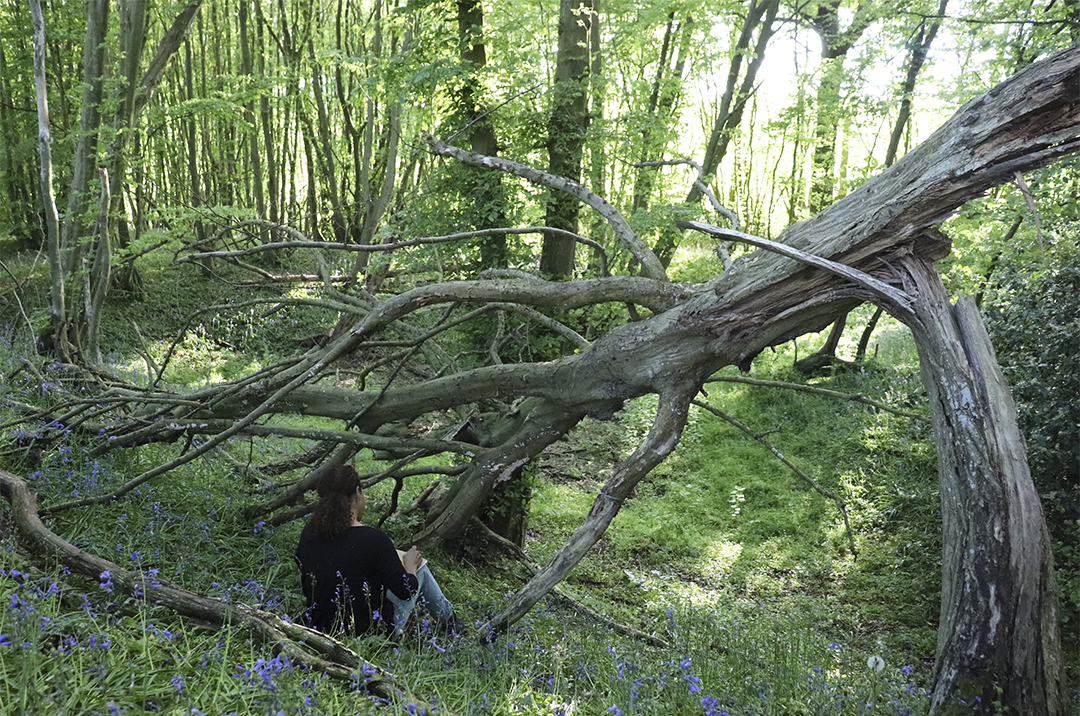
Bryony: I get a great deal of my inspiration from spending time in different landscapes, whether far-flung or hyper-local, primary rainforest or concrete jungle, I’m curious about how environments shape and influence our well-being. I became interested in this through my mother, I think, who was passionate about her discipline of art- and eco- psychotherapy. In my other career as an exhibition curator and producer, I gain so much inspiration through working with museum collections and contemporary science; dipping into ancient worlds and social history alongside cutting-edge scientific research provides a rich pool of concepts and perspectives to play with as an artist. I adore experimenting with colours and patterns, and aside from those observed in nature (I’m often walking with a sketch pad and pencils) I also find the use of pattern/colour by artists such as Beatriz Milhazes, William Morris, Chris Ofili, Silja Puranan, Pierre Bonnard, Henri Matisse, Frank Bowling and Gustav Klimt hugely inspiring. I also absolutely adore Islamic and Portuguese ceramic tiles!

Lisa: I think your community projects work because of the colour and joyfulness, which is inspired by nature. Do you feel a responsibility for bringing your experiences of the natural world to an urban setting, such as your home base of London?
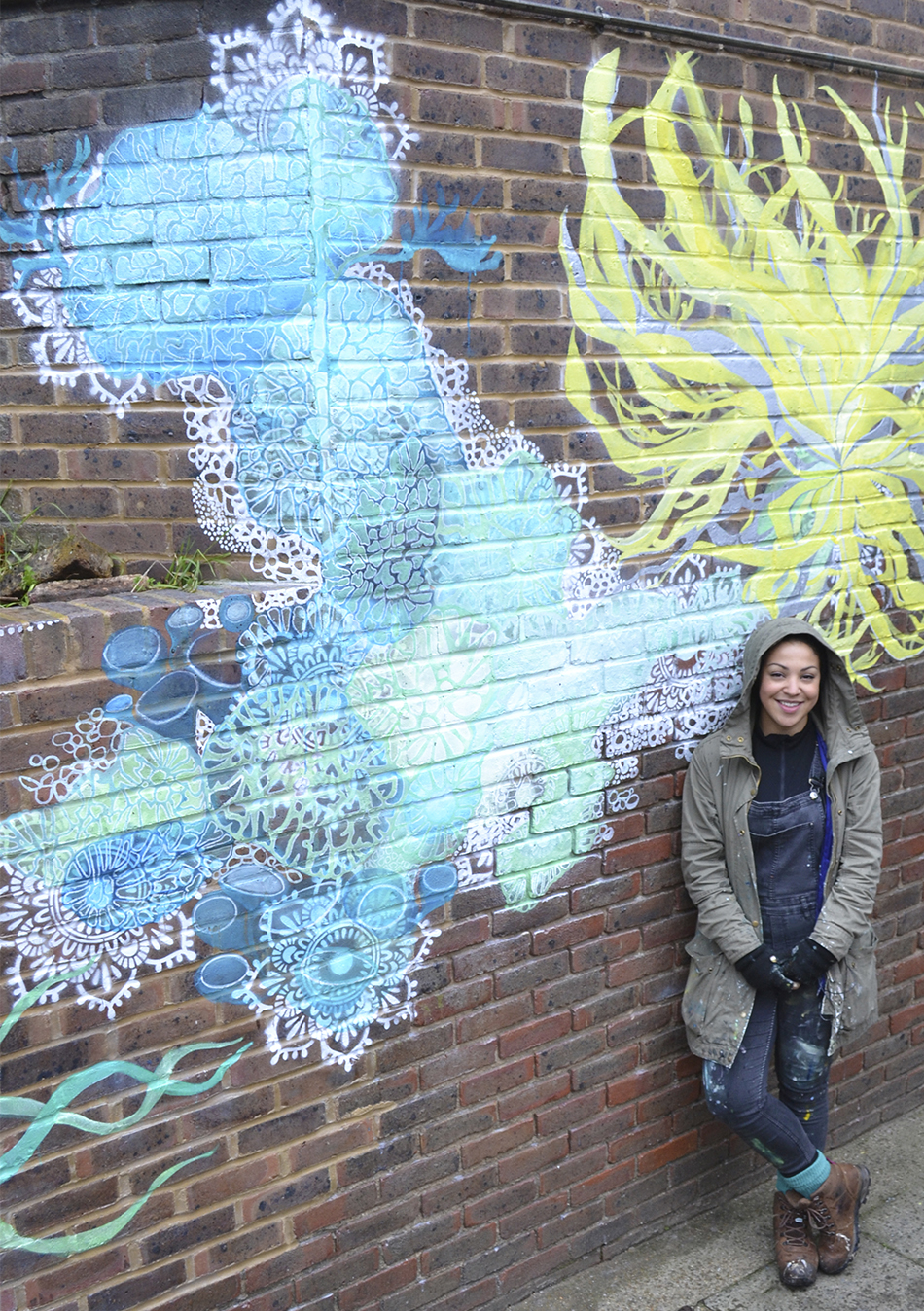
Bryony: Definitely. I was born in Bradford and lived in the centre of Leeds until I was about 8 when we moved into rural Kent. This was a huge shock to the system but looking back I realise how blessed we were to have so much safe, green space to run wild and play in as children. Inner city life feels restricted in comparison and I often feel the need to escape to the countryside just to get a sense of space, perspective – to remind myself that there is a world beyond the hustle of the capital! I do love London, it is such an exciting and vibrant city, but I think public art can play an important role in breaking up the relentless concrete and glass of urban life with bursts of colour that revel in natural wildness. If my murals can even in a small way act as a reminder of the healing potential of natural world, and support or encourage folk to seek out or create new green spaces of their own, then that’s hugely gratifying. A line in Jay Griffith’s book Wild has stayed with me and fed into my thinking about the role of public art and public space in densely populated areas. She writes that ‘violence comes from being outside nature,’ and I believe that there is great wisdom in her statement.

(read more about the making of the mural here)
Lisa: Do you approach how you go about designing a composition for a work of art differently, depending on whether it’s going to be a mural or a painting on canvas? Or is the process much the same?
Bryony: When I am painting on canvas or board I tend to work intuitively. I very rarely have a clear idea of what the final painting will look like, it is more a sense of what I want to feel or say through the painting and this often evolves or changes as I work. This is partly because it takes me months to create one painting – I need to stop and start as the oils dry, and in those in-between moments I am in a kind of reflective dialogue with the painting and continuing my research. My more recent work in particular can be viewed as a palimpsest in many ways; layers of ideas and explorations rather than one single statement. There will be an underlying structure to the work – the first few fast, loose marks provide a skeleton composition – but where it goes from there remains to be seen!
Designing murals is quite a different process and more similar in many ways to my work producing exhibitions for museums. As they are commissions, naturally everyone needs to be clear from the outset of the scale and positioning of the artwork. I start by mapping out on the computer a proposed composition in response to the environment – thinking about how/where/why the public move through the space, identifying vantage points, considering where the mural will have the most positive impact and where we need empty space so that the mural enhances rather than complicates the space. This is a collaborative process. I also really enjoy building in different ways for clients and communities to contribute to the conceptual design of commissions. However, I often leave the finest details of the mural undefined, as I find that it’s only when I am actually in the space with my paints, working alongside and interacting with the community, that I have a full “vision” of the what the final mural will look like. But certainly before I arrive at the wall to paint, everyone knows its theme, scale, overall composition, palette and primary structural patterns.
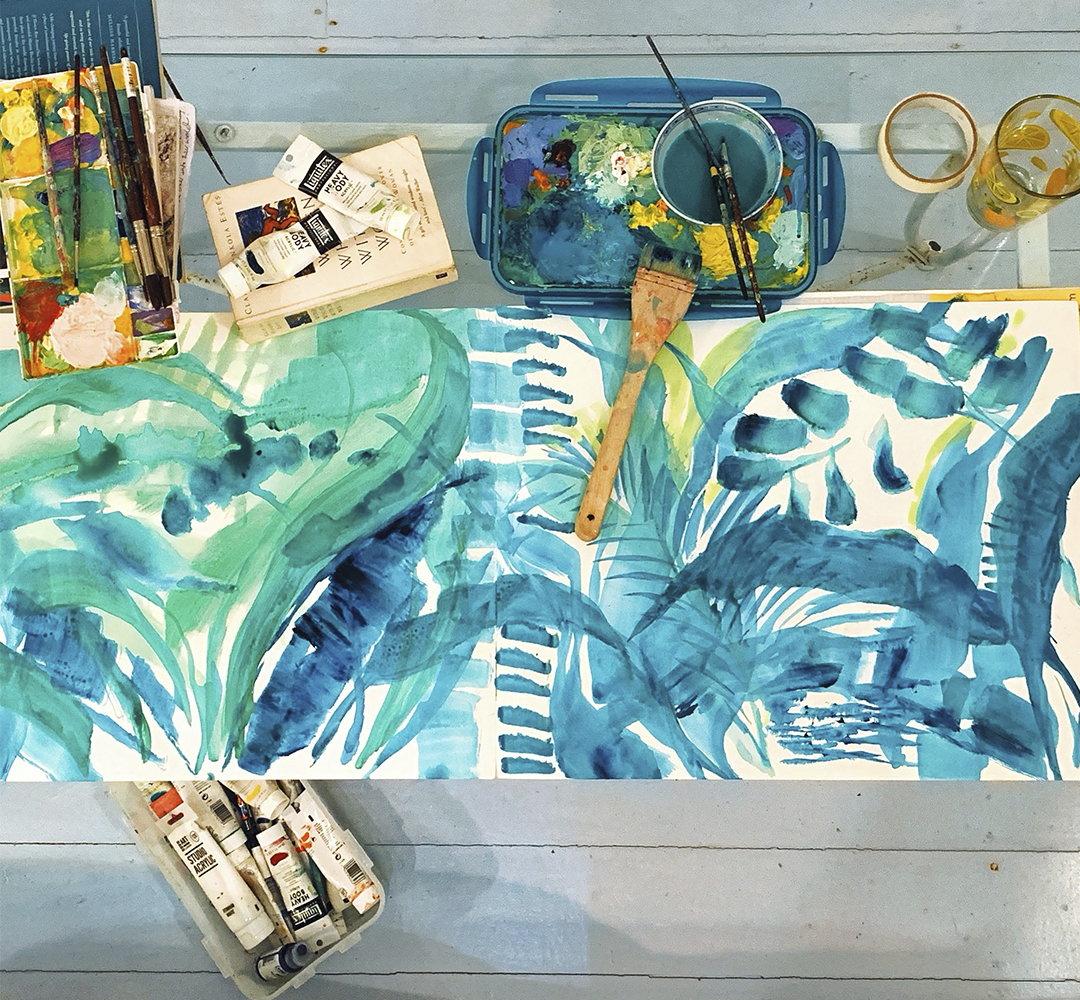
Lisa: How important is the quality of your art materials, and do you have any favourite paints and brushes that you like to work with?
Bryony: The environmental impact of my materials is increasingly important to me. I used to clean my oil brushes with white spirit. I’m not wedded to one oil painting brand; I am currently using paints by Winsor & Newton, Lukas and Michael Harding so a wide spectrum in terms of price points! But when I’m painting murals I’m a little more brand-specific. I find that the Liquitex range of heavy body acrylics covers a lot of wall whilst still retaining high pigment. And I always work over any spray paint or acrylic with Posca pens, which are absolutely amazing for fine detail.

Bryony Benge Abbott
Limited edition colouring zine, available here
Lisa: You also have produced 3 (so far!) colouring zines, that are a collection of your line drawings of plants to colour in. The latest is inspired by African plants and patterns, with profits going to ‘Black Lives Matter’ (as well as two UK charities supporting the Black community). How important is it to you to make something that is rooted in mindfulness and contemplation, in order to raise money for Black Lives Matter?
Bryony: Each ROOTS colouring zine supports a different charity during a time when this sector is really struggling to raise money. I didn’t want to just donate a lump sum to charity and move on, I also wanted to find a way to use my art to enable a reconnection to the natural world that we all had suddenly found ourselves disconnected from, and to offer a creative outlet and mindful experience to support mental health and wellbeing. The act of creating these zines was also quite cathartic for me during lockdown, particularly the African ROOTS colouring zine, which supports three charities working to protect and celebrate black lives: the global Black Lives Matter network, the UK 4Front project and the London-based New Initiative ORIGIN programme. As a mixed-race British-Caribbean artist, creating this zine during the global outcry over George Floyd’s murder felt like the most positive way for me to process the complex emotions it raised. The act of colouring-in is a very meditative, contemplative experience and I wanted to create a zine that brings one closer to the African continent, celebrating its extraordinary flora and highlighting its wonderful creation myths and legends. We only protect what we value and I guess a lot of my work involves deliberately focusing my gaze on certain themes and topics that I think deserve greater value, greater space and greater protection.
Lisa: I love that you have also compiled a Spotify playlist to listen to while colouring in your Zine! This suggests music is a big influence on you … can you describe the influence music has on your work?
Bryony: I always have to have some kind of soundtrack when painting but it varies depending on my mood and the stage I am at with the painting in question. There are three settings, really; I’ll dip in and out of wanting music on and turned up full volume, to turning everything off and opening the windows so that I can hear the wind and rain, or absorbing myself in an audio book related to theme of my painting. Right now I’m working on a series inspired by tree roots so I periodically switch on The Overstory by Richard Powers, a novel about the wisdom of trees. Whatever the soundtrack to which I am painting, it has to support me staying ‘in the zone’ and if there’s recently discovered a song that I’ve fallen in love with (for example, Massive Attack’s Ritual Spirit is currently getting a lot of air time in the studio) I’ll play it on repeat and it will kind of become intertwined whatever painting I’m working on at that time, forever linked in my memory of its making.
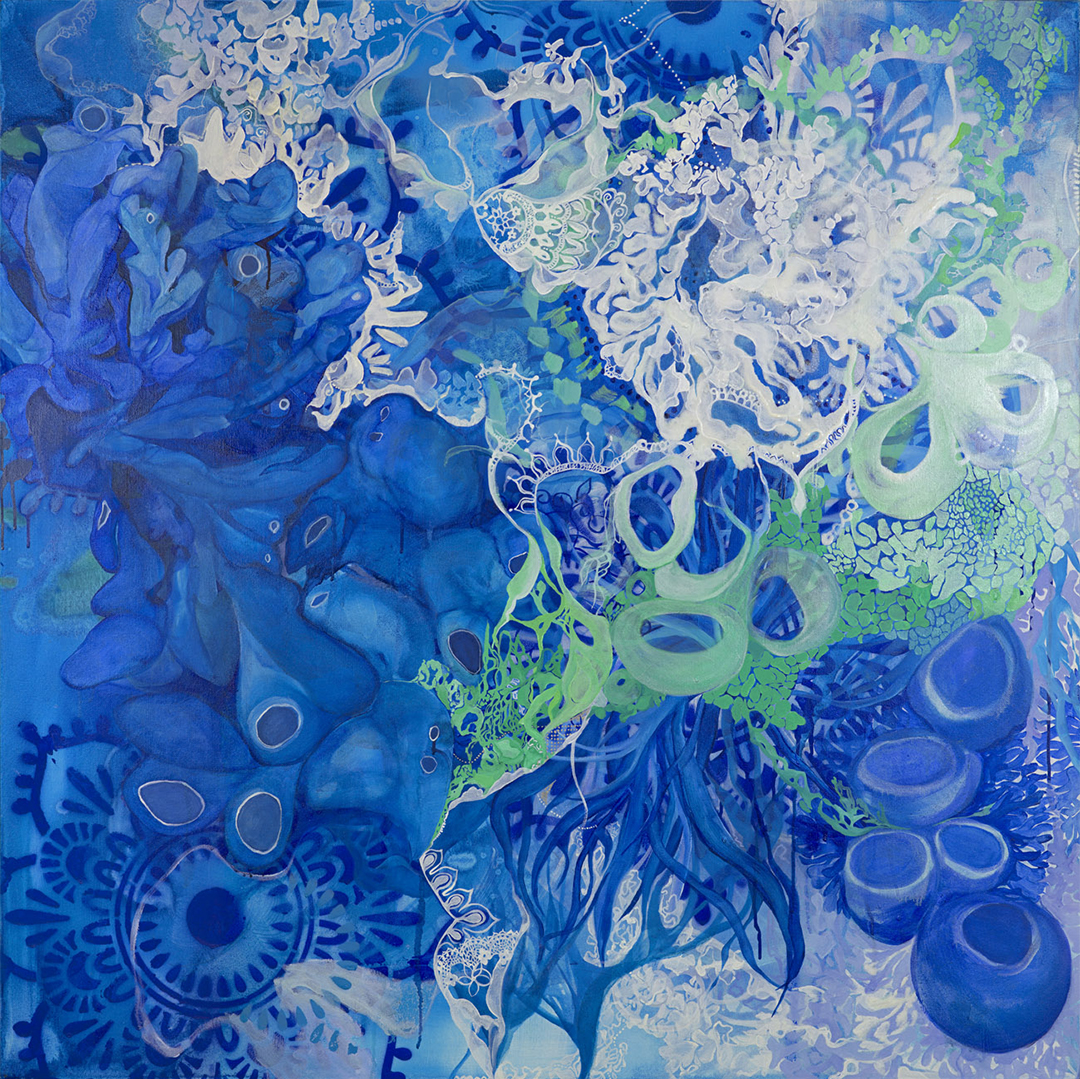
Bryony Benge Abbott
Oil and spray paint on canvas, 100 x 100 cm
Lisa: Your company is named Bryony and Bloom, “Bloom” a reference to the phrase ‘Bloom where you are planted’; could the plants in your work be seen as a metaphor for you, in a way? That wherever you find yourself – travelling on residencies, working on a community project, or alone in your studio, it’s instinctive to find nourishment and creatively grow?
Bryony: That’s a lovely idea! Perhaps. The older I am getting the more I am owning the fact that the need to create is a huge part of who I am and I’m increasingly trying to find ways to build that into my life and prioritise creative nourishment, no matter the location.
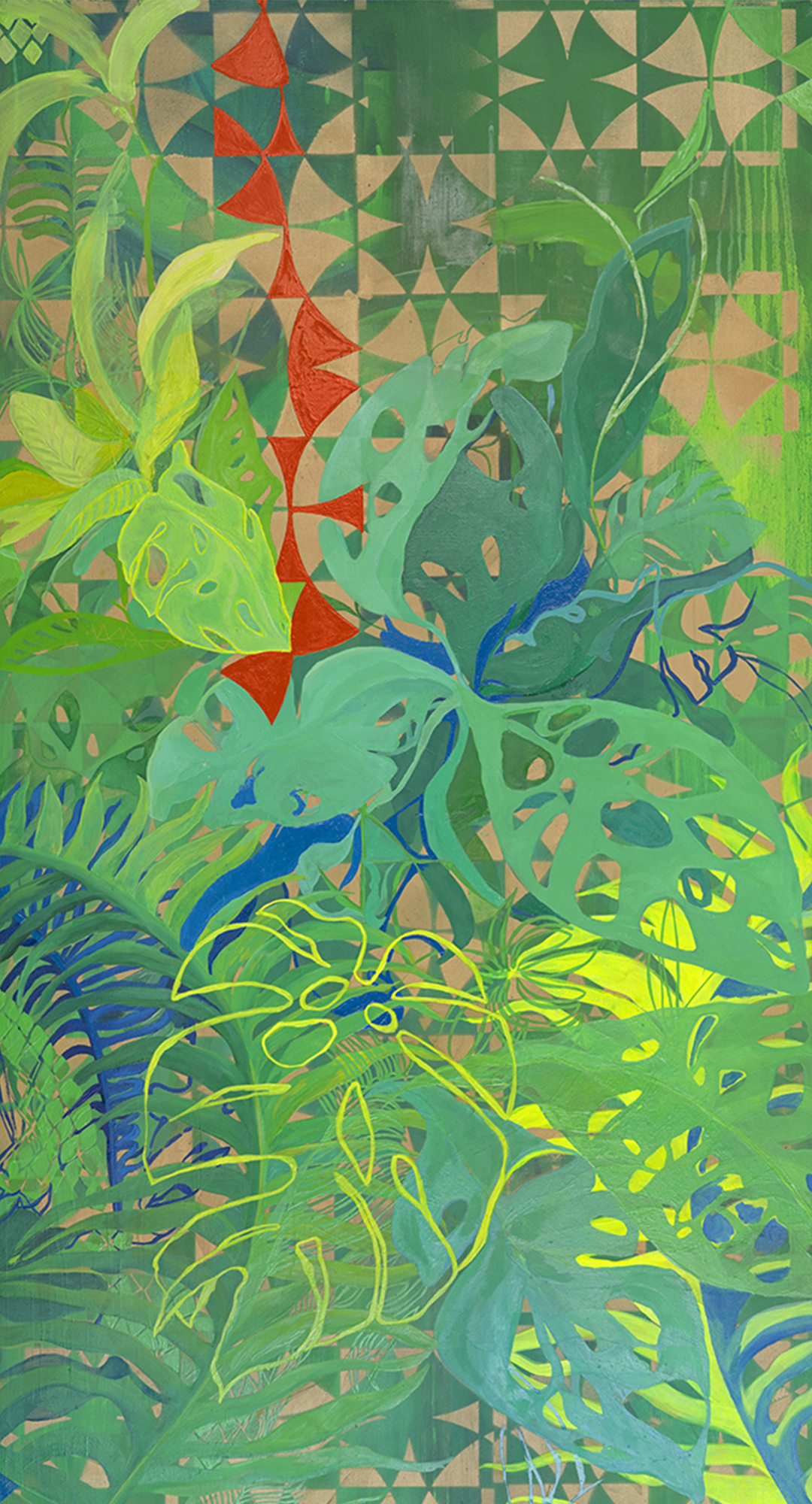
Bryony Benge Abbott
Oil and spray paint on board, 89 x 100 cm
Lisa: How has lockdown impacted upon your practice and do you see the effects of recent events (both the pandemic and the BLM protests) influencing your future work?
Bryony: Whilst lockdown has halted any public art projects, it’s also provided an opportunity to launch my collection of colouring zines and to focus more on my oil painting practice. I have had a very intense 12 months; I lost my mum in December and my father in April so those bereavements have absolutely shaken my foundations, and when combined with the global pandemic and the resurgence of the Black Lives Matter movement, against the backdrop of increasing warnings from scientists about the climate crisis, I find that my current creative practice is grappling with some big questions around concepts of identity, society, community, ancestry, legacy, spirituality, science and time. I’m not quite sure where these questions are leading me but this period has certainly altered my creative practice. I guess I will only be able to answer this question fully with the benefit of hindsight.

Bryony Benge Abbott
Gold leaf, oil and acrylic paint, paper and resin on board, 50 x 50 cm
Lisa: Are you working on anything at the moment?
Bryony: I’m still creating colouring zines, with two coming out shortly: Tree ROOTS and Rebel ROOTS. And I am working on a body of about 20 paintings that I am loosely calling the ‘Altar Peace’ collection, which is a meditation on the concept of sacred spaces in nature. I’m enjoying exploring different materials with this collection, playing with resin, metallic leaf, textiles, paper, acrylic, ink, oils and pencils as well as testing out new substrates like aluminium, and (whilst I can’t work on brick walls!) experimenting with the scale and spread of my oil paintings – for example, I have one painting that’s slowly growing up the wall and across the ceiling!
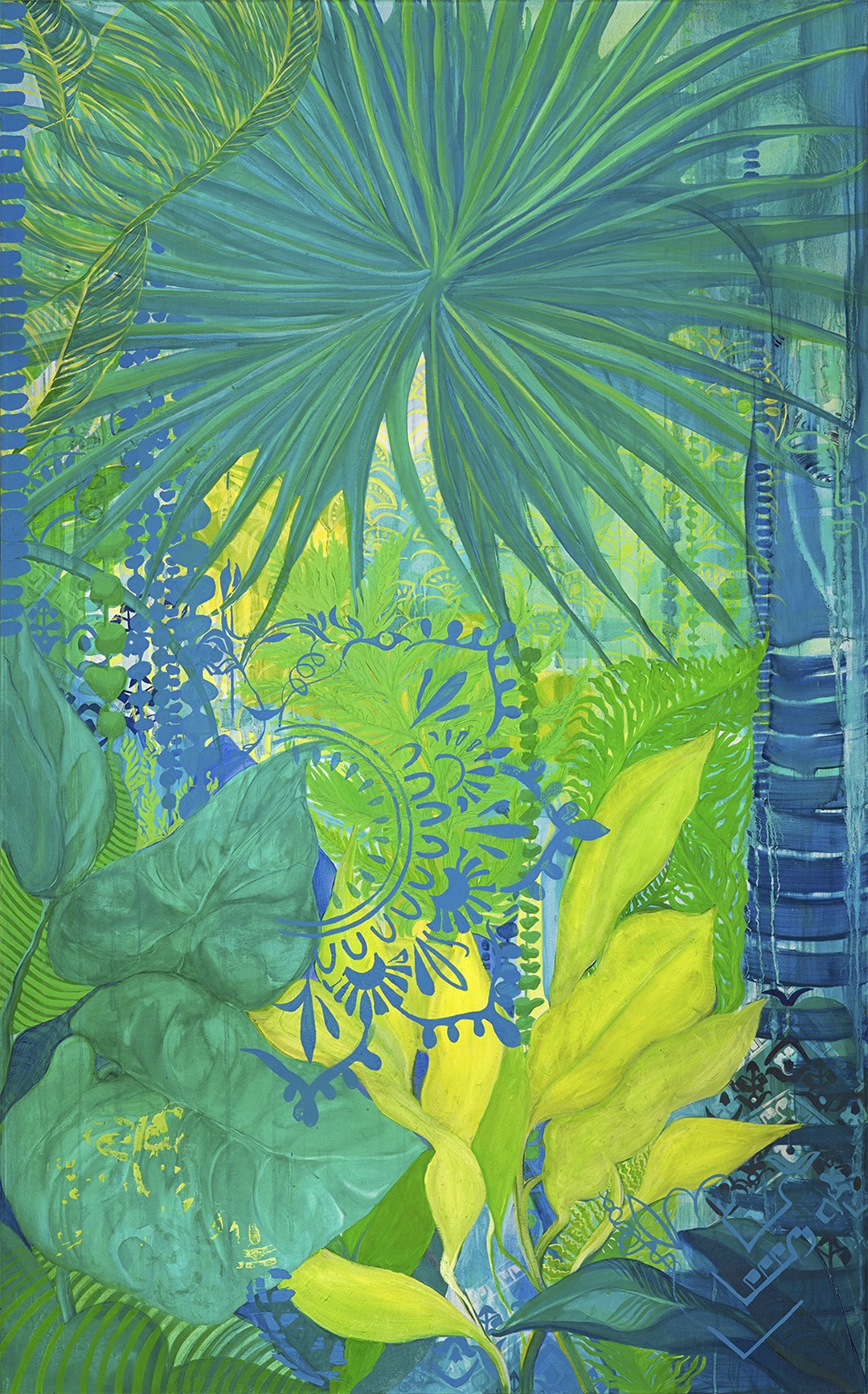
Bryony Benge Abbott
Oil and spray paint on canvas, 78.5 x 125 cm
Lisa: Where online or in the flesh can we view more of your work?
Bryony: If you’re in London, two murals that are currently easily accessible are the Not a Wallflower mural on Woodland Grove in Greenwich and Follow the Lichen in the Girdlestone Estate, Archway, opposite Whittington Hospital. Otherwise, you can follow me on Instagram @bryonyandbloom for studio ‘behind the scenes’ updates and explore my paintings, zines and textile collections on my website www.bryonyandbloom.com.
1 thought on “Bryony Benge Abbott: Bloom Where You Are Planted”
Beautiful art.
Comments are closed.