



When framing your artwork there are a number of points to consider. The purpose of a frame should be to focus the attention on the artwork, as well as protect it from environmental factors that could affect its appearance over time. Framing is an art in itself and choosing the right one can greatly enhance an artwork. It’s important to consider the medium the work is painted in, as well as the support it’s painted on. Understanding their properties will help you to choose a frame that not only compliments the work but protects it over time. When choosing the right frame for your artwork, consider the following points.

Frame Material, Colour, and Style
Frames are available in many varieties, so there is plenty of choice to ensure the frame complements the artwork. If framed incorrectly, a frame might overpower the artwork or lack in giving it the presence it deserves. While it’s important to pick a frame that is less eye-catching than your artwork, you should avoid frames that are too similar in colour to the artwork, or as busy in terms of decoration. Think about how a frame can present the work most effectively. For example, adding contrast with a dark frame on a light painting can make the artwork stand out.
The style of a painting will help to suggest the frame style. For example, paintings with a classical subject matter might be well suited to a traditional gold-leafed frame, or an attractive dark wood frame. Paintings that are lighter or more abstract usually look best in less ornate frames, such as a box frame with a thin border. For paintings with a subject matter somewhere in between, you could choose a frame that combines traditional and contemporary styles.
If you’re unsure about adding colour with a frame, black or white are always good choices. Both work well with most interiors and subject matters – simple black frames can add depth and drama, and white frames work well with bright coloured works and white walls.

Framing Artworks on Paper
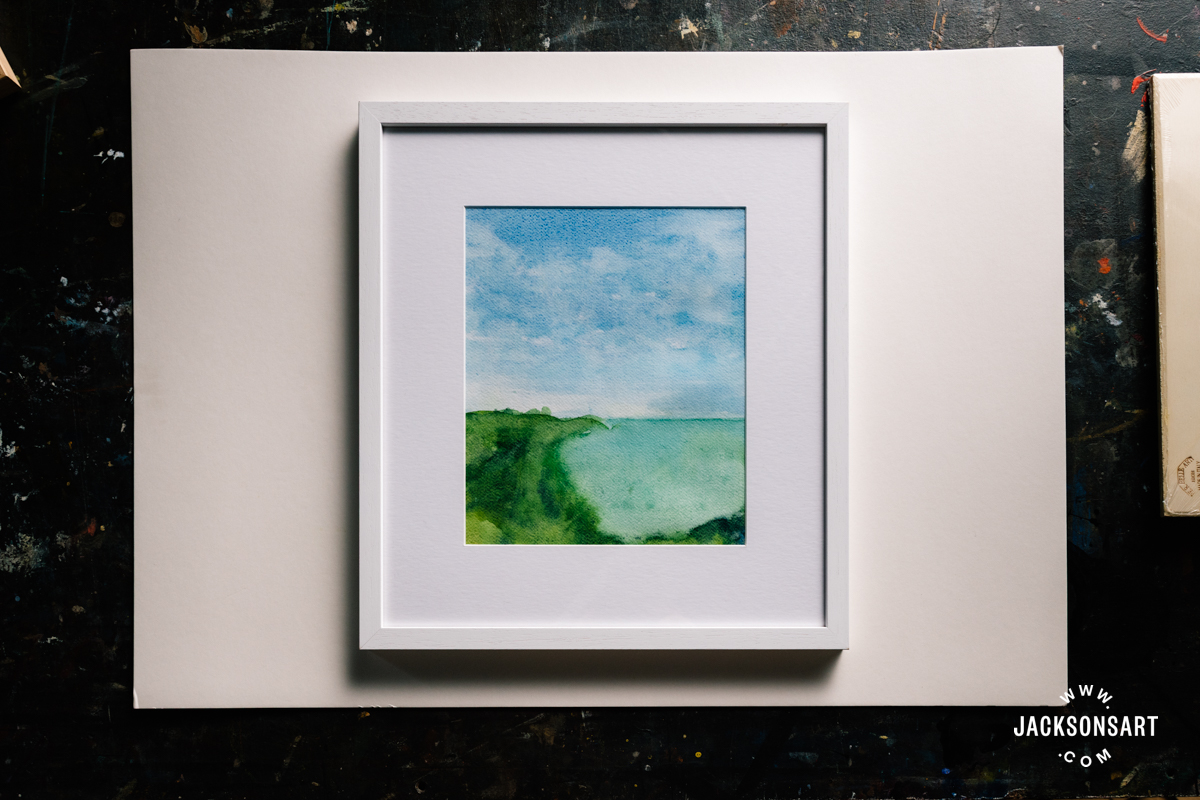
A frame for a work on paper should protect the artwork as well as draw attention to its appearance. Works made with mediums such as graphite, charcoal, or pastel are more delicate and require care when handling and framing. Watercolour paintings on paper can also be fragile. These artworks usually look best when framed with a mount, or ‘mat’. Acid-free mounts and backings will help protect the work from deterioration. Most good framers will use materials that are 100% acid-free.
The mount helps highlight the artwork by separating it from the frame and drawing attention to the work. They also help conserve fragile artworks by ensuring that the glass doesn’t touch the artwork directly. This can cause condensation and damage to the paper as mould and mildew can form.
Most artworks on paper look better with a mount, as it provides an elegant finish. But a mount isn’t always necessary. Some works on paper are ‘floated’ over the mat, in which case a framer will use conservation-quality materials to protect the back of the artwork.

Beautiful Girl II, 2011, Etching by Tracey Emin
© Thou Art In Hampstead Ltd
If you’re interested in learning how to frame a watercolour painting, drawing, or print, read our guide on how to frame artwork on paper.
Choosing a Mount or ‘Mat’
Neutral coloured mounts tend to be the most popular, although other colours can add an interesting dimension to an artwork. If you want to introduce subtle colour, you can layer one mat on top of another. This is called ‘double matting’. A coloured mat is placed beneath the neutral mat, and the windows of the two mats are cut so only about 1/4 in of colour is shown. Artworks can also be framed with a ‘liner’ – usually a piece of wood that acts like a separate inner frame, which is slotted under the rebate around the inner edge of the frame.
UV Protection
It is also important to make sure the glass has a UV filter. This plays a key role in protecting works that will fade over time if exposed to UV light. The best types of glass are low-reflective as they do not interfere when viewing the artwork. Acrylic glazing, sometimes known as Plexiglas, is much lighter than glass which makes it a good alternative for large artworks. It is virtually shatter-proof although it can scratch easily. It usually provides about 60% UV protection and is available in regular and non-glare forms.
Framing Oil Paintings
Oil paintings were never originally framed behind glass. And still today, you rarely find an oil painting with a glass frame in a gallery or museum unless it’s particularly valuable or at risk from damage.
The characteristics of oil paintings are important when looking at framing options. Oil paint doesn’t ‘dry’ like other paints. Instead, it hardens as the oil oxidises (a chemical reaction with air). This is different to watercolour, for example, where drying is caused by the water content of the paint evaporating. Oil paintings can feel touch dry and possibly safe to handle after a few weeks. However, depending on the thickness of the paint layers, they often take much longer to fully dry. Most argue that glass should be avoided and that oil paintings should be left to ‘breathe’.
A protective coating of varnish is key for oil paintings. Varnish prevents dirt from reaching the surface of the paint and damaging it, as well as enhancing the colours. It also creates a barrier to protect the paint from being removed when cleaning.

Framing Acrylic and Mixed Media Works
Acrylic paint dries differently to oil paint and this can affect how acrylic paintings are framed. Oil paintings dry to produce a very hard film created by the oxidized oil. The paint can soften in high heat, depending on how much the acrylic is diluted with water. This can mean if an acrylic painting is kept in unstable temperatures where it heats and then contracts as it cools, it may be vulnerable to cracking.
It’s important to keep paintings away from sources of heat, such as radiators, fires, or ovens. For some, concerns over the paint film softening is an argument for keeping acrylic paintings framed behind glass.
Mixed media works span across a variety of mediums, so consider what is appropriate for how the painting is composed. Works with three-dimensional characteristics are often left unframed, as are oil or acrylic paintings with heavy impasto. When framing these types of artwork, make sure to take into account any extra dimensions that the materials may be adding on.

Do All Artworks Need to be Framed?
Not every work of art needs to be framed. In many cases a frame isn’t necessary at all. Some early twentieth-century painters disregarded frames completely. Leaving work unframed means that the viewer focuses solely on the artwork, and it draws attention to the artwork as an object.
Paintings can be wired to hang without a frame, providing that the stretcher is solid and thick. The same applies to painting panels, although they will need a sturdy support fixed to the back. A conventional frame might not suit all works. So don’t be afraid to try something different.
‘Gallery wrap’ is a method of stretching canvas so that the canvas wraps around the sides of the stretcher bar and is secured to the back, rather than the sides of those bars. This leaves the sides of the canvas smooth and free of visible staples or tacks, providing a clean look when the work is displayed without a frame. Artists often continue the painting around the sides, or paint the sides a complementary neutral.

Protecting Framed Works
Artworks can be damaged if exposed to extreme changes in their environment, such as humidity, heat, and lighting. Mould can appear on canvases, paper, or even in paint itself if the frame expands and allows contact between the artwork and external climate. These adverse effects can also lead to pigments fading and colours becoming dull. Here are a few things to consider when hanging artworks:
- Avoid hanging works over sources of heat such as a fireplace, heater, or oven. If you are planning on putting artworks in a room with a working fire, they should be framed behind glass to protect from smoke. Burning candles can also cause soot damage.
- Certain pigments fade when exposed to direct sunlight. A shady wall is always preferable. Also avoid placing artworks too close to sources of light, unless they are LED.
- Avoid hanging works on damp or recently plastered walls, especially if they are close to air vents. If an artwork is valuable or sentimental, avoid storing it in an attic/loft or basement.
- You can gently dust artworks with a soft artist brush, but avoid using a cloth. A cloth can damage or scratch the surface of the paint. Don’t use water or household cleaning products. Take the artwork to a professional restorer if it needs cleaning.

Further Reading
How To Mount Artwork in a Frame
Making Art Prints at Home or in the Studio
How To Organise Your Own Art Exhibition
Shop our Framing Department or create your own frame with our Bespoke Frame Builder.




9 thoughts on “Choosing the Right Frame for Your Artwork”
I work on Khadi cotton paper from
Jackson’s which has a lovely heavy
texture, painting in acrylic with a loose
sketchy style – what recommendations
do you have for framing/mount?
@evpaintsthesea
Hey Ellie, check out our bespoke frame builder – lots of different styles available and you can upload an image of your work to get an idea of how it will look in the frame. Thanks for reading.
Happy New Year Daniel, informative
information. What I would like to know is the
ref number to some of the Jacksons frames.
I print small format photos and paint small
gouache abstracts. I refer to the photos,
etching and box frame with paint brush
exhibits. Many Thanks
Hi Isobelle, these are our ready made frames which are available on our website – box frames, float frames, and we have some new window mount frames. Also more custom choices available on our bespoke frame builder. Thanks for reading.
I would just like to thank you for the speedy
delivery of a tube of paint. Despite warning
me that there may be a delay in sending, I
thought you should know that the paint
arrived within two days of ordering. Many
thanks.
I was interested in the comment about
varnishing oil paintings. Please can you
direct me to an article about this, or the
correct product?
Many thanks
Tinx
Hi Tinx,
Although this article is primarily for acrylic paintings, there’s a lot of information here relevant for varnishing oil paintings.
https://www.jacksonsart.com/blog/2010/07/09/varnishing-acrylic-paintings/
Best wishes
Lisa
Hi I want to order a bespoke floating frame
for my 30×30 cm sq panel acrylic painting
What do I enter in the dimensions spec for
my purchase? as they ae bespoke they
cannot be returned. Do I enter 30.5cm x
30.5 cm 0r 31cm x31cm as the order info
eems to suggest? Confused!
Hi Nicola,
Thanks for your question. If you want to have a gap between the artwork and the frame, then the gap needs to be added to the length of your art work. So, if your painting is 30 x 30 cm, and you wish to have a 1c m gap all around, then you would need to enter 32 cm x 32 cm into the frame builder as the dimensions of the artwork (adding a centimetre for each side).
Many thanks
Lisa
Comments are closed.