



So you want to try watercolour painting for the first time, but you’re not sure what you need to get started? Watercolour Painting for Beginners: What You Need to Get Started, lists all the watercolour painting essentials you will need, including brushes, paints and paper, as well as some additional extras that will help you get the best from your painting experience.
Watercolour Paint
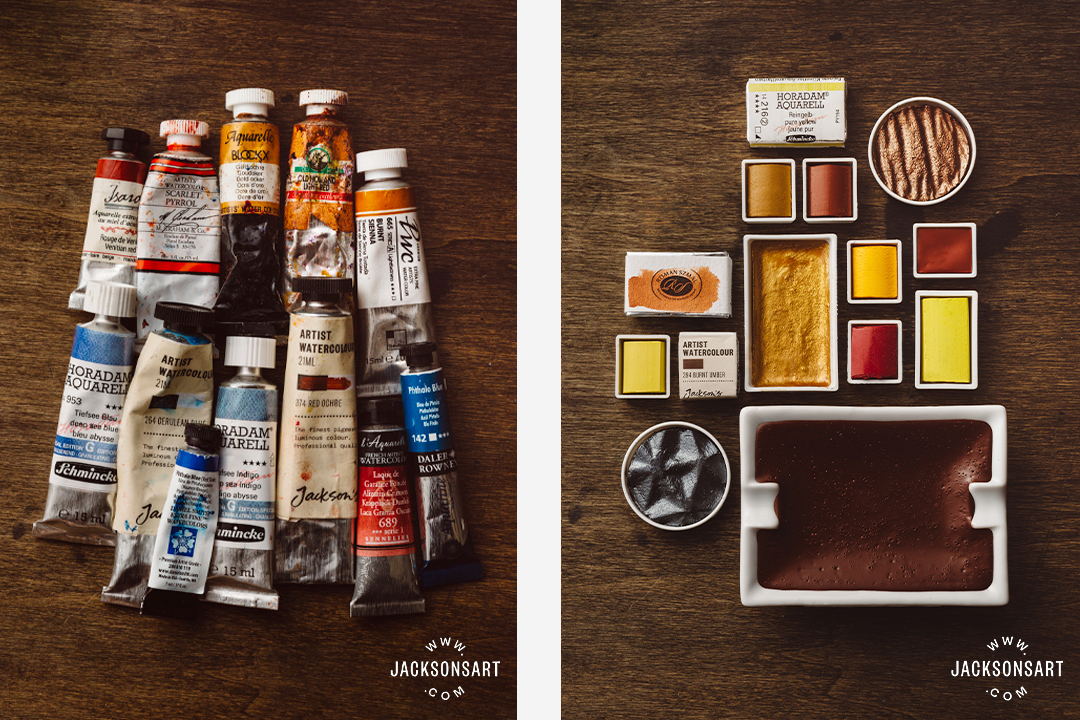
Watercolour paint is available in tubes and dry, solid watercolour pans that become fluid paint on contact with a wet brush. I would recommend a set of pans for a beginner as they are easier to use, allowing you to apply colour lightly and build it up in layers (there is a greater risk with using tubes of watercolour paint that you may apply too much colour too soon, which can be hard to control). As with all paint, as you gain experience you will inevitably develop preferences for certain pigments, but to start with, invest in a general set of watercolours so that you can explore a whole spectrum of colour.
An eight pan set of watercolours is considered small but will offer enough colours to get started painting any subject matter, from still life, landscape, figure paintings or abstract. However most will have 12 or 24 colours.

Student grade paints will have a lower concentration of pigment in the colour, which is the most expensive ingredient in paint, and is the provider of its colour. Paints with a greater proportion of pigment will also benefit from other characteristics of the specific pigment, such as texture or how much influence the pigment has in colour mixes. In a student grade paint where pigment concentration is less, how each colour behaves from pan to pan will be more consistent, which simplifies the painting process. A set of student colours can cost under £20, while the same amount of paint in an artist or professional grade set can cost over £50. When starting out, I would recommend a student set as the quality is still good and offers an economical introduction to the medium. This article by amateur artist Ann Cahill explains her experiences of working with both student and artist grade watercolours.


Why are my paints beading up on the palette when I mix my colours?
As an aside, watercolour paints do have a tendency to bead up (gather in pools and possess a resistance to the surface) on metal or plastic surfaces. However this effect wears away the more you use the palette for colour mixing. Scrubbing the palette with a brillo pad prior to use, and rinsing thoroughly to remove any traces of soap will stop the beading. Alternatively you can invest in a porcelain palette on which watercolour paints do not bead.

Brushes
Brushes for watercolour painting are shorter handled than oil and acrylic brushes, and available in flat, round and filbert shapes. Small brushes are useful when painting detail and other intricate marks while large brushes will hold more liquid and work well for broader brush strokes, including washes for skies. Traditionally sable hair is often used because it holds lots of liquid, but today there are plenty of synthetic alternatives, as well as brushes that have a blend of natural and synthetic hair (this article shows a comparison between sable and synthetic sable brushes by Jackson’s). For a watercolour beginner I recommend a brush set with a variety of shapes and sizes. This will get you started and as you paint more you will begin to discover which brushes are your favourites. You can then build on your collection of watercolour brushes with the right shapes and sizes for your way of working. I would start with a set of at least three brushes to begin with. The price of brush sets vary wildly. They start at under £10 and can go up to hundreds of pounds. The highest quality natural hair brushes (such as sable or squirrel) are the most expensive, while synthetic brushes offer a hardwearing alternative. To read more about how brushes for watercolour are made, click here.

Paper
Watercolour paper is usually available in three different textures. Completely smooth paper is known as Hot Press and allows for the finest lines and crisp details to show. Cold-pressed paper has a slight texture and is also known as NOT surface paper. It is the surface that most artists try to begin with. The texture is made with sheets of felt, so has an irregular, naturally dimpled quality. Rough paper has a more pronounced texture, which acutely changes the quality of brush strokes, often making them appear more broken and expressive than on smooth paper.
A watercolour pad is bound on one edge and is ideal for sketches. Watercolour pads are either spiral or glue bound, and would be a good source of paper for a beginner. Another option would be watercolour blocks, which are glued on all four sides, which keeps the paper taut as you paint on it. When your painting is finished and dry, simply slice off the top sheet with a craft knife, and your painting will be on a flat piece of paper, free from natural buckling caused by water saturation. If you know you want to paint large, then full sheets of imperial watercolour paper, which measure 22 x 30 in. may well be of interest, or if you want to try painting in watercolour on an even bigger scale, then a watercolour paper roll might be what you’re after, most are 10 metres long, which of course you can cut down to whatever size you need. To read more about the sizes and formats of paper click here.
With paper, paints and brushes, you have enough to make a watercolour painting. Simply add a jar of water and away you go! However there are also some other supplies you could invest in.
Pencils
Often, a set of artist pencils are worth having by your watercolour painting equipment as preparatory sketches can help to develop your ideas before you set brush to paper, allowing you to have more confidence during the painting process. A hard pencil can be useful in lightly drawing your composition on your paper before you apply colour. Graphite or coloured pencils won’t smudge, but it might be best to avoid charcoal pencils for this reason.


Easel
An easel is by no means essential. If you work standing up you could tape your watercolour paper to a wall, or you could work at a table. However, the right easel could allow you to move your work easily to better lighting conditions, or help you to work with a healthy posture, avoiding unnecessary aches and pains during a long painting session. When choosing an easel you have to ask yourself a set of questions.
- Will you be painting at a table? If you will be, then a table easel is a compact device that will hold your paper upright. Many have a drawer in which you can store your paints and brushes. They are easy to store.
- Will you need to have a portable easel? (perhaps for painting out of doors) – If you will be then a sketching easel is what you’ll need. Sketching easels are usually made from aluminium or wood. An easy to carry sketching easel will be lightweight with telescopic legs allowing it to fold into a compact portable size. However if you are likely to paint in bracing wind conditions it may be at risk from falling over. Some string and tent pegs can be a great way to get around this.
- Do you need an easel that will tilt to horizontal? (will you be painting with lots of dilute watercolour which might run?) Some studio and sketching easels will tilt fully to a horizontal working position, which can be really useful if you need to ensure your paint does not run.
- Do you need an easel that will hold very large work? The largest studio easels are H-frame and solidly stable for paintings up to 235 cm, but they will take up space and be heavy to move around. Crank handle easels make it easier to adjust the height of your painting.


Masking Fluid
Masking fluid feels a little like craft glue, and can be painted on to dry paper, and left to dry so that it forms a hard-to-move mask in areas on your painting. It can be useful when you want to have very fine lines, such as the rigging on boats, or highlights in foliage. One you’ve painted your work and it’s dry, you can delicately peel the masking fluid away to reveal the white of the paper. Masking fluid can be applied with a brush, a fine point such as a colour shaper, or a ruling pen.

Sponge
A sponge can be used to lift wet colour from a painting, to either reduce the colour saturation of the brush mark, to lighten its tone, or to remove it completely. Watercolour is rewettable so applying clean water to a passage of painting will allow you to remove some of the paint if you then dab the area with a clean sponge. A sponge is also useful for blotting a loaded brush (to reduce how much paint will be deposited with your brush mark), and also if you get into stretching your own paper, it can be really useful for removing excess water from the gumstripped edges of your paper.

Palettes
An extra palette will offer more room for colour mixing, on top of the palette area offered in most watercolour paint boxes. If you’re going to want your colour mixes on another day, or if you need to transport your colours, a palette with a lid will protect your mixed paint as well as offer even more palette space. All watercolour palettes have at least some wells – these are for squeezing tubes of colour out into and ensuring that the colours do not run into one another. Palettes are offered in plastic and ceramic.


Pots
You will need a pot of water in which to rinse brushes when changing colours, or at the end of a session. While a glass jar is perfectly usable at home, you might like to reduce the weight of your load if going elsewhere to paint. There are a number of collapsible water pots available, that fold compactly back into your kit bag at the end of your painting session.
Looking for inspiration or information on watercolour techniques? We recommend Etchr Studio’s Online Workshops.
Watercolour Supplies available at Jackson’s
Further Reading
What Colours Are on Your Palette? Five Watercolour Landscape Painters Respond
Anna Zadorozhnaya Reviews Jackson’s Watercolour Paints, Brushes and Paper
Four Artists Experiment With Jackson’s Watercolour Paper
On Location at the Two Rivers Paper Mill
Shop Watercolour on jacksonsart.com



11 thoughts on “Watercolour Painting for Beginners: What You Need to Get Started”
Interesting .. but how about a follow up
article on how a beginner would use water
colours, with examples to illustrate and
explain techniques etc
In Watercolor Article the author states that
when the painting is cut free from the block
it will be flat.That is not the case.
Hi Erram,
Thanks for your comment. A watercolour block is glued on all four sides to keep the paper taut, and if you allow your painting to dry before slicing the top sheet from the block the idea is that it should remain flat. I’m sorry you have not found this to be the case – it’s just a guess but I wonder if perhaps the painting wasn’t fully dry?
Many thanks
Lisa
Hi, I never thought of using a ruling pen with masking fluid. Great article, I use a variety of watercolour paper and sizes. My biggest problem is stretching paper so it stays flat. I have experiments with a number of technique but never happy. Do know have any information on this?
Hi Charlene
Thanks for your comment. We have a post on how to stretch paper here: https://www.jacksonsart.com/blog/2015/07/17/stretching-watercolour-paper-for-a-better-painting-experience/
Also our new Paper Guide has step by step instructions on paper stretching as well as pretty much everything you need to know about paper for all art applications.
https://www.jacksonsart.com/jackson-s-paper-guide
Definitely a handy reference for your art-making space!
Best wishes
Lisa
Do you sell watercolour boards?
Hi Jan,
Yes, we do… here’s a link to them – https://www.jacksonsart.com/surface/paper-card/paper-boards?x_application=9254
Best wishes
Lisa
Hello Lisa
What is the brand name of the very large pan (brown paint) in the photo near the top of the article? It looks like its got a brush rest across it.
Thanks
Hi Ann,
It’s a BLOCKX giant pan – https://www.jacksonsart.com/blockx-watercolour/
Many thanks
Lisa
Hi Ann,
Great article, there are just a couple of
ideas that I’ve thought up a I have
ventured on my watercolour journey, they
are; Ruling Pens can also be used for
applying paint in fine lines, though you will
need to adjust paint strength accordingly.
They are especially useful if you want to
include some straight ruled lines in your
painting. If using a ruler, use the type with
a slight rebate under the edge, which will
help prevent paint from bleeding under it.
It’s also worth noting that Ruling Pens are
adjustable for thickness of line to a
degree. Also for those who wish to put
some pencil sketched outlines down
before painting, but don’t want them to
show through the finished painting, I’ve
been experimenting with water soluble
graphite pencils, with some success.
Thanks for the great tips, Andrew! I forget how useful a ruling pen can be. And water soluble pencils are a great trick for getting lines that you can ‘erase’.
Comments are closed.