

We visited the studio of London-based artist Tuesday Riddell, who brings the forest floor to life using blazes of gold leaf and rich black lacquer. Watch this delicate process in action as Tuesday talks through her ideas, inspirations and how she has set up her studio with safety and efficiency in mind.
Tuesday Riddell’s Gold Gilding Process
Q & A with Tuesday Riddell About Using Gold Leaf in Her Practice
How did you come to use Gold Leaf and the Japanning Technique in your work?
In 2017 I was selected as the Painter Stainer’s Decorative Surface fellow at City and Guilds of London Art school. It’s a year long fellowship where I received training in historic decorative techniques. I learned amazing things like marbling, wood graining and one of the techniques was japanning. I was taught how to gild first and fell in love with the way the gold leaf moves as you cut it and lay it onto a board and the effect it has when covering an object and I was later taught how to prepare a lacquered board.
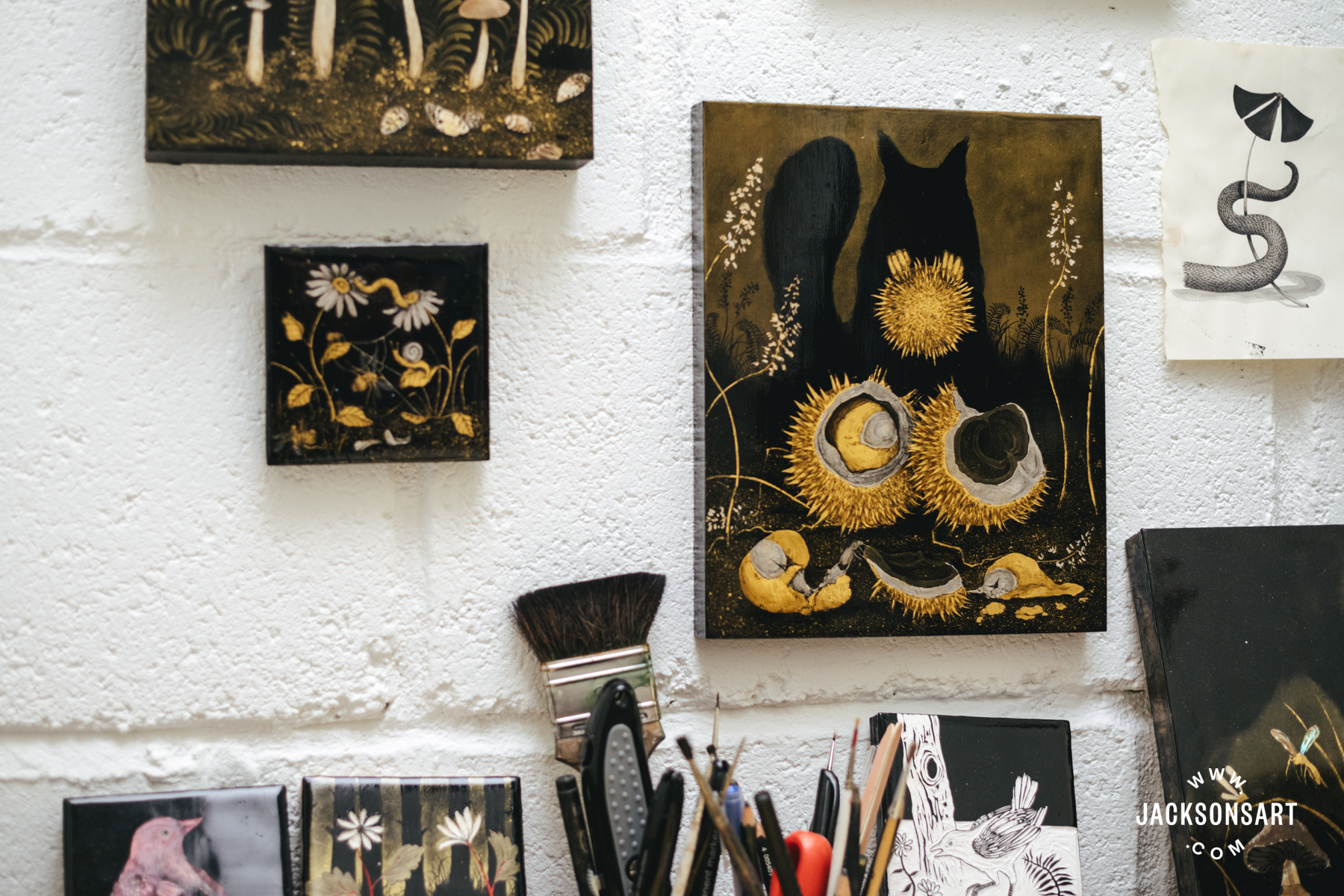
I immediately connected with the technique and felt it much better captured the world and feeling I had been trying to create in my paintings but couldn’t quite grasp through the medium of paint. I would say that as a technique it was perfect for my work and have been obsessed ever since.

What would you say are the three things someone should be aware of when trying Gold Leaf for the first time?
There’s two different ways of gilding: water and oil. I use oil so three things I would say when oil gilding is firstly, surface, because gold leaf is so thin it shows any texture of the surface it’s laid upon, so if you would like it to be flat and shiny, you have to make sure to sand and polish the surface so that it’s smooth for the gilding. Another important surface element is to make sure you brush the size as thin as possible, so the gold size doesn’t leave brush strokes. Unless of course that’s what you’re going for.
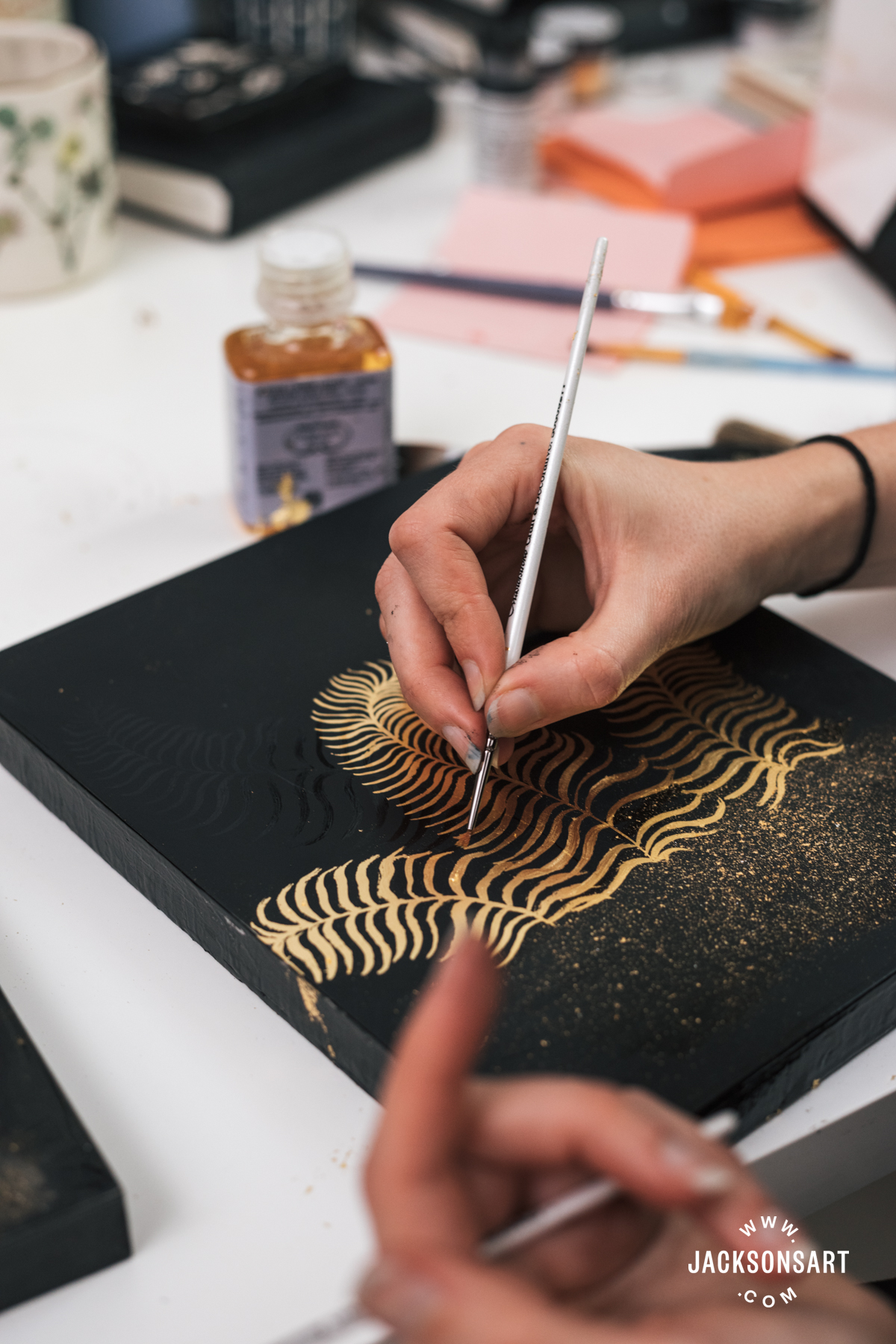
Secondly, choose your brushes carefully and always make sure you use a soft hair brush. I use synthetic squirrel brush or gilders tip for larger areas of gold. A harder brush can scratch the gold and agitate the surface so the shine is dulled, but always have a harder hair brush handy to brush away any pesky bits of gold that might get stuck where you don’t want them.

And lastly, take some time to try to feel what brands are the best for you. Like how most people will have a favourite gold size to use, or whether you prefer loose or transfer, as well as different thickness or karat of gold. I find different brands of gold size and types of gold feel very different so it’s not always just about the technical side of the material, but also about how it feels to you in your work.

Can you tell us a little bit about the natural world construct in your work? How do you think the use of Gold Leaf contributes to your fairytale-like, forest floor landscape?
I’ve always loved vintage book covers with the gold embossed titles, so my mind immediately goes straight to the magical covers which I think contributes to the fairytale-esque feel of my works. My first knowledge of gold was through fairy tales and folklore, like the idea of finding gold at the end of a rainbow or stories where characters find some gold or use magic to turn things into gold. It has a magical quality where it creates a beautiful, ever-changing glow in the works and I think this precious, jewel-like effect of the technique conjures up an almost subconscious intuition of its special nature, as if something is alive within the work as it changes throughout the day or as you move around it. The part I love the most is the depth of darkness you can achieve with the lacquer because of how its built up of around 25-30 layers of black lacquer and how that contrasts with the luminosity of the gold, so the results can be quite sharp or intense, but there’s also many ways you can use the gold with different techniques to build up a scene with different textures and gradients, so there’s a great level of variety and richness that can be achieved.


Do you find there is much room for experimentation with Gold Gilding and the Japanning process or do you have to be quite prepared before you start?
I would say that both are necessary in a way. On the one hand you do have to be prepared to manage having enough time for the gilding while the size sets, which is usually around 3 hours, and with making sure that the correct areas of the surface are ready to be worked on.
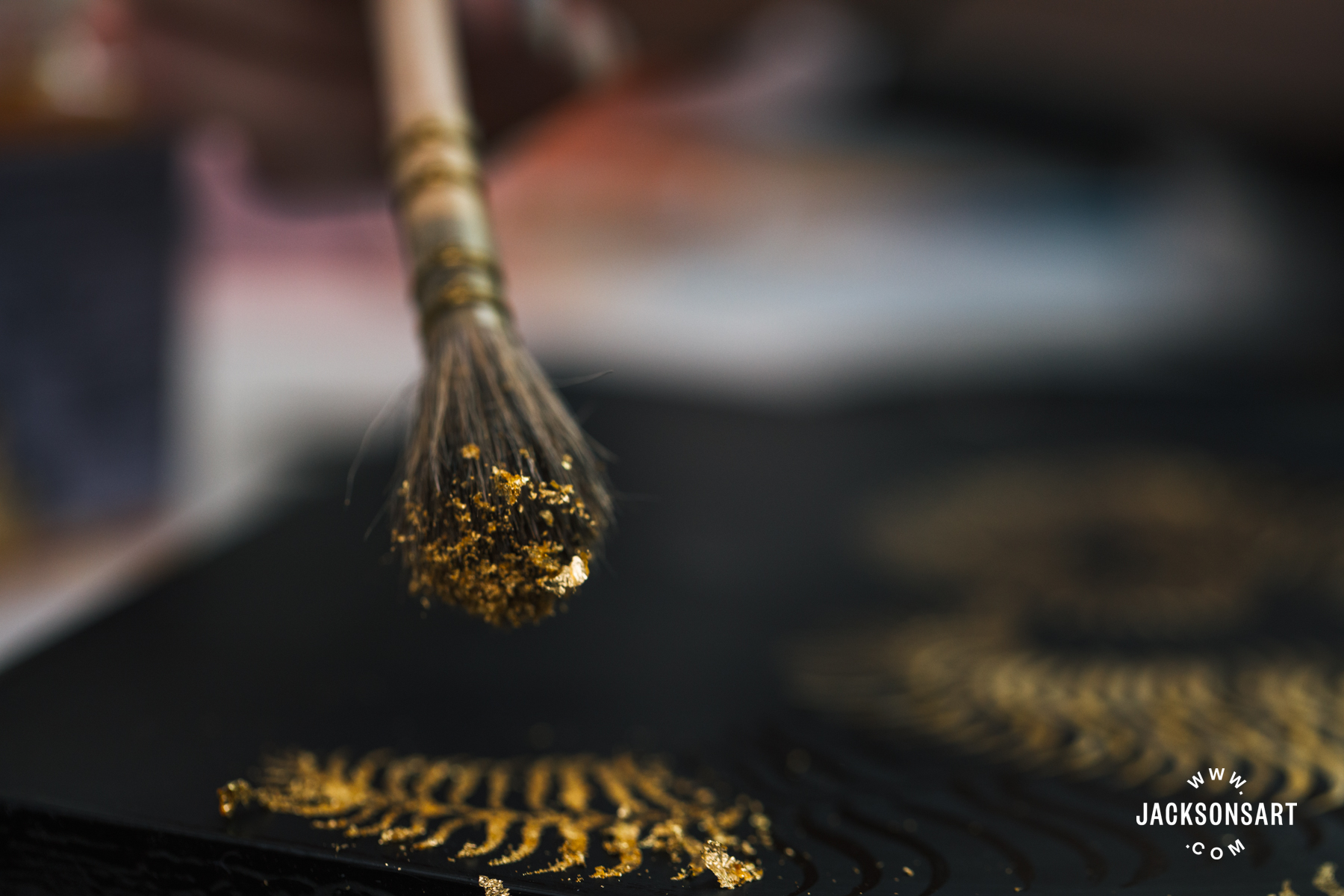
But I also find that some of my favourite ways of working with the gold have come from the more experimental side of things, like how mistakes can then be turned into great segments or details in trying to work around them. These have ended up creating beautiful effects that are some of my favourite parts of a compositions. You can experiment with the way the paint sits on gold leaf a lot and with how you use it, whether it be sprinkles, grinded to a dust or solid leaf, it’s quite a playful practice and there are so many elements to try different ways. You can even embed the gold within layers of the lacquer to create a beautiful deep night sky galaxy effect.
What is your favourite thing about your art practice?
The first time I tried the technique it felt like I was entirely able to express myself, it gave me so much excitement to be able to have this type of visual communication in a way that felt completely me after struggling to find my way through oil painting. The fact that I get to work in this medium is just truly rewarding and I love to continually discover different things about the technique and the way I can use it. It makes each day in the studio magical. The constant discovery, there’s so many different things to learn in so many different ways from polishing, varnishing, gilding and painting, I feel like I learn something new every week about the technique and I find that really exciting.


Further Reading
Painting in Acrylic or Oil on Top of Gold Leaf
Image Making With Screen Print, Linocut and Gold Leaf by Colin Blanchard
Inspired by Gold: How Alison Woolley Uses Traditional Water Gilding Techniques in Her Work
Screen Printing With Dave Buonaguidi Aka Real Hackney Dave
Shop Metal Leaf on jacksonsart.com





10 thoughts on “Gold Gilding Process with Tuesday Riddell”
Her art is beautiful! However, the link to her website is broken. It links to a 404 page, probably because there’s an extra slash at the end of the link.
Thanks for that Lucy! We updated the link now.
A really beautiful technique & stunning work,
this was all new to me….also the filming was
great, along with the music. A talented girl.
What spoilt it for me was the lack of use of
the letter ‘T’ …I expect this is an age thing!
Hi Jennie, Thanks for your comment… What do you mean by use of the letter ‘T’?
What amazing work! Well done Tuesday!
Cheers Karen! We’ll pass on your comment to Tuesday.
I absolutely love this work. I have never seen
this done before and found it fascinating and
other worldly. Thank you so, so much for
sharing this with us.
Thanks for letting us know Anne. Tuesday’s work is brilliant!
Great article and video! Tuesday Riddell’s
work is fabulous.
We couldn’t agree more! So glad you enjoyed the article.
Comments are closed.