Sally Muir won the Planographic Award in Jackson’s Art Prize this year with her work Beyond Black 15. In this interview, she discusses her love-hate relationship with pastels, the ephemerality of tissue paper, and how monotype lets her explore new paths.
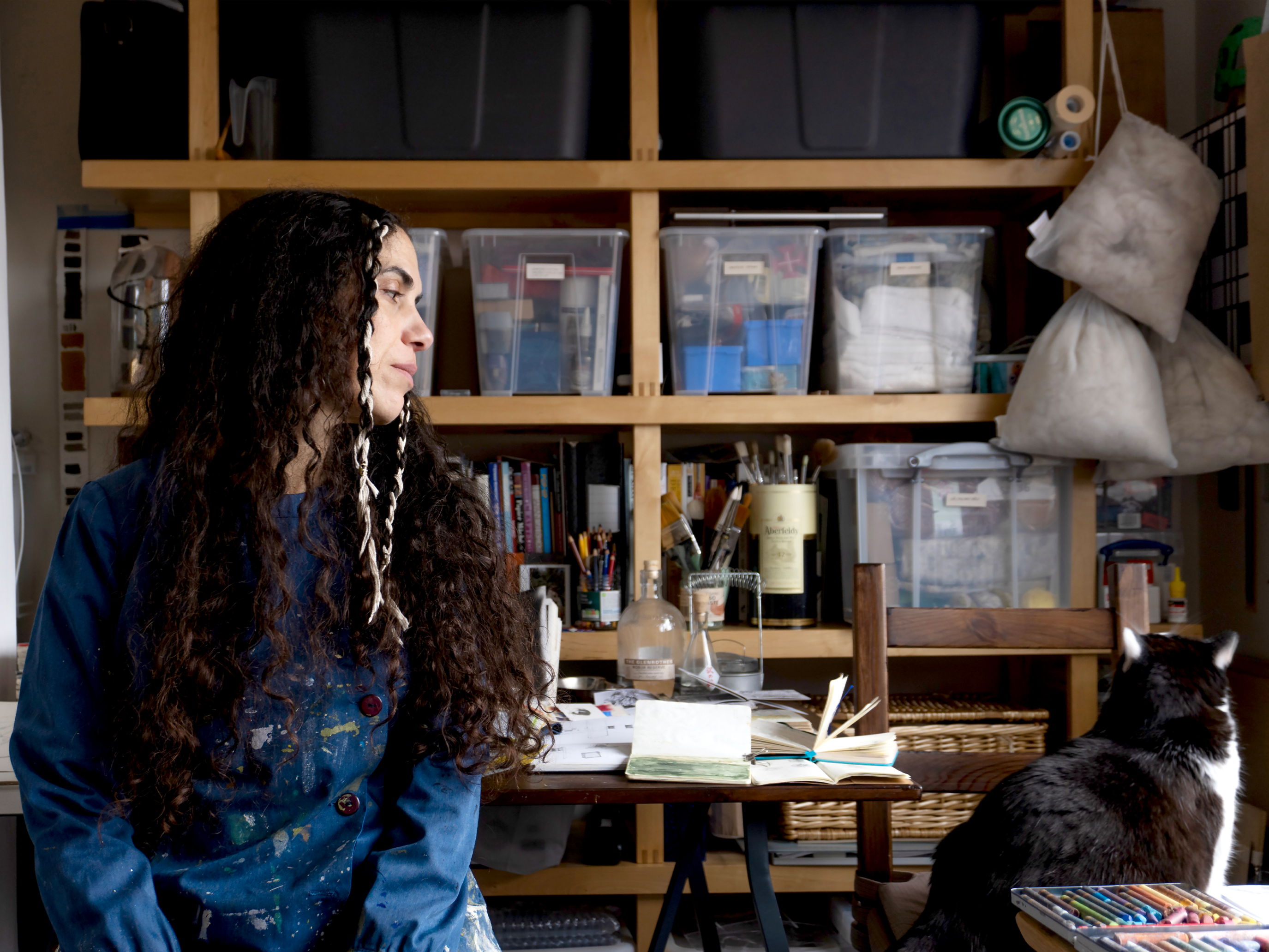
Above image: Sally Muir in her studio

Sally Muir
Monoprint on paper, 59 x 82 cm | 23.2 x 32.2 in
Josephine: Could you tell us about your artistic background?
Sally: I applied to art school when I was 17 and got rejected. I did various other jobs, mostly in publishing and bookshops, until I met my business partner, Joanna Osborne, and we became knitwear designers. That’s what I did for over 30 years, and then decided to try art school again and was accepted this time. So I did a year of foundation and then five years part-time at Bath School of Art and Design (where, coincidentally, I had originally applied).
As I needed to make a living when I left, I started working to commission as a portrait artist, painting children mostly. Occasionally, I was asked to include a dog. Gradually, dogs took over, and I started to specialise in dogs, visiting my local dogs’ home and drawing the dogs there became the basis of a year-long project; drawing, painting and posting one dog each day on social media. This project then turned into my first book A Dog a Day. I have published two more since then, Old Dogs and Rescue Dogs, and am just starting work on a fourth one.

Josephine: What does a typical working day in the studio look like for you? Do you have any important routines or rituals?
Sally: My mornings are spent doing admin and other stuff, and I try to get on with actual painting or drawing work in the afternoons. I try to be at my desk from 2 pm onwards every day, and I work until around 6 pm fairly solidly. I work at my father’s old desk; he was a writer. When he got a new one, it became my mother’s sewing desk, and it still has a drawer full of her sewing things. So it’s very much a family heirloom, filthy and covered in paint, but still with a lot of family history attached to it. I don’t really have any important routines or rituals, but I do listen to a lot of audiobooks.

Josephine: Which materials or tools could you not live without?
Sally: I couldn’t be without my pastels, now quite a large collection. But I have a weird love/hate relationship with them. I love the colour range and the freedom I feel when I use them, and I also love sorting them into pleasing colour arrangements. But I also dislike them for having a slightly weird, dry texture, which makes my hands dry up, and the dust, which gets into everything. So there’s a constant push and pull in my relationship with them. I also love charcoal, in both stick and powder form, and my favourite pencils are Wolff’s Carbon Pencils. I’m very attached to my flat-ended brushes, and my collection of feathers for drawing with, I could go on and on…

Sally Muir
Monotype, 48 x 85 cm | 19 x 34 in
Josephine: Do you work from a reference? What is your process?
Sally: It varies, with dogs, I work from photographs. If it’s not a commission, I will start with a photo, then at some point, it goes off in its own direction. If it’s a commission, I have to stick more closely to the reference. For the Beyond Black series, I worked purely from imagination; they’re all drawn with a finger onto an inked-up plate in a strange sort of automatic drawing technique, which is very hit and miss. They’re drawn onto either a metal or gelli plate, which is then printed off, sometimes several times and often layered.

Josephine: Do you regularly draw or keep a sketchbook? If so, how does this inform your work?
Sally: I do have a sketchbook, but I don’t really use it for my work; it’s quite separate. I often use it when travelling, drawing out of the window on the train and secretly drawing the other passengers. I’m always resolving to use a sketchbook properly as other people do, but I don’t seem to be able to sustain it. So I have many, many half-filled sketchbooks, it’s just not how I work, and my studio is absolutely littered with paper.

Josephine: Have you ever had a period of stagnation in creativity? If so, what helped you overcome it?
Sally: Yes, quite recently, I did an intensive course, and it sort of completely overwhelmed me, and I found I’d lost the thread of my own work somewhere in the process. I just sat it out and by turning up every day at my desk at 2 pm and doing something, didn’t really matter what, good, bad, or indifferent, I’ve slowly got back into my own way of working, but I was really panicking for a while.

Josephine: Are there any specific artists or mentors who have inspired you?
Sally: There are very many artists who have inspired me, but the book that I return to again and again, which may seem unlikely, is The Brutality of Fact, David Sylvester’s interviews with Francis Bacon. They had a profound effect on me when I first read them. There is something about his descriptions of how he approached his work that absolutely struck a chord with me and still does.
When I first started painting and drawing, I went to a class in Bath run by an artist called Anna Teasdale. She became a mentor and great help to me. She had a very uncompromising and exacting way of working; she was very true to herself, and I was always very admiring of that in her work. Although I moved away from her methods in many ways, I do still have a lot of her advice and wisdom, nagging away at the back of my mind, particularly when I do something glib or flashy.

Josephine: What were you thinking about or exploring at the time you made Beyond Black 15? What inspired it, and how did it come to be?
Sally: I started the Beyond Black series during lockdown, when I read, or re-read in some cases, everything by Hilary Mantel, including what I think is her masterpiece (among many), Beyond Black. To be accurate, I listened to them on audiobook. Somehow they crept into my subconscious. She had a strong belief in ghosts and that the dead are ever present. I conjured up these figures without really knowing what I was doing, which is sometimes how monoprinting works for me; you start on one thing and it turns into something else completely, which is what happened here.

Sally Muir
Monotype, 56 x 92 cm | 22 x 36 in
Josephine: Why did this piece feel like the right one to submit?
Sally: I’m particularly fond of this particular print. I like the mysteriousness of it, that you can interpret it in lots of different ways. It looks like there’s a narrative of some sort, but you’re not sure what it is. I like things to be open-ended, not too explicit.

Josephine: How did it feel to move through the stages of the competition and win the Planographic Award?
Sally: Well, it was very exciting, I didn’t realise I’d got through the first stage at all, as my email wasn’t working, I only found out when a friend congratulated me. Then to be shortlisted was even more exciting. I was sitting in the Eurostar Terminal when I got the message that I’d won the Planographic Award, which was a massive surprise and thrill. I googled Planographic immediately, as I’d never heard the term.

Josephine: What led you to printing on tissue paper? Is there a relationship between your subject matter and the materials you used in Beyond Black 15?
Sally: I love printing on tissue paper for its ephemeral feel. It seemed to suit the subject matter, the thin veil that separates the living from the dead, the past from the present. I love that it wrinkles and slightly fights the ink, and can be layered, to create a rich and dense image.

Sally Muir
Monotype collage, 64 x 90 cm | 25 x 35 in
Josephine: Your work usually consists of paintings of dogs, people, and landscapes, whereas this work feels different – perhaps more experimental and slightly brooding. Can you discuss this shift?
Sally: I still do the dogs, people, and landscapes, but I also want to do something that comes completely from my imagination, with no particular audience or end in view. This gives me a chance to be more experimental, and I do find that monotyping is a technique that lends itself to going off in unexpected areas. I’m trying to be open to following new paths and seeing where they go, letting go of a certain amount of the control that I usually have in my work, seems important to me at the moment..

Josephine: Are there any new materials or ideas you’re excited to explore using your prize?
Sally: I’ve got a very beautiful new roller which I haven’t dared use yet, but I’m hoping to try and work on some larger monotypes, maybe using a variety of printmaking techniques, working back into them and making them more complex. I also got a lot of new paper. I love paper and am always excited to try out new papers and explore the endless possibilities that come with fresh paper; it’s a new beginning each time.
Josephine: What’s coming up next for you?
Sally: I’m just starting work on a new book, Good Dogs. I’ve asked people to send me photos of their dogs, and I’ve had hundreds. I’ve now got to sift through them and choose which ones to paint, draw, print etc. It’s a massive job and quite heartrending as they all come with such touching stories and descriptions, and I can’t use them all. I’m also still working on prints and more experimental paintings and drawings with no particular end in sight. I like that balance of work with a purpose and end point, and work that meanders around and goes down blind alleys and sometimes works and often doesn’t.

Further Reading
Meet Eleanor Johnson, Winner of Jackson’s Art Prize 2025
Jackson’s Art Prize 2025 Exhibition at Affordable Art Fair
How We Collaborate With Artists
Expert Advice on Making Your Way as an Artist
Shop Monoprint on jacksonsart.com