



Miniature artworks draw us into an intimate dialogue and fill us with awe at the achievement of creating something so small with such care. In this article, I explore examples from art history, from Persian and Mughal miniatures to European portrait miniatures and Lover’s Eyes. Then, I demonstrate how to make miniature paintings of your own, inspired by each historical tradition.
Articles in the Techniques Series define the meaning and context of art making processes and give practical tutorials on how to work with them.
Definition: Miniature artworks are defined by their small scale. This includes artwork from around the world of various stylistic forms, including Mughal and Persian miniature painting and European portrait miniatures.
What is the Effect of Miniatures?
Miniatures are intimate artworks by format, since only one person can properly view them at a time. This makes the dialogue between the viewer and subject intensely personal, like a private conversation. This is especially true for European miniature portraits and ‘Lover’s Eyes’ that would be carried and gifted by a person’s spouse or paramour. In comparison to the relatively massive scale of history painting or traditional portraiture, miniatures don’t assert importance by overwhelming the viewer, but through the quiet care with which they’re made. If large-scale paintings shout to whoever will listen, miniatures whisper.
Both Persian and Mughal miniature paintings were designed to be kept in books, where history, culture, and sometimes a directory of people could be efficiently preserved. Despite their practical and archival aspects, the artworks within these pages are far from brief, with extensive detail, refined palettes, composition and style choices. Complex miniature paintings display the refined skill of the artist through intense care, patience, and hand-eye coordination.
The History of Miniatures
Persian Miniatures
Persian miniatures were made with close links to nobility, created through the patronage of royal courts. They emerged as a prominent art form in the 13th century, following the influence of Chinese art on Iran in the wake of the Mongol conquests. They also built on an existing tradition of manuscript illustration.
Different regions in Persia produced different schools, whose works differed slightly in style. By this period, Persia (modern-day Iran) was under the control of the Ilkhanate – one of the ‘khanates’ or territories held by the Mongol Empire after Genghis Khan died in 1227. Early Persian miniature paintings are easily confused as being East Asian in origin because of the resemblance of the people’s features to those in Chinese painting. Trade established by the Silk Road route connected a vast area of the world from Cairo to Tehran, Delhi and Beijing. Named after the silk that was exported by China and sought after across the globe. It’s only natural that artworks found their way onto the Silk Road route and prompted the exchange of visual ideas across cultures.
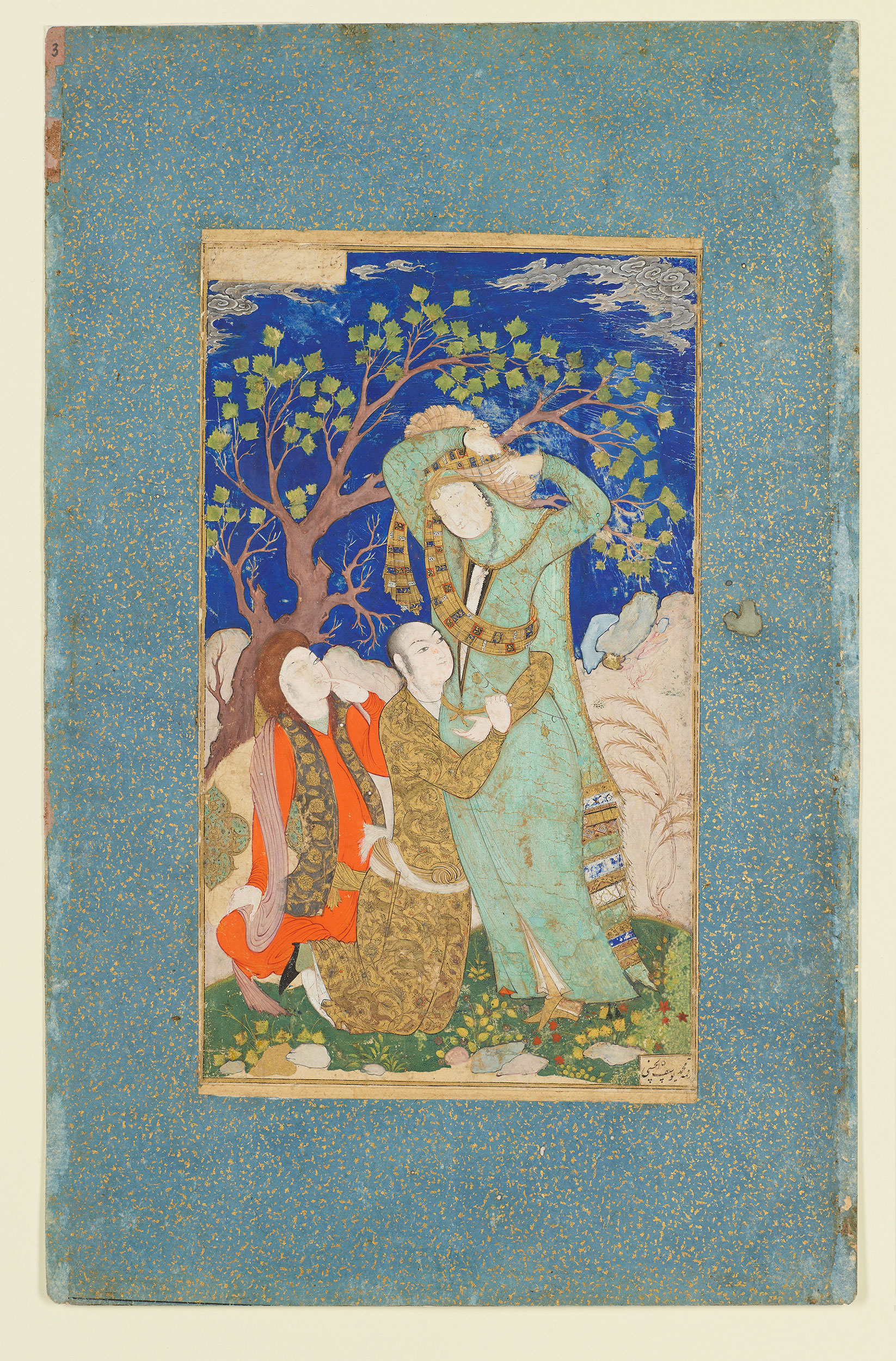
Muḥammad Yūsuf al-Ḥusainī
Watercolour on paper, 37.8 x 24.1 cm | 14.9 x 9.5 in
The Morgan Library & Museum
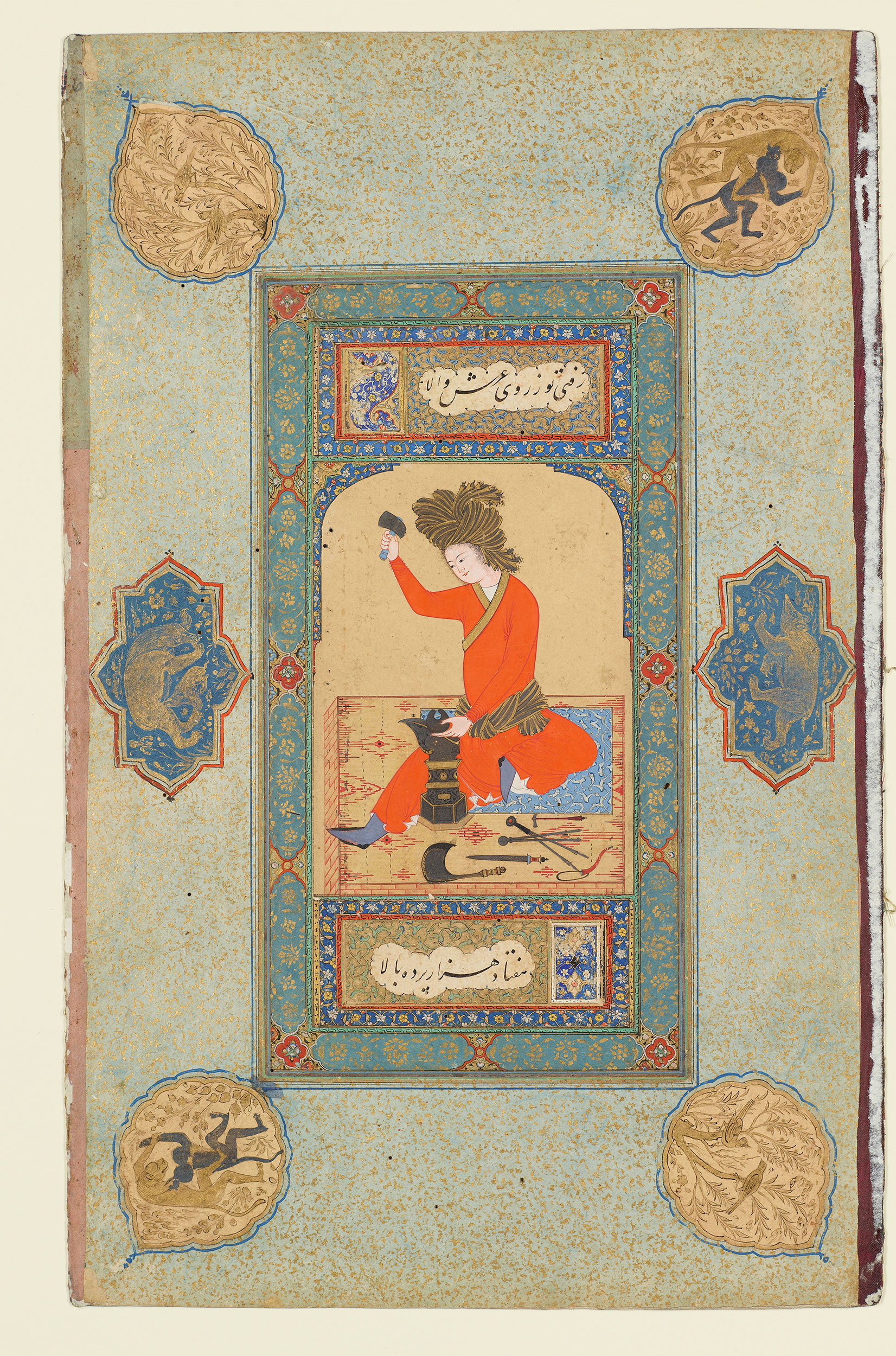
After Ḥabib-Allāh Mashadī
Watercolour on paper, 37.8 x 24.1 cm | 14.9 x 9.5 in
The Morgan Library & Museum
Persian miniatures were designed to be kept in books as individual artworks, and as accompaniments to historic records, long poems, and stories. Stylistically, Persian miniatures rely on flat planes of colour to create depth and have subtle linework delineating their imagery. In the following example, a group of horsemen are hunting deer in a gorge. The form of the craggy rock is reminiscent of Chinese artworks of mountains.
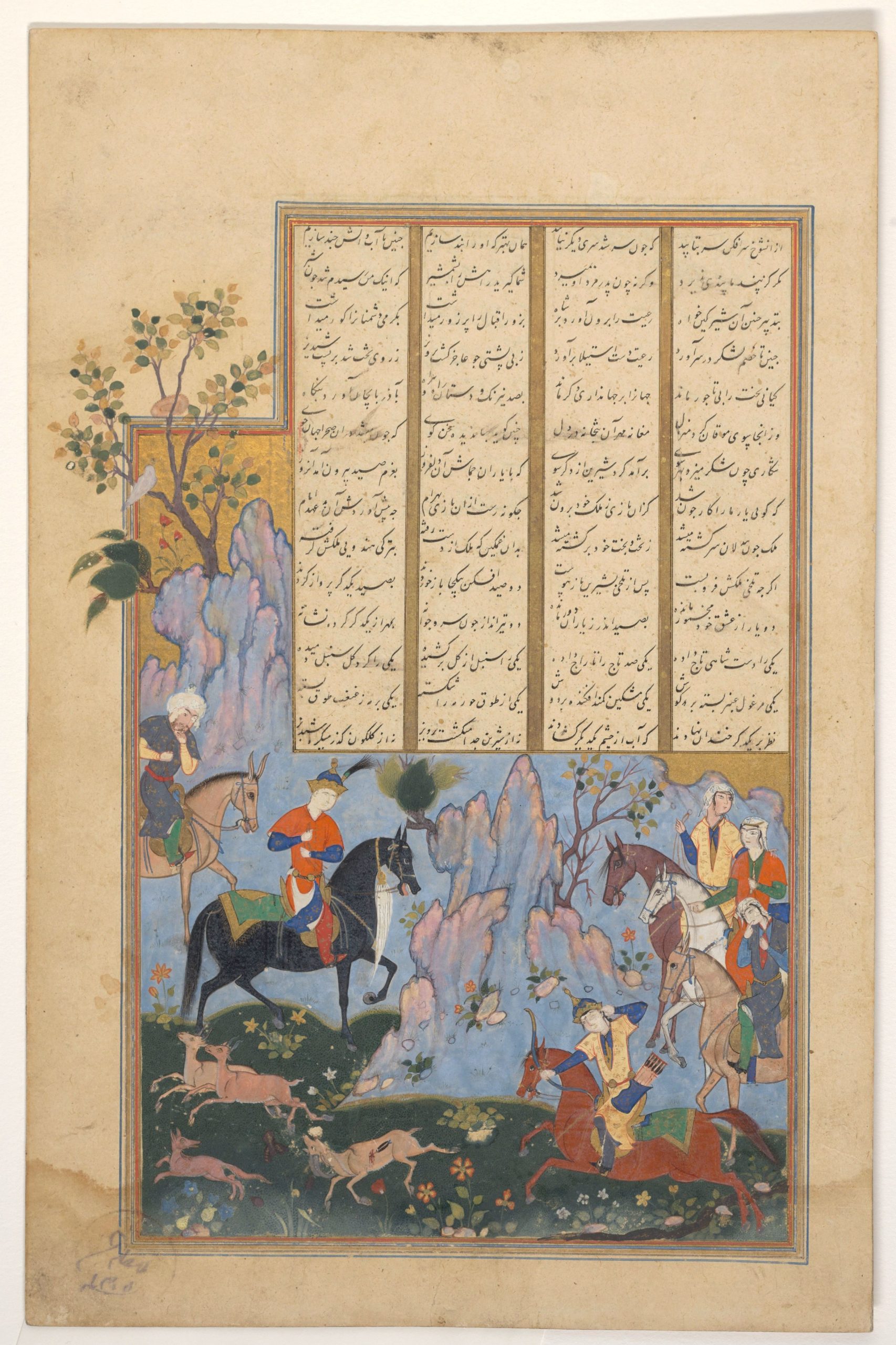
Persian, Iran
Brush in colours and gold, 18.6 x 22.7 cm | 7.3 x 9 in
Rijksmuseum
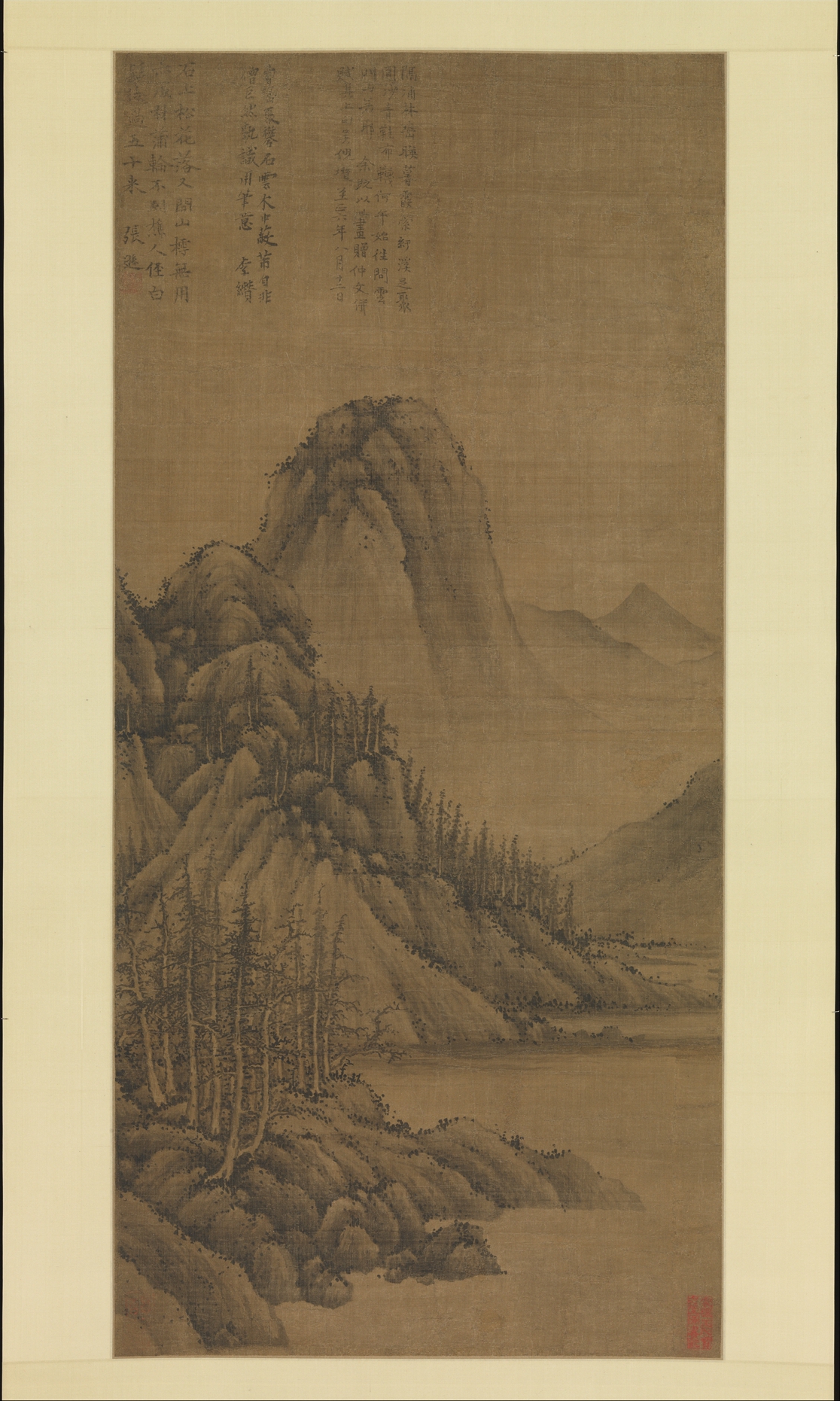
Zhang Xun
Ink on silk hanging scroll, 90.8 × 42.5 cm | 35.7 x 16.7 in
The Metropolitan Museum of Art
By the mid-17th century, Persian painting began to display the influence of increased contact between Europe and Iran. For the first time, Persian paintings were made in oil on canvas, sometimes at scale, and Western pictorial rules like perspective began to be used. Mohammad Zaman’s miniature paintings are incredible examples of this fusion of Persian and European painting, seen in this example with chiaroscuro-inspired lighting around a group of men meeting at dusk, cast in the light of a single candle. Flowers are placed around the border in the Persian and Mughal tradition, but have been painted to resemble those from Dutch still lifes.
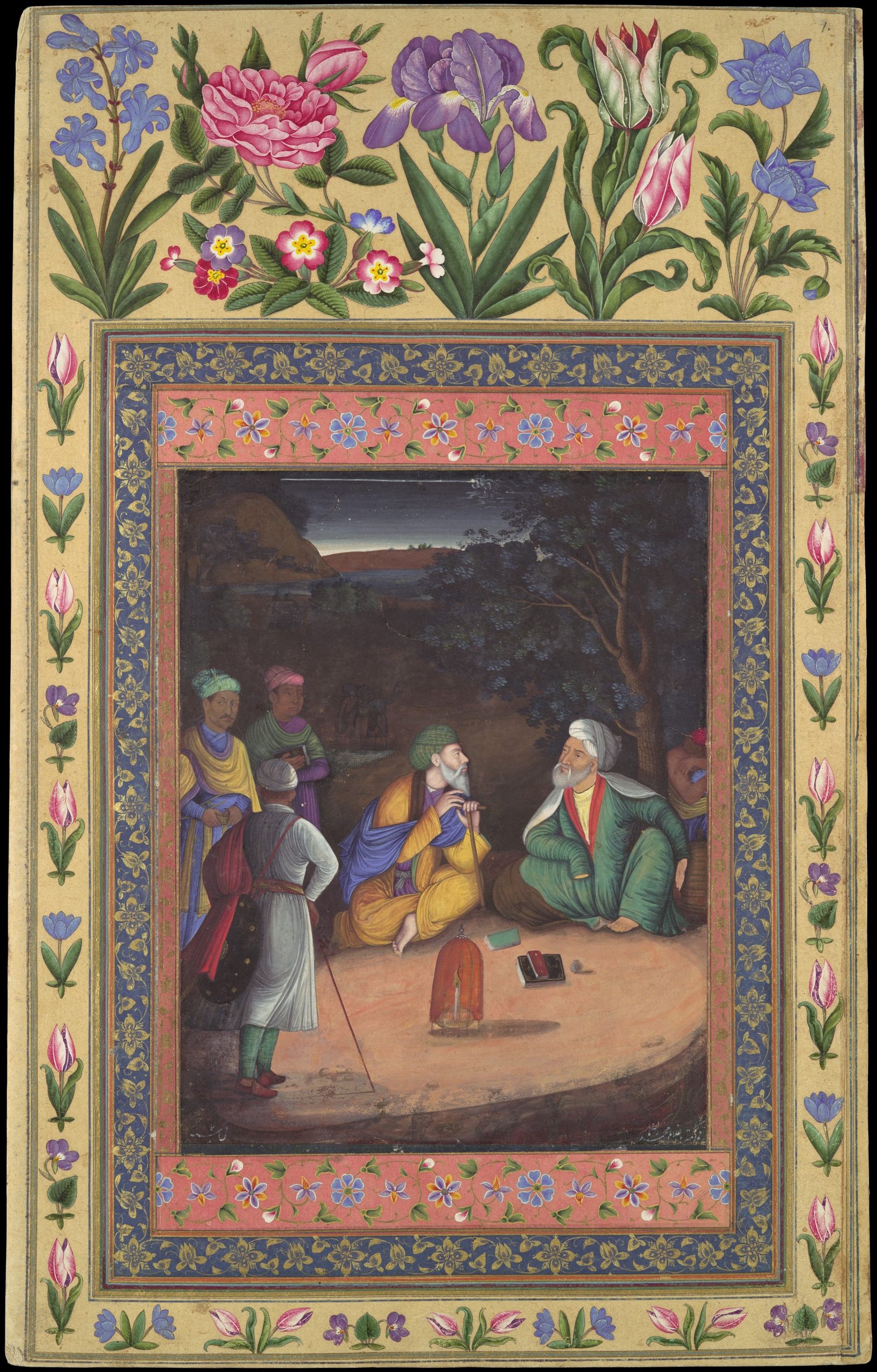
Mohammad Zaman
Ink, opaque watercolour, and gold on paper, 33.3 cm x 21 cm | 13.1 x 8.3 in
The Metropolitan Museum of Art
Mughal Miniatures
The Mughal Empire existed for over 300 years, and in that time expanded across regions of modern-day India, Pakistan, Bangladesh, and Afghanistan. From the 16th to 18th centuries, Mughal miniature painting emerged as the representative art style. Like in Persia, Mughal culture was also influenced by Chinese visual arts and the legacy of the Khan’s, and developed from the knowledge of skilled Persian craftsmen. A prince called Babur founded the Empire by seizing the Delhi Sultanate from its previous leader. Babur was descended from Genghis Khan himself through his mother’s side of the family, so the Empire took the name Mughal – because it’s the Persian word for Mongol.
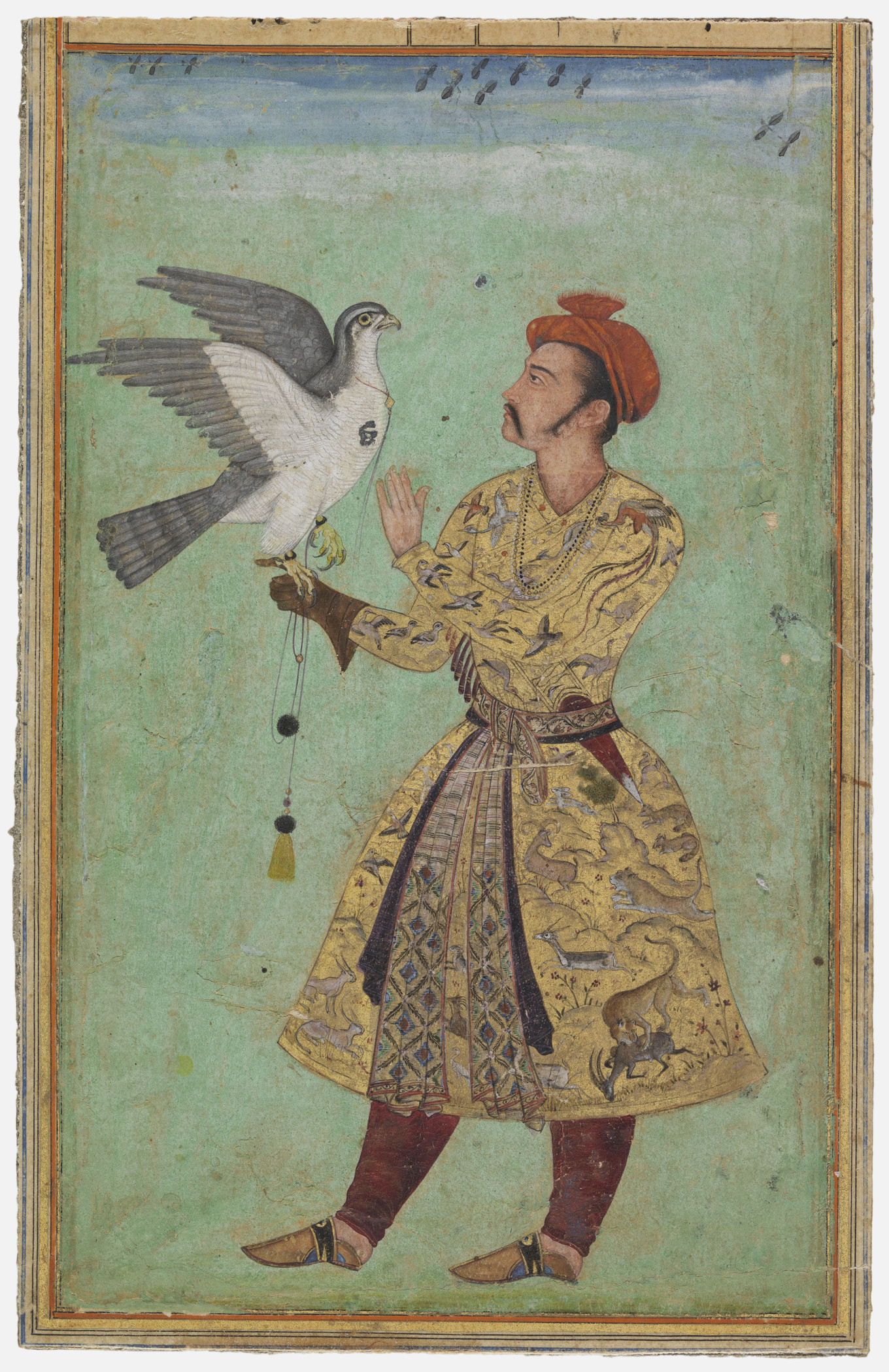
Mughal Empire, India
Opaque watercolour, gold and ink on paper, 14.92 x 9.53 cm | 5.9 x 3.8 in
LACMA
The ruling class of the Mughals were great patrons of the arts, who were keen to record their stories, lifestyle and people in the form of miniature painting. Portraits of individuals were used as a kind of ‘directory’ to remind the rulers who the people in the court were. From the inception of the movement, many of the bookbinders, illuminators, and calligraphers who worked on Mughal masterpieces were Iranian. These masters had already learnt from the traditions of Persian miniature that were a few hundred years old by this point.
The first major work was the creation of the Hamzanama, or the book Hamza. This charted the heroic story of Hamza and his followers against supernatural creatures and his enemies. Less than 200 paintings have survived to this day, from the 12-14 original volumes, each made with 100 paintings. The following image is one of the surviving paintings of a churning battlefield. The bubbling ground cleverly conveys the thunder of hooves and the chaos that ensues.
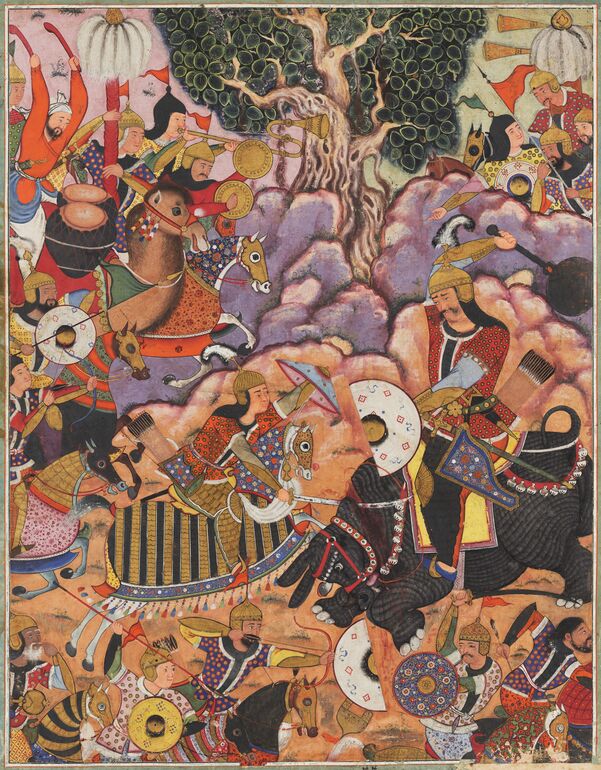
Mughal Empire, India
Watercolour, ink and gold on paper, 70 x 50 cm | 27.5 x 19.7 in
MAK
As time progressed, the Mughal miniature painting style evolved, adopting a distinctive palette including Lapis Lazuli Blue, Orpiment Yellow, Ochre, and Malachite. The ruler Akbar was interested in religions beyond his own Muslim faith and in finding common ground between his Hindu subjects. He had the major Sanskrit texts translated into Persian (the official language of the Empire), so that non-Hindus could understand them. The translation of the Harivamsa – which details the lineage, life and heroic acts of Krishna – was completed around 1590.
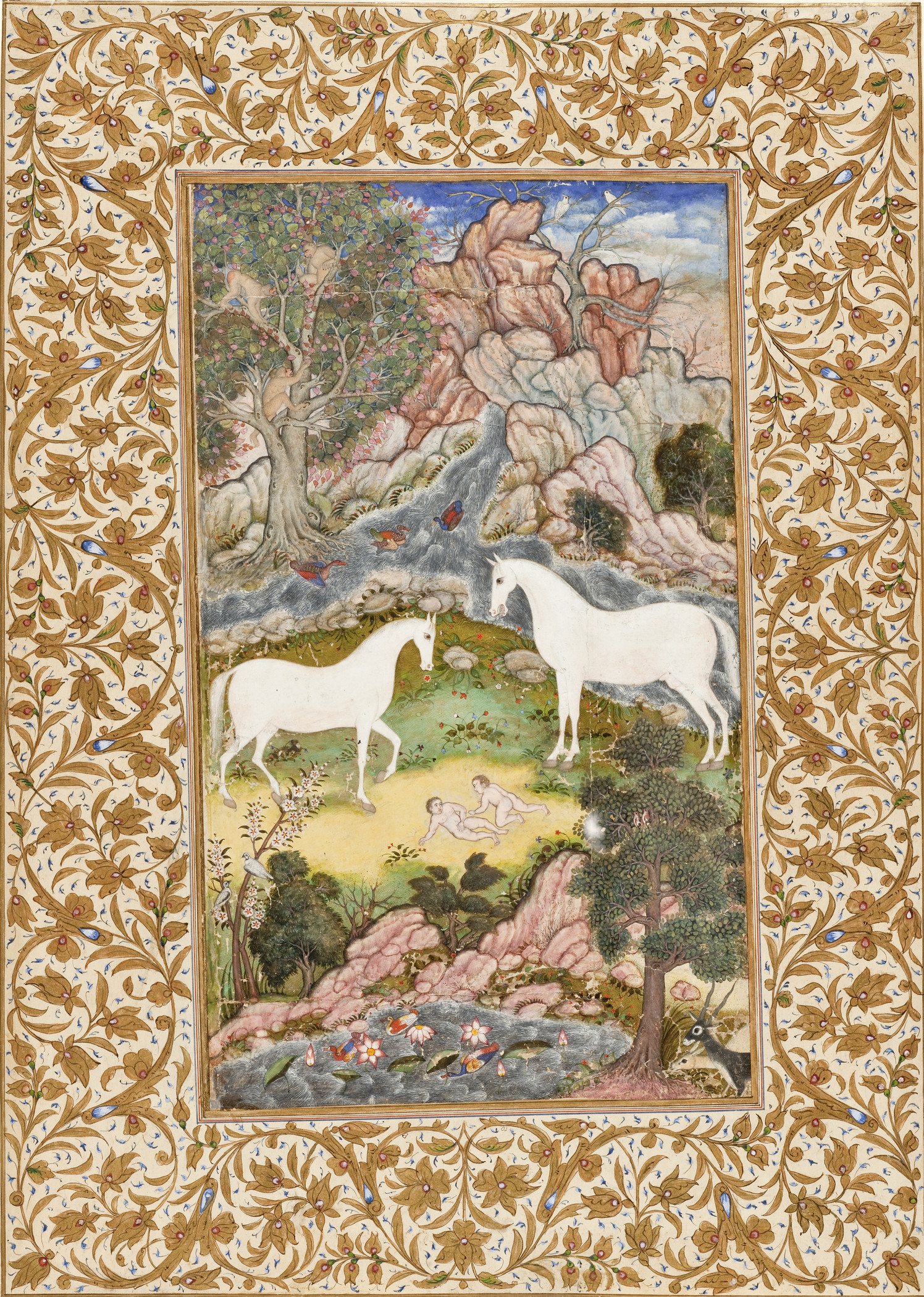
Mughal Empire, Pakistan
Watercolour, gold, and ink on paper, 40.96 x 29.85 cm | 16.1 x 11.8 in
LACMA
Jahangir was the fourth emperor of the Mughal Empire, who commissioned works surrounding his personal history, as well as beautiful studies of animals. A delegation visited his court in 1621, bringing with them exotic creatures as a gift. One of these was a zebra, captured in this painting, about which he wrote, “One might say the painter of fate, with a strange brush, had left it on the page of the world”. These animals were captured by one of his favoured court painters – Mansur. Inredibly, Mansur was also the first artist in history to paint the now extinct Dodo bird in colour, which died out somewhere between 1660 and 1690. Two of the birds were brought to India in the 1600’s, and his work is considered perhaps the most accurate.
This painting of a Nilgai, a type of antelope, is painted with the same care and dignity as portraits of humans from the period. Including naturalistic animals is a facet of Mughal miniature painting that distinguishes it from Persian miniature.
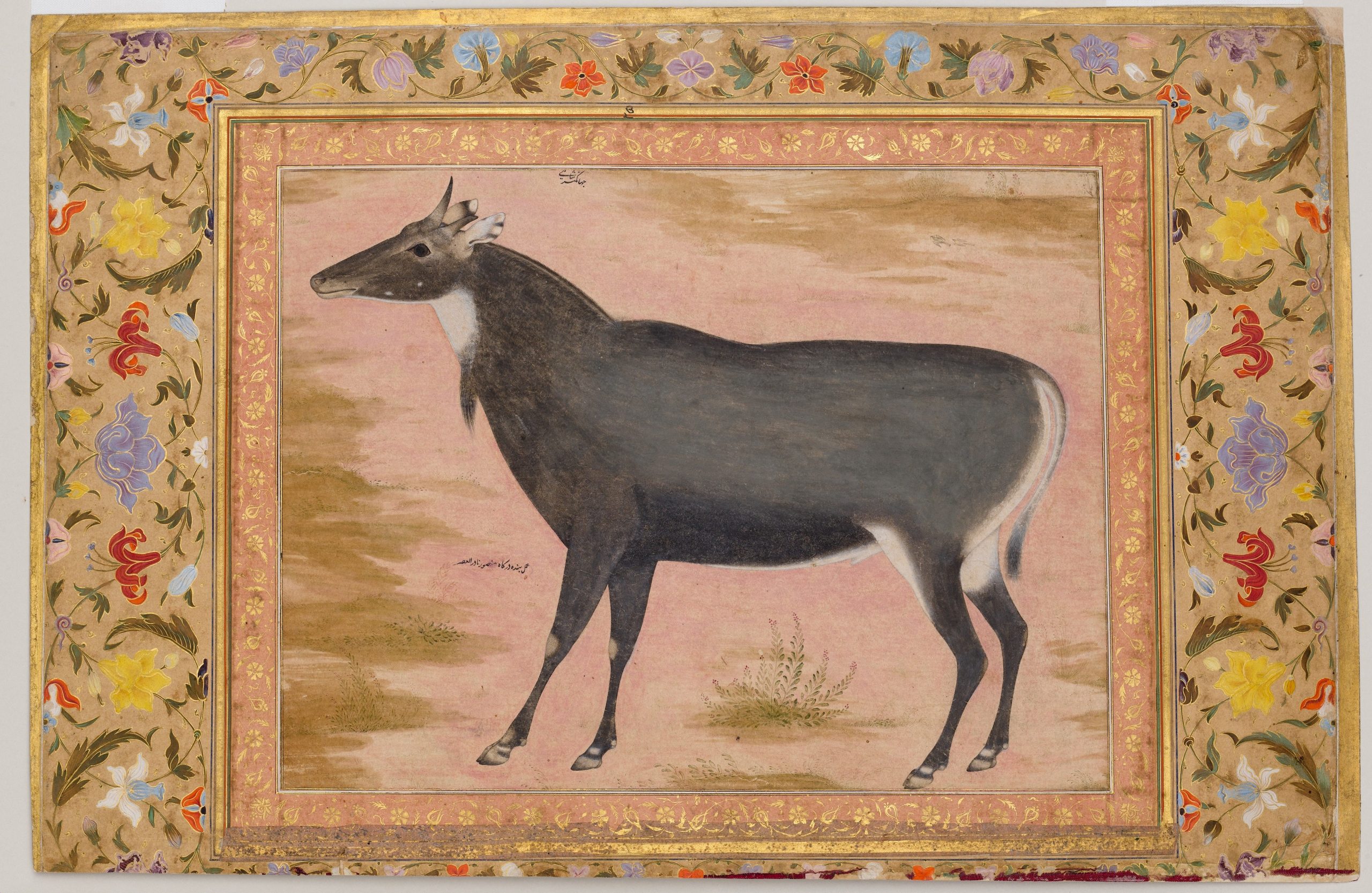
Mansur
Ink, opaque watercolour, and gold on paper, 38.9 x 25.6 cm | 15.3 x 10.1 in
The Metropolitan Museum of Art
Shah Jahan ruled the Mughal Empire for three decades from 1628 to 1658. He continued to patronise the arts like his father, Jahangir, but made efforts to have him removed from record as much as possible. This included commissioning a painting of the previous Shahs, excluding Jahangir, and having his face painted over with his own in another. He is best remembered for commissioning the architectural masterpiece of the Mughal Empire, the Taj Mahal, after his wife Arjumand Banu Begum died after giving birth to their fourteenth child. Shah Jahan features in many regal miniature portraits, where he holds prized jewels, rides on horseback, and has a halo effect around his head – all asserting his power to the viewer.
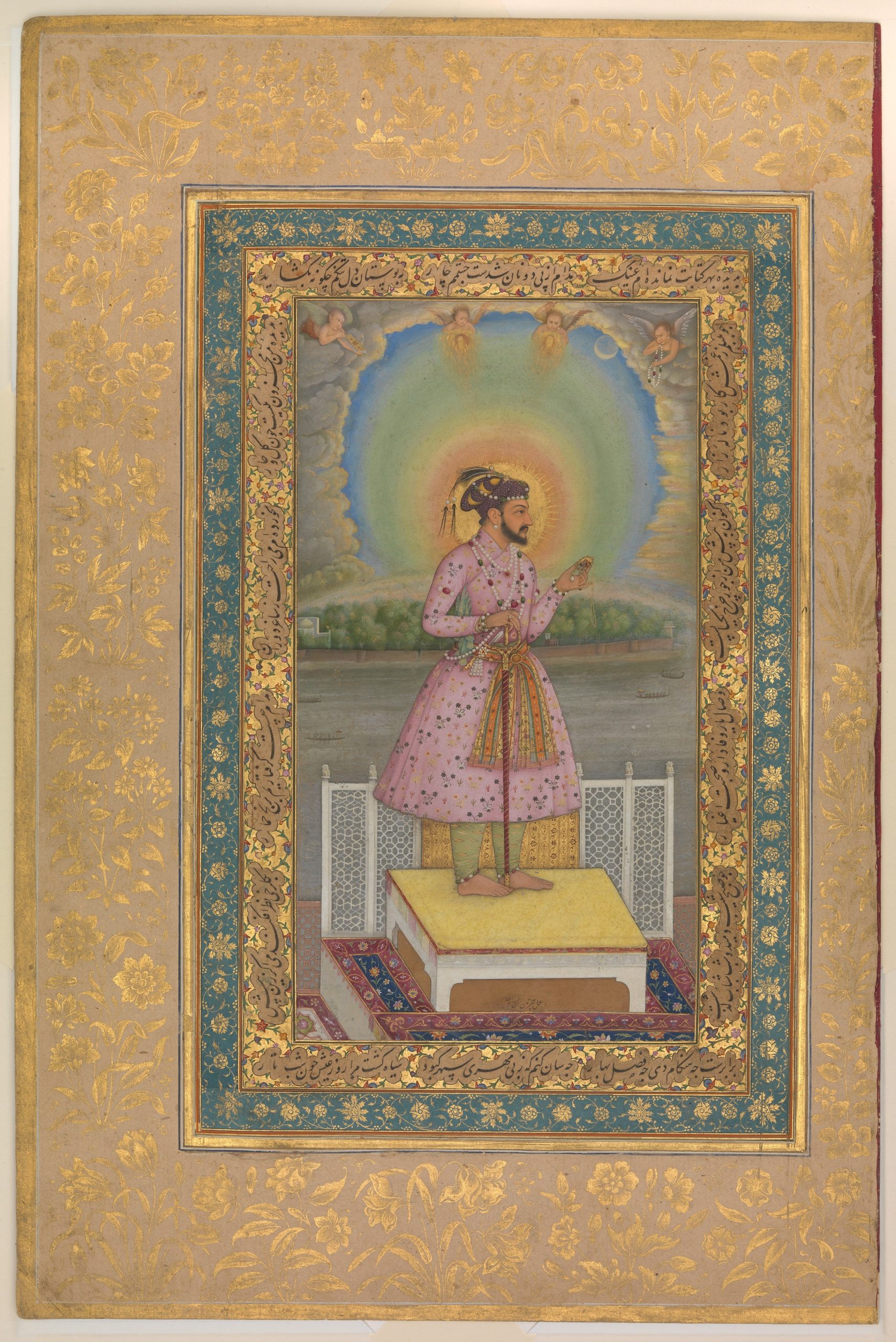
Chitarman
Ink, opaque watercolour and gold on paper, 38.9 x 25.7 cm | 15.3 x 10.1 in
The Metropolitan Museum of Art
European Miniature Portraits
Miniature portraiture developed from the stylistic tradition of illuminated manuscripts, where precise miniature figurative paintings brought Biblical and Medieval stories to life. Artists like Hans Holbein the Younger produced early independent tiny portraits on vellum laid on cards of important or wealthy figures, alongside incredible Tudor portraits made at scale, like The Ambassadors. The following portrait portrays the writer and translator Margaret Roper, who clasps a tiny book in her hands.
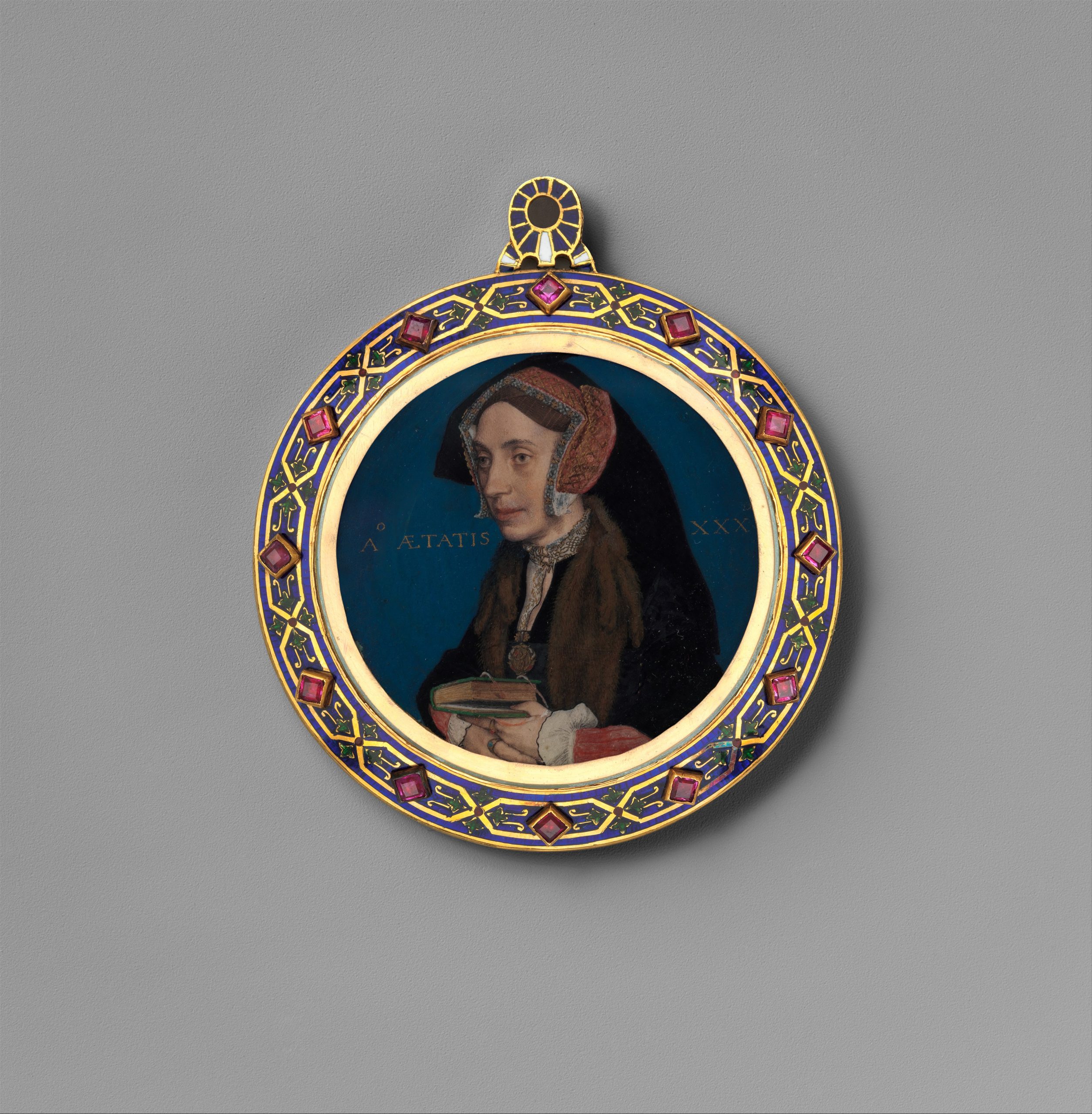
Hans Holbein the Younger
Vellum laid on playing card, 4.5 x 4.5 cm | 1.8 x 1.8 in
The Metropolitan Museum of Art
Nicholas Hilliard is perhaps the most renowned artist of the genre for his dedicated development of miniatures in England. He was born a whole century after Holbein, and studied the established techniques of ‘limning’ – meticulous small-scale watercolour painting. He began painting miniature portraits in the 1560s and gained acclaim for them in the 1570s when he was appointed Queen Elizabeth I’s official ‘limner’. He carefully crafted her miniature image to combine acute observation with an ageless idealism, to distract from her mortality and assert continued authority.
Whilst working at the Elizabethan court, he was able to produce portraits for numerous other members of the nobility. Beyond pure portraiture, Hilliard also developed some allegorical works that played with symbolism and spirituality. For instance, Portrait Miniature of an Unknown Man Clasping a Hand from a Cloud mysteriously links the sitter to a firm grasp on spirituality or a higher calling.
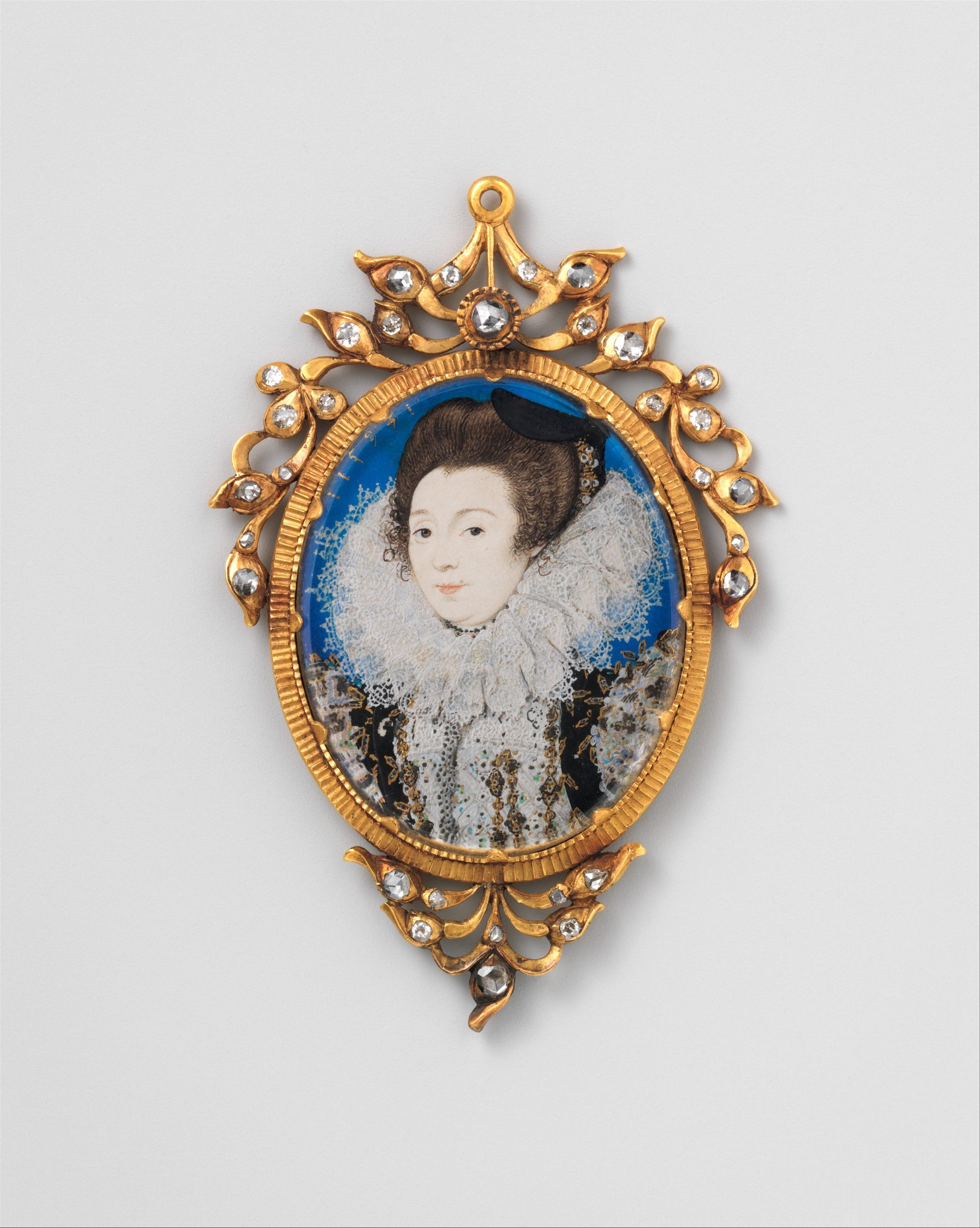
Nicholas Hilliard
Watercolour on vellum, 4.7 x 3.9 cm | 1.9 x 1.5 in
The Metropolitan Museum of Art
Anna Claypoole Peale came from an influential family of American artists, and alongside her sister, was the first woman elected to the Pennsylvania Academy of the Fine Arts. She was trained by her father, the miniaturist and still life painter James Peale. At 23, she chose to specialise in miniature portraiture herself and went on to paint more than 200 over her career. When her eyesight declined in the 1840s, she switched to easel painting. She made miniature portraits in watercolour on ivory, of notable politicians and creative figures, including the presidents Andrew Jackson, James Monroe, and George Washington.
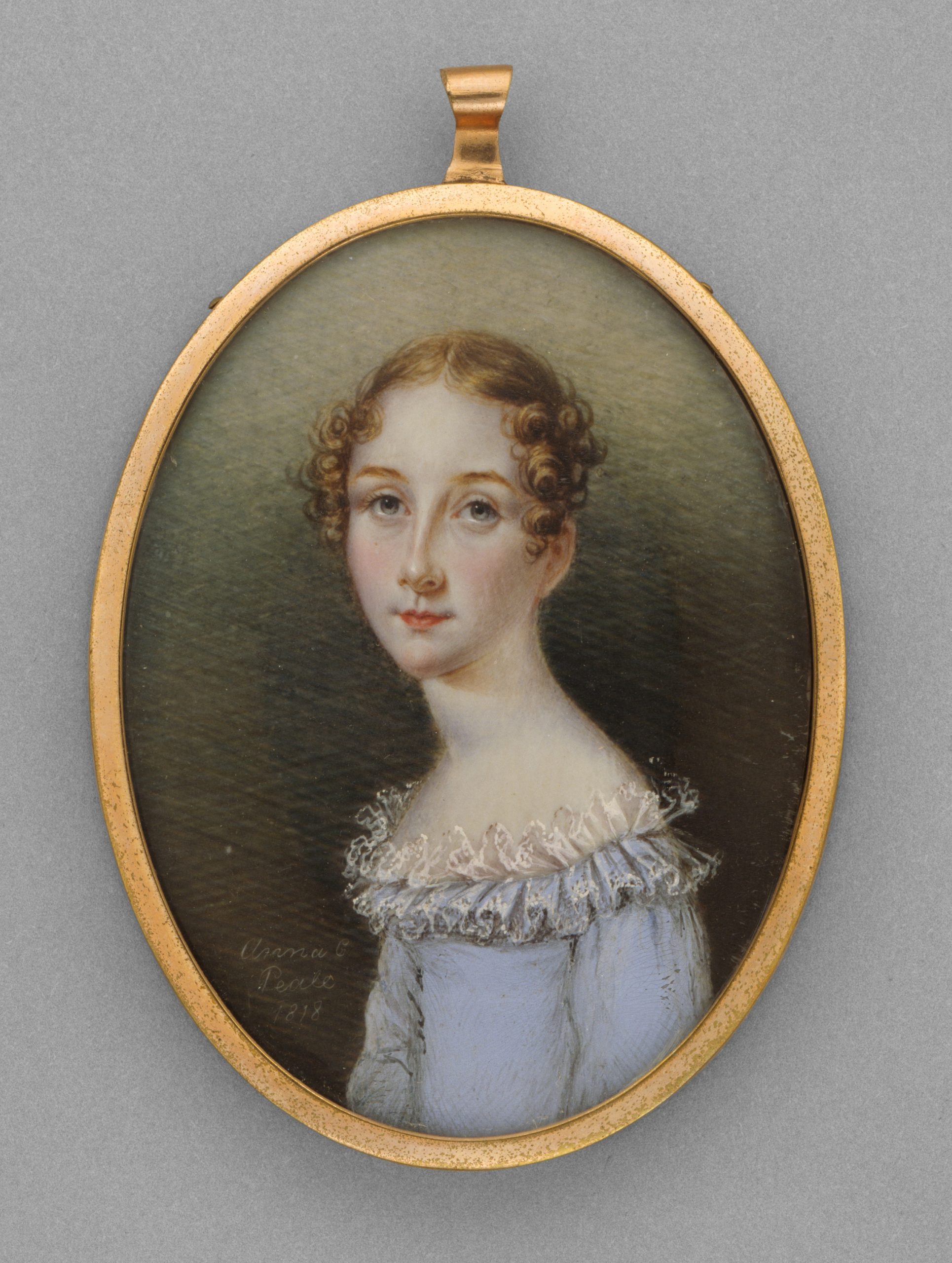
Anna Claypoole Peale
Watercolour on ivory, 7.3 x 5.7 cm | 2.9 x 2.2 in
Art Institute of Chicago
Lover’s Eyes
The trend for painting Lover’s Eyes began in Paris, but was popularised by King George IV of England. He had fallen in love with Maria Fitzherbert, whom he was forbidden from marrying since she was Catholic, and had refused to be his mistress. She fled to Paris, but George continued to pursue her and sent her a miniature painting of his own eye. After this romantic exchange, the couple married in secret in an unofficial ceremony, and George had Maria’s eye painted, which he kept around his neck. In his will, he wrote:
“the picture of my beloved wife, my Maria Fitzherbert, may be inter’d with me suspended round my neck by a ribbon as I used to wear it when I lived and placed right upon my heart”.
After this romantic tale was spread, lovers’ eyes became popular gifts. The mystery in them is that the majority of the subjects are unknown today, and were painted by unnamed artists. Their anonymity is both heartbreaking and touching, as they’ve become more broadly symbolic of love than tied to individual relationships. These watercolour paintings appeared commonly on brooches and lockets, but also sometimes in rings, snuff boxes and book covers. Some Lover’s Eyes also functioned as reliquaries, where the back contained a locket of the subject’s hair. The intensity of depicting a single eye allowed a person to carry an intimate artwork only for them to look at and understand, leaving the external viewer to wonder who it featured.
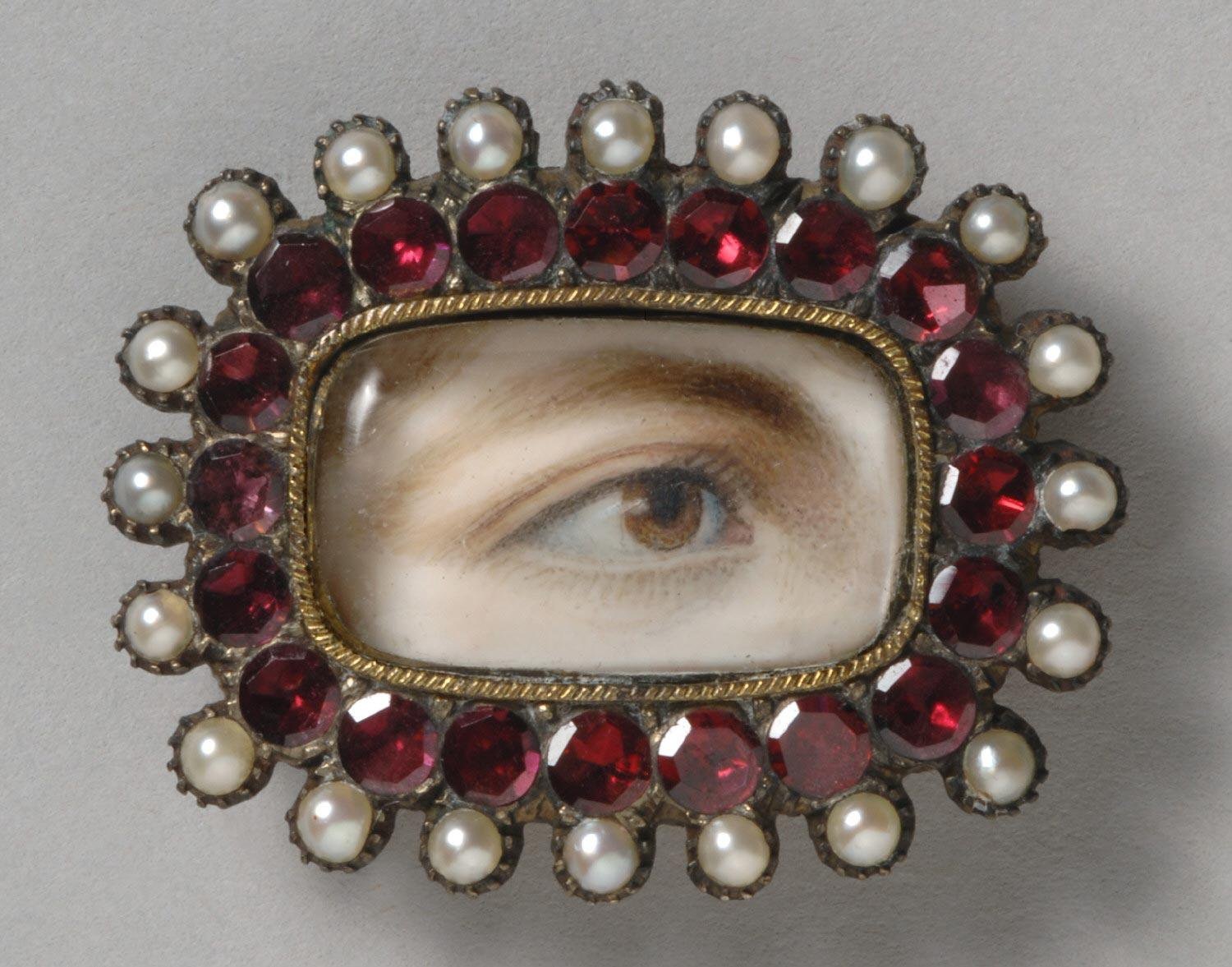
Unknown
Watercolour on ivory, 1.1 × 1.9 cm | 0.4 x 0.7 in
Philadelphia Museum of Art
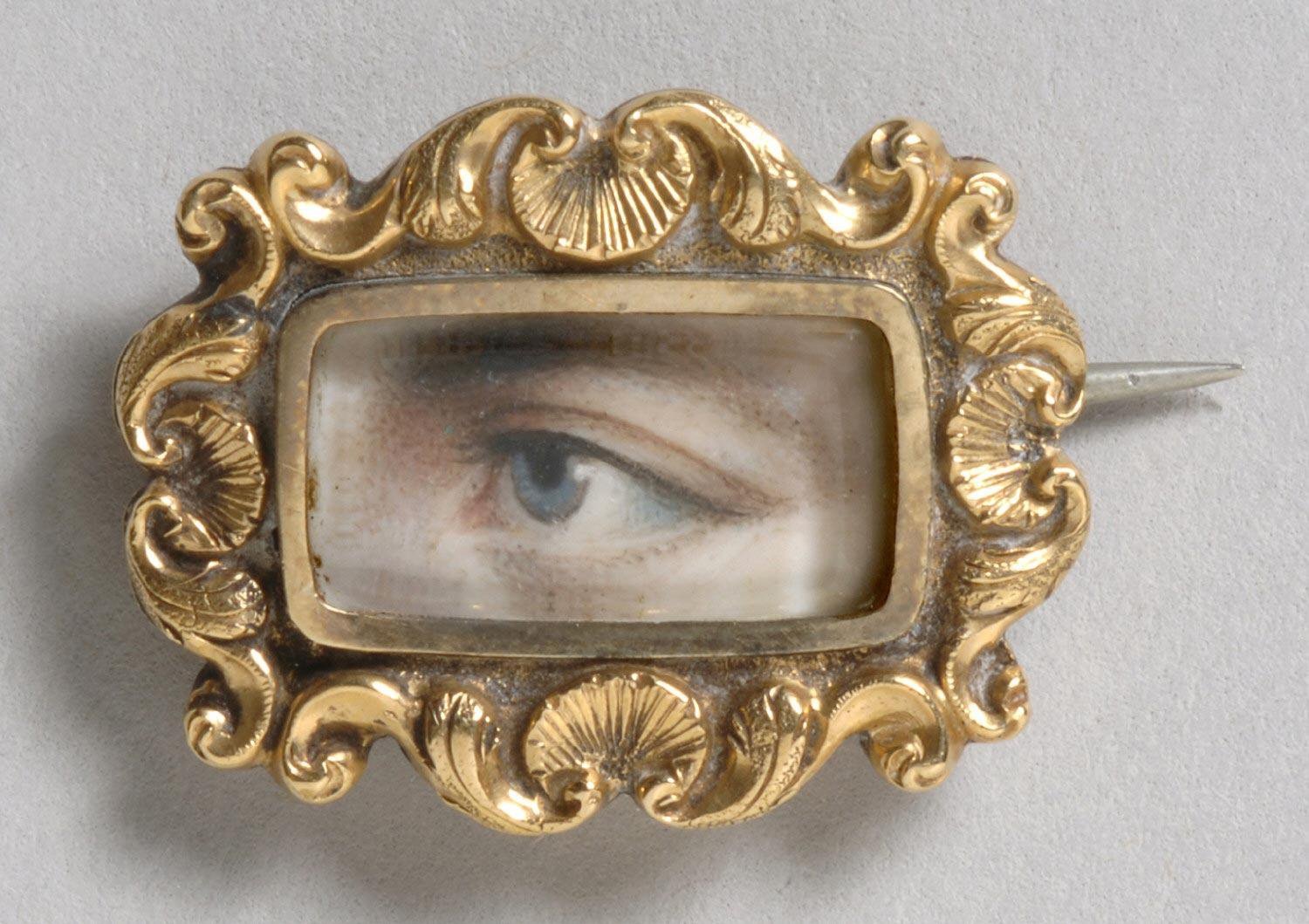
Unknown
Watercolour on ivory, 0.6 x 1.3 cm | 0.2 x 0.5 in
Philadelphia Museum of Art
Demonstrations of Miniature Painting
Miniature Painting Tools
To execute miniature painting techniques, small brushes are essential. I used a selection of fine brushes, including Silver Brush Ultra Mini Brushes and Pro Arte Miniature Synthetic Watercolour Brushes, for each of the following examples.
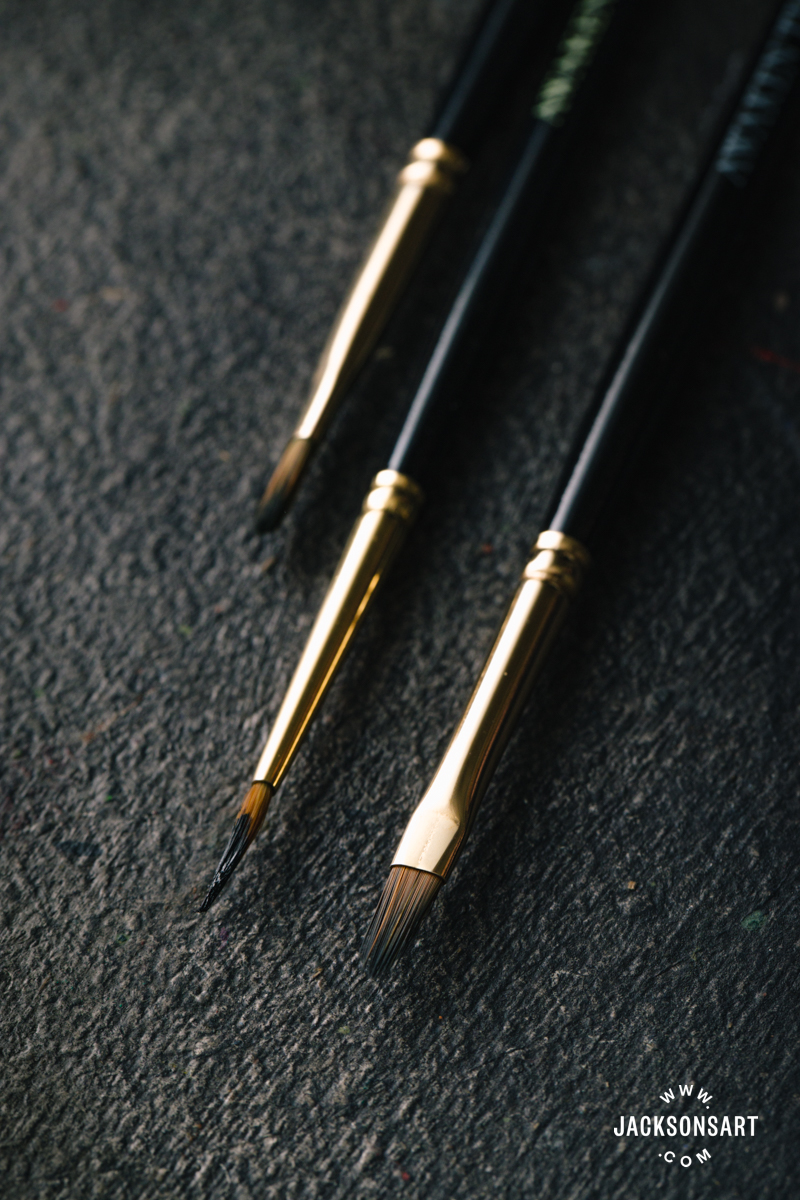
For mixing small volumes of multiple colours, it’s useful to have a miniature palette with lots of wells, like the Etchr Mini Palettes. Many miniature painters of the past used magnifying lenses to paint their works, so if you need to use one to help you work on a miniature scale, you’re working in keeping with tradition. Make sure that your workspace is well-lit to prevent eye strain when picking out the finer details by using an art lamp like those from the Daylight Company.
Demonstration of Persian and Mughal Miniature Painting Techniques
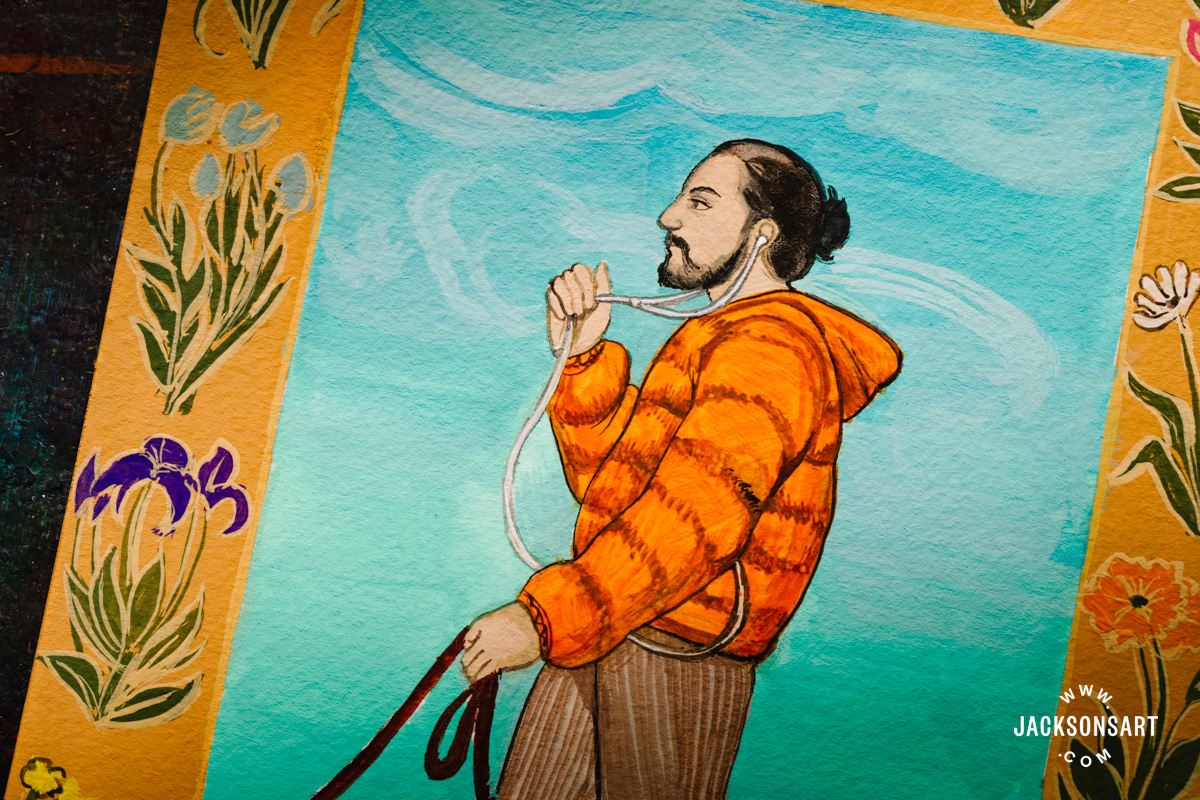
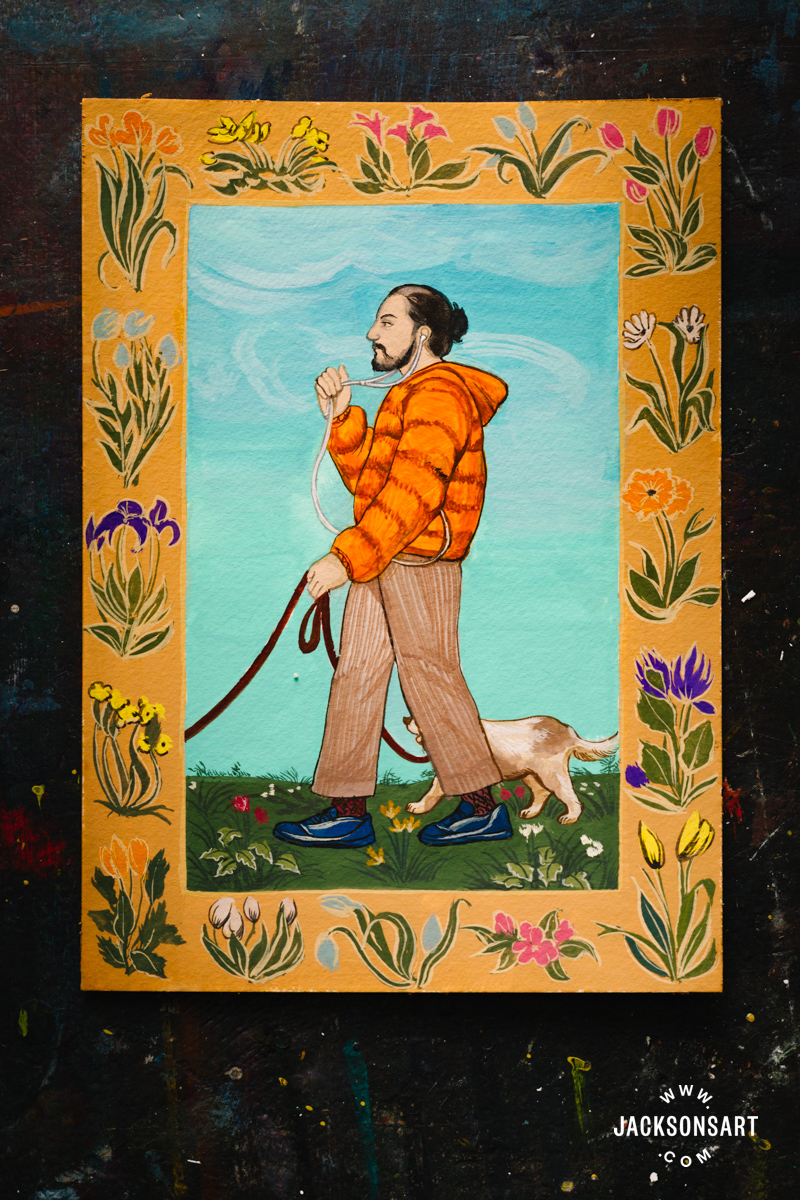
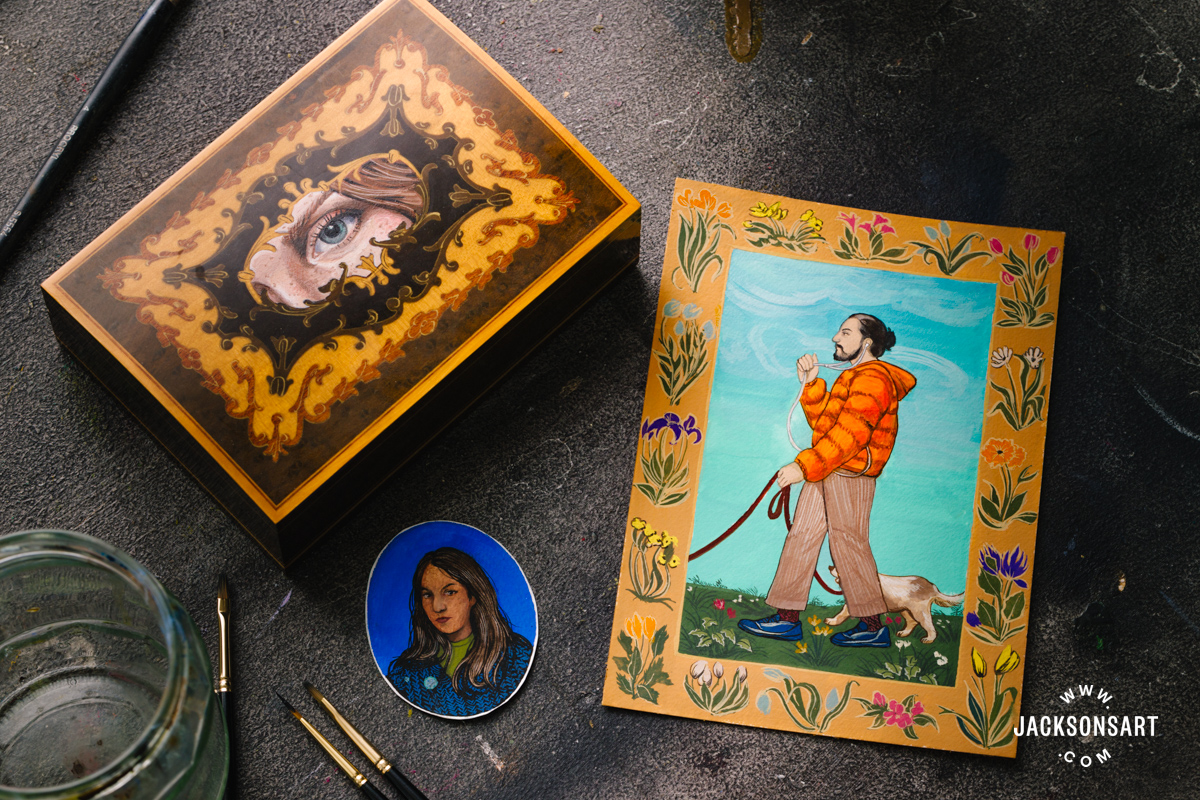
To demonstrate Mughal and Persian miniature painting, I made my own inspired by the following portrait of Shah Jahan on Horseback. My version replaces the ruler with a contemporary subject walking his dog, to reflect the Mughal tradition of capturing everyday life in their courts. I painted my work using Holbein Artists Gouache, in a palette intended to be a contemporary imitation of Mughal colours, using White, Bamboo Green, Elm Green, Black, Indigo, Bark Brown, Safflower Red, Ultramarine, Scarlet, Orange Yellow, Edo Violet, Canola Yellow, and Amber, on a small 12.5 x 17.5cm sheet from a Jackson’s Cold Pressed Watercolour Block.
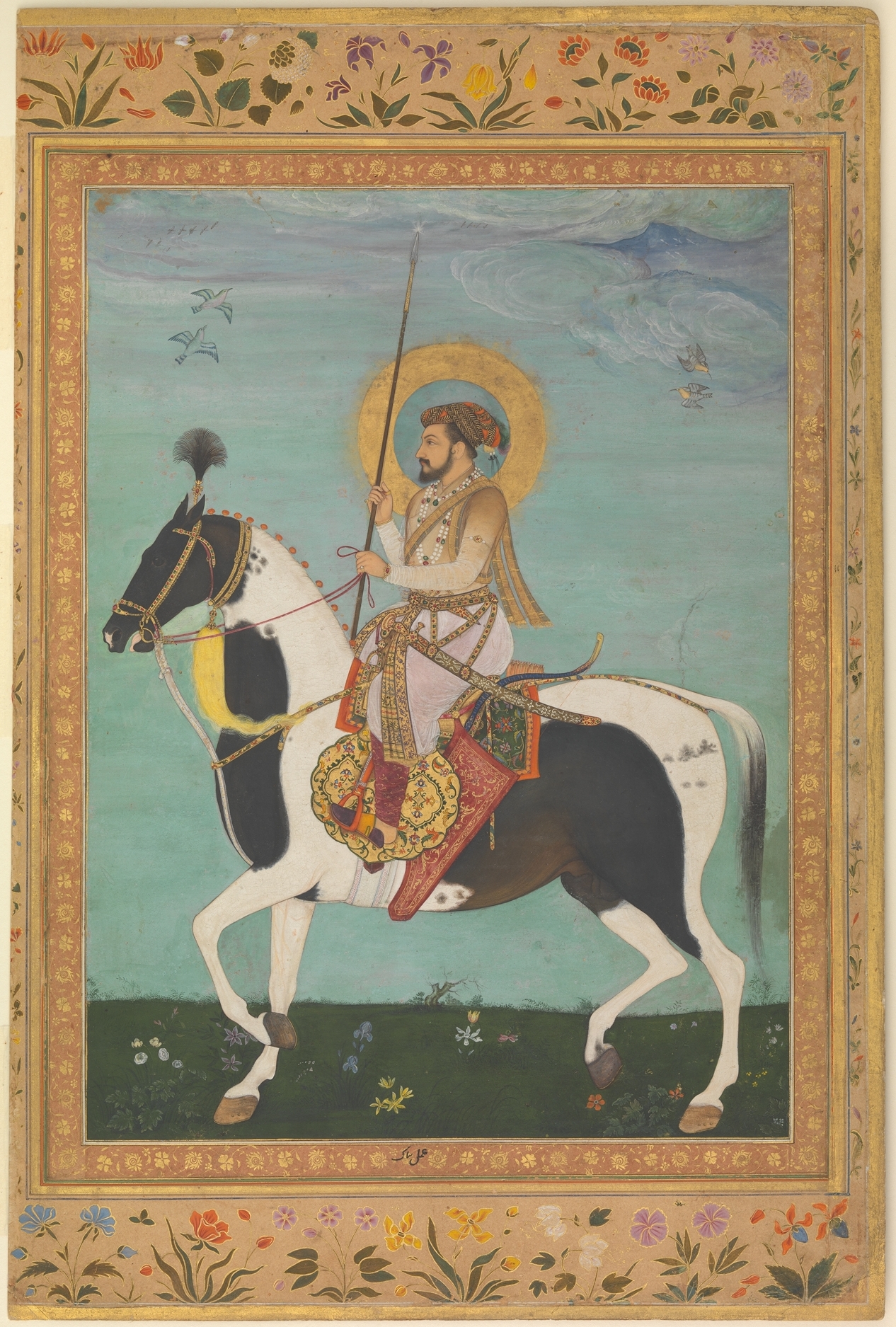
Payag
Ink, opaque watercolour and gold on paper, 38.9 x 25.7 cm | 15.3 x 10.1 in
The Metropolitan Museum of Art
To begin, I measured an even border to go around my image, and drew it out lightly in 2H pencil using a ruler. Then I lightly sketched my figure, making sure to capture the face in profile.
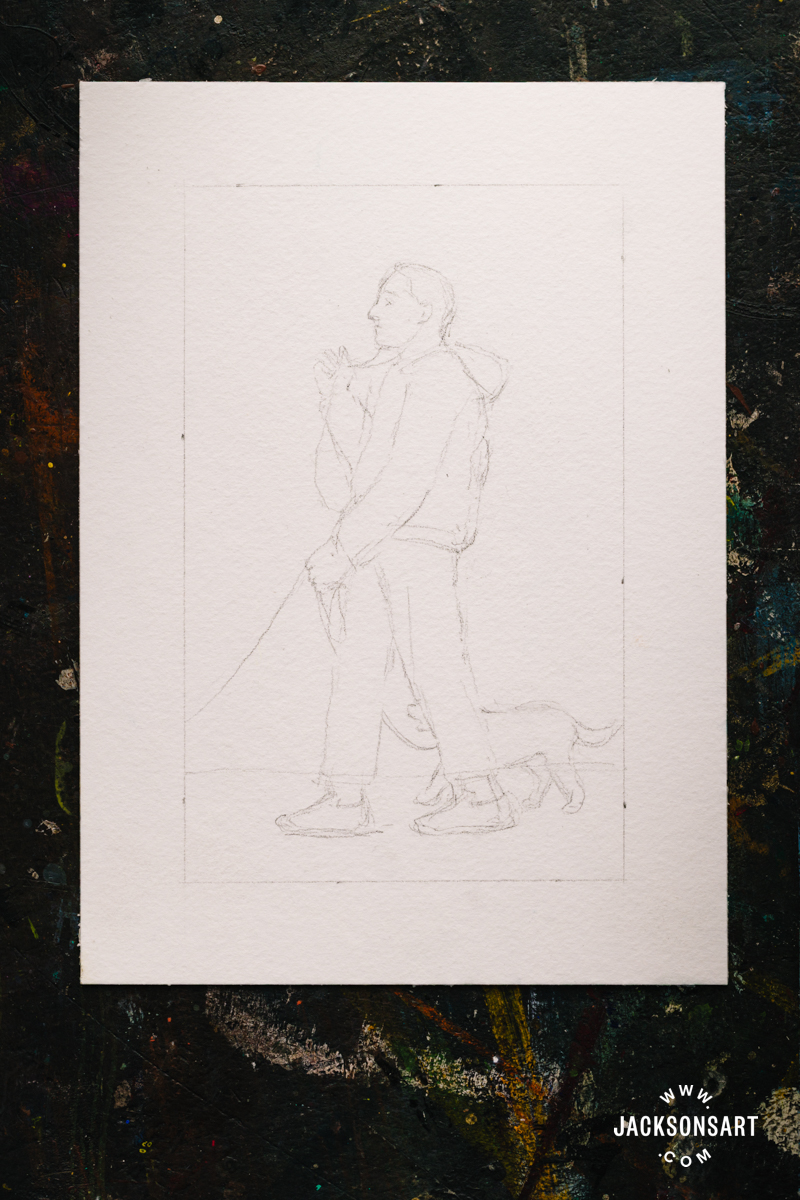
Next, I began painting by blocking in broader areas of colour, like the border, blue sky, orange jacket, and skin. Once I’d made a unifying blocked in layer, I refined the details by adding tonal details.
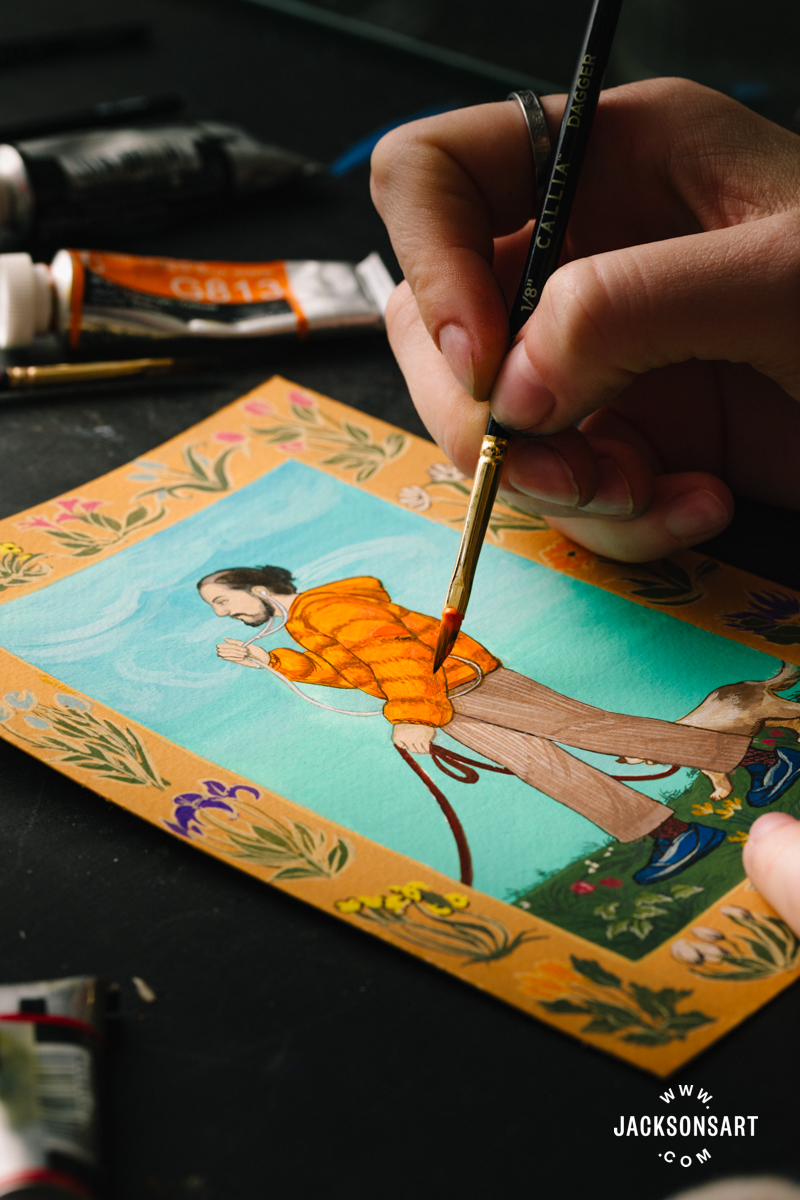
To complete the painting, I carefully painted outlines around the entire image, keeping them as fine and crisp as possible.
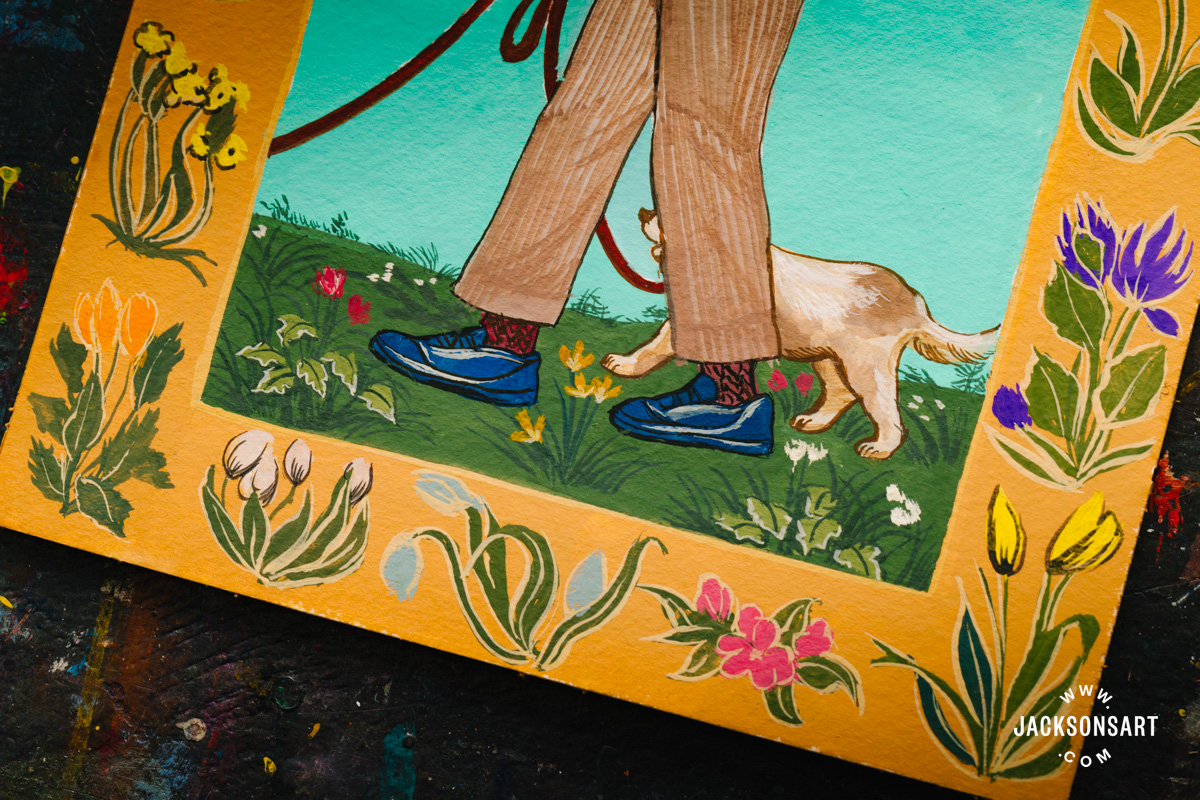
Tips: Sometimes the tiniest brushes aren’t actually the best for painting smooth, thin lines, since they can’t hold much paint and the line becomes broken. Test out which brush in your kit can sustain painting the longest thin line on a separate sheet of paper. I’d recommend using one with longer hairs and a pointed, narrow tip with a light hand, rather than a tiny detail brush with short hairs.
Demonstration of Portrait Miniature Techniques
European miniature portraits were most often made in watercolour on paper or vellum. For my example, I painted on a small oval cut from a sheet of Jackson’s Cold Pressed Watercolour Block, with with Holbein Artist’s Watercolours in Lamp Black, Titanium White, Burnt Umber, Yellow Ochre, Cobalt Green, Ultramarine Light, Permanent Violet, and Vermillion.
To begin my example, I cut out an oval of paper 6.5 cm tall and 5 cm wide, and lightly sketched my portrait in 2H pencil.
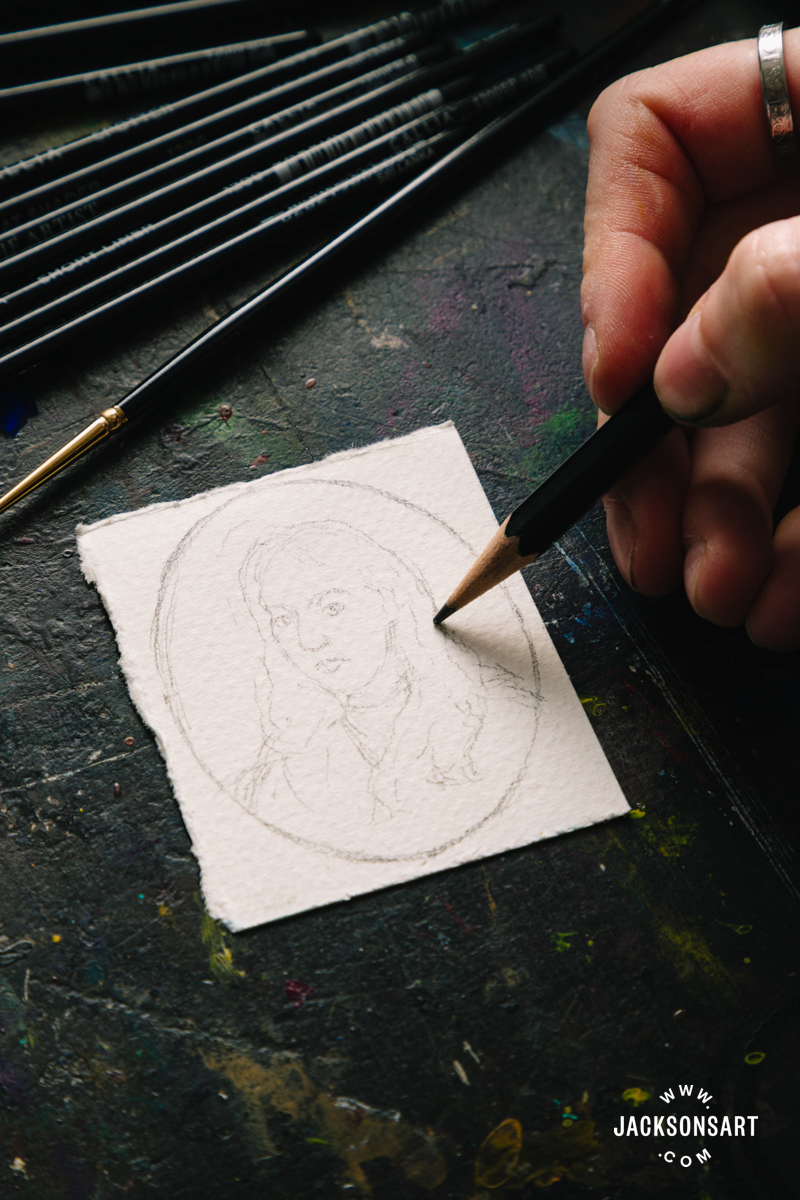
I began painting the face and worked outwards, by building the colour in soft transparent layers, and building opacity. This ensures that you have control of areas you want to keep luminous, like the skin, and can make any necessary corrections more easily.
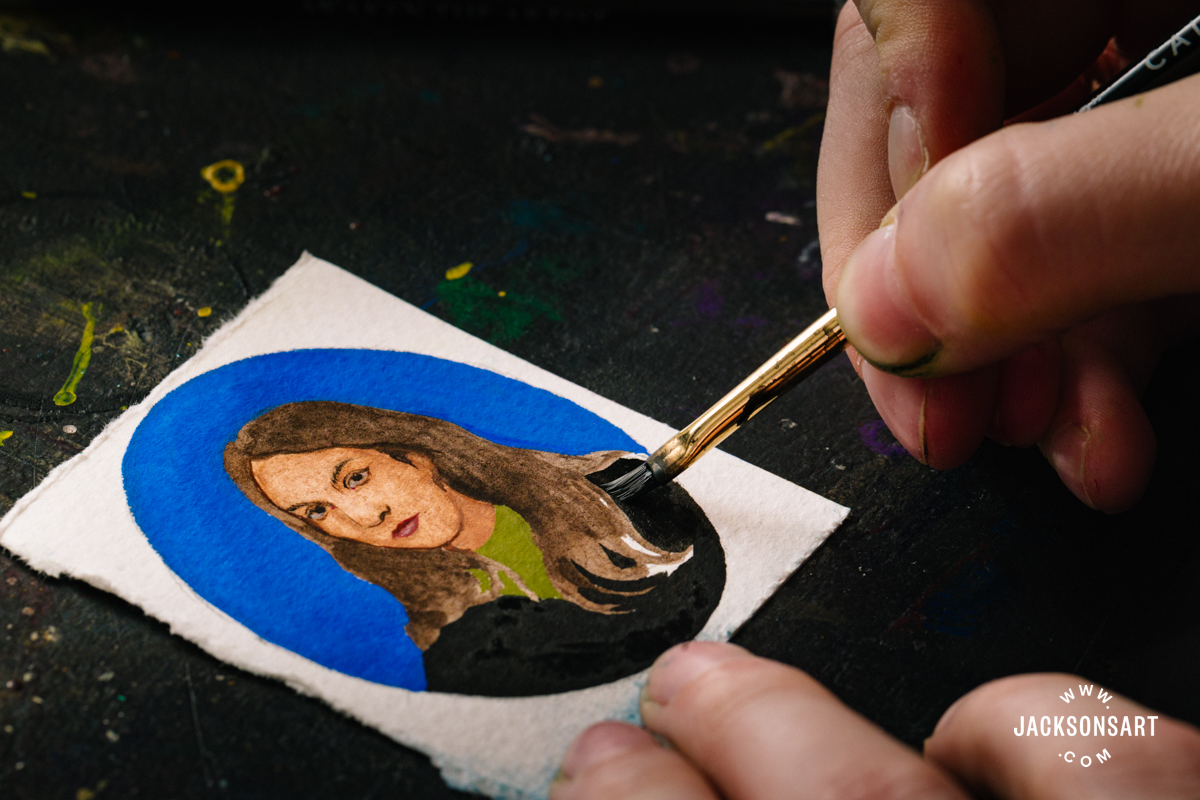
Once I’d worked my way around the portrait, I painted the background solid blue in reference to Holbein and Hilliard. I finished the painting by picking out some individual strands of hair.
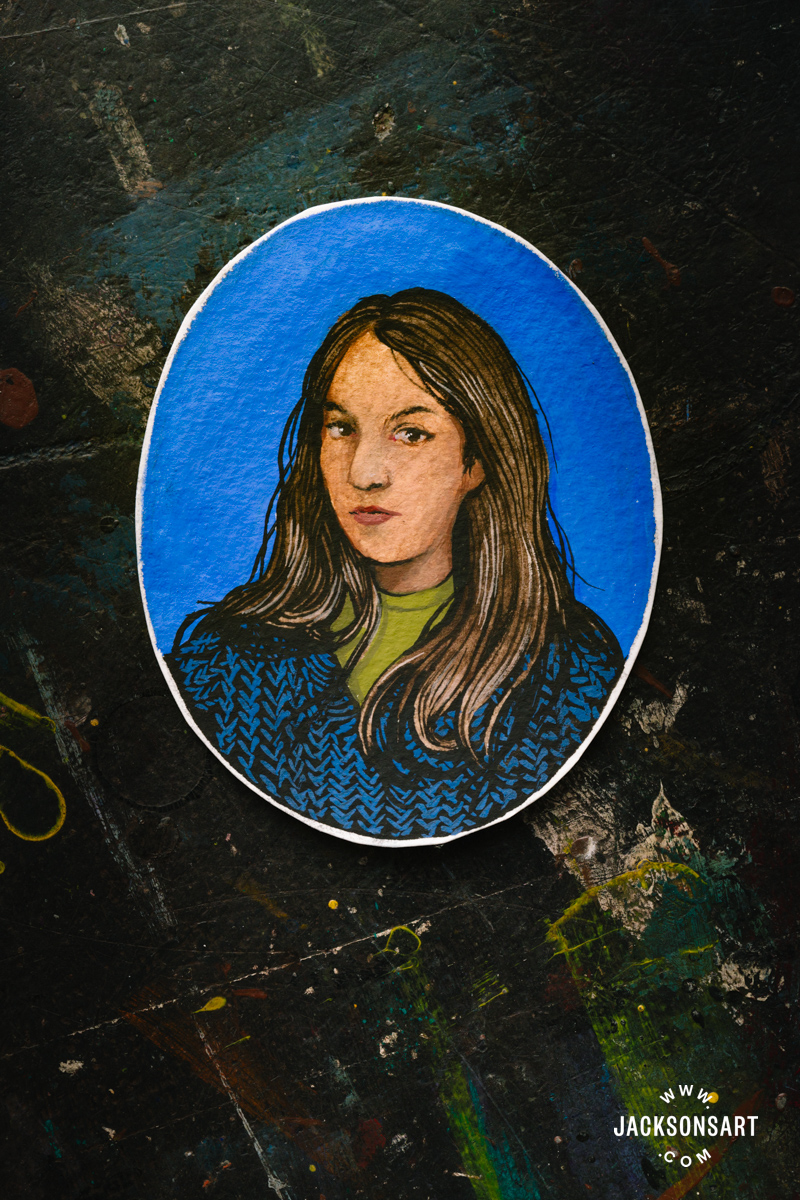
Tips: It’s very easy to make a mistake when painting a portrait on such a small scale, but it’s easy to make corrections with watercolours. Use gentle lifting with a small brush to pick up any unwanted colour. To make sure all of your paints can be lifted without worrying about staining colours, apply a layer of lifting medium to the paper before you start painting.
Demonstration of Lover’s Eye Techniques
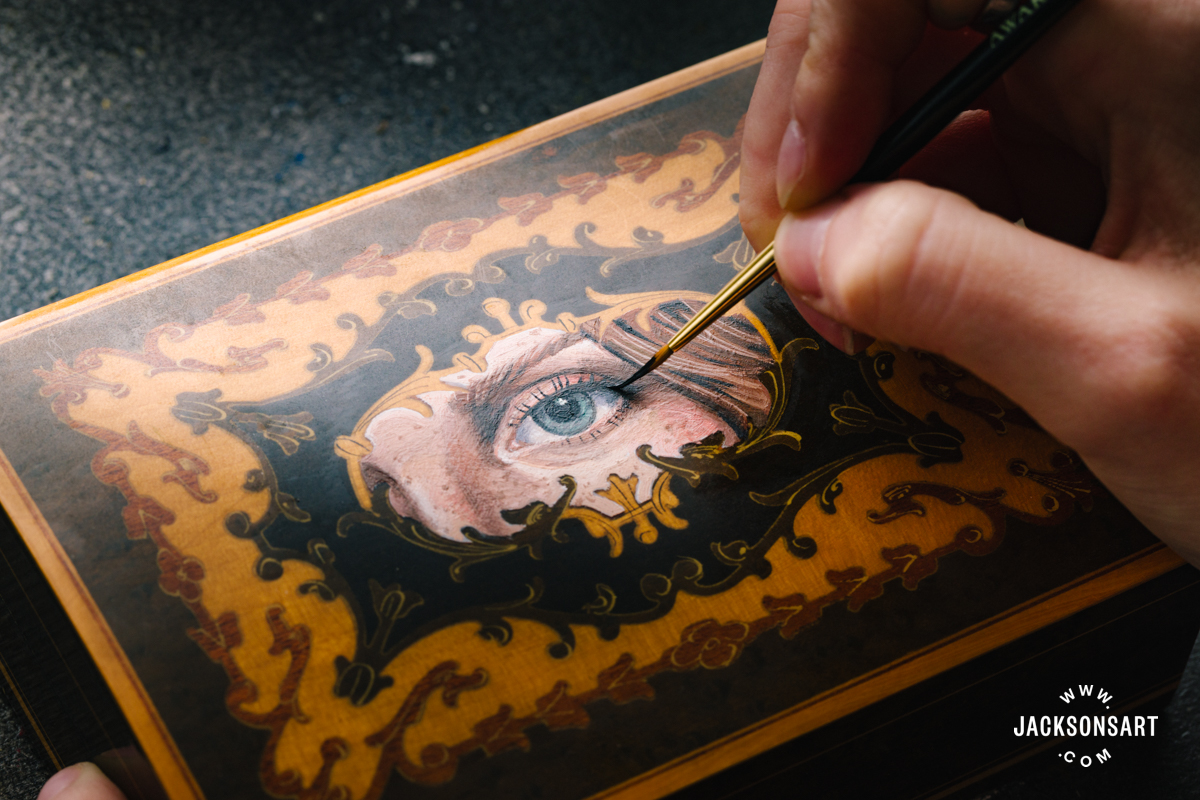
Lover’s Eyes were created to be part of objects – not to be hung on walls. For my lover’s eye example, I bought a cheap vintage box from a charity shop to paint the eye on. You could do the same with other objects like old brooches, lockets, book covers, dishes, or mirrors.
The preparation for each kind of object will be slightly different; consider how best your paint will adhere to the object if you’re painting it directly on, or if you can attach a new surface to it. My box already had a ‘framing’ design on the lid, which I knew would nicely accentuate the eye, like the bejewelled edges of Lover’s Eye brooches.
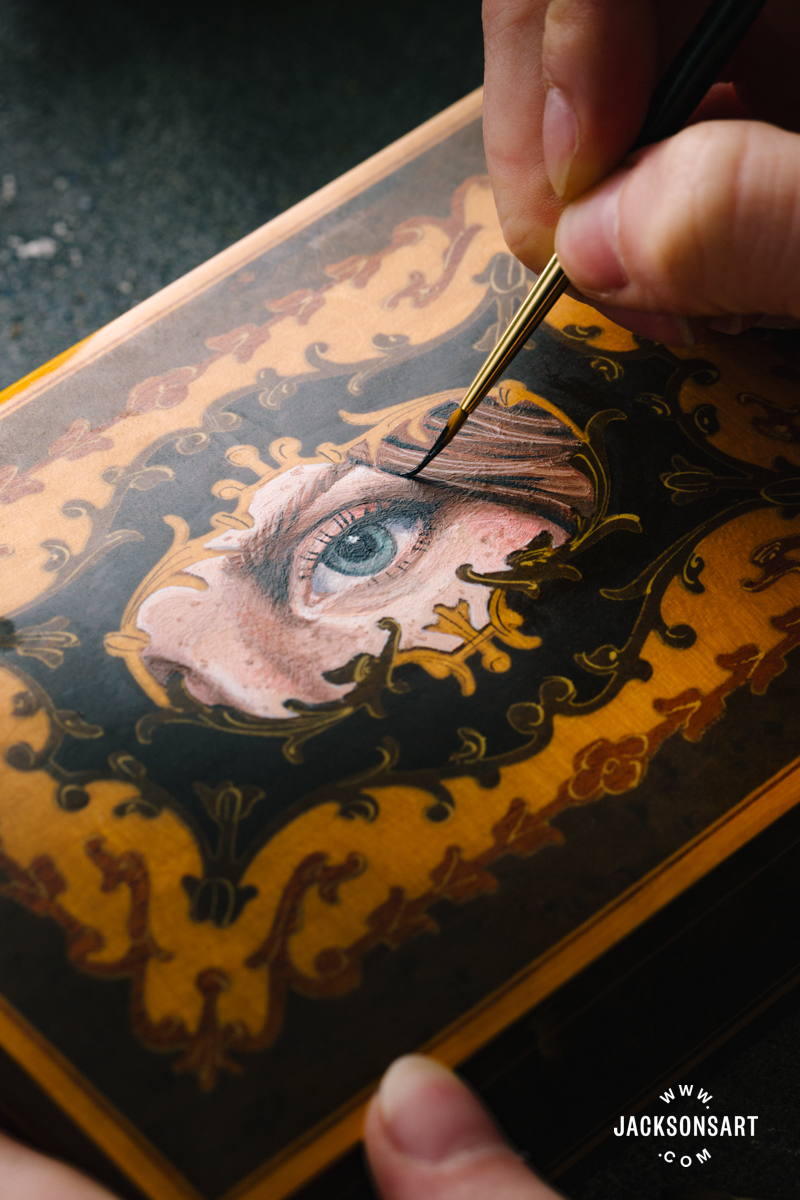
For my box, I lightly sanded the area I wanted to paint on, since the surface was very slick and smooth. Then I carefully painted a couple of thin layers of gesso onto the section, so my paint had something to grip onto. I painted the Lover’s Eye using Jackson’s Professional Acrylic Paint and the same small brushes from my previous examples.
I took care to block in the broad colours and tones before picking out refined details like freckles, eyelashes, and a highlight in the eye. I completed the work by sealing it with a layer of satin acrylic varnish.
Further Reading
Pigments in the Everyday: Love and Colour
Behind the Movement: Art Nouveau
A Guide to Painting a Self-Portrait from Life
Shop Art Supplies at jacksonsart.com

4 thoughts on “Techniques for Miniature Painting”
I have been thinking I should try a Mughal miniature for my son who loves their art but in reading it discovered that I actually turned out about 28 miniatures a week drawing different models during weekly sessions, where 14 of the artists pose for the length of a song. Anyway I do them on 140# watercolor paper. I use a 3/8” dagger brush because time is of the essence. I can do fine details with it or cover the faces with a broad swathe of prepared colors like flesh tone. Anyway interesting article. Will be reading it when I do one for my son. Thanks!
Thanks for you comment Margaret, that sounds brilliant – hope you enjoy making your Mughal inspired miniature too!
It’s great to see miniatures and their global history being celebrated! This is very much a living discipline and there are two miniatures societies in the UK alone – The Hilliard Society and The Royal Miniature Society – and they always encourage new miniaturists to have a go.
Technique-wise, stippling and hatching are so important for European portrait miniatures – it’s a fun technique to try and very satisfying to build up velvety shading this way. Good luck, all you budding miniaturists!
Thanks for your comment Ellie! I agree they are incredibly fun to make
Comments are closed.