



Metallic and pearlescent watercolours are becoming increasingly popular with artists who want to accentuate light and experiment with reflectivity, as well as for painters who want to emphasise a dark ground. Coliro is a favourite brand of pearlescent watercolour because the paints are luminous, intermixable, easy to manipulate and bright. We looked at the unique qualities of these paints and how they perform on black watercolour paper.

Nuanced Sheens: Coliro Pearlescent Paint
History
Coliro paints have been manufactured in Germany since 2005. They’re made from mica-pigments and gum arabic, which makes their handling very similar to watercolour, however, they are more opaque, resembling Japanese watercolour or gouache. They can be used on paper, stone and wood and have an excellent lightfastness. They are also free from any animal ingredients.

Pearlescent, Metallic, and Iridescent Colours
Pearlescent paint is reflective, but only reflects back some of the light that hits it, allowing you to see the colour of the pigments as well as reflected light. The pigment particles are transparent and as light is reflected between their tiny layers, they emit different coloured light that “sparkles”. A little like how a cut glass prism can create rainbows, but picture thousands of microscopic prisms packed in together with minuscule spaces between them. Once dry, it produces a diffused, textured glow that is reflective without being overpowering.

Metallic paint reflects back the maximum amount of light, evenly. This means, in bright conditions, the marks can show up as pure light and you are unable to see the colour of the paint, but get a very strong area of reflected light. Imagine the particles as mini coloured mirrors: in low light, you can see the backing colour but in bright light, you just see the reflection of the light.
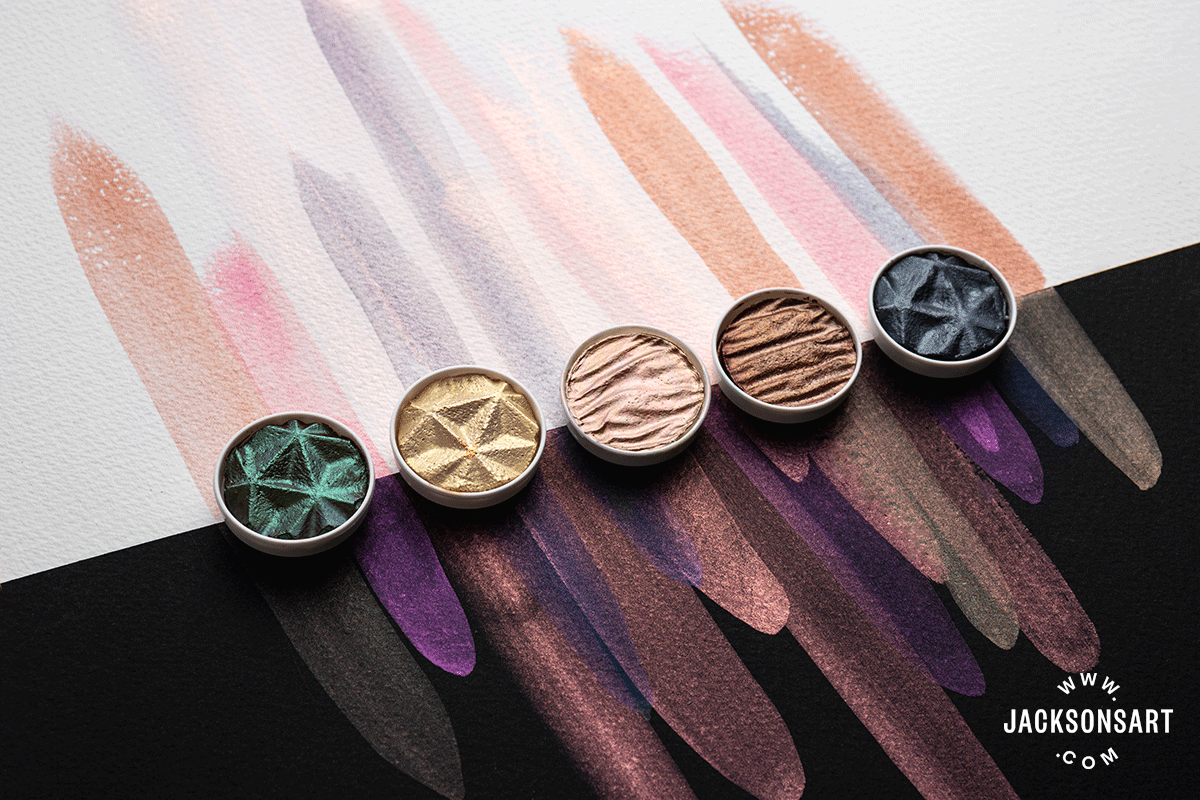
Iridescent paint varies in reflectiveness and can appear to be multiple different colours: these changes depend on the brightness and angle of the light in which its viewed, and the colour of the surface it’s painted on. It is made from fine prismatic particles: each particle has different coloured facets, through which light is refracted, giving off a different colour depending on which facet the light has travelled through and what angle the viewer is standing at.
Coliro’s range consists of all pearlescent colours, hence the name Coliro Pearlcolors, however, within the range their “shimmer” colours are both iridescent and pearlescent. For instance, Coliro’s Shimmer Fine Lilac can be both a light greenish silvery glaze but also the elusive pink of a trout’s belly. The shimmer colours leave a delicate sheen on white paper, whereas on black paper, they create vibrant colours.
Coliro’s Behaviour Wet and Dry
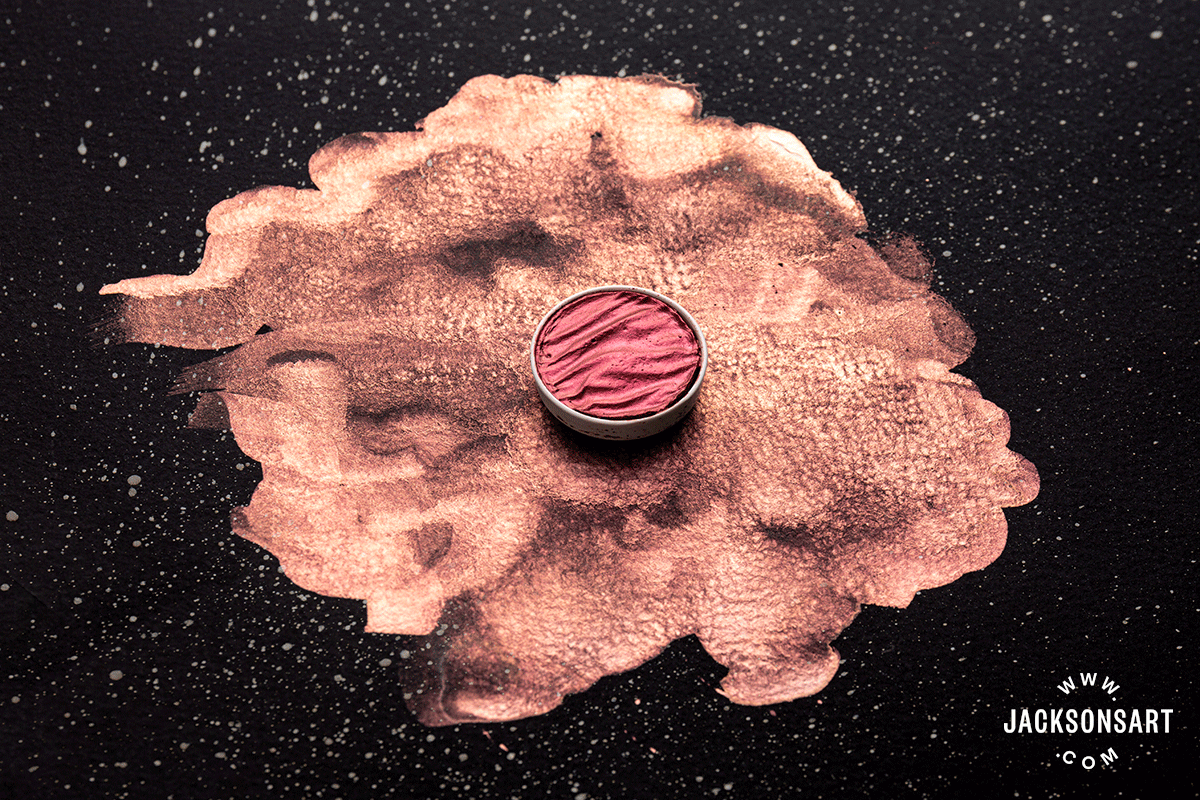
When used on fairly hard sized watercolour paper, the pigment stayed radiant on the surface without sinking in and dulling. Once dry, the paint stayed exactly where it was applied, even after vigorous scrubbing. This permanence is a great advantage of Coliro, as often, mica dust can remain transferable once dry, ruining clean, crisp marks and making a workspace glittery.

The first three strokes show different concentrations of Coliro washes; the next two, Coliro dropped into a wet wash; the third is Tibet Gold painted over lines of dried Red Coliro.
The last two vertical lines I went over, firstly back and forth with a wet wash, and then the next one down was made using a light wash of water.
The last stroke over the dried Coliro was to show the increase in opacity. I also tried to scrub at the dried Coliro but no dust was produced.
If dropped into wet washes, the paint barely disperses, making it surprisingly easy to control. Rewetting dried paint strokes is also easy and allows you to draw out colour later or redefine lines and boundaries as you go. Applied thickly over dried washes, it barely moves them, so you can layer highlight upon highlight. Coliro colours are brighter and more reflective once dry, so you may want to take this into account if you’re making tonal work.
Coliro can be mixed with other watercolours, in case you would like to tone down a Coliro paint or add a gentle shimmering diffusion to another watercolour or gouache. Coliro’s mica pigments are very predictable in their soft, malleable behaviour, creating washes with even coverage, unlike some metallics, with very heavy particles that can gather in the dips of paper and produce uneven marks.

Opacity
Used thickly, Coliro is incredibly opaque—perfect for adding strong, polished details to the shell of a beetle or the edge of a bee’s wing. In washes, they can create nuanced sheens, with a dappled reflectiveness that catches the eye without disrupting the cohesion of a piece. You can, also, build up their opacity in layers to create jewel-like marks.
Colour Range
The Coliro range includes over 46 rich, alluring colours. Collectively, they form a comprehensive palette, reducing the need to mix these pearlescent colours with normal gouache or watercolour. Most other brands that provide pearlescent or metallic versions of their watercolours and powders, typically only offer between 3 and 16 colour choices.
Coliro paints come in thematic sets, such as Ocean, which could be useful for capturing the glimmering shades of the deep sea, or Candy, which provides you with the colours to produce reflective works that can describe brash boiled sweets or the metallic shine of cutlery.

Packaging
The Coliro pans themselves resemble eyeshadow palettes. They are fairly large (30 mm in diameter) and are contained in circular white pans. Most of the pans have an intriguing wave pattern on the surface, this shows the glimmer of the paints when dry. When wet, the troughs in the surface act as wells with rivulets of sparkling wet colour running through them. This is useful because it is recommended to wet the pans with droplets, or a spray of water and leave them for a few minutes before you start working so that the paint is creamier to use.
Sets are plastic or metal, and the pans are held in place by a click mechanism that makes them easy to remove and exchange for another pan. All of Coliro’s colours are available to purchase individually.
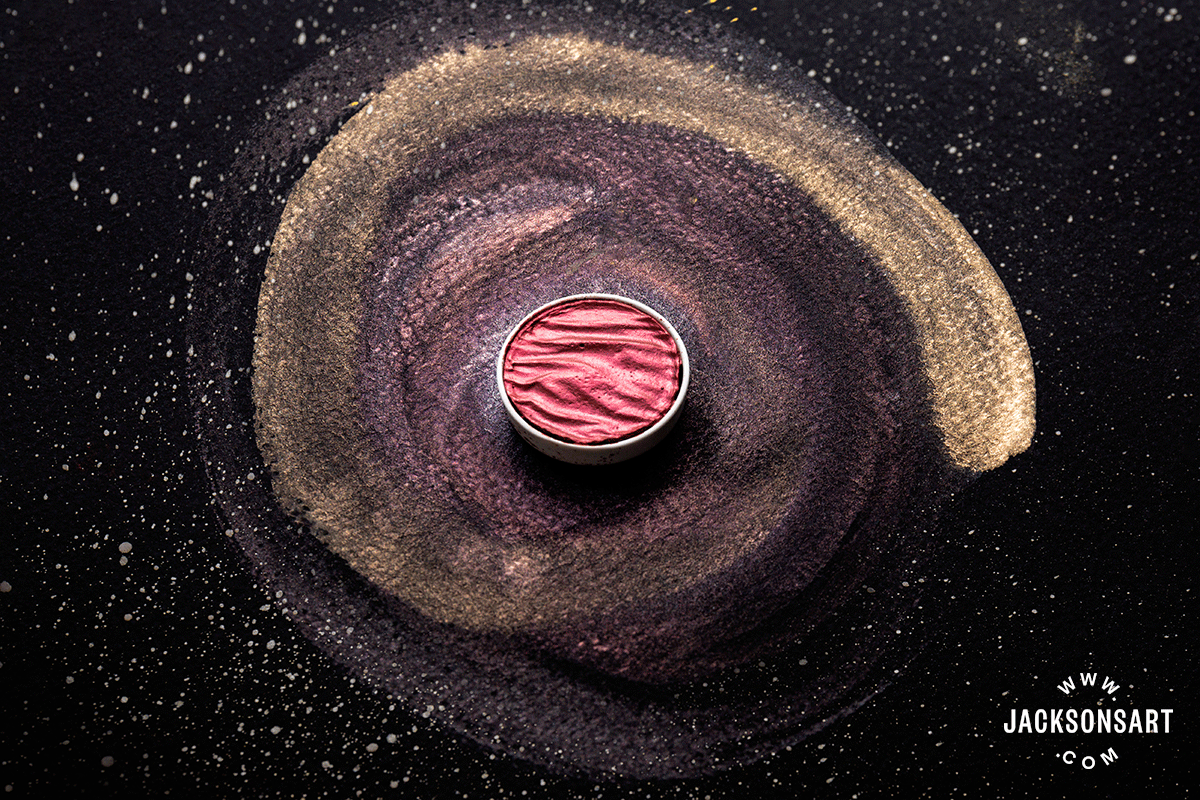
Bright, reflective, lightfast and rich with pigment—the colours are true to their uniquely designed pans. The pigments are lightweight, allowing them to be washed over other layers, leaving a consistent glimmer or they can be built up for maximum impact. With a vast colour range and easy handling qualities, Coliro is ideal if you want a pearlescent paint to bring your work to life with light.
Further Reading
Lightfast Black Surface: Stonehenge Aqua Black Paper
Black Watercolour Paper Comparison
Chromatic Black: Mixing Nuanced Dark Values
Gold Gilding Process with Tuesday Riddell
Shop Coliro Pearlcolors on jacksonsart.com



8 thoughts on “Nuanced Sheens: Coliro Pearlescent Paint”
A beginner wanting to learn more about
Coliro paints (and black watercolor
paper) so thanks for your very
informative blog post!
Hi Duane, I’m glad you found it useful and thank you for the feedback.
Oh wow!!!! These look absolutely
sumptuous! I know what I’m adding to
my birthday wish list.
Hi Nicky, thank you for the feedback, I’d argue they look even better in real life.
I wonder if someone could clear up my
confusion about lightfastness? This
review says these paints “have an
excellent lightfastness.” But for every
color I look at in the online store,
lightfastness is described as “fair.”
Hi Janice, there is some inconsistency in how they are described – on Coliro’s website they describe them as being lightfast. I will have a look into this and get back to you.
I am in need of a good, strong gold to use to paint flowers onto a
dark brusho background. Would Coliro’s Tibet Gold be strong
enough to stand out as a shiny gold?
Hi Janet
Although I have not tested on Brusho, the Coliro paints are designed to shine on a dark background so they should be great for your needs.
Many thanks
Lisa
Comments are closed.