



This article examines the differences between gouache and watercolour, their common features and advantages, and when to use each. From transparent washes to opaque layers, we explore how their different properties affect the way you paint.

As a painting medium, watercolour has come into its own in the last few decades. It is no longer used mainly for preparatory sketches for large studio paintings and is now accepted as a serious medium for finished paintings. At the same time its nearest relative material, gouache, is often still underrated both among artists and connoisseurs of painting. Lately however, a new trend has appeared – gouache has become more popular, both in terms of artists using this medium as their primary one, and in the number of books and courses devoted to the specific properties of this material.

What is the Difference Between Watercolour and Gouache?
The key difference between gouache and watercolour is transparency. Both paints are water-soluble, but watercolour is generally transparent while gouache is opaque. We will consider other specific similarities and differences, but this is the most important thing to understand.
Gouache differs from watercolour in its opacity: the binder in the paint is the same gum arabic that is used for watercolour, and there is usually also a higher pigment load, to add to the opacity. This is why gouache is opaque, dense and covering.

Watercolour as a material is more complicated in technique because of the transparency of the paint: layers are seen through each other, they are transparent and the previous layer is visible, so watercolour forgives less mistakes than gouache, which allows the possibility to add more layers in case of failures and mistakes.
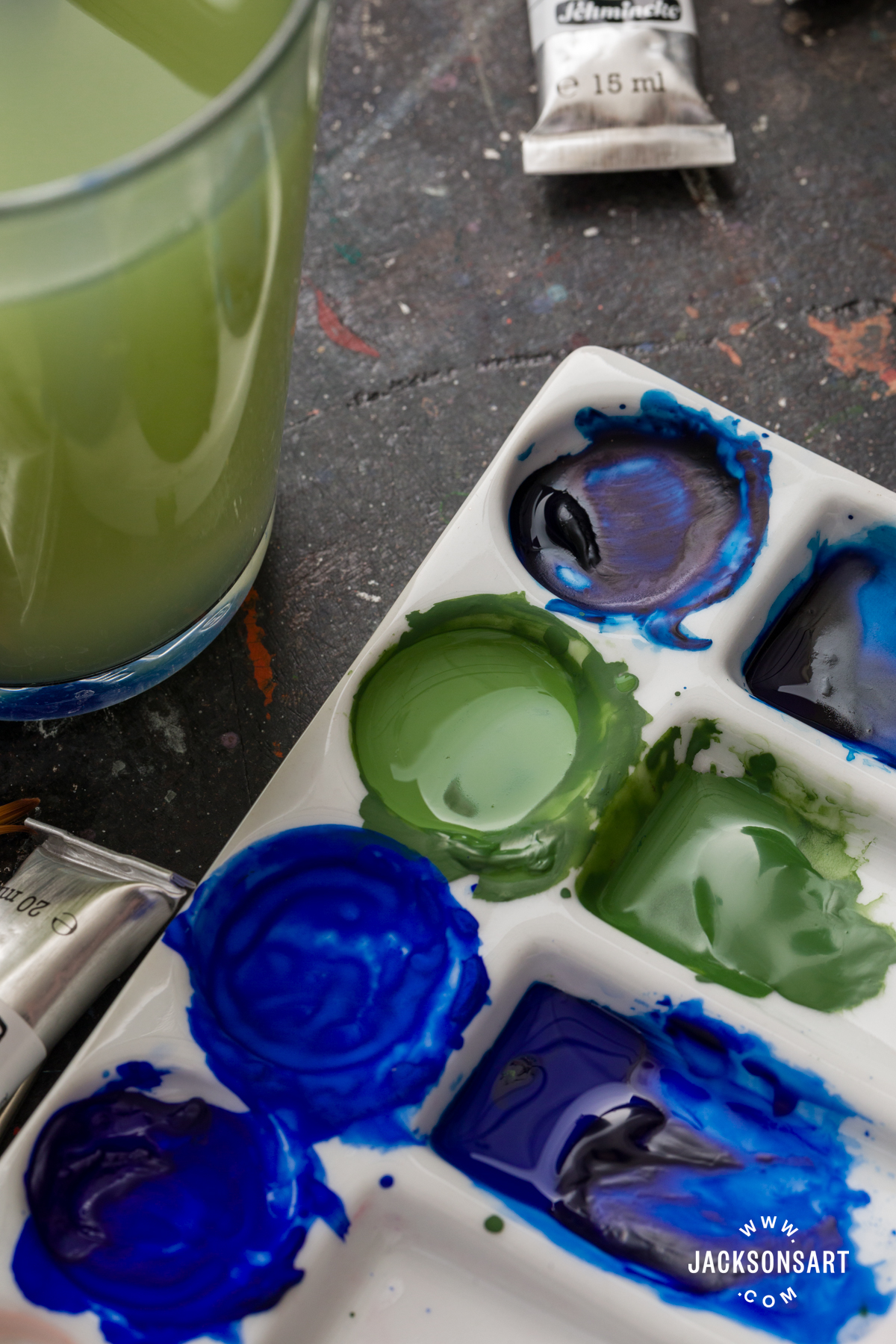
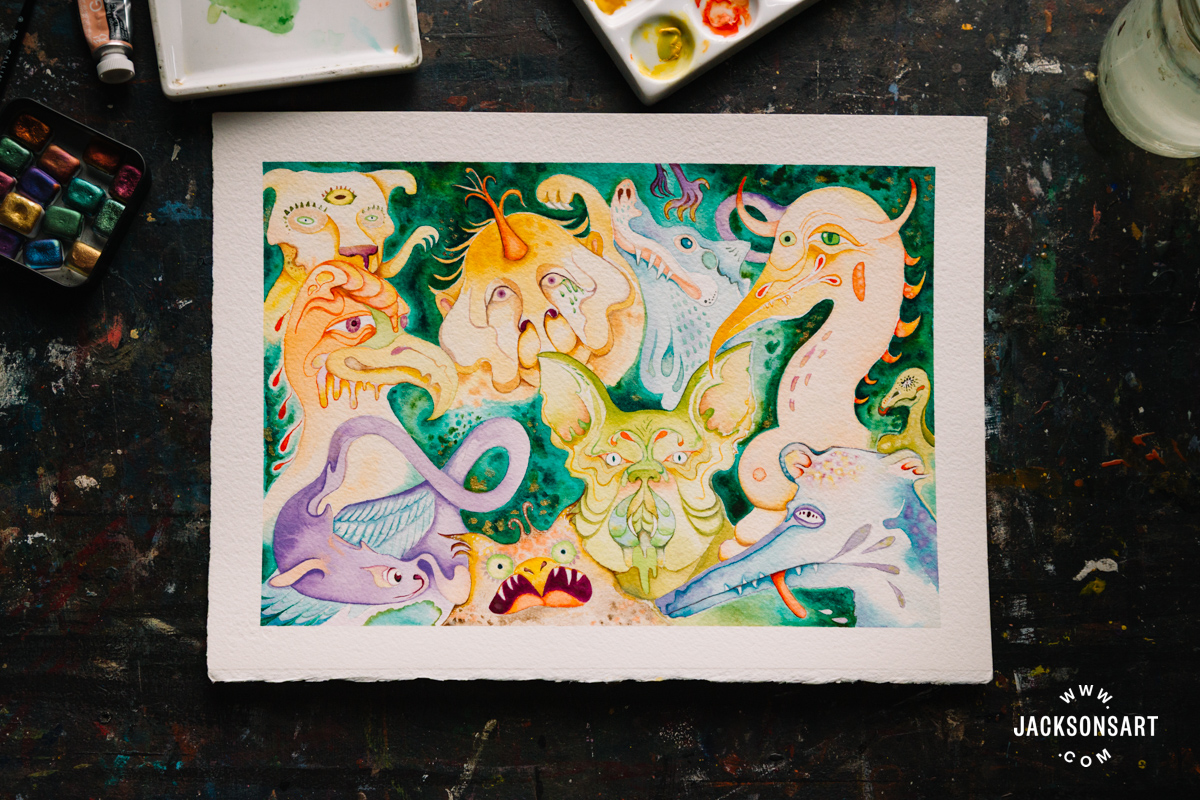
Gouache is a favourite material of illustrators. Among the definite advantages of gouache, is the fact that it is a very convenient and compact material: it does not smell, there is no need for additional solvents, and occasional spots of paint can easily be washed away with water. The only real negative might be that you go through more paint with gouache compared to watercolour, because watercolour is commonly diluted with water to create washes, while gouache is often applied in a thicker, less diluted way, so you use more paint.
To better understand the difference in materials, I painted the same subject in watercolour and gouache using Schmincke Horadam Aquarelle Watercolour and Schmincke Horadam Gouache.

Even the approach to painting in gouache and watercolour is different – someone aptly put it that opaque materials (oil, acrylic, gouache) are the experience of searching directly on the canvas, while watercolour is an expertise of concentration. In watercolour you need to think of the process and technology before applying the paint, in gouache you have enough time to decide while painting.

The sequence of applying layers in these materials is also different: the white colour in watercolour is traditionally the uncovered areas of paper. In this respect, gouache is more convenient: while the classic sequence of layers in watercolour is, for obvious reasons, “from light to dark”, gouache allows you to work in both ways: you can put light colour first and then dark, or vice versa, first dark and then light colour on top.

Gouache is more versatile, it allows you to make more textured strokes. Some may object that if you use watercolour too thick you can make paste-like strokes! But if you apply watercolour too thick (directly from a tube) it dries up in a thick glossy layer and you can really see it on paper. Gouache, on the other hand, allows you to put these dense strokes and it dries without this glossy sheen – but speaking of gouache, you should also remember that if you put too thick a layer of paint, it can later crack.

In gouache it is difficult to achieve such interesting uniform transitions and smooth washes as in watercolour, and in general the paint is a little less plastic. You can blur layers with water or wash them with pure water, but it requires more accuracy and carefulness. Another important factor to consider is that gouache, when applied to the previous layer, snags the bottom layer, even on cotton paper, unlike watercolour, which on the corresponding paper allows applying layers without blurring the previous one.

Gouache is less demanding in everything – and that includes additional materials. With watercolour, the quality of paper and brushes are very important. But while watercolour paper works the best for painting in gouache, you can use any paper that isn’t warped by water.

Schmincke Horadam Gouache Paint Chromium Oxide Green
Schmincke Horadam Watercolour Paint Chromium Oxide Green
Schmincke Horadam Gouache Paint Ultramarine Blue
Schmincke Horadam Watercolour Paint Ultramarine Blue
Painting with watercolour requires relatively soft and controllable brushes, and sharp tips are critical, in gouache this is desirable – but not obligatory. One thing that is the same for both mediums, the quality of colours themselves are really important: student grade gouache differs from designer and professional as much as student grade watercolour differs from professional painters’ materials.

Schmincke Horadam Gouache Paint Chromium Oxide Green
Schmincke Horadam Watercolour Paint Chromium Oxide Green
Schmincke Horadam Gouache Paint Prussian Blue
Schmincke Horadam Watercolour Paint Prussian Blue
Gouache can be applied in a dense layer evenly and in such a way that you won’t see strokes of paint, which is also possible in watercolour, but requires more water.
Gouache dries faster than watercolour and is less likely to differ in tone and look paler after drying, as do most watercolour paints. The general rule of gouache is that after drying, dark tones appear lighter and light tones appear darker.

To summarise, these two materials are both made with gum arabic so are re-soluable, but the transparency of the watercolour and the opacity of the gouache require different painting techniques, have their own advantages, and have different final appearances.

Watercolour requires more planning, because you cannot back up and correct mistakes. It requires more concentration and control over water, though this doesn’t mean it is always ‘tight’, it can be painted in a free, loose way, accepting the flow of water as a part of the process. And watercolour has its own special magic, that is very hard to express with words. It comes from the never quite controlled flow of paint, that you get only one chance to get it right, that the paint is a light film that seems to be a part of the surface, and of course the glow from the white paper shining through the transparent pigment.

Gouache is more suitable to contemporary painting where you work out the details as you go, with less planning. And it’s great for filling in flat areas of colour in illustrations or abstract paintings. It is more predictable and controllable, and in that sense it is much easier to use.
Further Reading
Underpainting in Oil and Acrylic
Art Terms Explained: Acrylic Painting
Inside the Sketchbook of Ann Witheridge
The History of Potter’s Pink (And Why It’s a Watercolourist’s Secret Weapon)
6 thoughts on “What is the Difference Between Watercolour and Gouache?”
Is this gouache water resistant
when dry, also can it be varnished
with acrylic varnish. Many thanks.
Hi David, the gouache mentioned in this article is traditional gum arabic-based gouache which water-resoluble after drying. Acrylic gouache, however, is water-resistant once dry so I think that’s what you’re looking for. Acrylic varnish is fine to use on acrylic gouache, but you might want to use a matt varnish to preserve the matt finish of the paint.
I’m not sure that I agree that gouache is
necessarily easier to use than watercolour,
but it does offer more versatility in being
able to work lighter colours over dark. Many
people really struggle with the issue of
lifting as they apply layers of gouache; it’s a
medium that requires a light touch. I
disagree that good paper is not as critical
with gouache. Use a cheaper paper, even if
it is watercolour paper and you will find
lifting of underlying layers a real problem
and the paint just won’t apply as nicely.
Schminke Horadam really is the king of all
gouache. It is a dream to work with and the
pigment intensity is stellar. I have also
made my own gouache using the Schminke
gouache binder and Jackson’s pigments that
work equally well.
It’s good to read about your experience with gouache, thanks for your comment. Making gouache with dry pigments sounds really exciting too
New to Jackson’s Art Articles. I mentor
seniors at a retirement home and I would
like to share the contents of this
“difference between gouache and
watercolour (22nd June 2023 by Anna
Zadorozhnaya). May I do this?
Hi Larry, yes please feel free to share
Comments are closed.