



YInMn Blue was discovered by chance in 2009 by Professor Mas Subramanian and Andrew E. Smith, who was then a graduate student at Oregon State University. Its unusual name is a combination of the chemical symbols for the elements it contains – Yttrium (Y), Indium (In), and Manganese (Mn). It is useful for a number of industrial applications, including infrared-reflective coatings, but its lightfastness, opacity, and permanence make YInMn Blue an ideal artist pigment.

The Significance of Blue Pigments
Blue is one of the rarest colours in nature, and creating it for the artist’s palette has been a challenge throughout history. For centuries, the only source for blue pigments were minerals like Lapis Lazuli and Azurite, which were rare and expensive. The Ancient Egyptians were the first to make a synthetic blue pigment which could be used instead of a mineral blue pigment. Egyptian Blue, thought to be made by heating sand, copper, and lime, remained in use until around 800 AD, when the recipe for its manufacture was lost.
When Lapis Lazuli reached Europe in the 13th century, it was the most expensive pigment used by artists due to its rarity and labour-intensive preparation. Because of this, in Renaissance Europe it came to symbolise the divine, and was reserved only for the most important subjects – most notably for the robes of the Virgin Mary. In 1824 chemist Jean Baptiste Guimet discovered French Ultramarine Blue, a synthetic pigment which is chemically identical to Lapis Lazuli. French Ultramarine is rich in colour and cheap to produce, and its discovery is one of the greatest advancements in artist colours.
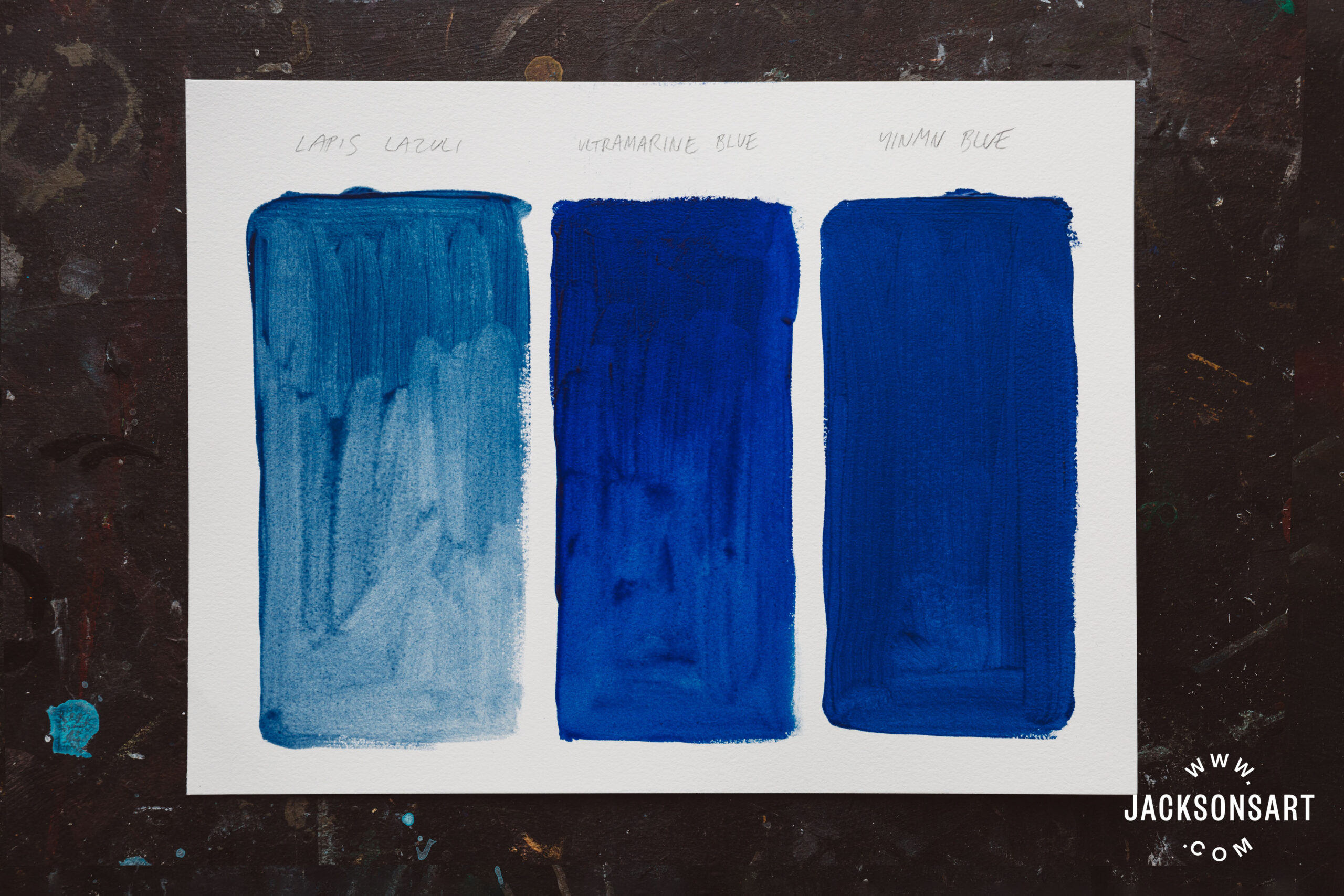
Artists have long had a fascination with the colour blue. 15th century artist Cennino Cennini wrote that Lapis Lazuli is “a glorious, lovely and absolutely perfect pigment beyond all the pigments. It would not be possible to say anything about or do anything to it which would not make it more so.” When artist Yves Klein developed International Klein Blue more than 500 years later, he was exploring the transcendent, extra-dimensional quality of the colour. He wrote: “Blue is the invisible becoming visible. Blue has no dimensions, it is beyond the dimensions of which other colours partake.” After reading this quote, it’s hard not to believe that the discovery of a new blue pigment is particularly exciting.
What Does YInMn Blue Offer in an Artist’s Palette?
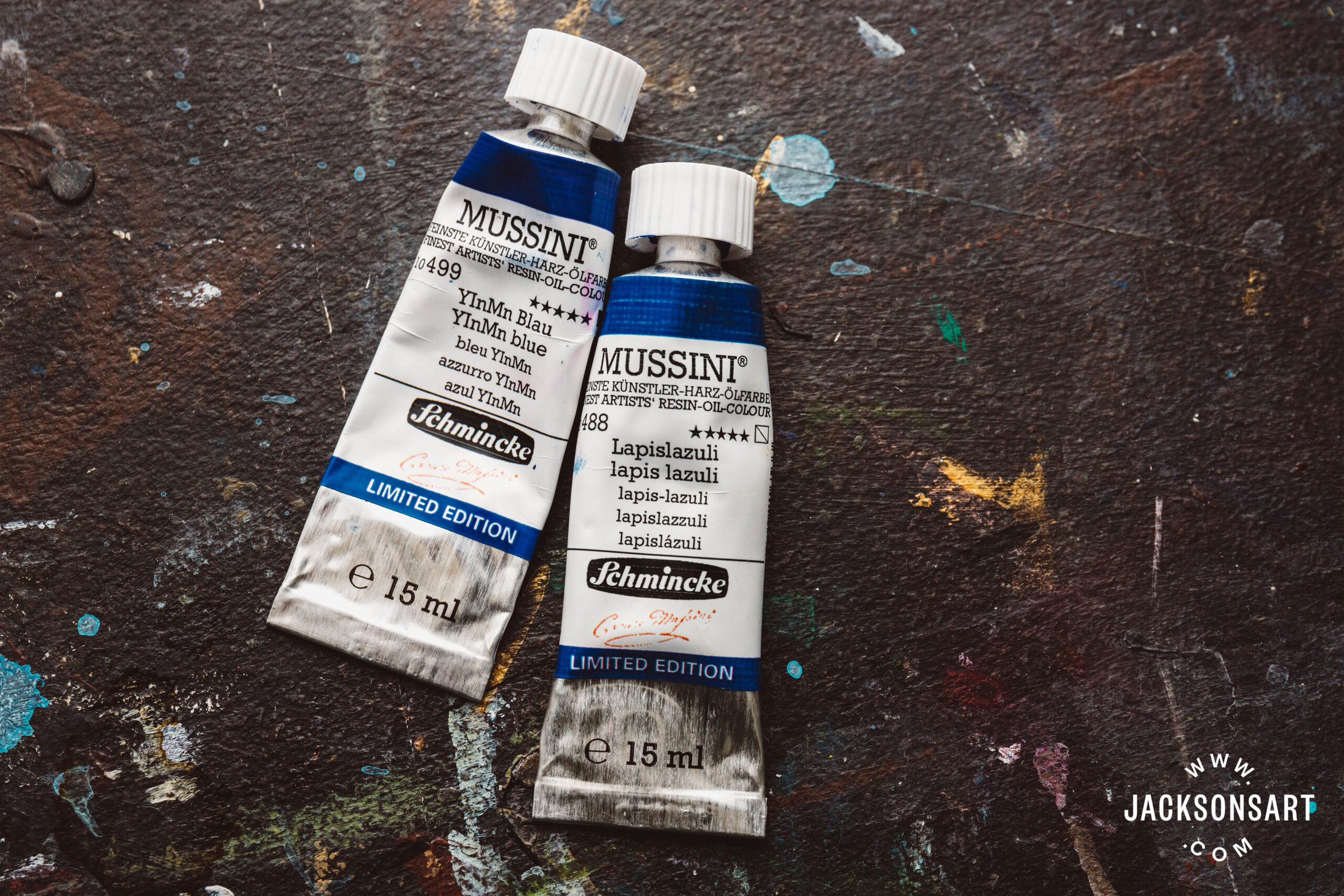
For testing I am using Schmincke Mussini YInMn Blue oil paint, a limited edition colour in their range that has now been discontinued. Pigments can vary depending on how it is produced and the binder that it is suspended in, so the pigment may be different in other ranges that carry it in the future.
Straight from the tube, YInMn Blue is opaque and deep, but it has a red hue which is particularly clear when compared with Ultramarine and Cobalt Blue, which are greener in comparison.

Its red undertones are revealed when mixed in tints with white, where it makes a soft lavender.
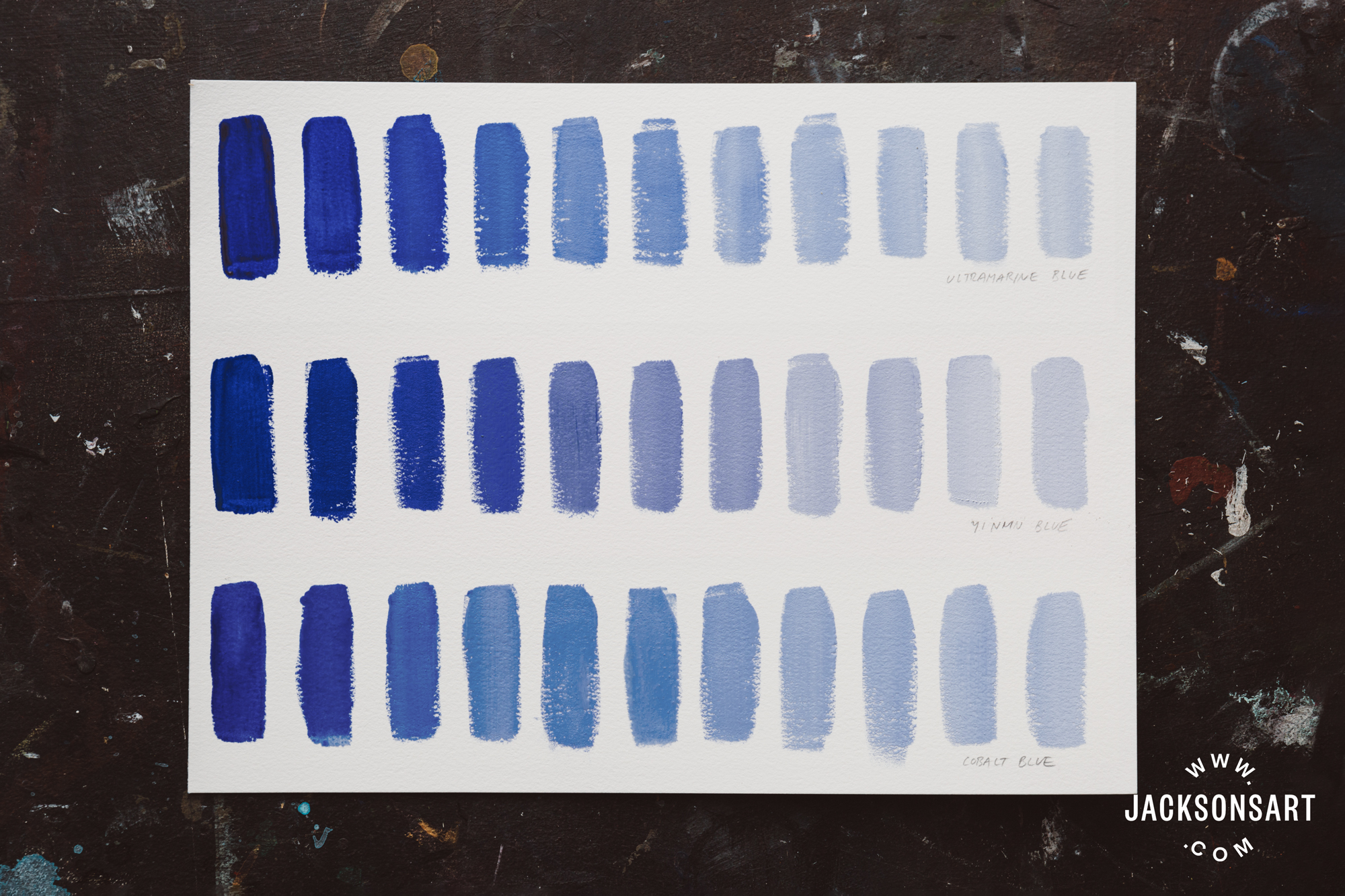
Many modern pigments, like Quinacridone and Phthalo pigments, have a very high tinting strength. I was expecting YInMn Blue to be similarly punchy, but while it is highly opaque, it has a modest tinting strength and is quite easily lost when mixed with stronger tinting colours. This subtlety means that it fares well in a palette inspired by the Old Masters, like this one inspired by the palette of Rembrandt:

Will YInMn Blue become a staple colour in artist palettes?
YInMn is more environmentally friendly to produce than other blue pigments, and is less toxic than the cobalt-based blue pigments (Cobalt and Cerulean Blue). However, the pigment is very expensive to make due to the elements that it contains, and this makes it less accessible. Whether YInMn Blue will become a widely used pigment remains to be seen, but it is always an exciting moment when a new pigment is discovered.
Further Reading
The Enduring Appeal of Alizarin Crimson
The Unique Qualities of Phthalo Pigments
Comparing Black Pigments, and Getting the Most out of Using Black in your Palette
Making Your Own Oil Paint with Jackson’s Pigments
Shop Oil Paint on jacksonsart.com


40 thoughts on “Pigment Stories: YInMn Blue, The Newest Blue Pigment”
These posts about pigments are very
interesting, well done, thank you.
Thank you, that’s very kind!
I love these articles about colours.
Mn is manganese and not magnesium (Mg)
though
Thanks Alex, I’ve amended the article now. Thanks for pointing it out!
This is a beautiful blue. A really
interesting read, although I am assuming
that the statement regarding the
elements it contains – Yttrium (Y),
Indium (In), and Magnesium (Mn) is
maybe a typo? As it is Manganese that is
Mn, not Magnesium, which is Mg?
Hi Tracey – yes you’re right it’s Manganese, not Magnesium! I’ve corrected this now.
Mn is manganese not magnesium
I’ve amended this in the article now, thank you Chris!
Interesting….many thanks
So glad you found it interesting, thank you for your comment
Awesome article! Exciting new blue hue. Who knew? Now i
do. Woohoo! Thank you
Very exciting indeed! Thanks Steve
Looks worth a try.
It was very interesting to test, would love to know how you find it if you do try it out.
Interesting. (Mn) stands for Manganese, though. Magnesium has (Mg) as abbreviation. Regards.
I’ve amended this now, thank you!
Just like all of Evie’s previous
articles,this is well thought out and
researched, written with a fresh clarity
that demonstrates her enthusiasm and
interest in materials. I really enjoy
them,and they also inspire me to try new
methods and ideas.Excellent!
That’s so kind of you to say, thank you John!
I just want to say thank you to
Jackson’s for providing these really
interesting articles on pigments both
old and new. As an artist and art
teacher I am always fascinated to learn
how pigments were made and used in
the past as well as newly developed
pigments, how they were discovered
and importantly today their
environment impact in development and
use.
Thank you Lorna, I’m so glad you enjoy our articles
Great article, very interesting. I’m an amateur and love learning, I learned a lot. Thank you.
Thank you Christine!
Thank you so very much for this article. It is
the best I have seen given I can’t afford to
make the purchase of the hue at this time.
Brilliant and thanks again!
Thank you Kim!
Very interesting article about the blues. Is
YinMn going to be available as a pastel any
time soon?
Hi Celestia, I’m not sure I’m afraid – we’ll have to wait and see!
Great read! Is this new blue available
widely amongst the paint brands or is it
only found from Schminke?
Hi Kat, it remains to be seen which paint brands will start to carry YinMn Blue. The only other range at the moment is Derivan acrylic – https://www.jacksonsart.com/derivan-matisse-structure-acrylic-paint-40ml-oregon-yinmn-blue
Thank you for an interesting article. I
look forward to reading more.
Glenys T
National Secretary
The Colour Society of Australia
Thank you Glenys.
I love all these interesting articles on
Techniques and materials put on by
jacksonart . Very stimulating – mostly for
the mind at the moment. Tho’ I’m sure
some will surface when I can get my
studio into action again. Thank you.
Thank you so much!
Hi, Do you know if the new
pigment will be available from
any brand in watercolour and/or
drawing ink? Thank you
Hi Rosie, I’m afraid I’m not sure which ranges it will be available in- the latest is Derivan acrylic.
When someone complains about the terrible things one finds on the
internet, I say you find what you look for. I was looking for info on
the new blue pigment and whether or not a monitor can adequately
show a green or red underlying hue. I prefer a bit of green in my
blues, and now I know what to expect with this one. Thank you.
That’s great, thank you Karen!
Yes. it is always a special moment when a new pigment is discovered/invented. Is this pigment available for all types of paint or just oils? I have read that acidic (?) pigments like PB27 Prussian Blue can not be used in acrylics. Will it bee too chunky and opaque for watercolours. Also (lots of questions here…), do you know how it differs from Mayan blue?
Hi Trond! I believe that YinMn Blue is stable in all media. I think an acrylic manufacturer is about to include it in their range, so it doesn’t have the same issue as Prussian Blue (an alkali reactive pigment which is unstable in acrylic binder). Mayan Blue is a very interesting ancient colour, I should have included it in this post! It’s a mixture of indigo dye and clay and natural resins, and it is far more durable and lightfast than other pigments of its kind (the reason for this is not entirely known as far as I can tell!).
I love pigments and your information is
fascinating! I used to buy pigments from
Kremer Pigments and now I’m learning
how to work with them. Thanks for all
your knowledge you’re sharing. I’m all
ears and very grateful.
Thank you Anita!
Comments are closed.