

Throughout art history, depictions of feasts have had the ability to make our mouths water, while our eyes marvel at the painting skills on display. Aside from triggering our own appetites, scenes of laden tables, plentiful markets, and well-stocked kitchens offer symbolism as varied as the cuisine depicted – from themes of wealth, death and gluttony, to celebration, harmony, and hospitality. The Art Through Symbols series explores the interpretation of symbols throughout art history – be they cultural, religious, folkloric, or personal. Each article analyses a series of artworks before detailing an art-making tutorial inspired by the symbol for you to try.
Art Through Symbols: The Feast

Unknown Spanish Master
Oil on canvas, 100 x 122 cm | 39.4 x 48 in
Rijksmuseum
“I attribute capital esthetic and moral values to food in general, and to spinach in particular. The opposite of shapeless spinach, is armor. I love eating suits of arms, in fact I love all shell fish… food that only a battle to peel makes it vulnerable to the conquest of our palate.”
– Salvador Dali in his 1973 cookbook, Les Diners de Gala
Our cultural identities are often represented by the foods we eat – but what do paintings of tables full of produce symbolise beyond regional taste? A table piled impossibly high may be a satirical warning against gluttony – or a display of exorbitant wealth. The placement and choice of food objects may remind us of the brevity of life, or exist purely for visual interest. Bringing people together around a table marks a celebration, yet the actions that occur around it can be both vice and virtue. The kitchen as a setting for artworks depends on order for its symbolism, encompassing both harmony and complete chaos. The feast in general is full of duality – an interplay of indulgence and caution – making it a rich theme for artists to dine on.
For this article, I’ll focus on paintings of feasts in a broader sense, where there is a piled tabletop, banquet, kitchen, or market stall. The detailed symbolism of individual foods is extensive and something to be explored separately.

Tabletop Still Life – Wealth and Death
Bountiful feasts atop tables that practically invite the viewer to sit down and help themselves proliferate in European painting. The edge of the surface tends to align with the bottom edge of the support, and often a dish or other object is precariously balanced on the edge. This may initially seem like an accident by a busy table guest, but this placement actually has hidden symbolism. When objects are placed very close to the edge, there’s a sense that they could tip off at any moment – a visual reminder of the brevity of life. Once you’re aware of this fact, tables stacked high with cooked seafood, plucked fruits, vegetables, and dead game suddenly all reek of death. This interplay between the celebration of life that eating together brings, paired with a ready awareness of life’s fleeting nature, makes the genre existential in concern.

Pieter Claesz
Oil on panel, 77.5 x 128.9 cm | 30.5 x 50.7 in
National Gallery of Art
In Still Life with Peacock Pie, Pieter Claesz painted some of the most indulgent foods available to the rich in Holland at the time, at life-size scale. It seems to mark a very special occasion with the combination of the extravagant pie, candied nuts, and plump, ripe fruits. At the time, salt was a very precious material, here elevated in a golden dish. The crumpled napkin and discarded cutlery imply the presence of a person in the scene, welcoming us to join in. The material wealth of the recipient of this food is evident not only through the presentation but also by the international trade required to gather it.

Clara Peeters
Oil on panel, 25 x 34.8 cm | 9.8 x 13.7 in
Rijksmuseum
Clara Peeters had a key role in the establishment of the still life genre in the 17th Century, being among the first Dutch painters to paint refined compositions of food, flowers, and fish. The term ‘still life’ or stilleven was only coined in the mid-17th Century, which this example, Still Life with Fish, Seafood and Flowers, predates. She painted shells from Indonesia and the Pacific Ocean, paired with fish, shrimp, and oysters from Europe, underlining the significance of colonial trade in this era. Her specific artistic training and early life have been difficult for art historians to pinpoint, although it’s clear she was commercially successful and cleverly devised her still lifes to appeal to a public where food and trade were important. Her paintings are masterfully rendered, with some even including small ‘self-portraits’ in the form of reflections in objects.
Feasting – Celebration and Lust
As opposed to the vacant still life of a banqueting table, the active feast also recurs in art history, marking celebrations. The Feast of Acheloüs is a collaborative painting by two giants of the Baroque period – Peter Paul Rubens and Jan Brueghel the Elder. It depicts a scene from Ovid’s Metamorphoses where Theseus is treated to a feast by the river god Acheloüs, who personifies Greece’s longest river. Rubens painted the figures, jovial and generous, some stepping into the scene from the left, with arms laden with seafood and flowers. Brueghel painted the rest of the composition, rendering the intricate grotto they dine in. In this work, the food is a gesture of goodwill, and a support for dialogue.

Peter Paul Rubens and Jan Brueghel the Elder
Oil on wood, 108 x 163.8 cm | 42.5 x 64.5 in
The Metropolitan Museum of Art
The bacchanalian feast is a genre of painting inspired by the god Bacchus, and his pursuit of excess through food, drink, partying, and lust. In the Roman Era, ‘bacchanals’ were real events of revelry in honour of Bacchus, some ensuring a good harvest for the next season. These were outlawed by the Roman senate in 186 BCE for their excess and disorder. This didn’t stop Renaissance artists, millennia later, from being inspired by their story. The bacchanals provided the perfect framework for complex figure compositions, and gave artists a way to depict nudity and folly through Gods that people no longer believed in.
To follow the previous collaborative painting example, The Feast of the Gods by Giovanni Bellini and Titian is based on a scene from Ovid’s Fasti. The Gods are humanised to dine and drink amongst nymphs and satyrs, with erotic undertones. Here, the feast is a device for lust and revelry.

Giovanni Bellini and Titian
Oil on canvas, 170.2 x 188 cm | 67 x 74 in
National Gallery of Art
The Market – Morality and Mischief
Paintings of market stalls were particularly popular in the Netherlands in the 16th Century, combining the skill of still life painting with social commentary. The paintings both depict commerce and became commodities themselves due to their own popularity with the richest in society.
Frans Snyders is often considered the pioneer of the market still life, depicting overflowing tables of produce and animals with a seller. In Still Life with Dead Game, Fruits, and Vegetables in a Market, Snyders depicts a table covered in game, but when you look closer, you notice some living creatures too. A dove takes flight at the top right, its mate perched next to it, and two roosters fight on the ground – carefully watched by a pair of cat’s eyes under the shadow of the table. Hidden below the basket in the distracted market seller’s arm, a little boy picks his pocket.
Once we notice these details, the idea of morality is introduced to the painting. Where some carcasses represent negative traits – the peacock symbolising vanity, and the boar gluttony – there are also animals that embody positive attributes, like the purity of the deer, and the swan’s association with love. Combined with the mischievous pickpocket, hunting cat, and welcoming vendor, the painting proposes the push and pull between virtues in our lives through the vehicle of selling food.

Frans Snyders
Oil on canvas, 212 x 308 cm | 83.5 x 121.3 in
Art Institute of Chicago
Cooking – Harmony and Chaos
Artworks of food in preparation draw attention to labour done behind the scenes, finding beauty in the mundane. Kitchen Scene by Kitagawa Utamaro is a diptych of four women working away in the kitchen. From left to right, they are washing dishes, holding a baby, peeling vegetables, blowing on the cooking flames, and tending to the stove. We don’t see much of the food they prepare, but we do get a sense that their individual roles are harmonious and organised. Utamaro is one of the most famed ukiyo-e artists, who produced over 2000 prints in his lifetime. Unusually for ukiyo-e artists, he found fame during his lifetime in the 1790s with his prints of beautiful noblewomen with exaggerated features. This print shows that his subject matter didn’t solely draw from women of the upper classes, but from people of all walks of life.

Kitagawa Utamaro
Colour woodblock print, 50.2 x 75 cm | 19.8 x 29.5 in
Art Institute of Chicago
In contrast to the organised peace of Utamaro’s kitchen, The Fat Kitchen is a chaotic engraving by Pieter van der Heyden inspired by a drawing by Pieter Brueghel the Elder. Here, food is used as a vehicle to satirise social class and political issues, leading to unfair distribution of resources. In The Fat Kitchen, we see people gorging themselves on food, indulging in the sin of gluttony. They chase a thin man out of the door, unable to share because of being overpowered by greed. It exists in a pair with The Thin Kitchen, where an inverse scene takes place. The kitchen in this engraving is piled high with plates and pots, with a copious amount of meat hanging from the ceiling – underlining that excess to this extent is immoral.
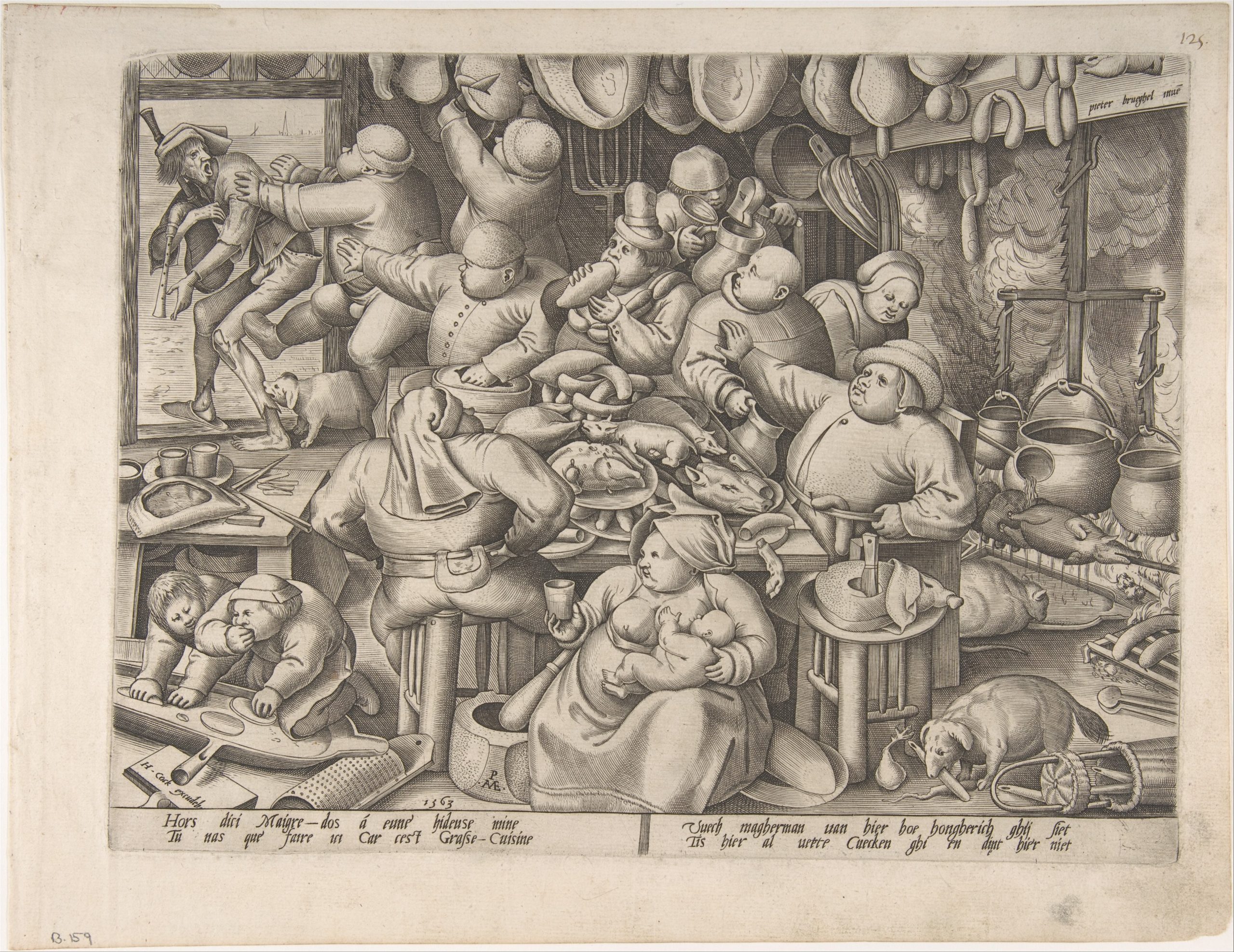
Pieter van der Heyden after Pieter Brueghel the Elder
Engraving, 22.2 x 29.5 cm | 8.8 x 11.6 in
The Metropolitan Museum of Art
The Feast – Art Prompt
I was inspired by Clara Peeters’ and Pieter Claesz’s masterful still life oil paintings, with their rich brown backgrounds, and low lighting. For this art prompt, we’ll paint a still life of food from life in one sitting inspired by their palettes.

For this art prompt, you’ll need:
Michael Harding Oil Paints in Warm White, Turners Yellow, New Gamboge, Cadmium Green, Phthalo Blue Red Shade, Rose Dore, Transparent Oxide Red, and Raw Sienna.
Jackson’s Professional Acrylic Paint in Burnt Sienna
Jackson’s 25 x 30 cm Cotton Canvas
Jackson’s English Distilled Turpentine and Jackson’s Refined Linseed Oil
A jar

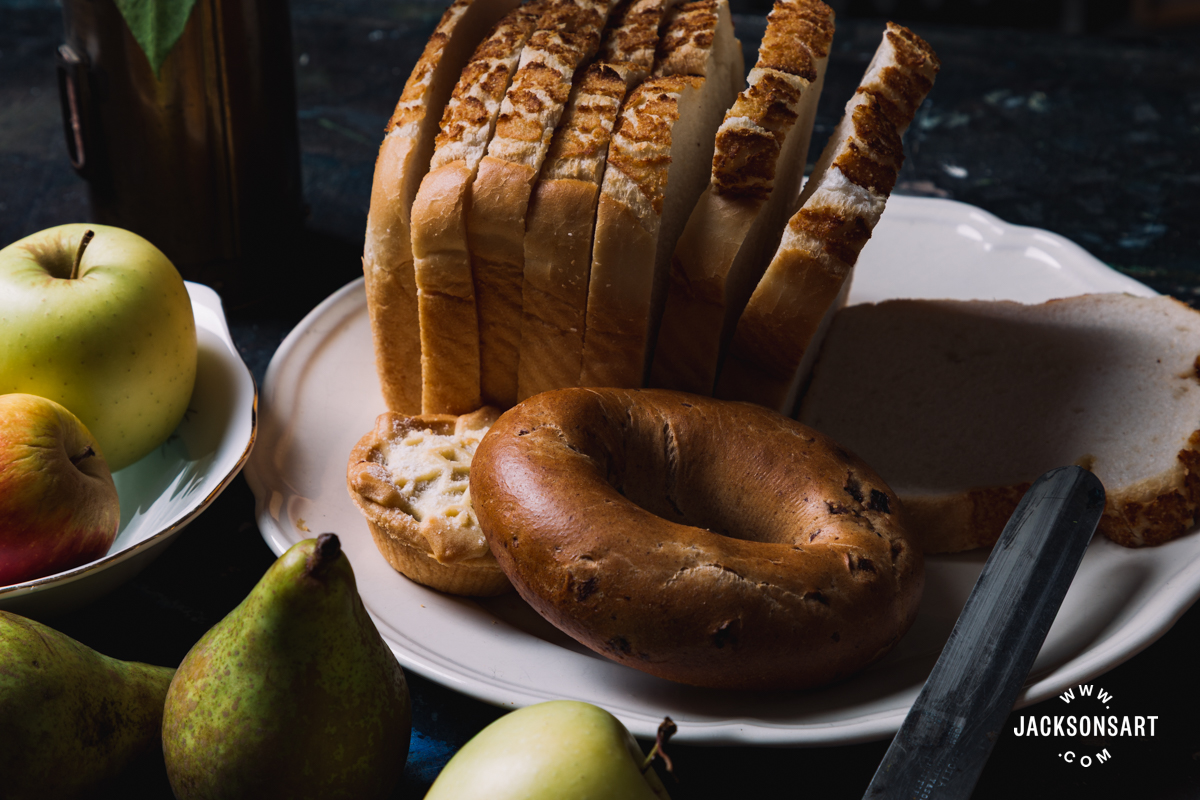
To begin my still life, I assembled an assortment of food objects in front of me, with a plate, bowl, oyster shell, knife and vase of flowers for visual variety. My goal was to arrange them in a believable table scene that someone could lift a snack from.

Next I positioned the lighting on my objects to create a full range of tone – catching highlights, and casting dark shadows. I’m right handed, so I positioned my table easel to the right of the still life scene, so I could look at it on my left without my view being obstructed by my own arm.

I prepared my canvas by applying a Burnt Sienna ground, to build the image from a darker base tone, and to immediately incorporate the brown of my inspiration palette. To start painting I lightly sketched the composition in oil, using a combination of Transparent Oxide Red and Phthalo Blue Red Shade.

Next I blocked in the areas of shadow, using the same colours but with more blue in the mixture. Then I blocked in a layer to establish the colour and tone of each object, working my way around the composition, without worrying about fine detail. At this stage it was still very easy to adjust the spacing of objects, since I kept my paintwork loose.
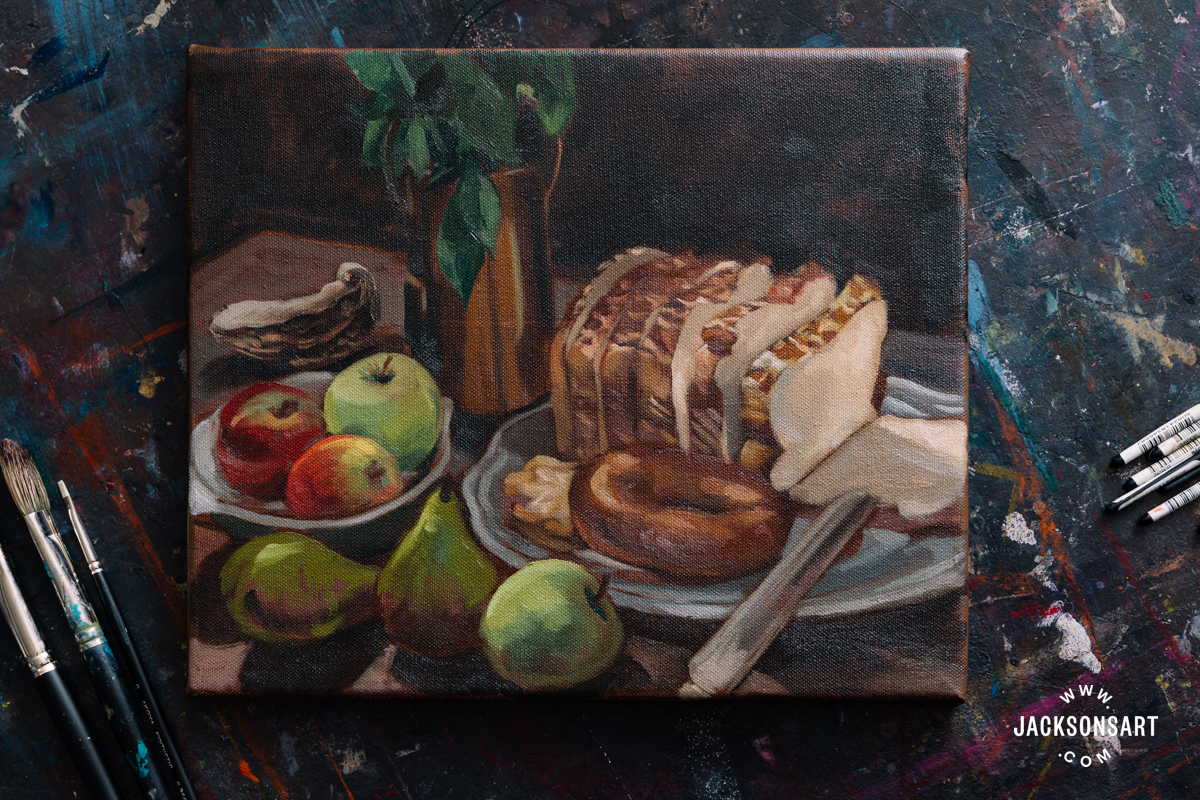
Once I was satisfied with the composition and placement of colour I worked back around the painting, rendering one object at a time with sharper observation of tone, colour and texture.

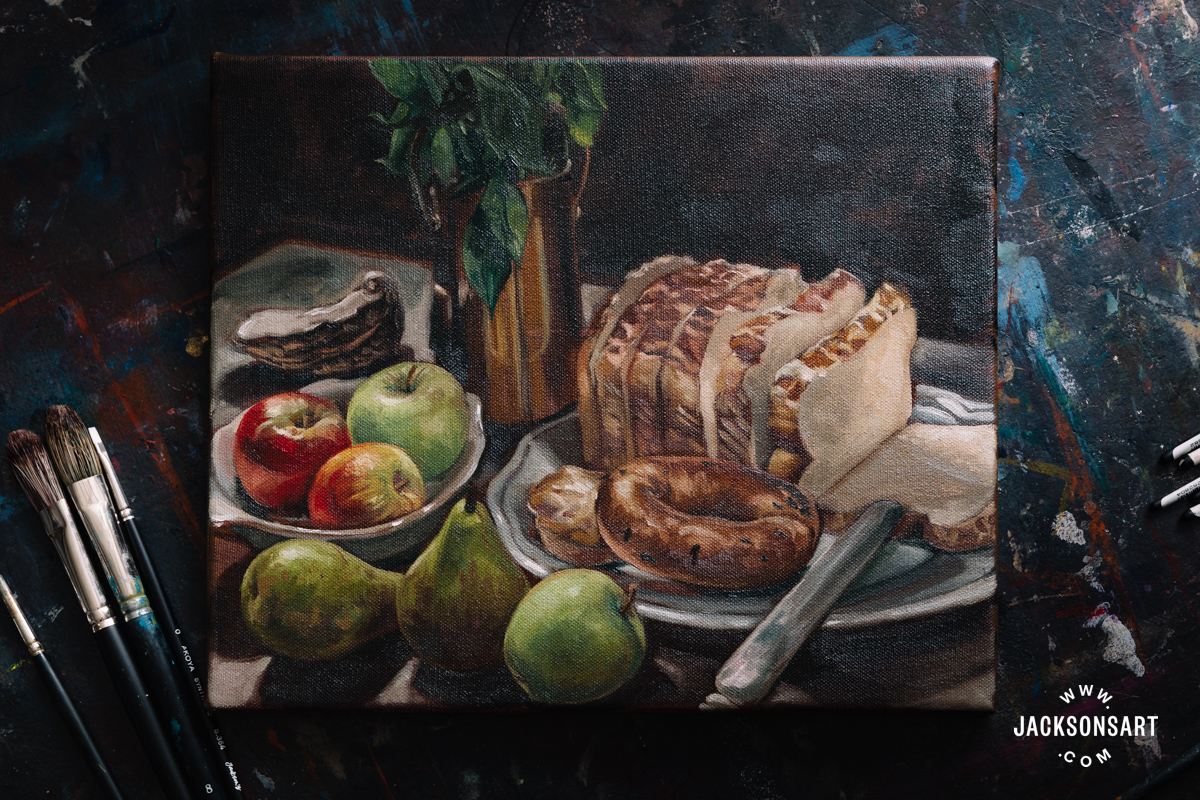
To complete the work I picked out the finest details like the raisins in the bagel, texture of the oyster, and stems of the apples. Finally I applied the pure white highlights to the fruits and plates.
Further Reading
Art Through Symbols: The Skull
Chiaroscuro Techniques for Painting, Drawing and Printmaking
Shop Art Materials on jacksonsart.com


2 thoughts on “Art Through Symbols: The Feast”
Thank you Louise. That was an interesting look at the painting of food and the meaning behind the different types of subject. Useful to remind us of the Japanese angle. Useful analysis of progress of your painting.
Thanks so much Angela!
Comments are closed.