

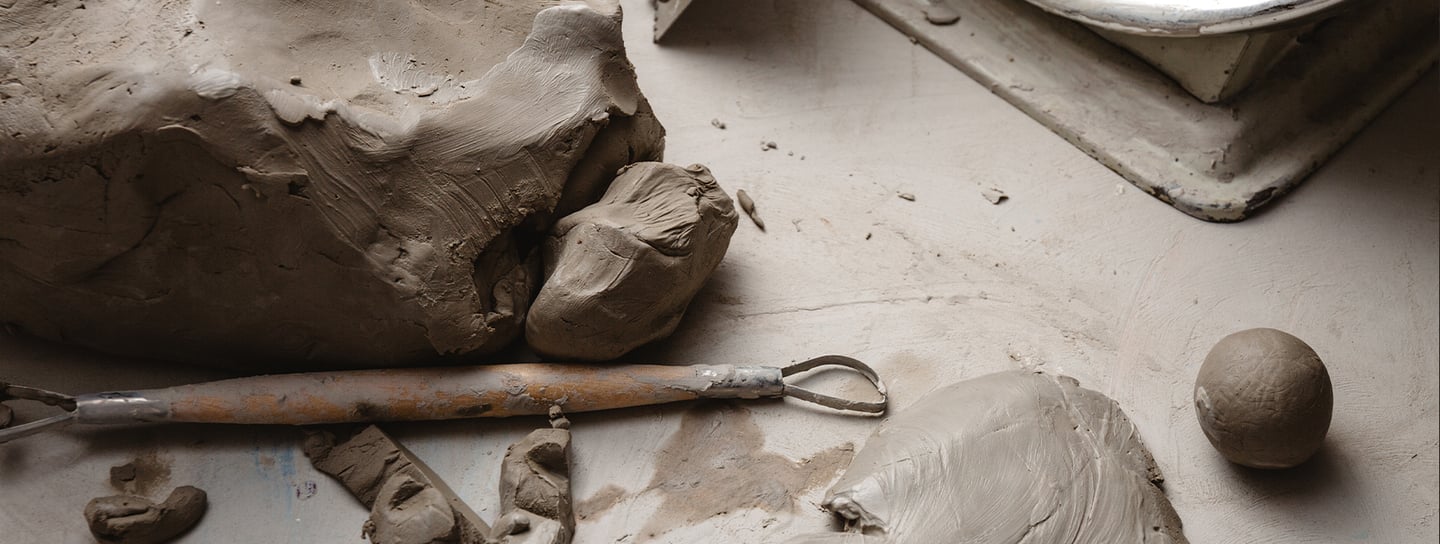
A Guide to Modelling
Introduction to Modelling

Modelling is the term used to describe the creation of a three-dimensional piece of art. Traditional and modern materials include clay, polymer clay, epoxy resins, and plaster.
Modelling materials can be sculpted with a wide range of tools. Colour can be added to a model using paint, such as acrylic. Studio accessories such as a sculpture stand will allow you to rotate a delicate model easily whilst working on it.
What is Clay Modelling?


Clay modelling is the most common form of sculpting. It involves some form of clay, such as air-drying or self-hardening (non-firing) clay, natural ceramic/pottery clay that requires firing in a kiln, oil-based clay, or polymer-based modelling clay (which can be baked in an oven).
Clay is versatile and very easy to work with. It is ideal for both beginners and professionals.


What Do I Need to Get Started with Modelling?

- Air-drying or self-hardening (non-firing) clay (if you don’t have access to a kiln). Or natural ceramic/pottery clay that requires firing in a kiln.
- A selection of modelling tools
- Rags and a container of water
- Sculpture stand (useful, but not crucial)


Air-Drying Clay
Air-drying clay, or air dry clay, can be shaped by hand or by using press moulds, stamps, or cutters. It dries and hardens within hours or days, depending on the size of the piece. Adding water as you work with the clay will make it more pliable to use.
Air dry clay is usually available in a natural red or grey. It is made with a synthetic binder so that it hardens without the need for firing. Air dry clay is also useful for making moulds to cast plaster and other materials.
To prevent drying, air dry clay needs to be stored in an airtight container. Clay that has partially dried can be made workable again by wrapping it in a damp cloth overnight.
Oil-Based Clay
Oil-based modelling clay is sometimes called plasticine. It is designed to be worked and reworked without drying out. As the name suggests, it is made of natural clay and non-drying oils. It is ideal for young artists.
Oil-based clay is also useful in the studio for sealing the edges of a clay mould when pouring plaster.
Ceramic/Pottery ‘Firing’ Clay
Pottery or ‘firing’ clay is water-based. It needs to be shaped and then fired at temperatures in excess of 121°C to stay firm. This clay is used for creating sculptures and household ceramics.
Polymer-Based Modelling Clay
What Tools Can I Use for Clay Modelling?

Modelling tools allow you to manipulate the clay into your desired shape. They come in a variety of shapes and sizes. Modelling tools are used to scrape, cut, or shape the clay to create a specific effect.
Armatures
Armatures help by providing an internal support structure. Often constructed from aluminium, they help to support the weight of the clay model as you build it. The armature can be used to keep the clay from collapsing while also protecting the integrity of any extensions, such as legs, arms, or branches.
Modelling Stands
Modelling stands can be moved around your workspace to provide a work surface that can be raised and lowered.
Plaster Casts
Plaster cast heads and anatomical models have long been used by artists. As reference tools, they help to study light, shadow, and form. Whether used for drawing practice or as part of a sculpture study, plaster casts provide a timeless resource for those who want to learn proportion and structure. They are ideal for both the studio and academic settings.
Sculpture Tools
Sculpture tools will act as extensions of your fingers. They are made for accuracy and precision. The tools selected by the sculptor are a personal one, so it is worth asking yourself what you want to do with the tools. The principal uses of sculpture tools are cutting, scraping, detailing, shaping, and smoothing.
The most common tools for cutting and scraping are wire-end tools. Tools made from solid wood or plastic are more often used for shaping and creating detail. Many tools are also interchangeable, so a tool used for air dry clay could also be used for working with plaster or in mould-making.


What Other Materials Can I Use for Modelling?

Modroc Plaster Roll
Modroc is a plaster bandage i.e. a gauze impregnated with Plaster of Paris. Once dipped in water, it can be applied to a surface to make a cast or shape. The plaster will start to set after about 3 minutes.
Modroc will be hard enough to handle after 30 minutes and will develop to full strength overnight. It can be used on its own in a suitable mould, or sculpted around wire or card models. Smaller strips can be cut off with scissors. Modroc can be decorated and painted with acrylic paints when fully dry.
Claycrete
Claycreate is a 100% pure paper pulp/papier maché. It is ready-prepared in a white, lightweight formula that mixes easily and instantly. Claycreate is easy to prepare by adding water; mixing enough to use in a half hour of modelling. It will adhere to Claycrete and various armatures including wood, metal, wire, and other paper and cardboard structures.
Claycrete can be worked with hands, modelling tools, knives, and spatulas. Keep a bowl of water nearby to keep tools and hands moist while working.
Crea-Stone
Crea-Stone is a versatile sculpture medium which is easy to use. The material carves like soap and hardens like stone. It is ideal for casting and carving. Just add water, mix, and cast in cartons to form blocks for carving. When first cast, Crea-Stone blocks are easy to carve, but after three to four months, the material becomes as hard as stone, yet about four times lighter.
Crea-Stone comes in a white or natural colour. It can be smoothed with sandpaper or steel wool. This modelling material can be painted with a brush or spray. Crea-Stone is also suitable for use with direct wire modelling or sand, clay, and wax casting.
How to mix: It can be mixed in a plastic or metal container. Slowly add one and a half pints of water for each five pounds of Crea-Stone. Mix and allow to stand until the desired degree of firmness is achieved.
Plaster of Paris
Plaster of Paris can be used to mould, layer, and sculpt shapes. It is the ideal material for model-making and plaster casting for crafts and in schools.
Plaster of Paris generates heat as it sets. Care must be taken when removing models from a mould. Do not place any part of the body into the setting plaster.
Resin
Pebeo Gedeo Resins are easy to use. They can be applied onto canvas, metal, wood, photos, postcards, and more.
How to mix: Mix two parts resin with one part hardener. Then, either pour the resin over an item to coat it (Glazing Resin) or pour it into a mould to make a jewel-like casting (Casting Resin).
Glazing Resin
Transparent and solid, glazing resin will create self-rounded edges without spilling over when applied to a flat, level surface. This will give you a wet-look, magnifying-glass effect when poured over canvas. It can be used instead of a traditional varnish or on top of a varnish for extra depth and gloss.
Glazing resin is usually applied over acrylic paint on almost any surface, such as canvas, paper, metal, glass, and more. It can also be applied over 3D paints like Vitrail and Prisme colours to fill in between the raised areas of paint and level the surface.
A key tip is to create a small 'roof' over the canvas to prevent dust from settling during the 12-hour curing period, as the glossy surface will highlight even the tiniest speck.
Mixed Media Resin
You can also use the resin as a painting resist by applying it to your surface and then painting or staining over the top with fluid colour. The colour will not penetrate where the glass-like resin has been applied.
For building up transparent layers in a thick surface, Pebeo have created Liquid Art Panels. These wooden painting panels have leak-proof raised sides to hold in your poured paints or resins. These are also great for embedding objects in resin. They would also likely work well for encaustic painting.
Pebeo Casting Resins
Pebeo casting resins can be poured into many types of moulds. Artists can choose from the jewel, crystal clear, or pearly colours.
Testing the resins using Pebeo Siligum as a mould:
Mould making with Pebeo Siligum is very easy. The mould is flexible and can be reused many times. You can use Vaseline with a cotton bud as a release agent. Pebeo also makes a Liquid Vaseline for easier application into the grooves of your mould.
Mix the two parts of the resin, and pour between two cups to be extra sure of the mixing. Then, pour into the moulds. Create a roof above to prevent dust from settling while it cures.


Mediums and Varnishes for Modelling
Demoulding Talc
Simplifies the unmolding of plaster and metal castings, clay embossing, and protects moulds. An essential with the use of latex.
Demoulding Vaseline
Simplifies the demoulding of Crystal Resin and protects the moulds.
Waterproofing Agent
An acrylic resin-based product used to waterproof containers made from non-firing clay. Its yellow colour makes it easy to see areas which have not been coated. The colour disappears within a few days in full light. Transparent once dry. Drying time: 10hr.
Gloss and Varnish
Gedeo’s Gloss plus Solvent Phase Varnish allows you to add a glossy finish to all Gedeo Resin creations. It offers the ability to play with opacity/transparency contrasts. Application with a flat brush ensures the best result.
FIMO Varnish
FIMO Varnish is a water-based gloss varnish with improved gloss brilliance. It has a high scratch resistance after drying. The varnish is odourless, touch dry after 20 minutes, and completely dry after 24 hours. It is transparent when dry.


Moulds

Moulds are strong, flexible, and easy to use. They are often made from silicone, which gives clean, detailed results. Moulds offer an easy introduction to casting and moulding.
Embossing and Engraving
Thin sheets of copper anodised aluminium (one side copper/one side silver) or pure copper (a medium-heavy foil, 6-7 times thicker than household foil) are a traditional thin sheet metal for tooling and embossing. This pure, soft metal takes high detail from tools, easily cuts with a scissors, and can be drawn on, embossed, or stamped to create raised designs.
This malleability allows you to easily get bas-relief depictions using the repoussage techniques of embossing and engraving. The copper/aluminium sheets come in sizes 10 x 15cm, 15 x 30cm, and 30 x 30cm. The pure copper sheets come in sizes 10 x 15cm, 20 x 30cm, and 30 x 40cm.
Glossary
A
Air-Drying Clay
Most often called ‘Air Dry Clay’. A modelling material that hardens when exposed to air. It does not require a kiln or oven. Used by beginners and professionals alike.
Armature
A support framework. Made of wire or aluminium. Used to hold up the modelling material during sculpting.
C
Casting Resin
A clear or coloured resin. Can be poured into moulds to create hard, glass-like castings.
Ceramic Clay / Pottery Clay
A traditional clay. Must be fired in a kiln at high temperatures to become permanent.
Claycrete
A papier-mâché-like pulp. Mixed with water and used for sculpting or applying to armatures.
Crea-Stone
A casting and carving material. Hardens like stone but remains lightweight. Carvable shortly after casting.
D
Demoulding Talc
A powder that aids in the removal of plaster and metal castings from moulds. Protects the mould surface.
Demoulding Vaseline
Used to simplify the removal of resin casts from moulds and to protect the moulds.
E
Embossing
A technique in which a raised design is created by pressing into a surface, such as metal foil.
Epoxy Resin
A two-part system (resin and hardener). Used for clear coatings or casting. Offers a glossy and durable finish.
F
FIMO
One of the best known and most popular modelling clays. For beginners and professionals. Made by Staedtler.
G
Glazing Resin
A self-levelling clear resin. Apply over surfaces for a glossy, glass-like finish.
Gloss Varnish
A finish applied to models to add shine and protect the surface.
L
Latex Moulds
Flexible rubber moulds. Used to reproduce detailed shapes and figures in casting.
M
Metal Foil
Thin sheets of copper or aluminium. Used in embossing and engraving.
Modelling Clay
A general term for all clays used in sculpting. This can include air-drying, polymer, oil-based, and ceramic types.
Modelling Tools
Tools used to shape, cut, smooth, and detail. Often made of wood, metal, or plastic.
Modroc
Plaster of Paris-impregnated gauze. Used for creating casts, masks, or adding strength to structures.
Mould
A hollow container used to shape a casting material. Available in silicone or latex. For resin, plaster, or clay casting.
O
Oil-Based Clay
A non-hardening clay. Made from oils and waxes. Ideal for reuse and sealing moulds in studio settings.
P
Papier-Mâché
A modelling material made from paper pulp and glue, or clay-based products like Claycrete.
Plaster of Paris
A fast-setting material. Used for casting, moulding, and sculpting. Generates heat as it sets.
Plaster Cast
A 3D reproduction of a human figure or anatomical feature. Often made from Plaster of Paris. Historically used in classical art academies, plaster casts serve as study tools for artists learning to draw or sculpt the human form. A plaster cast provides a consistent subject for studying light, shadow, and proportion. Used in cast drawing practice.
Polymer Clay
A plastic-based clay. Cures in a domestic oven. Remains pliable until baked.
R
Repoussage
A metalworking technique that involves embossing or engraving thin sheet metal.
Resin
A material used in casting and coating. Can be clear or coloured. Includes epoxy and polyester types.
S
Sculpture Stand
A rotating support platform. Allows access to all sides of a model during sculpting.
Sculpture Tools
Hand tools used to cut, shape, texture, or smooth modelling materials. Includes wire-end tools and spatulas.
Self-Hardening Clay
Another term for air dry clay. Dries without kiln firing.
T
Tooling Foil
Soft metal foil. Used in embossing and engraving. Takes detailed impressions. Easy to cut.
V
Varnish
A protective and often glossy finish. Applied to the surface of a sculpture after it has dried or cured.
W
Waterproofing Agent
An acrylic resin-based medium. Used to make non-firing clay sculptures waterproof.
Wire-End Tools
Sculpting tools with loops of wire on the ends. Used for removing, shaping, and refining clay.