Cyanotype is the ’original’ sun-printing process, one of the earliest photographic techniques. Discovered in 1842 and distinctive for producing rich, Prussian Blue monochromatic prints, it was popular well into the 20th century as an inexpensive method for reproducing photographs, documents, maps and plans (hence the enduring architectural term blueprint) and famously, for making impressions of biological specimens in the field (photograms).
Harness the power of the sun to make detailed prints from virtually any object that casts a shadow: tools, toys, plants, leaves, stones, sand, string, lace, etc. Simply place the object on the sensitized surface and expose it to sunlight. Use a digitally-printed photographic negative (an inverted black and white photo inkjet-printed onto a transparency) instead of an object to create full-resolution photographs on paper or fabric. Great for photographers, mixed media artists, printmakers, quilters, kids and more. The cyanotype process is easy, forgiving, quick, magical and fun. It can be used on any natural fiber/porous surface, including cotton, linen, silk, canvas, wood, paper, and leather.
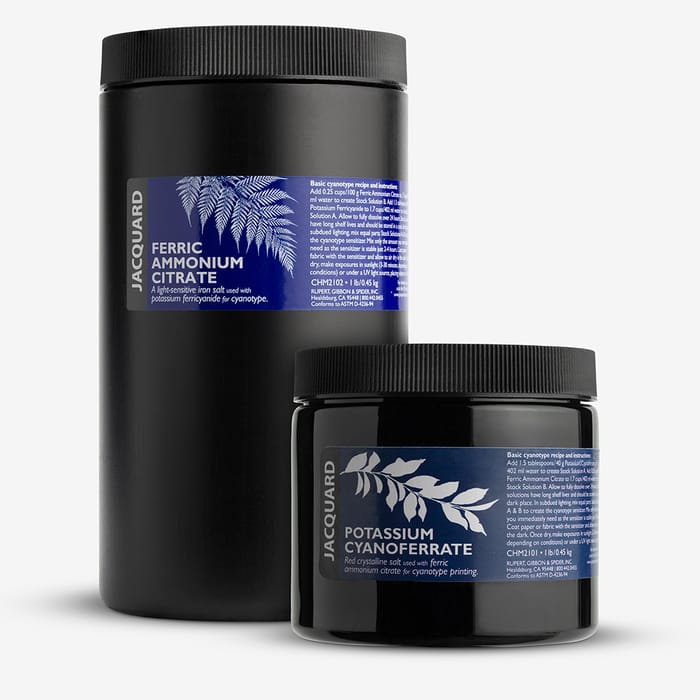
Jacquard Cyanotype Potassium Ferricyanide (Part A) and Jacquard Cyanotype Ferric Ammonium Citrate (Part B) are the two components used in the cyanotype process to create traditional blue sun prints. When mixed together and exposed to UV light, they produce the characteristic deep Prussian blue image on paper or fabric.