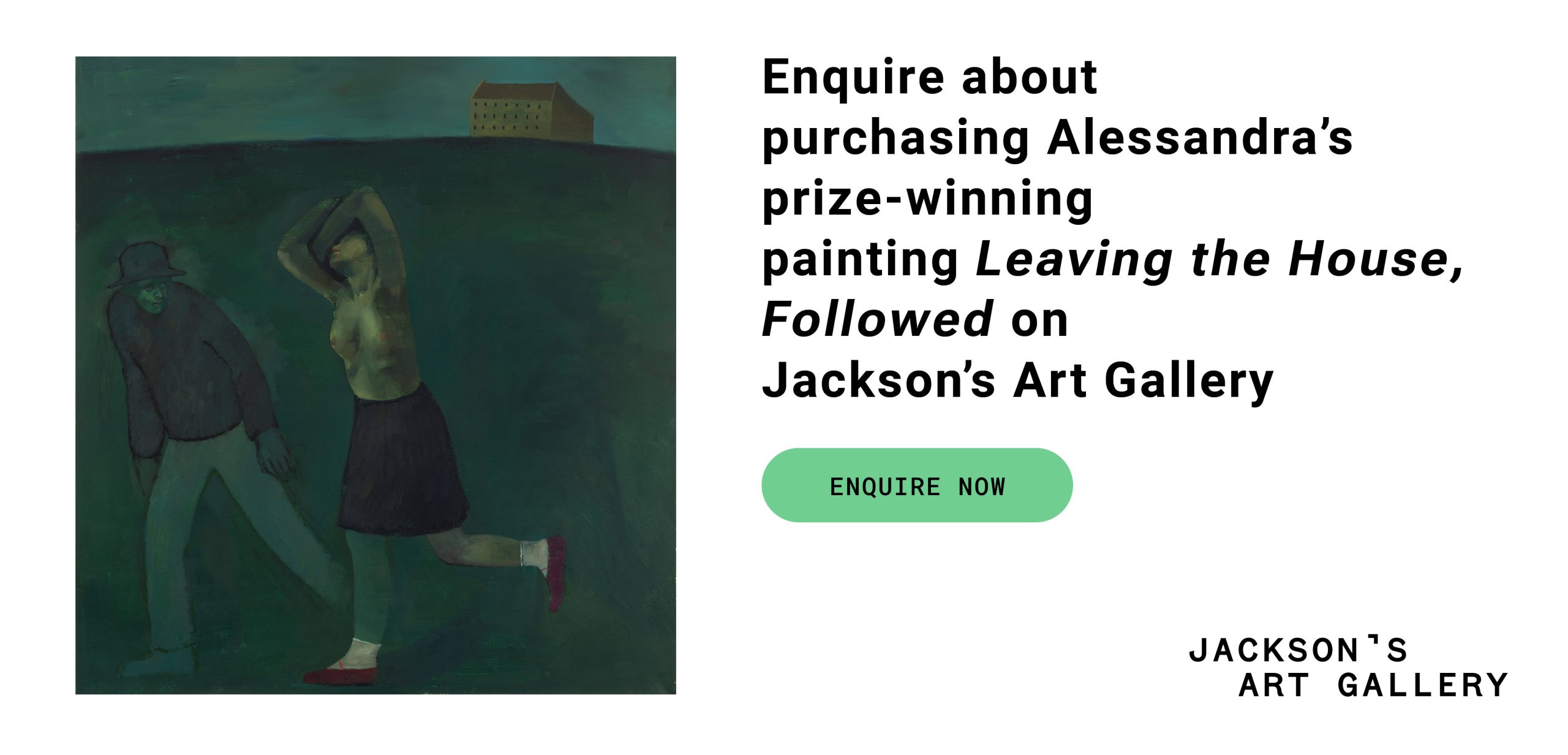
Alessandra Acierno won Second Prize in the Jackson’s Art Prize this year with her oil on canvas work Leaving The House, Followed. In this interview she discusses her low-dark colour palette, the ebbs and peaks of her studio practice, and the materials she can’t do without.
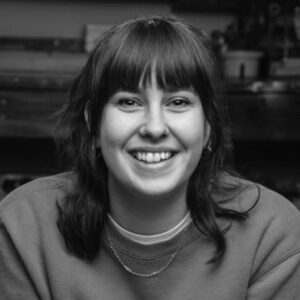
Above image: Alessandra working in her studio.

Alessandra Acierno
Oil on canvas, 127 x 117.5 cm | 50 x 46.2 in
Alessandra Acierno: Paintings That Hide in Plain Sight
Josephine: Could you tell us about your artistic background?
Alessandra: Art has always been a part of my life. My father is a psychologist and my mother is an architect – a combination that created an intellectually stimulating environment for a child. I was always making; my hands were always busy. I was constantly creating little narratives that I depicted in my sketchbooks. Part of my attachment to art was because I was – until age 13 – an only child, so I dwelled mostly in my imagination, in imagined stories and places. My interest in figurative painting is rooted in its narrative potential, which hooked me early and deeply. Had I been better at it, I may have gone into fiction writing, but art was where I found my language.
At 11, I was accepted into a magnet school for the arts in Charleston, SC, and there I began my ‘formal’ art education. I received my BFA from the Maryland Institute College of Art (Baltimore, USA) in 2016 and my MFA from the Bezalel Academy of Art and Design (Tel Aviv/Jerusalem, Israel) in 2021. Now, I am living and working in Tel Aviv.

Josephine: What does a typical working day in the studio look like for you? Do you have any important routines or rituals?
Alessandra: This would depend on what stage of painting I am in. If I am in the planning stages, a typical day involves a lot of sketching, sitting, and staring. The first move is always the most difficult, in my experience. I’ll often flip through art books or scroll through my saved folder on Instagram, which has become a gargantuan archive of inspiration over the years.
If I am already mid-piece, a studio day involves diving right in. Recently, I have set up a home studio, which I haven’t had in years. The benefit of this is that now if I have an idea at 9pm, I can rush in and execute it without delay. The downside is that I can easily wander to the living room to ruminate when I reach an impasse with the piece.
I don’t have any important routines or rituals, other than prepping the surface, which I see as a kind of ‘revving up’ to work. When my studio was outside the house, my routine was to prepare a coffee, a tea, and a water to-go, this way I had no excuse to leave early.

Josephine: Which materials or tools could you not live without?
Alessandra: I could not live without my R&F oil bars. They are essential to both the early stages of a painting when I am laying out the composition, and the later stages when a painting has gotten too tight and I need to introduce an element of looseness and flow back into the work. I used to use Winsor & Newton oil bars, but they discontinued them a few years back.

Josephine: What are the stages of your work on a painting? Do you make drafts?
Alessandra: My process always begins with sketches: I never start a painting without having some idea of how it will develop. Naturally, it will evolve away from the sketches in the process, but they always act as a kind of scaffolding for the finished work. After working out an idea and composition in my sketchbook, I prepare the surface. First I tone my canvases, as this gives me something to react against when selecting colours. After preparing the surface, I sketch my composition using an R&F oil bar. From there, I build up the paint. I try to keep a painting fresh, meaning I try not to over-paint, and the toned surface is a useful tool to this end. I can leave some areas unpainted and build up others, or I can leave elements of the original sketch showing (this can be seen in my piece Evening Broadcast). Once a painting approaches the boundary of feeling ‘tight,’ I know it is time to leave it.

Josephine: You often work with a rich, somewhat solemn palette. Is this informed by your subject matter or are you drawn to these colours regardless? How do your palette and subject matter inform each other?
Alessandra: For me, the colour palette operates on a few levels. First, I’ve always been interested in paintings that hide in plain sight. In the internet age, there is an abundance of work that screams and flashes. In contrarian fashion, I want to make something that resists easy consumption. To see a group of my paintings installed in a room is to see, at first glance, what appears to be a series of black rectangles and squares. It is only upon closer inspection that the images reveal themselves.
Second, the dark low-contrast palette is woven with the content of the work. For the past two years, I have been developing pieces that deal with slippage: the slippage between border states, such as sleep and wakefulness, the familiar and the strange. Central to the work is the notion of an ‘encounter’ – the tension of two units crossing paths, and the power dynamic implicit in this brief contact. For me, the painting itself is a moment of encounter. Within its boundaries, once-familiar objects and places shift, assuming alien qualities. The dark palette facilitates this slippage, both visually and conceptually. The painting does not reveal itself all at once – it teeters on the edge between being seen and being silent.

Josephine: Do you regularly draw or keep a sketchbook? If so, how does this inform your work?
Alessandra: I always plan out my pieces in a sketchbook. But I am not regularly sketching, as I once did. Now I sketch with an eye toward turning the sketch into a larger piece. That being said, I do regularly draw and make monoprints that function as stand-alone pieces. At times, these turn into paintings.

Alessandra Acierno
Oil on canvas, 66 x 57 cm | 25.9 x 22.4 in
Josephine: Have you ever had a period of stagnation in creativity? If so, what helped you overcome it?
Alessandra: Certainly, I have, usually after a move. I have moved frequently over the past decade, and each time, it has been incredibly hard for me to reignite my studio practice. There is something about a new environment that makes you reconsider everything you have been working on. It reorders the logic of your practice, and it takes time to assimilate this new reality and extricate its potential. Generally, after a period of a few months, during which time making seems impossible, I tentatively begin again. Then, this bout of stagnation is often followed by a great frenzy of work. My process is quite manic in that way: for months I will produce nothing, and then in a very short period, I might create eight to ten new pieces. Now, I intend to stay put for a while – at least for a few years. Perhaps this will lead to a more regulated tempo, with fewer ebbs and peaks.

Josephine: Do you know the narrative behind each painting, or do you create a moment without a backstory, leaving it open to interpretation in your own mind as much as the viewer’s?
Alessandra: I have a narrative in mind when I begin a piece, but it is unimportant to me whether the viewer perceives the same narrative. Often, I’m interested in a moment that carries some kind of tension. This could be sexual, physical, logical, etc. I reside in ambiguity, and the narratives I depict are ambiguous. To me, there is often an element of humour in them too – the humour of the absurd, the humour of the joke told in a dream that when recounted upon waking is a jumbled heap of senseless words.

Alessandra Acierno
Oil on canvas, 119 x 120 cm | 46.8 x 47.2 in
Josephine: Are there any specific artists or mentors who have inspired you?
Alessandra: Absolutely. To name them all would require a few pages! Those most on the forefront of my mind are Goya, Balthus, Munch, James Ensor, William Kentridge, Mamma Andersson, Sanya Kantarovsky, Victor Man, David Byrd, Luc Tuymans, Anselm Kiefer, Tal R, and Marlene Dumas, among many others. I’ve also recently discovered a young Italian artist, Leonardo Devito, whose work I find incredibly exciting.
In terms of mentors, I’ve had a few colleagues and professors who really made an impression on me – my partner, first of all, the painter Guy Moshayov, who gives wonderfully incisive critiques. A few professors whose classes were formative were Dominic Terlizzi, Rex Stevens, Sangram Majumdar, and Timothy App (all taught at Maryland Institute College of Art).

Josephine: How did it feel to realise you had won the Second Prize?
Alessandra: I was shocked! I was honoured to have been included as a finalist and was absolutely floored when I saw that I’d won the Second Prize. I’m so grateful for awards such as this one, which are open to international artists and provide support and supplies. They are INCREDIBLY rare and invaluable. Thank you!!!

Alessandra Acierno
Oil on board, 30 x 20 cm | 11.8 x 8.9 in
Josephine: What will/have you done with the prize money and what materials will/have you purchased with your voucher?
Alessandra: So far, the prize money has gone toward the installation of my current solo exhibition at the Maya Gallery in Tel Aviv, an artist-run nonprofit art space for emerging and established painters. I haven’t used the voucher yet, but I have a rather large online Jackson’s Art basket filled with paint that I will be ordering this week! I’m going to (of course) buy a few R&F oil bars, but I also want to take the opportunity to try Old Holland paint, as I have only used it once. Usually, I paint with Gamblin.

Alessandra Acierno
Oil on canvas, 168 x 105 cm | 66 x 41 in
Josephine: What’s coming up next for you?
Alessandra: I have a few things in the works in the US, but nothing I can mention officially yet. But keep an eye out for something this November!
Follow Alessandra on Instagram

Alessandra Acierno
Oil on board, 30 x 30 cm | 11.8 x 11.8 in
Further Reading
Inside the Sketchbook of Luisa Rivera
A Guide to Drawing in Galleries and Museums
Using the Grid Method for Painting
Recreating the Colour Palette of Claude Monet
Shop Oil Painting on jacksonsart.com