


Introduction to Airbrush

Airbrushing is a way for artists to apply very thin colour to a variety of surfaces. Inks and dyes can both be used. The most popular medium is very fluid acrylic colour. Many acrylic paintmakers, such as AV and Golden, have created fluid colours to the required viscosity for airbrushing.
Airbrushing was once the preferred method for correcting photos before digital photography and imaging software.
Airbrushes work by passing a stream of fast-moving compressed air through a venture (chamber). This creates a reduction in the local air pressure that allows paint to be pulled from a reservoir. The high speed causes the paint to travel in tiny droplets. This is known as atomisation. The airbrush can control the amount of paint being applied by varying the amount of pressure applied to the trigger.
Airbrushing is good for the following:
- Blending of two or more colours seamlessly
- Photorealist painting
- Bold shapes using stencils and masking (Frisket film)
- Colouring and decorating 3D models
- Painting murals
- Decorating and colouring cars, motorcycles, helmets and other vehicles
What Do I Need to Get Started with Airbrush?

To start airbrushing, you need your airbrush equipment and colours, as well as the surface you wish to apply your colour onto. This can be paper, card, canvas, or metal. You may also wish to invest in a spray booth to keep your spraying work contained.
- Airbrush
- Compressor
- Adaptor
- Needle caps and nozzles
- Valves
- Face mask
- Airbrush colour
Useful tools:
- Frisket Film
- Airbrush stand
- Airbrush mediums
- Airbrush varnish
- Uni-Booth studio extraction system
Airbrush Tools and Equipment Explained

Airbrush
The airbrush is the tool that the paint is dispensed from. It has the trigger which you apply pressure to in order to dispense the colour. It connects to the paint source and the air compressor.
A double-action airbrush offers great control and is essential when producing fine lines and thick-thin strokes (the classic ‘dagger stroke’). These are also known as ‘internal-mix’ airbrushes. This is because the air and paint mix inside the nozzle.
A double-action airbrush has two trigger movements. As with the single-action, airflow is controlled by pressing the trigger down; however, the amount of paint can also be controlled by pulling the trigger back. The farther the trigger is pulled back, the more paint comes out. T-shirt lettering is much easier with this type of airbrush.
Experienced ‘freehand' (painting without the aid of masking materials) airbrush artists can control a double-action to produce photorealistic work. The finer the atomisation of the paint, the greater the ability to create the smoothest blending effects.

Compressor
The compressor is a source of compressed air that forces the paint through the airbrush. It looks like a canister or an aerosol.
Adaptor
The adaptor connects the airbrush to a hose and its compressor. An adaptor must have the correct diameter and length for compatibility with your equipment. This is something you should check before you buy.
Needle Cap and Nozzles
The needle is required for fine line spraying. It fits into the nozzle which is attached to the airbrush, reducing the hole that the paint passes through in order to leave the brush. The nozzle and the needle should be tapered in the same way.
Valves
A valve acts as an aerosol can regulator. The higher the air pressure, the finer the ‘mist’ of paint. This is also known as atomisation. In an airbrush with a fine needle, less pressure is required to produce good atomisation. The valve can regulate the air pressure supplied by the compressor.
Uni-Booth
Uni-Booths are a studio extraction system for safe spraying indoors. They let light in from the top so that your view of your work is not compromised and you can stay accurate when spraying. The Uni-Booths possess a powerful centrifugal blower with a polyester intake filter and dual activated charcoal-impregnated filter. This helps to achieve the best solvent and odour removal.
Face Mask
A face mask helps to protect your lungs from fine paint particles and dust. This is a very important piece of protective equipment.
Airbrush Colour
Viscosity is measured in centipoise: 1cP describes the viscosity of water. Airbrush colour has been developed to have the optimum viscosity for airbrushing. This is 40-60cPs. Acrylic ink and watercolour dyes can also be used for airbrushing. However, you may need to experiment with how much pressure you apply with these as they may have a finer viscosity.
Airbrush Mediums
Airbrush mediums allow you to achieve the right consistency of your colour. You can mix these with regular acrylic paint, and even heavy body paint. As long as you make sure the ratios are right, you will be able to create your own airbrush colour mixes. Ensure that you follow the advice of the manufacturers.
Frisket Film
Frisket film is a great tool for any airbrush artist. It is used to mask off areas of work in order to achieve crisp, clean lines and sharp edges in your work.
Airbrush Varnish
Vallejo makes a range of airbrush varnishes. This is a great way of evenly applying a protective cover over your work. A varnish can also unify or alter the surface sheen to gloss, matt or satin.


Airbrush Inks
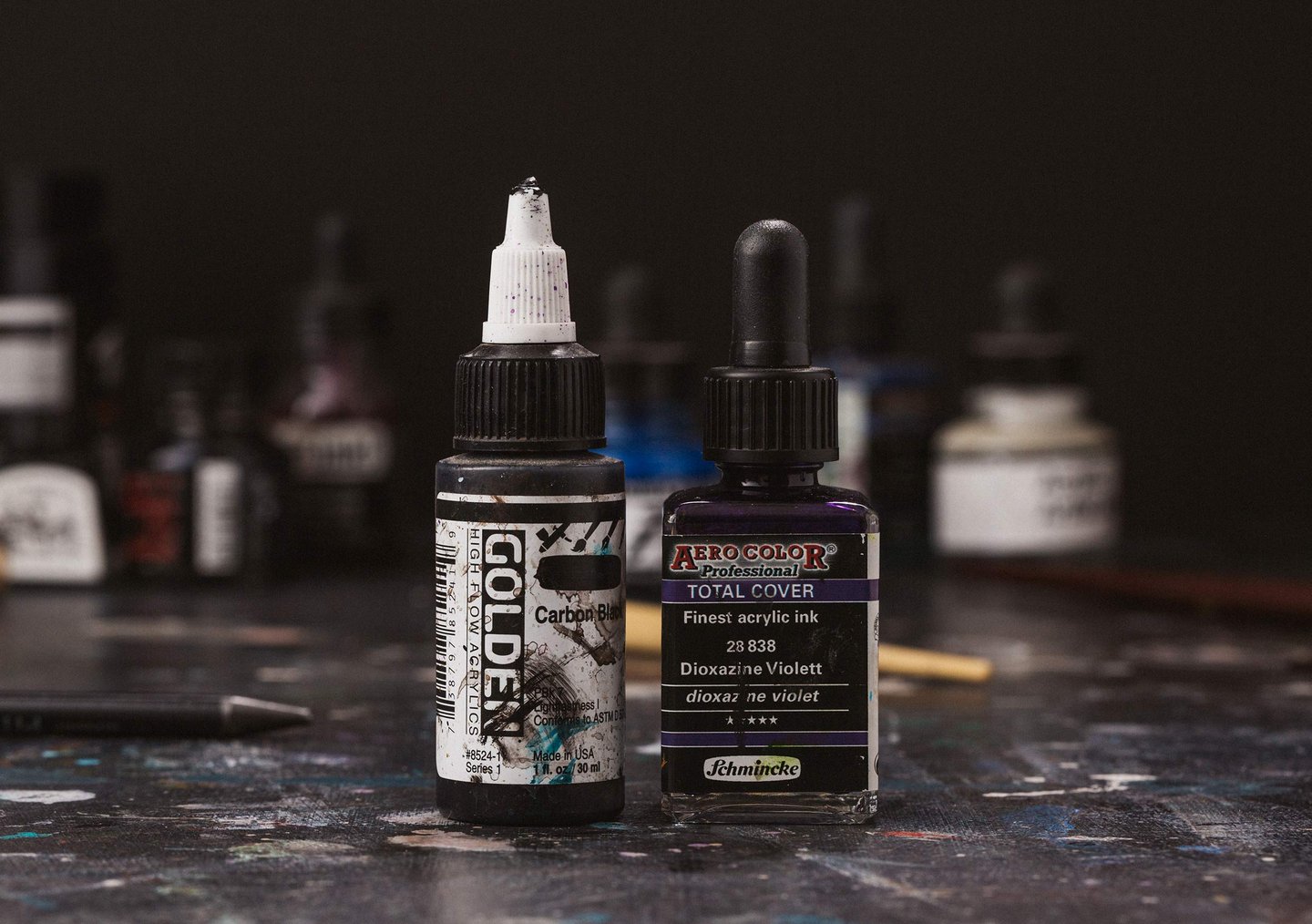
Airbrush inks are the lowest possible viscosity inks. This ensures consistent flow and maximum control with minimal risk of your airbrush clogging. Airbrush inks are acrylic-based. They can be applied to any surface and they dry to a waterproof finish. Airbrush inks can also be used with dip pens and brushes.
The paint you use in your airbrush needs to be very fluid. This is so that the flow of the paint is uniform and consistent. Fluid paint will enable you to apply even layers of colour to your work. Fluid colour can also be washed more easily than thick or lumpy paint, which will not give an even spread of colour.
Airbrush paint is the thinnest consistency acrylic paint available on the market. It is even thinner than regular fluid acrylics. Manufacturers have found a way of grinding pigments to the finest possible state and then suspending them in a binder that is adhesive enough to hold the paint together without the pigment separating from it. Yet, it is still thin enough to possess excellent dispersion.
What is the Difference Between Acrylic Ink and Acrylic Airbrush Paint?


The differences between acrylic ink and acrylic airbrush paint are marginal. Generally, the inks tend to be more transparent and will dry with more sheen than acrylic paint. All acrylic inks and airbrush paints can be mixed with other ranges of acrylic medium and acrylic colour. Remember, this may impair their compatibility with airbrush techniques.
It is also possible to use shellac-based inks, such as Winsor & Newton Drawing Ink, Sennelier Ink, and Jackson’s Indian Ink. While the colour is very lightfast and the colours are intensely saturated, there may be some issues with cleaning these inks from your airbrush. You will have to use pure acetone, but it is possible.


Airbrush Sundries
Vallejo Airbrush Paint Cleaner
Vallejo Airbrush Paint Cleaner is great for cleaning your airbrush between colours. It removes all of the paint used and lubricates the interior of the airbrush without damaging its mechanism.
This product is made for use with the Vallejo Premium Airbrush Colour range and other compatible acrylics. It helps to prevent paint build-up and ensures smooth performance.
To flush out paint between colour changes, it can be diluted with 50% water. For deeper cleaning, disassemble the airbrush and soak the parts in a small amount of undiluted cleaner for a short period of time.
After cleaning, rinse with water, dry thoroughly, and reassemble. Regular use of this Airbrush Cleaner keeps your airbrush in its best condition and extends its working life.
Grafix ‘Edge’ Bandana Masks
A lightweight fabric mask that protects the face and neck from overspray. Easy to take on and off.
Airbrush Propellant
For economy and occasional use, a disposable aerosol propellant can is a great choice. The only other items you require are a control valve and an airline. Then, you can spray anywhere.
Glossary
A
Adaptor
A connector that links the airbrush to a hose and compressor. Must match the correct size for compatibility.
Airbrush
A handheld tool that uses compressed air to spray paint in a fine mist. Double-action airbrushes offer greater control over paint and airflow.
Airbrush Cleaner
A cleaning solution. Used to remove residual paint from an airbrush. Helps to maintain the internal components of your airbrush.
Airbrush Medium
A fluid additive. Used to alter properties such as reducing the viscosity of acrylic paints for airbrush use.
Airbrush Paint
Highly fluid colour. Designed specifically for airbrushing. Has an ideal viscosity of 4060 cPs.
Airbrush Propellant
A disposable aerosol can. Provides compressed air for airbrushing when a compressor is not available.
Atomisation
The process by which liquid paint is turned into a fine mist via compressed air in the airbrush.
C
Compressor
A device that generates the airflow for airbrush operation. Can be used continuously or intermittently.
D
Double-Action Airbrush
An airbrush that controls both air and paint flow. Pressing the trigger controls airflow; pulling it back controls paint.
F
Face Mask
Protective equipment worn over the nose and mouth. Helps to prevent the inhalation of fine paint particles.
Frisket Film
A masking film. Used to block off areas of the surface when spraying. Ensures clean edges and sharp shapes.
I
Ink (Airbrush Ink)
Acrylic-based, highly fluid ink. Designed for airbrushing. Dries waterproof. Can be used with dip pens and brushes.
N
Needle Cap and Nozzle
The precision components at the tip of the airbrush. Controls the flow and fineness of the paint spray.
P
Pigment Dispersion
The even distribution of pigment in a binder. Essential for smooth, clog-free airbrush performance.
Propellant
Compressed gas. Used as an alternative to a compressor. For powering an airbrush.
S
Spray Booth (Uni-Booth)
A contained workspace with ventilation. Safely extracts overspray and solvent fumes when using an airbrush.
T
Trigger
The mechanism on the airbrush that is pressed and pulled to control air and paint flow.
V
Valve
A device that regulates air pressure from the compressor to the airbrush. Ensures optimal atomisation.
Varnish (Airbrush Varnish)
A protective coating. Applied using an airbrush to seal and finish a painted surface.
Viscosity
The thickness of a liquid. For airbrushing, paint must be thin enough (40–60 cPs) to atomise effectively. To learn more, read 'The Dairy Scale of Paint Viscosities' on Jackson's Art Blog. This is a means of communicating how thick or thin a product is.