


Introduction to Encaustic Wax
Encaustic wax is a historical painting technique in which the wax is heated and applied as paint. Encaustic paint is made with beeswax, pigment, and a small amount of hardener. This can be either dammar resin or carnauba wax.
The paint is solid at room temperature, so you need to melt it before it can be applied. Once on the support, it cools and hardens, and a heat tool is used to ensure that each layer is fused to the last. This makes for a very tactile working experience.
Encaustic is perhaps the most beautiful of all artists' paints and is as versatile as any 21st-century medium. It can be polished to a high gloss, carved, scraped, layered, collaged, dipped, cast, modelled, sculpted, textured, and combined with oil. It cools immediately so there is no drying time, yet it can always be reworked.
History of Encaustic Painting
Painting with molten wax was first recorded over 2000 years ago. The most well-known examples are the funerary portraits in Roman Egypt from 100-300 AD. Some of these can be seen at the British Museum in London; the vibrancy of the paint is a testament to the longevity of the medium. The remarkably lifelike rendering of skin and hair shows the use of transparent glazing techniques long before they were used in the 15th century in oil painting.
Over the centuries, the use of encaustic has been superseded by other techniques. However, the rise of electric heated palettes in the 20th century has led to a revival in popularity.
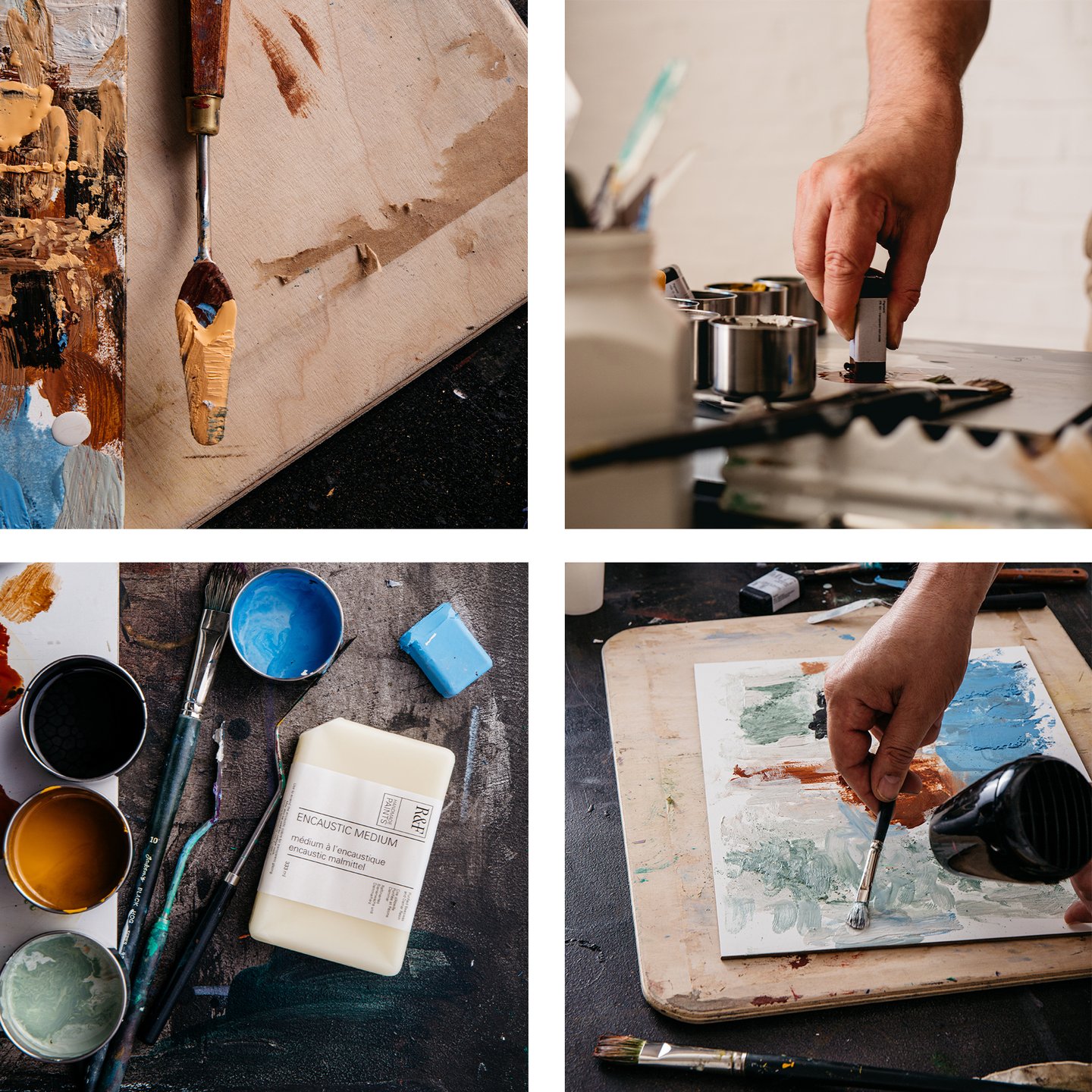


What Do I Need to Get Started Painting with Encaustic Wax?
- Pigment sticks (linseed oil, pure pigment, and wax) and encaustic paints
- Wooden panels from Jackson’s or Ampersand
- Real rabbit skin glue gesso that you apply warm (not acrylic gesso or acrylic primer. Read about the difference in our Glossary under Gesso) or R&F Encaustic Gesso. Both types will be absorbent enough for the wax to stay stuck when it cools. Or you can glue heavy watercolour paper onto your wooden panel with acrylic soft gel or a thick layer of PVA glue. The paper will also give you an absorbent enough surface for the wax to stick to.
- Catalyst blades and wedges. They are made of heat-resistant silicone.
- Heat gun
- A hot plate with a metal tray to melt your paints directly on, or a hot plate with a metal tray with metal cups that you melt the paint in. Or a flat iron with no steam holes (travel iron) – you melt the paint directly on the surface of the iron. Or an electric heated palette.
Encaustic Wax
R&F Encaustic Wax Cakes are available in small (40ml), medium (104ml), and large (333ml) sizes. They are made from beeswax, dammar resin, and pigment. At room temperature, these blocks feel like hard cheese. Just like other professional quality paints, they vary in transparency and tinting strength, depending on the nature of the pigment.


What Painting Supports Can I Use for Encaustic Painting?
Encaustic paints require a rigid and absorbent surface so that the paint can adhere properly. A wooden panel is a great surface to use. This is because encaustic paint can be applied directly onto raw wood, but an absorbent gesso can also be applied. R&F produce an encaustic gesso which is ready to use and can be applied like any other acrylic gesso primer. It differs in that it contains a lower proportion of binder. This is to make it more absorbent, unlike most acrylic primers, which are not absorbent enough for the wax to adhere effectively. You could also make a traditional gesso with rabbit skin glue and whiting.
Stretched canvas is an inappropriate surface to use. This is because the paint is likely to crack on the flexible surface. The weight of the wax could also make the canvas sink in the middle. However, you can use canvas or watercolour paper that has been glued to a board or panel.
Iceflow Encaustic Card and Ampersand Encausticbord are also suitable. Both surfaces are ready to paint on. The encaustic card is very smooth and a bright white colour. Encausticbord is more of a natural white colour with a slightly textured surface. It is similar in texture to Ampersand Gessobord panels.


Heating the Palette
R&F wax cakes have a melting point of 72°C, so it is advisable to use a hot plate with an adjustable temperature dial and an aluminium panel on top as a heated palette. Metal dippers clipped onto the palette are good for creating contained areas to keep colours separate.
Heat Gun
Heat guns are hand-held and are used to fuse each layer to the one before, as well as for reheating the paint while it is on the surface. This allows the paint to be manipulated by a brush or a palette knife while you work.

Brushes for Encaustic Painting
It is important to use natural hair brushes with encaustic as synthetic filaments may melt. Hog brushes are particularly good for encaustic work. Softer natural hairs, like sable and squirrel, are unsuitable for this kind of painting, as the hairs are too delicate. Once a brush has been used for encaustic painting, you’ll be unable to use it for other types of painting because the wax will remain in the bristles.
Palette Knife
A palette knife can be useful to control the paint on the heated palette. It is also great for creating sgraffito marks. This is a technique where one layer is scratched, or scraped through, to reveal the layer underneath. You can also use clay tools to smooth the ridges of applied wax before heating, or to gouge into it to add texture.


Encaustic Painting Method in Practice
Preparation
There is an appealing immediacy to pressing the wax cakes directly on to the palette and letting them melt into ready-to-use puddles of colour.
The wax colours tend to spread gradually across the palette. They can bleed together unintentionally. Dippers are useful for keeping the colours separate when required.
Before you start painting, you’ll need to prime your surface with a layer of wax to paint on.
Painting Process
While making your painting, you’ll need to heat the whole painting every time you add a layer. This is to fuse each new layer of paint to the one before and prevent them from flaking apart once cool.
When you’ve finished, you’ll need to do a final 'burning in'. This means heating the whole painting again to ensure the layers form one solid piece of thick wax.
The smell of hot wax and resin is quite strong but quite pleasant. It could be preferable to the more potent smell of turps or white spirit. That said, it is crucial to keep your working area ventilated while working. The fumes released from encaustic paints, when concentrated, may cause headaches and irritation. Oil solvents are unnecessary when painting or during clean-up. Instead, soy wax can be used to clean brushes and surfaces after a painting session.
The paint cools and hardens almost as soon as it touches the support. This can allow for only very short brush strokes. If you paint in a very fluid manner, you may find it initially jarring to use a medium that moves so quickly between liquid and solid. A heat gun is an essential tool for extending the liquid working time of the paint, as well as ensuring the adhesion of the wax to the previous layer. Holding the heat tool in one hand, and a brush in the other, allows you to brush out the paint and blend colours. After adding a few layers of paint, the subsequent layers will remain liquid for longer – presumably because the heat tool has warmed the support.
The fast cooling of the paint can lead to the brushes’ bristles getting gummed up within seconds. It is essential to wipe the excess wax from the brushes with a cloth while it is still liquid. Then leave the head of the brush resting on top of the palette so it stays malleable during the painting session. Alternatively, you can leave the wax to harden on the brush, and then use the brush with waxes of a similar colour for future painting sessions, as the wax will melt when reheated.
Even when the paint has solidified on the support, it remains workable. Encaustic painting gives a new meaning to painting 'sculpturally' – you can work in relief by building up layers of thick texture, without the worry of previous layers being disturbed. Additionally, you can sculpt the paint as a solid material, by drawing through it and scraping it away. Equally, while the paint is on the support, you can continue to reheat and liquefy the paint to blend and create textural effects.
You might think that the repetitive cooling and reheating of the paint would affect the longevity of a painting. However, R&F say that reheating their encaustic paint numerous times has no adverse effect. Any solid wax that is scraped off the surface of the painting can be put back onto the palette, to be melted and used again.
Finish
The finish of encaustic paint is like a satin enamel, without a colour shift from liquid to solid. Any painter who loves a rich application of colour will find encaustic satisfying to work with. After the painting is finished, it can be buffed with a soft cloth to give it a shiny finish and enhance the colours.
Encaustic paintings cure over time, rather than drying by evaporation in the way that watercolour does. This is due to the addition of dammar resin that makes the paint harder and more resilient over time.
Varnishing is unnecessary. This is because encaustic contains beeswax which is water-resistant and is often used to varnish oil paintings. Because of this, encaustic is a very stable and long-lasting medium. Encaustic paint will melt at temperatures of 72°C and above, but it will remain solid in normal storage or exhibition conditions. Just avoid storing paintings in hot areas. Equally, avoid freezing temperatures which could cause the paint to crack.
Encaustic paint colours stay true rather than having oil paint’s tendency to yellow with age. However, like linseed oil, beeswax is photoreactive. This means it may go yellow when kept in the dark for long periods of time. The reaction is reversible. The colours will be restored to their original brilliance when the painting is exposed to natural light.
To learn more, read 'What is Dark Yellowing' on Jackson's Art Blog.
Mixed-media
There are many possibilities for adding mixed-media elements to an encaustic painting. For example, collage and photo transfers can be incorporated into the paint. Oil colour, whether brushed on from the tube or drawn on with an oil stick, can also be applied on top of the painting.
The ability to use additional materials is quite interesting. You can use encaustic with a bit of oil colour (too much will keep the encaustic layers from sticking to each other), oil pastel, oil paint sticks, and dry pastels, and charcoal. This allows you to paint and draw directly on the wax. You can paint the waxes over a watercolour painting, ink drawing, or photograph. You can transfer photocopies to the wax, wetting the paper and rubbing it away. You can embed objects like leaves and paper collage in the layers of wax. You can incise lines and fill them with oil colour, wiping away the excess.
The unique sensitivity and physicality of encaustic wax are unlike any other medium. It has surprisingly little in common with acrylic and oil painting. Encaustic can come into its own in abstract and textural work. Here, the artist is led by the changing nature of the paint, adapting as the paint moves between liquid and solid. There is something special about discovering a historical medium and its relevance to contemporary approaches to painting.
Encaustic paint does not require the use of solvents. As a result, a number of health hazards are reduced or eliminated.
Shellac burn is a technique used in encaustic painting to create intricate, organic patterns. After brushing a thin layer of pigmented shellac over the cooled wax and allowing it to dry, the shellac is carefully ignited with a small flame. As it burns, the shellac contracts, causing the top layer of wax to crack and shift – producing delicate, web-like effects. This technique adds texture and depth to a finished piece. However, because shellac becomes brittle after burning, it’s best used on stable, final artworks that won’t be frequently handled.
To create a shellac burn, you’ll need a blowtorch set to its lowest flame or a long-reach lighter. Always use this technique in a well-ventilated area and observe all fire safety precautions.
Encaustic Mediums
- Layers of extended colour can be laid one on top of another or separated by layers of straight medium to create unusual translucent effects (with no wait for drying time between layers).
- Glazing can be done by greatly extending a colour with the medium. There is no technical danger in adding large amounts of medium to a colour as there is in adding large amounts of oil to oil paint. The encaustic can also be made more fluid by adding medium or raising its temperature a little.
- For variations of surface effects, different degrees of fusing can be employed. Well-fused paint will take a higher polish than paint that is not as thoroughly fused.
Encaustic Tools
Palette cups can be used to melt large amounts of paint at one time. They are excellent for keeping colours pure, or for saving mixes. Jackson’s palette cups are made of a heavy aluminium and steel alloy. Large rectangular cups can hold one 104 ml cake while small rectangular cups are perfect for the 40 ml cakes. Each size is offered in a handy three-pack.
Palette Thermometer
This is an essential component of painting safely with encaustics. Perfect for reading the temperature of your encaustic palette or other heated surfaces. The surface thermometer has a temperature range of 50°-600°F.
Do I Need to Varnish my Encaustic Painting?
Wax is its own varnish. Encaustic paintings do not have to be varnished or protected by glass because encaustic, which is the most durable of all artists' paints, is its own protector. This is because beeswax is impervious to moisture, which is one of the major causes of deterioration in a paint film. Wax resists moisture far more than resin varnish or oil. Buffing encaustic will give lustre and saturation to colour in just the same way resin varnish does.
Encaustic paint will not yellow or darken. However, wax itself is photoreactive, so the unpigmented encaustic medium that has been kept in dark storage will darken slightly. When re-exposed to light, that darkening will bleach out. Read 'What is Dark Yellowing' to learn more.


Other Wax-based Mediums
Wax Crayons
Wax crayons were once the drawing material of choice for children. Today, they are very popular among artists who like to work with media that is bright and easy to transport. Watersoluble wax crayons are also popular as they can be diluted with water and blended with ease.
The Caran D’Ache Neocolor range is non-toxic and safe for use by children. The Neocolor I range is not watersoluble, while Neocolor II is watersoluble.
Oil Sticks and Oil Bars
Oil sticks or Oil Bars are essentially oil paint in stick form - pure pigments suspended in a linseed or safflower oil binder. The difference with conventional oil colour is that it is then mixed with a specially selected wax. This thickens the consistency of the colour. Oil sticks are sold with a dried layer of the colour encasing the non-dry colour underneath. To begin work many artists like to use a knife to chop off the end of the stick.
You can use oil sticks to draw directly onto your support to make crayon-like marks which can then be blended or worked into with oil, turpentine, or oil paint. Some artists like the effect of drawing with an oil stick into wet oil paint as it creates expressive textures. You could also use it to apply watercolour-thin layers of colour by using a brush immersed in turpentine to lift colour from the stick, ready to paint with.
- R&F Pigment sticks are available in 2 sizes 38ml and 188ml. They have a lipstick soft consistency and are available in over 80 different colours.
- Sennelier Oil Sticks are available in 38ml and 96ml sizes. They have long been a staff favourite. Over 50 colours in the range, and a very useful transparent medium for blending colours with.
Oil Pastels
Oil pastels are made of pigments bound in a non-drying oil and wax binder. They are first thought to have been developed by Sennelier who acted on the requests of Pablo Picasso. Picasso wanted to find a painting and drawing medium that could be applied to wood, paper, canvas, or metal, without having to prepare or prime the surface.
Oil Pastels are often favoured by artists who find conventional soft pastels too dusty or chalky for their liking. Oil pastels are creamier in their consistency, and the texture is noticeably more moist (a result of the presence of wax in their make-up). They are very versatile and can be used to draw into oil or acrylic colour. Many artists enjoy working with them in mixed media projects. They can also be useful in creating quick sketches and colour studies.
The best oil pastels will be those with the highest pigment concentration. Because the pigment to binder ratio is greater, the properties of the pigment will influence the behaviour and characteristics of each pastel. For example, a French Ultramarine oil pastel will appear more transparent than a Cerulean Blue oil pastel, in the same way that a French Ultramarine oil paint would appear more transparent than a Cerulean Blue oil paint. This is why the characteristics of each pastel in the range of Sennelier oil pastels more greatly vary than those to be found among the range of Inscribe oil pastels, for example. As well as pigment saturation, a professional grade oil pastel will have an even consistency. This means that it will not show any lumps or particles of wax binder when the colour is thinned over an area.
Sennelier Oil Pastels are very soft in their consistency. The colour glides on with very little pressure. Because the colour is so saturated, the sticks last a long time as very little of the pastel is required to achieve bold marks. Even less is required when applying the pastel colour thinly. They layer over each other and other media very well, and the opaque colours have unbeatable coverage.
When heated up significantly, Sennelier oil pastels can be used in an almost sculptural way. You can use a palette knife to apply and sculpt the colour onto your support. Sennelier oil pastels are available as single sticks, as well as in sets of assorted and themed sets such as landscape, still life, and portrait sets.
Caran d'Ache Neoart Oil Pastels combine the softness of wax with the richness of oil, giving them a unique, rich texture and silky appearance. They're easy to work with, offering a smooth application and great coverage. And with a high pigment concentration and excellent lightfastness, they're made to last and keep their vibrancy. They are the first wax and oil pastels to comply with the ASTM D-6901 standard, which guarantees exceptional lightfastness for up to 100 years.
What is the Difference Between Wax Crayons and Oil Pastels?
Artist’s oil pastels differ from children’s wax crayons as they have a far superior lightfastness (although this varies between brands). They tend to be softer than wax crayons and less pressure is required to apply colour to the surface.
Drawing and Painting with Oil Pastels
The consistency of oil pastels can be manipulated with heat. A cold oil pastel will feel harder and marks will appear sharper; more pressure is needed to deposit the colour onto your support. When an oil pastel is cold it is a better drawing material as fine and broad lines can easily be drawn. Some artists keep their oil pastels outdoors or in a fridge in order to keep them hard in this way. An oil pastel that has been warmed up, either on a radiator or in your hands, will become more malleable, and the colour will glide on to your surface with less pressure. When oil pastels are warm their properties start to resemble those of oil paint, and as a result, more painterly effects can be achieved.
Oil pastel colour can be thinned with solvents and extended with linseed oil, in the same way as can be done with oil paint. Oil pastels are used by some oil painters to draw into wet oil paint, perhaps to re-establish a composition in a painting or to add texture or detail.
Mixed Media and Oil Pastel
Oil pastels can be used with media of any kind. The only thing to bear in mind is that it never properly sets or dries. In this sense, it is a relatively unstable material on which to overlay other drawing and painting media. You would have to protect the work well by framing it under glass, or by fixing it with a special oil pastel fixative.
Oil pastels are popular with mixed media artists as vibrant colours can be easily applied and blended into other materials. This can include soft pastel, watercolour, coloured pencils, and graphite, without any adverse effects. Sgraffito is often used in oil pastel technique as its surface can very easily be scratched into. When the oil pastel is applied thickly, very little effort is required to scratch into the colour. This means that paper and other supports are not at any risk of being ripped or damaged.
Glossary
A
Absorbent Surface
A surface that accepts encaustic wax, allowing it to adhere properly. Absorbent surfaces include raw wood, encaustic gesso, and paper mounted onto panels.
B
Beeswax
A natural wax produced by honeybees. Used as the main ingredient in encaustic paint. This is due to its smooth application, durability, and resistance to moisture.
Blending
The process of smoothing and mixing encaustic paint layers. Artists use heat tools or bristle brushes.
Blowtorch
A handheld tool used to fuse layers of encaustic paint. This ensures adhesion and creates smooth transitions.
Burning In
The process of reheating an encaustic painting to ensure all layers fuse into a single cohesive structure.
C
Carving
A technique used to remove layers of wax. Creates texture and depth. Often done with clay carving tools or metal scrapers.
Catalyst Tools
Heat-resistant silicone blades and wedges made by Princeton. Used to work encaustic paint, add texture, and create smooth effects.
Cold Wax Medium
A painting medium containing beeswax and solvent. Used to create a wax-like painting surface without the need for heat.
D
Dammar Resin
A natural tree resin that can be added to encaustic paint. It increases the hardness and colour vibrancy of the paint. It also improves its durability over time.
E
Encapsulation
The process of embedding objects within layers of encaustic wax. This can include, but is not limited to, paper, fabric, and found materials.
Encaustic Gesso
An absorbent ground used to prepare a surface for encaustic painting. It ensures the proper adhesion of wax layers.
Encaustic Medium
A combination of beeswax and dammar resin. Used alone or mixed with pigment to create encaustic paint.
Encaustic Paint
A painting medium made of beeswax, pigment, and dammar resin. Requires heat for application and fusing.
Encausticbord
A prepared rigid surface made for encaustic painting. It has an absorbent ground for optimal wax adhesion. Made by Ampersand.
F
Fusing
The act of reheating encaustic layers using a heat gun, torch, or heated tool. This binds layers together and creates a seamless surface.
G
Glazing
A technique in which thin, transparent layers of encaustic paint are applied over one another. Creates depth and luminosity.
Gesso
A priming ground that prepares a surface for painting. Traditional encaustic gesso is absorbent and differs from acrylic gesso, which is unsuitable for encaustic work.
H
Heat Gun
A handheld electric tool that blows hot air. Used to fuse layers of encaustic paint or to soften wax for painting.
Hot Plate
A heating device used to keep encaustic paints and mediums molten. This ensures they remain workable during the painting process.
L
Layering
The process of building up multiple layers of encaustic paint. Often fused to create a rich, textured surface.
M
Molten Wax
Wax that has been heated to a liquid state. For painting or application purposes.
P
Palette Thermometer
A tool used to monitor the temperature of an encaustic palette. Helps to prevent overheating and ensure safe working conditions.
Pigment Stick
A blend of wax, pigment, and linseed oil. Used to add colour and details to encaustic paintings without additional heat.
Polishing
The act of buffing an encaustic painting with a soft cloth. Helps to achieve a glossy surface and enhance colour vibrancy.
R
Relief
A raised surface effect created by layering and carving into encaustic wax. This gives the painting a sculptural quality.
S
Scraping
A technique where layers of wax are removed with a palette knife or other tools to reveal underlying colours and textures.
Sgraffito
A technique where a sharp tool is used to scratch into the wax. This reveals contrasting colours beneath the top layer.
Shellac Burn
A process where shellac is applied over an encaustic painting and then heated with a torch. This creates organic textures and patterns.
Silicone Tools
Heat-resistant tools that are used to work with encaustic wax. Helps to achieve smooth application and texture variation.
Substrate
The surface or support onto which encaustic paint is applied. This can include wood panels, paper, or fabric mounted on a rigid board.
V
Varnish-Free
Encaustic paintings do not require varnishing. This is because beeswax acts as a natural protective layer against moisture and dust.
W
Wax Bloom
A natural haze that may appear on the surface of an encaustic painting over time. It can be removed by buffing with a soft cloth.
Wax Crayons
Solid sticks of pigmented wax. Used for drawing and mark-making in encaustic painting. Some are compatible with heat-based encaustic techniques.
Workability
The characteristic of encaustic wax that allows it to be reworked by reheating, scraping, or adding new layers indefinitely.